



Education Journalist | Study Abroad Lead
Esters are a functional group characterized by a carbon bound to three other atoms: a single bond to a carbon, a double bond to an oxygen, and a single bond to an oxygen. The bound oxygen is bound to another carbon. It is obtained by replacing the hydrogen of an acid with an alkyl or other organic group. Esters have a sweet odour and act as a good-quality solvent for plasticizers, plastics, and lacquers. They’re also one of the most important classes of synthetic lubricants on the commercial market.
Read More: Planck's Quantum Theory and Black Body Radiation
| Table of Content |
Key Terms: Esters, Acyl Chloride, Methyl butyrate,Transesterification, hydrolysis, hydrogen, atoms, carbon, plastic, oxygen
Read More: Brown Ring Test
Structure of Ester
[Click Here for Sample Questions]
Esters are carboxylic acid derivatives in which the hydroxy group (-OH) is replaced by an alkoxy group (-OR)
Read More: valence electronic configuration
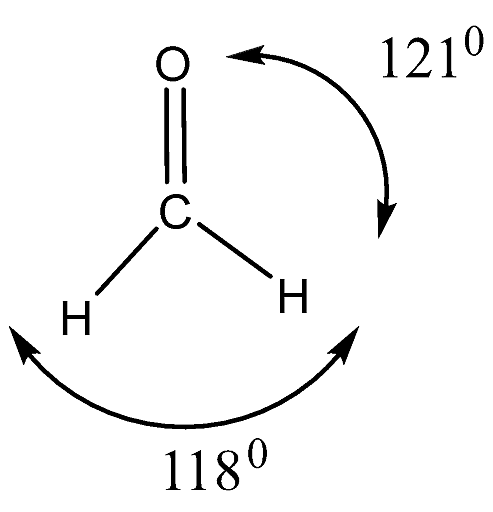
Esters contain a carbonyl centre, which provides rise to 120° C–C–O and O–C–O angles. The structure of the ester contains a flexible functional group because the rotation about the C–O–C bonds features a low barrier. Their flexibility and low polarity are manifested in their physical properties; they have a tendency to be less rigid (lower melting point) and more volatile (lower boiling point) than the corresponding amides.
Physical Properties of Ester
[Click Here for Sample Questions]
Esters are strong polars as compared to ethers but less than alcohols. They take part in hydrogen bonds as hydrogen-bond acceptors, but cannot act as hydrogen-bond donors, unlike their parent alcohols. Due to their lack of hydrogen-bond-donating ability, esters don’t self-associate. Consequently, esters are more volatile than carboxylic acids of comparable relative molecular mass. Ester is detected through gas chromatography, taking advantage of their volatility. The IR spectra for Esters show an intense sharp band within the range of 1730 – 1750cm−1 assigned to Vc=0. This peak changes counting on the functional groups attached to the carbonyl.
Read More: First Order Reactions
Preparation of Ester
[Click Here for Sample Questions]
What is Esterification?
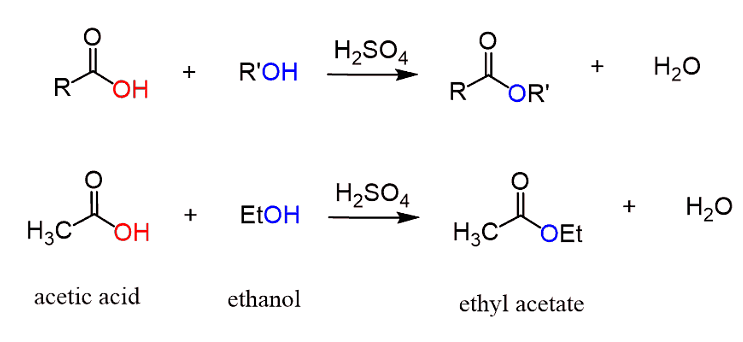
Esterification is the process of combining an organic acid (RCOOH) with an alcohol (ROH) to form an ester (RCOOR) and water (where R and R’ are any organic combining groups); or a chemical reaction resulting in the formation of at least one ester product. Ester is obtained by an esterification reaction of an alcohol and a carboxylic acid.
Ethyl Acetate
Ethyl acetate is a carboxylate ester that is used widely as a solvent, especially for paints, varnishes, lacquers, cleaning mixtures, and perfumes. It is a colourless liquid with a sweet, fruity odour. The most commonly used method of preparing ethyl acetate is from ethanol and acetic acid through the Fischer esterification. Another method of synthesizing ethyl acetate is through the Tishchenko reaction, where acetaldehyde disproportionates in the presence of base to the alcohol and the acid that then esterify in situ.

Methyl Butyrate
Methyl butyrate (methyl butanoate) is a methyl ester of butyric acid, with a fruity odour resembling apples or pineapples. Under room temperature, methyl butyrate is a colourless flammable liquid with low solubility in water. It floats on water to form an oily lair. It is found in small amounts in several plant products, especially pineapple oil. Methyl butanoate is formed by the condensation reaction between methanol and butanoic acid.
Read More: Difference Between Accuracy and Precision
From Acyl Chlorides
Acyl Chloride reacts with alcohol and phenols to produce esters. The reaction does not require a catalyst even though alcohol is a weak nucleophile because acyl chlorides are highly reactive.
The reaction is irreversible unlike esterification.

From acid anhydrides
On reaction with alcohol, acid anhydrides produce ester and carboxylic acid. The reaction is slower than the reaction with acyl chlorides. The reaction is carried out in the presence of a small amount of concentrated sulphuric acid. The reaction is reversible, and therefore, water is removed as soon as it is formed.

Reactions of Esterification
[Click Here for Sample Questions]
Hydrolysis
Ester molecules can undergo hydrolysis in either acidic or basic condition, to form carboxylic acids or carboxylate salts and alcohols. Since the reaction with pure water can be very slow, it is catalysed by diluted acids such as HCL, H2SO4 and heated under reflux.

Ammonolysis
Esters react with ammonia, primary and secondary amines to produce amides with alcohol
Read More: Platinum


Grignard Reagent
Esters undergo nucleophilic acyl substitution, followed by nucleophilic addition with two equivalent moles of Grignard reagent (RMgX) to yield two different alcohols, of which one of them is tertiary.

Transesterification
Transesterification is a process that sees changing of one ester into another one. This involves substitution of one alkoxy group for another in an ester. The reaction can take place under both acidic (HCL or H2SO4) and basic conditions.

The reaction is very important for degrading triglycerides, e.g. within the production of carboxylic acid esters and alcohols.
Read More: Huckel Rule of Aromaticity
Uses of Esters
[Click Here for Sample Questions]
Some of the common applications are:
- Esters that have fragrant odours are used as a constituent of perfumes, essential oils, food flavourings, cosmetics, etc
- It is used as an organic solvent
- Natural esters are found in pheromones.
- Naturally occurring fats and oils are fatty acid esters of glycerol.
- Nitrate esters, such as nitroglycerin, are used as explosive materials.
- Polyesters can be further converted into fibres to make clothing.
- It is used to make surfactants E.g. soap, detergents.
Read More: Fehling Test
Things to Remember
[Click Here for Sample Questions]
- A compound or functional group derived from alcohol condensation and an acid with simultaneous water loss. Carboxylic ester (also referred to as carboxylate ester; also simply called an ester), derived from carboxylic acid, is the most common form of ester.
- Esters smell partially because of the feeble intermolecular forces they show. This encourages ester molecules to penetrate and hit the nose in the gas phase. To share in hydrogen bonding, there are not highly positively polarised hydrogens in esters.
- The condensation reaction between an alcohol and a carboxylic acid produces esters. This is referred to as esterification. Two molecules combine and create a larger molecule in a condensation reaction thus removing a tiny molecule. This small molecule, during esterification, is water.
Also Read:
Sample Questions
Ques. A liquid was mixed with ethanol and a drop of concentrated H2SO4 was added. A compound with a fruity smell was formed. The liquid was:-
(1) CH3COCH3
(2) CH3
(3) CH3OH
(4) HCHO (2 Marks)
Ans. The fruity smell is the characteristic property of ester. So, the reaction leads to the formation of ester. The process is called esterification. Hence option (2) is the answer
Ques. During dehydration of alcohols to alkenes by heating with conc. H2S04 the initiation step is:
(1) formation of carbocation
(2) elimination of water
(3) formation of an ester
(4) protonation of alcohol molecule (2 Marks)
Ans. Protonation of alcohol molecules is the initial step during the dehydration of alcohols to alkenes by heating with conc. H2SO4
Hence option (4) is the answer.
Ques. Hydrolysis of ester leads to the formation of which of the following products in basic medium?
a) Ether and alcohol
b) Alcohol and sodium carboxylate
c) Aldehyde and alcohol
d) Sodium carboxylate (2 Marks)
Ans. Under basic conditions, hydroxide acts as a nucleophile, while an alkoxide is the leaving group.

Hence, (b) is the answer.
Ques. The principal product of the reaction between methyl butanoate and 2 mole of CH3MgBr after hydrolysis is:
a.C3H7COCH3
b.C3H7C(OH)(CH3)2
c.C3H7CHOCH3
d.C3H7COCO(CH3)2 (5 Marks)
Ans. In the given reaction, first reaction between methyl butanoate CH3CH2CH2COOCH3CH3CH2CH2COOCH3 with one mole of CH3MgBrCH3MgBr (Grignard reagent) takes place.
The Grignard reagent CH−3Mg+Br−CH3−Mg+Br−. The negative charge of the bromine ion attacks the oxygen atom of methyl butanoate and MgBr gets attached to the oxygen atom, the double bond of C=O of methyl butanoate shift to oxygen to form a positive charge on the carbon and methyl anion of Grignard reagent attack the carbon cation and methyl group gets attached to it.
Again the intermediate C3H7C(CH3)OMgBrOCH3C3H7C(CH3)OMgBrOCH3 is reacted with one mole of Grignard reagent CH3MgBrCH3MgBr. Again the grignard reagent dissociates into CH−3Mg+Br−CH3−Mg+Br−. The negative charge of the bromine ion attacks the oxygen atom intermediate and MgBr gets attached to the oxygen atom.
The C-O breaks down to form carbon cation and OMgBr is removed. The negative charge to the methyl anion attacks the carbon cation and the methyl group gets attached to it forming a second intermediate C3H7C(CH3)(OMgBr)CH3C3H7C(CH3)(OMgBr)CH3. After that the second intermediate is hydrolysis where the hydrogen ion gets attached to the oxygen and removes MgBrOH to form C3H7C(OH)(CH3)2C3H7C(OH)(CH3)2 as a main product.
The reaction of methyl butanoate with 2 moles of CH3MgBrCH3MgBr is shown below.

Thus, methyl butanoate CH3CH2CH2COOCH3CH3CH2CH2COOCH3 reacts with 2 mole of Grignard reagent CH3MgBrCH3MgBr and on hydrolysis gives 2-methyl-pentan-2-ol C3H7C(OH)(CH3)2C3H7C(OH)(CH3)2.
Therefore, the correct option is B.
For Latest Updates on Upcoming Board Exams, Click Here: https://t.me/class_10_12_board_updates
Check-Out:



Comments