



Content Writer
Factors Affecting Solubility are very distinct like pressure, temperature, polarity, bonds, and forces. Solubility is the property of a substance (solid, liquid, or gas) to get dissolved in another substance (solid, liquid or gas). The matter that completely dissolves is called soluble, and that does not dissolve, such matter is said to be insoluble.
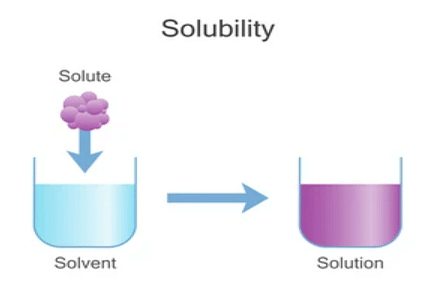
- A solution is a fluid that is made up of a homogenous mixture of a solvent and one or more solutes.
- Solvent: The material that a solute dissolves in to create a homogenous mixture.
- Solute: a material that dissolves in a solvent to create a homogenous mixture
- There are numerous varieties of solutions. A solute, for instance, could be a gas, a liquid, or a solid. Moreover, solvents can be solids, liquids, or gases.
| Table of Content |
Key Terms: Solubility, Henry’s Law, Le Chatelier’s Principle, Solution, Temperature, Pressure, Forces, Liquids, Solvent
What is Solubility?
[Click Here for Sample Questions]
Solubility can be defined as the maximum amount of solute to be dissolved in a solvent at a given pressure and temperature. It depends on various factors; mainly temperature, pressure, and the nature of the solute and solvent. Solubility is a natural property of a substance, hence it has some effects of other natural causes.
- For example, salt is soluble in water, but oil is insoluble in water.
- Temperature and pressure are the two main factors that affect the solubility of a substance.
- Henry’s law states that there is a direct proportion between a gas’s solubility in a liquid solvent to the partial pressure (i.e., the pressure applied to the gas) above the liquid solution’s surface.
There are certain physical and chemical changes that occurs.
Physical Changes
A physical change occurs when a substance's molecules are rearranged but its chemical makeup does not. Physical change is just transient.
Properties of Physical Changes
The properties of physical changes are as follows:
- It is a temporary change.
- It merely changes the substance's physical characteristics, such as shape, size, etc.
- Energy absorption is either negligible or nonexistent.
- The creation of energy is generally not required for physical changes.
- No new substance is created.
- It is reversible process.
Solutions Video Lecture
Chemical Changes
Chemical changes occur when a substance's molecular composition is completely altered. Hence, new compounds are created as a result of chemical reactions. A permanent change is a chemical alteration.
Properties of Chemical Changes
The properties of chemical changes are as follows:
- It has changed permanently.
- It has the ability to alter the substance's composition as well as its physical and chemical properties.
- Both energy absorption and energy evolution occur.
- It involves energy production.
- New substance is created.
- The process is irreversible.
Read More:
| Relevant Concepts | ||
|---|---|---|
| Unsaturated Solutions | Solubility curve | Steam Distillation |
| Specific Heat Capacity of Water | Acetamide | Hydroxide |
Factors Affecting Solubility
[Click Here for Previous Year Questions]
The factors impacting solubility can be divided into the following categories:
1. Solubility of Liquid in Liquid
2. Solubility of a Solid in Liquid
3. Solubility of a gas in Liquid
Solubility of Liquid in Liquid
The bond formation between the solvent and solute plays a vital role in solubility. The strength of the bonds in between molecules of solute and solvent decide if the solute is easily soluble, insoluble,or somewhere in between.A matter is called highly soluble if 0.1g of solute can easily be dissolved in 100g of solvent. If less than 0.1g of solute is being dissolved in 100g of solvent, then it is said to be sparingly soluble.
Factors Affecting the Solubility
There are three main factors that affect the solubility of the substance. Both the chemical as well as physical properties play a vital role in solubility of a substance.
- Temperature: Increase in temperature increases the solubility of liquid solute in a liquid solvent. For example, water as a solvent can dissolve most of the liquid solute within the temperature range of 20 degrees celsius to 100 degrees celsius.
- Pressure: Increase or decrease of the external pressure does not really affect the solubility of liquids. The effect could be too small to notice.
- Bonds and Forces:The same intermolecular forces between their own molecules, the solubility is much higher. Polarity can be used to discuss solubility. Polar solute would easily be dissolved in a polar solvent. For example, polar ammonia molecules dissolve in polar water molecules.
Solubility of a Solid in Liquid
A solid solute, when added to a liquid solvent in a provided concentration, then the process is known as dissolution. Crystallization occurs when in a solution, the solute particles collide with other particles in the solution and they regain their original form. Both the process i.e., dissolution and crystallisation stay in action while a solution is being formed.
- The state at which the amount of solute particles entering the solution and the amount of solute particles leaving the solution are the same is known as equilibrium.
- The solution is called a saturated solution when no more solute could be added.
- The concentration of solute affects solubility.
- The amount of solute in solvent, the time taken to dissolve, heat for complete dissolution in the solvent, and a lot more other factors are based only on the solute.
Factors Affecting the Solubility
- Temperature: According to Le Chatelier's principle states that in an endothermic dissolution process, the solubility would increase. When the process is exothermic, the solubility decreases.
- Pressure: Solid and liquid both are highly incompressible and hence change in pressure has negligible consequences.
Solubility of a Gas in Liquid
The solubility of a gas in liquid majorly based on the type of solvent or solute. But unlike solid and liquid as a solute in a liquid solvent, the pressure and temperature plays a vital role in the gas in liquid solution. Some gases easily get dissolved in liquid while some do not.
For example,
- Oxygen can be dissolved in water while unlike other hydrogen.
- Oxygen sparingly dissolves in water and similarly aquatic animals breathe underwater.
- HCl and ammonia are highly soluble in water.
Factors Affecting the Solubility
- Pressure: Increase in pressure consequently increases the solubility of gasses in liquid solvent. The solution will lose its equilibrium state and more gas particles will start getting dissolved into the solution. Henry's Law states that the partial pressure of a gas existing above a liquid's or solution's surface directly correlates to a gas's ability to dissolve in a liquid.
- Temperature: Temperature increases cause a decrease in solubility. Through dissolution, gaseous molecules are broken down, and heat is produced in the process. Le Chatelier's Principle states that when a system's equilibrium is disturbed, the system readjusts itself in a way that counteracts the influence that caused the change in equilibrium.
Henry’s Law
[Click Here for Sample Questions]
Henry’s law says that the solubility of gas in a liquid solvent is proportional to the pressure applied to the gas above the liquid solution’s surface (aka Partial Pressure).

It provides a relation between solubility of gas and pressure of gas in a quantitative form as explained in the equation below –
| P = KHX |
where,
- P is the partial pressure of solute /gas,
- KH is Henry’s law constant,
- And X indicates the mole fraction of gas in a liquid solution
Read More:
Things To Remember
- Factors Affecting Solubility are pressure, temperature, polarity, bonding, and forces.
- The measure of hotness or coldness is considered as temperature.
- A solution has two parts- solute, which is being mixed (usually the smaller amount) and solvent, in which the solute is getting into (usually the larger amount).
- Change in pressure has no effect on solid or liquid solute in liquid solvent.
- Change in temperature and pressure remarkably changes the solubility gases in liquids.
- Increase in temperature decreases the solubility of gas solute in liquid solvent to validate the Le Chaterlier’s Principle.
- The provided equation given by Henry’s Law is- P = KHX
- Solution becomes saturated when no more solute can be added to the solution.
Previous Year Questions
- The vapour pressure of due to….[KCET 2012]
- Number of moles of ions which 1 mole of ionic compound produces...[NEET 2009]
- the boiling point of this solution will be….[NEET 2016]
- A 0.1 molal aqueous solution of a weak acid is...[NEET 2011]
- For an ideal solution, the correct option is….[NEET 2019]
- an aqueous solution of a protein contains its….[NEET 2011]
- Which solutions are mixed to form a buffer solution ?...[BHU UET 2000]
- The molecular weight of unknown organic substance will be:...[UPSEE 2017]
- At same temperature, which pair of the following solutions are isotonic solutions ?...[GUJCET 2006]
- The mass of oxalic acid present in 500 cc of the solution is….[COMEDK UGET 2009]
Sample Questions
Ques. In a gas to liquid mixture, what does an increase in temperature mean? (1 Mark)
Ans. In a gas to liquid mixture, an increase in temperature means a decrease in solubility.
Ques. Mole fraction of a gas in water is 0.001 at STP, then determine its Henry's law constant. (2 Marks)
Ans. Henry's law is represented as-
C = KH * P
0.001 = KH * 1
KH = 0.001 mole / atm
Ques. What are the factors that affect solubility? (2 Marks)
Ans. Four factors that affect solubility are:
- Pressure
- Polarity
- Temperature
- Bonds and forces.
Ques 8. Consider the following exothermic reaction that is in equilibrium CO2(g)+H2O(l)?H2CO3(aq)
What will happen to the solubility of the carbon dioxide if: (4 marks)
1.Temperature is increased?
2.Pressure and temperature are increased?
3.Pressure is increased but the temperature is decreased?
4.Pressure is increased?
Ans. Following are the reactions of solubility:
- Solubility will decrease.
- When pressure increases solubility increases but when temperature increases solubility decreases.
- An increased pressure and temperature is the indicator of greater solubility.
- Increase in solubility.
Ques. Butters is trying to increase the solubility of a solid in some water. He begins to frantically stir the mixture. Should he continue stirring? Why or why not? (1 Mark)
Ans. Butters should stop stirring because it has an effect on how fast the liquid will reach its equilibrium point but doesn't help the solids in dissolving.
Ques. At what partial pressure, oxygen will have a solubility of 0.06 gram per litre in water at 293 Kelvin. Henry's law constant of oxygen in water at 303 kelvin is 46.82 k bar. Assume the density of the solution is the same as that of water. (5 Marks)
Ans. Given:
Solubility of O2 = 0.06 gram/litre
KH = 46.82 kbar
= 46.82 × 10³ bar
Mass of 1 L of water = 1000 gm
Mass of solvent = 1000 - 0.06 ≈ 1000 gm
No. of moles of water = 1000/18 = 55.55 mol
No. of moles of O2 = 0.06/16 = 0.00375 mol
Mole fraction of O2 = No. of moles of O2 / moles of O2+moles of H2O
Mole fraction of O2 = 0.00375 /0.00375+55.55 = 6.75*10-5
We have,
PO2 = KH × ΧO2
= 46.82 × 103 × 6.75 × 10−5
= 3.160 bar
The partial pressure of O2 is 3.16 bar.
Ques. Gas (A) is more soluble in water than gas (B) at the same temperature. Which one of the two gases will have the higher value of KH (Henry’s constant) and why? (2016) (1 Mark)
Ans. According to Henry’s law, the solubility of gas is inversely proportional to the law of constant (KH) for gases. Hence gas (B) would have a higher KH value since it is less soluble.
Ques. Explain the following: Henry’s law about dissolution of a gas in a liquid. (AI 2012) (2 Marks)
Ans. According to Henry’s law the partial pressure of a gas present in the vapour pressure is proportional to the mole fraction of the gas present in the solution. If P is referred to as the partial pressure of the gas in the vapour pressure phase and x is the mole fraction of the gas, in that case Henry’s law can be stated as p = KHX where the KH is referred to as a constant in Henry’s law.
Ques. State Henry’s law and mention two of its important applications. (AI 2013) (3 Marks)
Ans. Henry’s law says that the solubility of gas in a liquid solvent is proportional to the pressure applied to the gas above the liquid solution’s surface (aka Partial Pressure). It provides a relation between solubility of gas and pressure of gas in a quantitative form.
Two important applications are:
- Carbonated soft drinks: When the bottle of a carbonated soft drink is opened, it is because of low pressure on top of the liquid and carbon dioxide escapes in the form of bubbles.
- Respiration: The amount of CO2 that dissolves in the blood flow in the body, is in proportion to the partial pressure of oxygen present in the alveoli air.
Ques. Explain why aquatic species are more comfortable in cold water rather than in warm water. (Delhi 2012) (1 Mark)
Ans. The aquatic species are more comfortable in cold water than warm because the solubility of oxygen in water increases with a fall in temperature.
For Latest Updates on Upcoming Board Exams, Click Here: https://t.me/class_10_12_board_updates
Do Check Out:



Comments