



Content Writer
The hyperbolic functions are equivalent to the circular and ordinary trigonometric functions. The function is defined using hyperbola instead of a circle.
- The hyperbolic function appears in linear differential equation solutions and distance formulas.
- It is used for determining the angle calculations in hyperbolic geometry and Laplace's equations in cartesian coordinates.
- In general, the hyperbolic function occurs in the real argument known as the hyperbolic angle.
- Hyperbolic sine, Hyperbolic cosine and Hyperbolic tangent are three types of functions.
- These functions can be explained using complex arguments.
- The functions are periodic with respect to the imaginary component.
- The graph of hyperbolic functions can be expressed with a rectangular hyperbola.
Key Terms: Hyperbolic Functions, Trigonometric Functions, Hyperbolic Sine, Hyperbolic Cosine and Hyperbolic Tangent, Hyperbolic functions formulas, Hyperbolic function identities, Integration
Hyperbolic Function Definition
[Click Here for Sample Questions]
Hyperbolic functions are comparable to trigonometric functions in mathematics, except they are defined using the hyperbola rather than the circle. In trigonometry, the points (sin t, cost t) form a unit circle with radius, while the points (sinh t, cosh t) form the right half of a unit parabola.
- In trigonometry, the derivatives of sin(t) and cos(t) are cos (t) and − sin(t), respectively.
- Meanwhile, the derivatives of sinh(t) and cosh(t) in hyperbolic functions are cosh(t) + sinh(t).
- In hyperbolic geometry, hyperbolic functions appear in the calculation of angles and distance.
- They can also be found in the solutions to numerous linear differential equations and cubic equations.
- The hyperbolic functions can be explained using algebraic expressions that include the use of exponential function (ex).
Other functions, such as hyperbolic cosecant (cosech), hyperbolic secant (sech), and hyperbolic cotangent (coth), are derived from these three basic functions.
Real Life Example of Hyperbolic FunctionExample: For example, a corporation intends to construct a suspension bridge that will extend from the basketball arena to the baseball stadium and all the way to the other side of a railway line in a specific city.
y(x) = a cosh (x/a) + b
30= a cosh (0/a) + b
|
Also Check:
Hyperbolic Functions Formulas
[Click Here for Sample Questions]
The exponential function and its inverse exponential function define the basic hyperbolic trigonometric formulas for sinh x and cosh x. In this case, e is Euler's constant.
- Let us go over the hyperbolic functions formulas one at a time for variable a.
Hyperbolic Sine Function
The hyperbolic function f(x)= sinh x is defined as:
Sinh(x) = ea−e−a /2
- This function satisfies the condition of sinh (-x) = - sinh x and sinh 0 = 0

Sinh Function
Hyperbolic Cosine Function
The hyperbolic function f(x)= cosh x is defined as:
Cosh (x) = ea+e-a /2
- This function satisfies the condition of cosh (-x) = - cosh x and cosh 0 = 1

Cosh Function
Hyperbolic Tangent Function
The hyperbolic function f(x)= tanh x is defined as:
Tanh (x) = ea−e−a/ ea+e−a

Tanh Function
Hyperbolic Secant Function
The hyperbolic function f(x) = sech x is defined as:
Sech (x) = 1/coshx
sech (x) = 2/ ea+e-a

Sech Function
Hyperbolic Cosecant Function
The hyperbolic function f(x) = cosech x is defined as:
Cosech (x) = 1/sinhx
cosech(x) = 2/ ea−e−a

Csch Function
Hyperbolic Cotangent Function
The hyperbolic function f(x) = coth x is defined as:
Coth (x) = ea+e−a/ ea - e−a

Coth Function
Properties of Hyperbolic Functions
[Click Here for Sample Questions]
Hyperbolic functions have features that are similar to trigonometric functions. The following are some of the most key features of hyperbolic functions:
- sinh(-x) = -sinh x
- cosh(-x) = cosh x
- tanh(-x) = -tanh x
- csch(-x) = -csch x
- sech(-x) = sech x
- coth(-x) = -coth x
- sinh 2y = 2 sinh y cosh y
- cosh 2y = cosh²y + sinh² y
Trigonometric functions with complex arguments can also be used to construct hyperbolic functions.
- sinh y = i sin(iy)
- cosh y = cos (iy)
- tanh y = -i tan(iy)
- sech y = sec(iy)
- cosech y = i cosec (iy)
- coth y = i cot(iy)
The six hyperbolic function derivatives are as follows:

Hyperbolic Functions Identities
[Click Here for Sample Questions]
Different hyperbolic functions identities are as follows:
Pythagorean Trigonometric Identities
The identities of hyperbolic functions are similar to those of trigonometric functions. Some examples of identities are:
- cosh2(x) – sinh2(x) = 1
- tanh2(x) + sech2(x) = 1
- coth2(x) – cosech2(x) = 1
Sum to Product
- sinh x + sinh y = 2 sinh( (x+y)/2) cosh((x-y)/2)
- sinh x – sinh y = 2 cosh((x+y)/2) sinh((x-y)/2)
- cosh x + cosh y = 2 cosh((x+y)/2) cosh((x-y)/2)
- cosh x – cosh y = 2 sinh((x+y)/2) sinh((x-y)/2)
Product to Sum
- 2 sinh x cosh y = sinh(x + y) + sinh(x -y)
- 2 cosh x sinh y = sinh(x + y) – sinh(x – y)
- 2 sinh x sinh y = cosh(x + y) – cosh(x – y)
- 2 cosh x cosh y = cosh(x + y) + cosh(x – y).
Sum and Difference Identities
- sinh(x ± y) = sinh x cosh x ± cosh x sinh y
- cosh(x ±y) = cosh x cosh y ± sinh x sinh y
- tanh(x ±y) = (tanh x ± tanh y) / (1± tanh x tanh y)
- coth(x ±y) = (coth x coth y ± 1) / (coth y ±coth x)
Inverse Hyperbolic Functions
[Click Here for Sample Questions]
Inverse hyperbolic functions are the inverse functions of hyperbolic functions. It is often referred to as the area hyperbolic function. The inverse hyperbolic function returns the hyperbolic angles corresponding to the hyperbolic function's supplied value.
- Sinh-1, cosh-1, tanh-1, csch-1, sech-1, and coth-1 are the symbols for these functions.
In the complex plane, the inverse hyperbolic function is defined as follows:
- sinh-1x = ln (x + √[1+x2])
- cosh-1x = ln (x + √[x2-1])
- tanh-1x = (½)[ln(1+x) – ln(1-x)
Read More:
Things to Remember
- Hyperbolic functions work in a similar manner to trigonometric identities
- These functions appear in the calculation of angles and distance.
- Sinh x function is the odd part of the required exponential functions.
- Cosh x function is the even part of the required exponential functions.
- Hyperbolic functions are used to solve second-order ordinary differential equations.
Sample Questions
Ques. Solve cosh2 x – sinh2 x? (3 marks)
Ans. Given: cosh2 x – sinh2 x
We know that
Sinh x = [ex– e-x]/2
cosh x = [ex + e-x]/2
cosh2 x – sinh2 x = [ [ex + e-x]/2 ]2 – [ [ex – e-x]/2 ]2
cosh2 x – sinh2 x = (4ex-x) /4
cosh2 x – sinh2 x = (4e0) /4
cosh2 x – sinh2 x = 4(1) /4 = 1
Therefore, cosh2 x – sinh2 x = 1
Ques. Evaluate the integral  ? (3 marks)
Ans.Given Data


Ques. How do you show tanh−1x = (1/2) ln(x+1)/(x-1) ? (3 marks)
Ans.
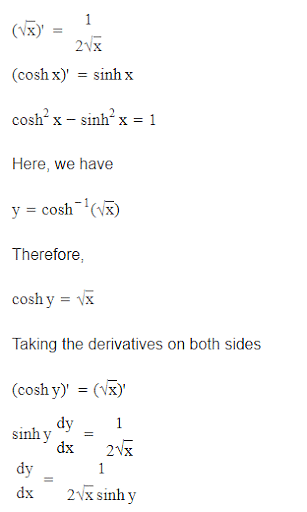
Ques. How do find the derivative of the function y=cosh-1(\(\sqrt{}\)x)? (3 marks)
Ans. 
Explanation: We need

Ques. Solve  ? (3 marks)
Ans.
Ques. Find the derivative of hyperbolic function.  ? (4 marks)
Ans.


Ques. What is the purpose of Sinh? (2 marks)
Ques. Are hyperbolic functions periodic? (2 marks)
Ans. Hyperbolic functions are exponential functions, they are not periodic in R. As a result, hyperbolic functions have a period of 2πi for the imaginary component.
Ques. What are six hyperbolic function integrations? (2 marks)
Ans. The six hyperbolic function integrations are as follows:
- ∫ coshy dy = sinh y + C
- ∫ sinhy dy= cosh y + C
- ∫ sech²y dy = tanh y + C
- ∫ csch²y dy = -coth y + C
- ∫ sech y tanh y dy = -sech y + C
- ∫ cosech y coth y dy = - cosech y + C
Ques. Prove the function cosh x + sinh x = ex using hyperbolic functions? (3 marks)
Ans. According to hyperbolic function formulas sinh x = (ex - e-x)/2 and cosh x = (ex + e-x)/2
- cosh x + sinh x
- (ex - e-x)/2 + (ex + e-x)/2
- (ex - e-x + ex + e-x)/2
- 2ex / 2
- ex
Ques. Prove the function coth2x - csch2x = 1 using hyperbolic functions identites? (3 marks)
Ans. According to hyperbolic functions identites coth x = cosh x/sinh x and csch x = 1/sinh x
- coth2x - csch2x
- (cosh x/sinh x)2 - (1/sinh x)2
- cosh2x/sinh2x - 1/sinh2x
- (cosh2x - 1)/sinh2x
- sinh2x/sinh2x [Using hyperbolic functions identites cosh2x - sinh2x = 1 ⇒ cosh2x - 1 = sinh2x]
- 1
For Latest Updates on Upcoming Board Exams, Click Here: https://t.me/class_10_12_board_updates
Check-Out:



Comments