



Education Journalist | Study Abroad Lead
Hyperconjugation is a permanent stabilizing effect in which σ electrons of the C-H bond of an alkyl group are directly attached to an atom in an unsaturated system. Hyperconjugation involves the delocalization of sigma electrons of the C-H bond of an alkyl group connected to an atom of an unsaturated system or to an atom with an unshared p orbital.
- Electron displacement occurs due to the presence of an appropriate attacking reagent in an organic molecule.
- Such an electron displacement leads to bond polarization.
- Hyperconjugation and the Electromeric Effect are the two effects that feature electron displacement.
- Hyperconjugation provides stability to the molecule.
The delocalization happens by overlapping the p-orbitals of a double bond with the sigma-orbital of the adjacent single bond. The effects of hyperconjugation are observed in bond length, dipole moments, stability of carbocations, and heat of formation.
Read More: NCERT Solutions - Class 11 Chemistry – Organic Chemistry
Key Terms: Hyperconjugation, Electromeric Effect, Delocalization, Carbocation, Resonance, Orbital, Alkyl Group, Hydrogenation
What is Hyperconjugation?
[Click Here for Sample Questions]
Hyperconjugation is an effect that involves the delocalization of σ electrons from the C-H bond of an alkyl group directly attached to an atom in an unsaturated system or to an atom with an unshared p orbital.
- Unlike the temporary nature of the electromeric effect, hyperconjugation is a permanent effect.
- Hyperconjugation is the reason for the stabilization of glucose as it allows the dispersion of the positive charge.
- The greater the alkyl group number attached to a positively charged carbon atom, the greater the degree of stabilization and hyperconjugation interaction of the carbonation.
- Hyperconjugation is also referred to as “no bond resonance” since there is no bond between the hydrogen and the adjacent atom.
| Cause of Hyperconjugation: “Hyperconjugation is a stabilizing reaction occurring when electrons in a σ-bond engage with either an adjacent partially full or vacant p-orbital or a π-orbital resulting in the formation of an extended molecular orbital.” |
Read More: Organic Chemistry: Basic Principles and Techniques
Electromeric Effect
[Click Here for Previous Years' Questions]
Electromeric Effect is a temporary effect observed in the presence of an attacking reagent in the vicinity of an organic compound having multiple bonds. There is a complete transfer of a shared pair of π-electrons to one of the atoms joined by multiple bonds on the demand of an attacking reagent. The effect stops as soon as the attacking reagent is removed from the domain of the reaction.
There are two types of electrometric effects:
Positive Electromeric Effect (+E Effect)
The positive electromeric effect denotes the transfer of π-electrons from the multiple bonds to the atom to which the reagent becomes attached.

Positive Electromeric Effect
Negative Electromeric Effect (–E Effect)
The negative electromeric effect refers to the transfer of π−electrons of the multiple bonds to the atom to which the reagent does not get attached.

Negative Electromeric Effect
Read More:
Hyperconjugation Effect
[Click Here for Previous Years' Questions]
The hyperconjugation effect is a crucial concept in organic chemistry. It can be best understood by the example of the ethyl cation (CH₃CH₂⁺). In this scenario, the positively charged carbon atom possesses an empty p orbital.
In the ethyl cation, the positively charged carbon with an empty p orbital can align with one of the three C-H bonds from the methyl group. The electrons of the C-H bond in this plane get delocalized into the empty p orbital, resulting in a stabilizing hyperconjugation effect.

Hyperconjugation in Ethyl Cation
Stabilization of Carbocations
Hyperconjugation also stabilizes the carbocation by assisting in the distribution of positive charges. Thus, it can be said that the more alkyl groups connected to a positively charged carbon atom, the more hyperconjugation interaction and carbonation stabilization there is. Thus, the relative stability on the basis of hyperconjugation is given as:

Relative Stability of Carbocations
Extension to Alkenes and Alkynes
Hyperconjugation is also possible in alkenes and alkynes. Hyperconjugation is not limited to carbocations; it also occurs in alkenes and alkynes. An orbital diagram showcasing hyperconjugation in propene depicting the delocalization of electrons in alkene structures is as follows.

Hyperconjugation in Propene
Effects of Hyperconjugation
[Click Here for Sample Questions]
Hyperconjugation affects several qualities such as:
Bond Length
Hyperconjugation acts as a crucial element in the shortening of sigma bonds (σ bond).
- For example, in 1,3-butadiene and propyne, the single C–C bonds are approximately 1.46 angstroms long.
- These are comparatively shorter than the 1.54 angstroms observed in saturated hydrocarbons.
- This can be attributed to the regular conjugation of the two alkenyl components in the case of butadiene.
Dipole Moments
Hyperconjugative structures lead to a substantial increase in the dipole moment of 1,1,1-trichloroethane when compared to chloroform.
Heat of Formation
The heat of hydrogenation per double bond is less than the heat of hydrogenation of ethylene. Molecules featuring hyperconjugation display a heat of formation greater than the sum of their bond energies.
Stability of Carbocations
The stability hierarchy of carbocations is influenced by hyperconjugation. Considering the three C–H σ bonds of methyl groups connected to the carbocation, the stabilizing interaction occurs more strongly when there are more adjacent methyl groups. The order of stability is as follows:
| (CH3)3C+ > (CH3)2CH+ > (CH3)CH2+ > CH3+ |
Here, the two mismatched C–H bonds have a weaker donation. The larger hyperconjugation stabilization occurs when there are more adjacent methyl groups because of the greater number of neighboring C–H bonds.
Applications of Hyperconjugation
[Click Here for Previous Years' Questions]
There are numerous applications of hyperconjugation however the most important application of hyperconjugation is that it is used in rationalizing numerous chemical phenomena such as:
- Anomeric Effect
- Gauche Effect
- Rotational Barrier of Ethane
- Beta-silicon Effect
- Vibrational Frequency of Exocyclic Carbonyl Groups
- Relative Stability of Substituted Carbocations
- Substituted Carbon-centered Radicals
- Thermodynamic Zaitsev’s Rule for Alkene Stability
Quantum mechanical modelling suggests that hyperconjugation, rather than the concept of steric hindrance, is a better explanation for the preference for staggered conformation.
Negative Hyperconjugation
[Click Here for Sample Questions]
Negative Hyperconjugation refers to the donation of electron density from a filled – or p-orbital to a nearby σ*-orbital.
- Negative Hyperconjugation is a type of resonance, that helps to stabilize molecules or the transition state.
- It also lengthens the -bond by increasing electron density in the antibonding orbital.
- Negative hyperconjugation occurs frequently when the σ*-orbital is placed on particular C–F or C–O bonds,.
- It does not occur to a significant degree with conventional C–H bonds.
- In negative hyperconjugation, the electron density moves in the opposite direction (from π– or p-orbital to empty σ*-orbital) than in the more typical hyperconjugation (from a lone pair of electrons to an empty p-orbital).
Also Check:
Things to Remember
- Hyperconjugation and Electromeric effect are the two effects that display electron displacement.
- Localization of σ electrons of C-H bond of an alkyl group directly attached to an atom of the unsaturated system or atom with an unshared p orbital takes place in hyperconjugation.
- Hyperconjugation is a permanent effect, unlike the electrometric effect.
- Hyperconjugation occurs when electrons in a σ-bond engage with either a nearby partially full or vacant p-orbital or a π-orbital to generate a longer molecular orbital.
- Negative Hyperconjugation is defined as the donation of electron density from a filled – or p-orbital to a nearby σ*-orbital.
- Hyperconjugation is used in rationalizing chemical phenomena such as Zaitsev’s rule for alkene stability, beta-silicon effect, etc.
Previous Years’ Questions
- Hyperconjugation involves… [BITSAT 2010]
- Hyperconjugation involves overlap of the following orbitals… [JEE Advanced 2008]
- The increasing order of relative stabilities of the carbocations…
- Most stable carbocation is… [DUET 2011]
- Which is the least stable carbocation… [AMUEEE 2014]
- According to MO theory… [KEAM 2014]
- The major product formed in dehydrohalogenation reaction… [NEET 2021]
- Conjugated double bonds are present of these in… [JIPMER 2001]
- Two pi and half sigma bonds are present in… [JEE Main 2019]
- Propyne molecule contains…
Sample Questions
Ques. What is Hyperconjugation? (3 Marks)
Ans. Hyperconjugation is a stabilizing interaction in organic chemistry that involves the delocalization of electrons from a σ-bond to an adjacent π-orbital or an empty p-orbital.
- It occurs in compounds with alternating single and multiple bonds, and it contributes to the stability of molecules.
- The phenomenon is particularly evident in carbocations, where the adjacent σ-bond donates electron density to stabilize the positive charge.
- Hyperconjugation is associated with the overlap of molecular orbitals, leading to increased stability, altered bond lengths, and other observable effects in organic molecules.
- Understanding hyperconjugation is crucial for explaining the relative stability of various organic compounds.
Ques. How hyperconjugation improve the stability of the compound? Explain with an example. (3 Marks)
Ans. CH3CH2+ is an ethyl cation in which the positively charged carbon atom has an empty p orbital. One of the C-H bonds of the methyl group can align in the plane of this empty p orbital and the electrons constituting the C-H bond in the plane with this p orbital can then be delocalized into the empty p orbital as depicted in the figure.
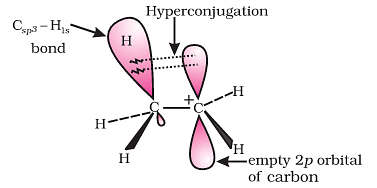
This type of overlap stabilizes the carbocation because electron density from the adjacent σ bond helps in dispersing the positive charge.
Ques. What is negative and positive inductive effects? (2 Marks)
Ans. The inductive effect refers to the transmission of electron density through sigma bonds. The positive inductive effect occurs when electrons are pulled towards an atom through a sigma bond, resulting in electron accumulation. Conversely, the negative inductive effect involves the withdrawal of electron density from an atom, leading to a decrease in electron density. These effects impact the overall electron distribution within a molecule, influencing its reactivity and properties.
Ques. Define resonance effect. (3 Marks)
Ans. Whenever we can write two or more two Lewis structures for a molecule that are different just because of the position of electrons is known as the phenomenon of resonance. Due to this resonance, electrons can flow from one part to another part in a conjugated system (single bond-double bond alternatively). This flow of electrons creates spaces of low and high electron density due to the resonance and is called the resonance effect or mesomeric effect.
Ques. What is reverse hyperconjugation? (3 Marks)
Ans. Reverse hyperconjugation also referred to as negative hyperconjugation, is a system in which an electron interaction is directed from the pi bond to the sigma bond rather than from the sigma to pi bond. In simpler terms, there is a movement of electrons from the pi bond to the sigma bond in reverse hyperconjugation.
Ques. Mention any three applications of hyperconjugation. (3 Marks)
Ans. Hyperconjugation is applicable in the following aspects:
- Hyperconjugation explains the stability of specific alkenes over other alkenes.
- It helps in determining the durability of alkyl carbonation. The stability of alkyl carbocations is directly proportional to the number of resonating structures and the number of alpha hydrogens.
- It determines the Carbon-carbon double bond size in alkenes. The more will be the number of resonating structures, the more will be the single bond character.
Ques. Why does the number of alkyl groups attached matter? (2 Marks)
Ans. The greater the number of alkyl groups implies the greater the number of sigma-hydrogen atoms which in turn means the greater the number of hyperconjugative structures and greater the inductive effect. This also means more stability, especially in the case of alkenes.
Ques. How is the resonance effect related to the hyperconjugation effect? (2 Marks)
Ans. The hyperconjugation effect is a subpart of the resonance effect. In the resonance effect, the pi-electrons delocalize whereas in hyperconjugation the sigma-electrons delocalize to show different structures. This delocalization happens by overlapping p-orbitals of a double bond with the sigma-orbital of the single bond next to it.
Ques. Define the Inductive Effect. (2 Marks)
Ans. The tendency of sigma-electron to displace slightly towards the more electronegative atom such that a dipole develops i.e. one end of the bond becomes slightly positively charged and the other end becomes slightly negatively charged.
Ques. Define carbocation. (2 Marks)
Ans. A carbocation is an organic species with a positive charge and a carbon atom with only six electrons in its outermost shell. With a flat structure, the carbocation has all three covalent bonds in the plane with a bond angle of 120 between them.
Ques. Explain the impact of hyperconjugation on bond lengths. Provide an example. (3 Marks)
Ans. Hyperconjugation has a notable impact on bond lengths, especially in molecules with alternating single and multiple bonds. This effect influences the lengths of sigma (σ) bonds in the molecule. A classic example is 1,3-butadiene.
In 1,3-butadiene, the molecule contains alternating single and double bonds. Due to hyperconjugation, the electrons from adjacent sigma (σ) bonds are delocalized into the π-orbital of the double bond. This delocalization results in a more even distribution of electron density, leading to a shorter effective bond length for the sigma bonds.
As a consequence, the single C–C bonds in 1,3-butadiene are about 1.46 angstroms long, which is comparatively shorter than the 1.54 angstroms observed in saturated hydrocarbons. This phenomenon demonstrates how hyperconjugation contributes to the stabilization of the molecule and influences the bond lengths in the structure.
Ques. How does hyperconjugation affect the dipole moments of molecules? Provide an example. (3 Marks)
Ans. Hyperconjugation has a significant impact on the dipole moments of molecules, and it can be illustrated using the example of 1,1,1-trichloroethane.
In 1,1,1-trichloroethane, the molecule contains a chlorine atom attached to a carbon atom, and hyperconjugation plays a role in modifying the electron distribution. The hyperconjugative structures result in increased electron density around the carbon atom, affecting the overall dipole moment of the molecule.
Due to hyperconjugation, there is a substantial increase in the dipole moment of 1,1,1-trichloroethane when compared to chloroform, which lacks hyperconjugation effects. The redistribution of electron density caused by hyperconjugation influences the dipole moment, making it a useful factor to consider when analyzing the properties of molecules with hyperconjugative interactions.
Check-Out:



Comments