



Education Content Expert
Islets of Langerhans are irregular patches of endocrine tissue located within the pancreas of vertebrates. These patches are named after German physician Paul Langerhans.
- An average human pancreas contains approximately 1 million islets.
- Islets of Langerhans consist of four different cell types namely alpha, beta, delta, and C cells.
- Out of these four types, alpha, beta, and delta cells produce vital hormones.
- The fourth cell, i.e. C cell has no function known till date.
The most common cell among these four cells is the beta cell. Beta Cell produces insulin responsible for regulating carbohydrate, fat, and protein metabolism. The alpha cells of Islets of Langerhans produce an opposing hormone called glucagon. This hormone releases glucose from the liver and fatty acids from fat tissue.
Read More: NCERT Solutions for Class 11 Biology Chemical Coordination and Integration
| Table of Content |
Key Terms: Islets of Langerhans, Beta Cell, Insulin, Alpha Cell, Glucagon, Endocrine Cells, Islets, Delta Cell, Pancreas, Blood
Islets of Langerhans
[Click Here for Sample Questions]
Islets of Langerhans are important for the proper endocrine function of the pancreas. Pancreas contains endocrine cells and acinar cells. Endocrine cells include under 2% of the pancreatic mass of the grown-up pancreas. This fully formed pancreas contains around 1 million Islets, with every islet containing approximately 3000 cells.
- The A cells in the pancreas are responsible for releasing glucagon.
- The B cells release insulin.
- F cells release the chemical pancreatic polypeptide.
- D cells are responsible for releasing somatostatin.
- D2 Cells emit vasoactive digestive peptides.
Inside the pancreas, B and D cells are located in the body and tail of the pancreas. Whereas, F cells are gathered in the uncinate interaction. A cells disseminate all throughout the pancreas. The blood vessels supply blood to the pancreas first and then through islets to the exocrine part of the organ.
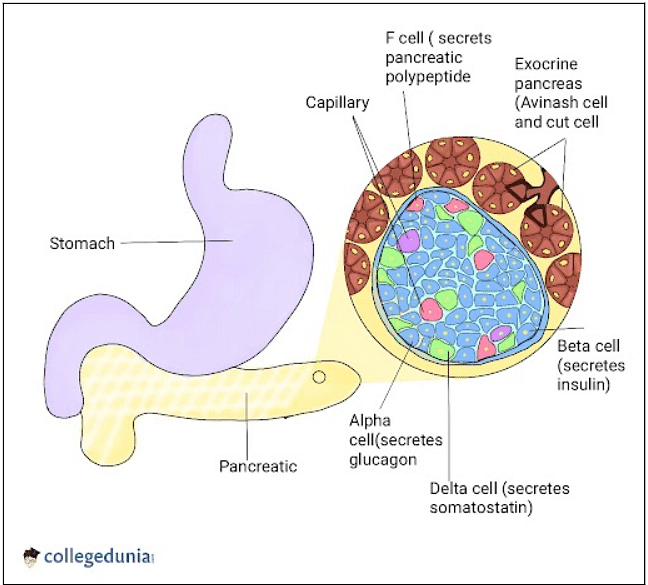
Islets of Langerhans
Read More:
| Relevant Concepts | ||
|---|---|---|
| Proteolytic Enzymes | Difference Between Endocrine and Exocrine Glands | Digestive Enzymes |
| Diabetes Mellitus | Human Endocrine System | Small Intestine |
Function of Islets of Langerhans
[Click Here for Previous Year Questions]
The Islets of Langerhans in the pancreas are the primary cell in the endocrine tissue. The pancreas' clogged cells continue to produce a large number of hormones. Alpha, beta, and delta cells are the three types of cells that are located in the pancreas.
- Blood sugar levels are raised by glucagon or glucose produced by alpha cells.
- Insulin is secreted by the beta cells in response to elevated blood sugar levels.
- The somatostatin hormone is produced by the delts cell.
- The fourth Cell is also there, although it serves no particular purpose.
Read More: Chemical Coordination and Integration
Types of Cells in Islets of Langerhans
[Click Here for Sample Questions]
There are four types of cells present in Islets of Langerhans, namely
- Alpha Cell
- Beta Cell
- Delta Cell
- C Cell
Alpha, Beta, and Delta cells are three distinct Cell types present in the Islets of Langerhans. The fourth Cell which is C Cell has no special function in the human body.
Alpha Cells
[Click Here for Previous Year Questions]
Pancreatic alpha cells release an opposing hormone. They consist of glucose and glucagon.
- The hormone glucagon aids in the liver's release of glucose.
- Fatty acids are also secreted from fat tissues with the aid of glucagon.
- In turn, free fatty acids and glucose favor the released insulin. This further restricts glucagon release.
- Alpha cells cover approximately 20% of the human Islets of Langerhans.
Read More: Chemical Coordination & Integration Important Questions
Beta Cells
[Click Here for Sample Questions]
The most crucial hormones secreted by the pancreas are beta cells. The b Cell secretes insulin.
- Insulin is important for several metabolic activities.
- It encourages the body's cells to take up and use glucose at a faster pace.
- It prevents the liver from secreting glucose.
- It aids in the absorption of proteins and amino acids by the muscles.
- It encourages the release and breakdown of fat.
- Growth hormone encourages the beta Cell to secrete insulin.
Delta Cells
[Click Here for Previous Year Questions]
Somatotropin, glucagon, and insulin are all strongly inhibited by a substance secreted by the pancreatic delta cells.
- Somatostatin is the main inhibiting substance.
- Although its purpose is unclear, it plays a part in the control of metabolism.
- The hypothalamus also makes somatostatin.
- With the aid of the pituitary gland, it serves the purpose of inhibiting growth hormones there.
- The stomach, intestine, and pancreatic islets of Langerhans also contain these delta Cells.
Read More: Chemical Coordination and Integration MCQs
Functions of Insulin
[Click Here for Sample Questions]
Insulin is a key hormone that controls the metabolism of carbohydrates, fats, and proteins. The b Cell secretes this insulin.
- Insulin is important for several metabolic activities.
- It encourages the body's cells to take up and use glucose faster.
- It prevents the liver from secreting glucose and also aids in the muscles' absorption of proteins and amino acids.
- Insulin encourages the release and breakdown of fat.
- Growth hormone encourages the beta Cell to release insulin.
- It aids in reducing an increase in blood glucose levels that occur right after an individual consumes food.
Check More:
| Related Topics | ||
|---|---|---|
| Carbohydrate Metabolism | Human Endocrine System | Endocrine Glands |
| Cortisol Hormone | Acromegaly | Endocrine Glands Disorders |
Things to Remember
- Islets of Langerhans are irregularly shaped patches of endocrine tissue located within the pancreas of many vertebrates.
- Islets of Langerhans contain four types of cells namely alpha cells, beta cells, delta cells, and C cells.
- Beta cells are responsible for producing Insulin.
- Insulin controls the metabolism of carbohydrates, fats, and proteins.
- Alpha cells consist of glucose and glucagon.
- Delta cells control metabolism.
- Fully formed pancreas contains endocrine cells and acinar cells.
- Patients are given Islets to prevent or avoid hazardous labile diabetes mellitus.
Previous Years’ Questions
- The islets of Langerhans are found in… (BHU 2006)
- The α-cells in the Islet of Langerhans secrete a hormone… (Himachal Pradesh PMT 2011)
- In the homeostatic control of blood sugar level, which organs function… (KCET 2006)
- Somatostatin is secreted by… (UP CPMT 2010)
- Pancreas is a heterocrine gland, Endocrine part secretes insulin and glucagon…
- Which of the following is secreted by the pancreas… (OJEE 2012)
- Insulin is secreted by_____ of pancreas…
- Release of pancreatic juice is stimulated by… (NEET 1989)
- Which of the following is not an endocrine gland… (OJEE 2010)
- A temporary endocrine gland in humans is… (CUCET 2012)
Sample Questions
Ques. Where are Islets of Langerhans present? (2 Marks)
Ans. Islets of Langerhans are scattered throughout the pancreas. They are a group of cells within the pancreas that are responsible for producing and releasing hormones that regulate glucose levels.
Ques. Are Islets of Langerhans ductless glands? (3 Marks)
Ans. The pancreas is a compound gland. The pancreas is a crucial endocrine gland that produces digesting enzymes in addition to other hormones. The pancreas contains cells that cluster together to form the islets of Langerhans, which secrete insulin and glucagon hormones. Humans have about 1 million islets. They primarily consist of alpha cells, which emit glucagon, and beta cells, which secrete insulin.
Ques. What is the function of Insulin and Glucagon? (3 Marks)
Ans. The balance between insulin and glucagon is essential for controlling a person's blood sugar levels. Glucagon converts glycogen to glucose in the liver. Cells use blood glucose to make energy when it enters the cells thanks to insulin. Together, insulin and glucagon provide homeostasis, the stable state of conditions within the body.
A person's pancreas secretes more insulin when their blood sugar level is too high. Their pancreas releases glucagon to increase blood sugar levels when they fall. This equilibrium aids in giving the cells enough energy while avoiding damage that could be brought on by persistently high blood sugar levels.
Ques. Which type of gland is the pancreas? (3 Marks)
Ans. The pancreas is both a duct gland and a ductless gland. As a ductless gland, pancreas has special groups of hormone-secreting cells. These groups of cells are called Islets of Langerhans. They are scattered throughout the entire gland. Islets produce three hormones: insulin from beta cells, glucagon from alpha cells, and somatostatin from delta cells.
Ques. What does glucagon produced by A cells of Islets of Langerhans do? (3 Marks)
Ans. Glucagon produced by A cells of Islets of Langerhans converts glycogen to glucose. The hormone acts on hepatocytes to raise blood sugar levels and stimulates:
- Glycogen breakdown (also known as glucose conversion, or glycogenolysis).
- Glucose synthesis from proteins and lipids (Gluconeogenesis).
- decreased blood sugar absorption rate.
Ques. What causes diabetes mellitus? (1 Mark)
Ans. When the islet Cells can not produce insulin or are unable to control blood glucose levels, then a serious issue occurs in the level of hormones in the body. This causes diabetes mellitus.
Ques. How is the Island of Langerhans different from the islets of Langerhans? (2 Marks)
Ans. There is no difference between the island of Langerhans and the Islets of Langerhans. Instead, the two of them are the same. Both of them are irregularly shaped endocrine tissue located within the pancreas of most vertebrates, and both of them are named after a German physician Paul Langerhans.
Ques. What purpose do the islets of Langerhans serve? (2 Marks)
Ans. Islets of Langerhans are a cluster of cells. They are located within the pancreas and are responsible for releasing hormones that regulate glucose levels. The insulin released is preferred by fatty acids and glucose.
Ques. Define Exocrine Gland. (3 Marks)
Ans. Exocrine glands are the type of glands that produces sweat, tears, saliva, milk, and digestive juices. These glands release them through a duct or opening to a body surface. Examples of exocrine glands include- mammary glands, sweat glands, lacrimal glands, salivary glands, and digestive glands in the stomach, pancreas, and intestines.
Ques. Define Hormones. (3 Marks)
Ans. Hormones are the chemical messengers of the body. They travel throughout the bloodstream to tissues or organs. They work slowly and affect many processes including growth and development, metabolism, sexual function, reproduction, and mood. Endocrine glands are responsible for making hormones. The pancreas is one of the major endocrine glands that stores Islets of Langerhans.
Check-Out:



Comments