



Content Curator
Jacobian or Jacobi method is an iterative method used to solve matrix equations which has no zeros in its main diagonal. It can also be said that the Jacobi method is an iterative algorithm used to determine solutions for large linear systems which have a diagonally dominant system. Each diagonal element has an ‘approximate value’ which is further converged and iterated. It is also called the simultaneous displacement method since all displacements are modified at the end of each iteration.
| Table of Content |
Key Terms: Jacobi, Jacobian, Matrix, Equation, Linear, Diagonal, Displacement, Elements
Read More: Differential Equations Applications
Jacobian Matrix Method
[Click Here for Sample Questions]
Carl Gustav Jacob Jacobi, a German mathematician first discovered this method hence, the name Jacobian/Jacobi method. Jacobi method is done in linear systems like matrices.
Matrices expressed in the form of “AX=B” represent a large linear system. Where, A is a square matrix which has ordered coefficients in the large linear system, X is all the various variables and B is the constant equal to each linear equation.
If there are unknown x values it can be solved by using equation AX=B where, A represents a variable and X represents x variables which are the unknown values and B is the constant equal to each linear equation.
Now, AX = B is the linear system, where

Now, matrix A can be decomposed into a diagonal component ‘D’, the elements above the diagonal is denoted as ‘U’ and the elements below the diagonal is denoted as ‘L’.

The solution can be obtained iteratively by using the equation,
X(k+1) = D−1 [b - (L + U) X(k)]
Where X(k) and X(k+1) is the kth approximation or iteration of X and X(k+1) is the next or k + 1 iteration of X. The element-based formula is thus:

Now, X value can be determined by putting the previous iterative value in the above equation.
Discover about the Chapter video:
Determinants Detailed Video Explanation:
Read Also: Area of a Triangle
Jacobi iterative method
[Click Here for Sample Questions]
This method has 2 different ways to solve; in the first one the given system of equation has unique solution.

In the second one, the dominant diagonal of matrix A does not have any zeros in it. If there are any zeroes in the main diagonal entry then the rows and columns are rearranged to obtain a coefficient matrix of diagonal that does not have any zeroes.
There are few formulas to solve the equation to get the values of X1, X2, Xn, respectively.
X1 = 1/a11 (b1 – a12x2 – a13x3 - … - a1nxn)…. (1)
X2 = 1/a22 (b2 – a21x2 – a23x3 - … - a2nxn)…. (2)
Xn = 1/ann (bn – an1x2 – an2x2 - … - an,n-1xn-1)…. (3)
Now, make the initial guess of the solution as, x(0) = (x1(0), x2(0), x3(0),…, xn(0))
Substitute the values obtained in the previous step in equation as (x1(1), x2(1), x3(1),…, xn(1))
Do it in the same way as done in the previous step and compute, Xk = (x1(k), x2(k), x3(k),…, xn(k)); k = 1, 2, 3…
Formula:
- A = D + L + U
- aX1 = 1/a11 (b1 – a12x2 – a13x3 - … - a1nxn)
- X2 = 1/a22 (b2 – a21x2 – a23x3 - … - a2nxn)
- Xn = 1/ann (bn – an1x2 – an2x2 - … - an,n-1xn-1)
Properties of Jacobian method
[Click Here for Sample Questions]
There are different applications of Jacobian matrix in various areas. Jacobi method is a simple method but it has its both good and bad aspects. Jacobi method is easy to understand yet it not practiced typically. However, the strategy is also seen as ineffective because it is rarely implemented in practise. Despite its drawbacks, it is nevertheless a nice place to start for people who want to learn more useful but more complex iterative approaches.
Read Also: Determinant of a matrix
Things to remember
- Jacobian method is also known as simultaneous displacement method.
- Jacobi method has two assumptions: one; the given equation has unique solutions and seconds; the leading diagonal matrix should not contain zero.
- The algorithm of Jacobi method was called as Jacobi transformation process of matrix diagonalisation.
- There are two iterative methods: the Jacobi and Gauss-Seidel method. The key difference between these two is that in Jacobi previous step value is used & in Gauss-Seidel new values are used.
- The RHS of the equation's matrix may be divided into two parts: a matrix of coefficients and a matrix of constants.
Read Also: Transpose of a Matrix
Sample Questions
Ques. Jacobi’s method is a method of solving a matrix equation on a matrix that has no zeroes along _____ (2 marks)
a) Leading diagonal
b) Last column
c) Last row
d) Non-leading diagonal
Ans. (a)
Explanation: Jacobi’s method is a method of solving a matrix equation on a matrix that has no zeroes on its main diagonal because convergence can be achieved only through this way.
Ques. Jacobi iteration converges, if A is strictly dominant. (2 marks)
a) True
b) False
Ans. (a)
Explanation: If A is matrix is said to be diagonally dominant if for every row of the matrix, the magnitude of the diagonal entry in a row is larger than or equal to the sum of the magnitudes of all the other non-diagonal entries in that row, and for such matrices only Jacobi’s method converges to the accurate answer.
Ques. In Jacobi’s Method, the rate of convergence is quite ______ compared with other methods. (2 marks)br
a) Slow
b) Fast
Ans. (a)
Explanation: In Jacobi’s Method, the rate of convergence is quite slow compared with other methods because here the selection of unknowns of an iteration is done using the results of the previous iteration only, whereas in other methods, selection of unknowns is done along with the generation of results in an iteration
Read More: Invertible Matrices
Ques. Which of the following is an assumption of Jacobi’s method? (2 marks)
a) The coefficient matrix has no zeros on its main diagonal
b) The rate of convergence is quite slow compared with other methods
c) Iteration involved in Jacobi’s method converges
d) The coefficient matrix has zeroes on its main diagonal
Ans. (a)
Explanation: Because it is the method used for solving a matrix such that for every row of the matrix, the magnitude of the diagonal entry in a row is larger than or equal to the sum of the magnitudes of all the other (non-diagonal) entries in that row. This helps in converging the result and hence it is an assumption.
Ques. Jacobi’s method is a method of solving a matrix equation on a matrix that has no zeros along its main diagonal. (2 marks)
a) True
b) False
Ans. a
Explanation: Jacobi’s method is a method of solving a matrix equation on a matrix that has no zeros along its main diagonal because the desirable convergence of the answer can be achieved only for a matrix which is diagonally dominant and a matrix that has no zeros along its main diagonal can never be diagonally dominant.
Ques. Solve the system of equations by Jacobi’s iteration method. (4 marks)
20x + y – 2z = 17
3x + 20y – z = -18
2x – 3y + 20z = 25
Ans. Write the equations in the form
x = 1/20 (17 – y +2z)
y = 1/20 (-18 -3x + z)
z = 1/20 (25 -2x +3y)
Approximately, x = y = z = 0.
Substituting these in the right sides of the equations (i), (ii), (iii), we get
x = 0.85, y = -0.9, z = 1.25
Putting these values again in equations (i), (ii), (iii), we obtain,
x = [17 – (-0.9) + 2(1.25)] = 1.02
y = [-18 -3(0.85) + 1.25] = -0.965
z = [25 – 2(0.85) + 3(-0.9)] = 1.03
Substituting these values again in equations (i), (ii), (iii), we obtain,
2nd iteration:
x = 1.00125, y = -1.0015, z = 1.00325
Proceeding in this way, we get,
3rd iteration:
x = 1.0004, y = -1.000025, z = 0.9965
4th iteration
x = 0.999966, y = -1.000078, z = 0.999956
5th iteration
x = 1.0000, y = -0.999997, z = 0.999992
The values in the last iterations being practically the same, we can stop.
Hence the solution is
x = 1, y = -1, z = 1.9
Ques. A system of linear equations of the form Ax = b with an initial estimate x(0) is given below. Solve using Jacobian method.  (5 marks)
Ans. Given –

We know that x(k+1) = D-1(b – Rx(k)) is used to estimate x.
Rewrite the above expression as, D-1(b – Rx(k)) = Tx(k) + C
Here,
T = -D-1R
C = D-1b
R = L + U
Let us split matrix A as a diagonal matrix and remainder

Here,
R = Remainder matrix
L = Lower part of R
U = Upper part of R
T = -D-1(L + U) = D-1[-L + (-U)]
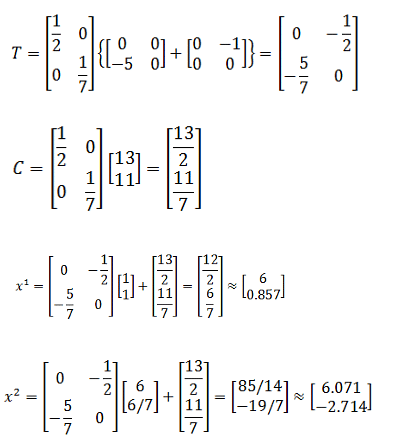
Repeat the above process until it converges, i.e. until the value of ||Axn – b|| is small.
Read more: Orthogonal Matrix
Ques. Solve the following system of linear equations using iterative Jacobi method. (4 marks)
4x1 + 2x2 – 2x3 = 0
x1 – 3x2 – x3 = 7
3x1 – x2 + 4x3 = 5
Ans. Given,
4x1 + 2x2 – 2x3 = 0
x1 – 3x2 – x3 = 7
3x1 – x2 + 4x3 = 5
Let us write the equations to get the values of x1, x2, x3.
x1 = (1/4)[0 – 2x2 + 2x3] = (-1/2)x2 + (1/2)x3
x2 = (-1/3) [7 – (-3)x1 – (-1)x3] = (-7/3)- x1 – (1/3)x3
x3 = (1/4)[5 – 3x1 – (-x2)] = (5/4) – (3/4)x1 + (1/4)x2
Now, make the initial guess x1 = 0, x2 = 0, x3 = 0.
So, x1(1) = (-1/2)(0) + (1/2)(0) = 0
x2(1) = (-7/3)- 0 – (1/3)(0) = -7/3 = -2.333
x3(1) = (5/4) – (3/4)(0) + (1/4)(0) = 5/4 = 1.25
We can continue this iterations for the values k = 0, 1, 2, 3, …
| X | K = 0 | K = 1 | K = 2 | K = 3 |
| X1(k) | 0 | 0 | 1.9717 | 1.7083 |
| X2(k) | 0 | -2.333 | -2.75 | -1.9583 |
| X3(k) | 0 | 1.25 | 0.6667 | -0.7812 |
Ques. Solve the system of equations by Jacobi’s iteration method. (4 marks)
10a - 2b - c - d = 3
- 2a + 10b - c - d = 15
- a - b + 10c - 2d = 27
- a - b - 2c + 10d = -9
Ans. Rewriting the given equations as
a = 1/10(3 + 2b + c + d)
b = 1/10(15 + 2z + c + d)
c = 1/10(27 + a + b + 2d)
d = 1/10(-9 + a + b + 2d)
Start from an approximation a = b = c = d = 0.
1st iteration: a = 0.3, b = 1.5, c = 2.7, d = -0.9
2nd iteration:
a = 110[3 + 2(1.5) + 2.7 + (-0.9)] = 0.78
b = 110[15 + 2(0.3) + 2.7 + (-0.9)] = 1.74
c = 110[27 + 0.3 + 1.5 + 2(-0.9)] = 2.7
d = 110[-9 + 0.3 + 1.5 + 2(-0.9)] = -0.18
Proceeding in this way we get,
3rd iteration, a = 0.9, b = 1.908, c = 2.916, d = -0.108
4th iteration, a = 0.9624, b = 1.9608, c = 2.9592, d = -0.036
5th iteration, a = 0.9845, b = 1.9848, c = 2.9851, d = -0.0158
6th iteration, a = 0.9939, b = 1.9938, c = 2.9938, d = -0.006
7th iteration, a = 0.9939, b = 1.9975, c = 2.9976, d = -0.0025
8th iteration, a = 0.999, b = 1.999, c = 2.999, d = -0.001
9th iteration, a = 0.9996, b = 1.9996, c = 2.9996, d = -0.004
10th iteration, a = 0.9998, b = 1.9998, c = 2.9998, d = -0.0001
Hence, a = 1, b = 2, c = 3, d = 0.
Ques. Which of the following systems of linear equations has a strictly diagonally dominant coefficient matrix? (2 marks)
3x1 – x2 = -4
2x1 + 5x2 = 2
4x1 + 2x2 – x3 = -1
x1 + 2x3 = -4
3x1 - 5x2 + x3 = 3
Ans.

Ques. Solve the system of equations by Jacobi’s iteration method. (4 marks)
10x = y – x = 11.19
x + 10y + z = 28.08
-x + y + 10z = 35.61
Correct to two decimal places.
a) x = 1.00, y = 2.95, z = 3.85
b) x = 1.96, y = 2.63, z = 3.99
c) x = 1.58, y = 2.70, z = 3.00
d) x = 1.23, y = 2.34, z = 3.45
Ans. Rewriting the equations as,
x = 1/10 (11.19 – y + z)
y = 1/10 (28.08 – x – z)
z = 1/10 (35.61 + x – y)
From an approximation, x = y = z = 0.
1st iteration, x = 1.119, y = 2.808, z = 3.561
2nd iteration,
x = 1/10 (11.19 – 2.808 + 3.651) = 1.19
y = 1/10 (28.08 – 1.119 – 3.561) = 2.34
z = 1/10 (35.61 + 1.119 – 2.808) = 3.39
3rd Iteration:
x = 1.22, y = 2.35, z = 3.45
4th iteration:
x = 1.23, y = 2.34, z = 3.45
5th iteration:
x = 1.23, y = 2.34, z = 3.45
Hence, x = 1.23, y = 2.34, z = 3.45.
Also Read:



Comments