



Life cycle of the Moss plant (plural- mosses) shows alternation of generation. Mosses are small, green, non-vascular plants belonging to the Plantae kingdom and Bryophyta division. Mosses are flowerless plant species that grow in shady and damp areas.
- Moss plants do not have vascular tissue arrangements.
- They reproduce by asexual mode of reproduction.
- Mosses do not produce seeds and flowers.
- It develops spores for asexual reproduction.
Read More: What is Angiosperm?
| Table of Content |
Key terms: Life cycle, Moss, Mosses, Gametes, Spores, Plant, Gametophyte, Sporophyte
Overview of Moss Plant
[Click Here for Sample Questions]
Mosses belong to the Bryophyta group with almost 1200 specieses. They are commonly found in shady areas where they get plenty of water. For instance, near rivers and streams. It can be found colonized on other trees, roots, walls, buildings, or even on rocks. Some common examples of mosses are Funaria, Polytrichum, Sphagnum and Hypnum.
- Breakdown of mosses releases nutrients that can be beneficial for other plants.
- Moses also aid in soil erosion control by providing surface cover.
- Mosses show alternation of germination.
- Spore bearing mosses reproduce through two stages, gametophyte generation and sporophyte generation.
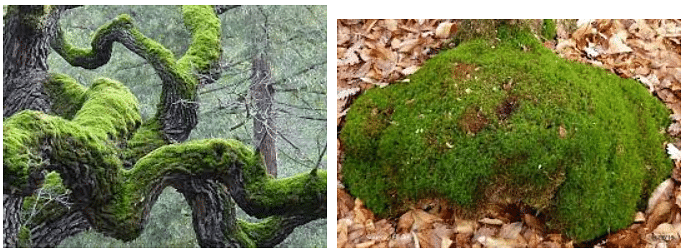
Mosses on the bark of tree and rock
Read More: Anatomy of Flowering Plants
Life Cycle of Moss
[Click Here for Sample Questions]
The life cycle of moss alternates between haploid gametophyte and diploid sporophyte. This is why it is called alternation of generation.
- Gametes (n) are produced by both male and female parts of the plant.
- These gametes develop the zygote (2n) after fusion.
- This further gives rise to a diploid sporophyte.
- Sporophytes will germinate to the gametes (n) for the next generation.
Gametophyte
The gametophyte is distinguished in two structures, protonema and leafy stage. These two forms male and female sex organs.
- The female organs are known as archegonia.
- It produces female gamete or ovum.
- It is protected by perichaetium modified leaves.
- The male sex organ is called antheridia.
- They are tiny, stalked and resemble a club-shaped structure.
- It produces male gametes and is protected by perigonium.
- A mature antheridium releases biflagellate structured antherozoids.
- They swim in water and fertilize ovum.
- Upon fertilization, diploid zygote is formed.
- This initiates a new life cycle stage of moss, the sporophyte.
- The archegonium divides to form calyptra.
- Calyptra protects the capsule in the sporophyte.
Sporophyte
A sporophyte contains a seta which is a capsule capped by the operculum. This sporophyte remains attached to the gametophyte and divides by mitosis.
- The capsule contains spore-producing cells which undergo meiosis to form spores.
- The capsule has specialized structures named as peristomes.
- It prevents spores from falling off in wet conditions.
- Spores are dispersed when the conditions are favorable.
- During this, the operculum and peristome fall off, and the spores are scattered in the environment.
- The spores that fall on a wet, damp ground germinate to form protonema.
- Protonema acts as a transitional structure, which later develops into a gametophyte.
Hence, a new life cycle of the moss plant begins with the formation of male and female sex organs.
Life Cycle of Moss
Also Read:
| Related Articles | ||
|---|---|---|
| Difference Between Gametophyte and Sporophyte | Apogamy and Apospory | Reproduction in Plants |
| The Flower | Flower Structure | Morphology of Flowering Plants MCQs |
Things to Remember
- Moss plant is a small, green, non vascular plant belonging to the Bryophyta division.
- It is found in shady and damp areas which are moisty.
- The moss plant grows on trees, rocks or walls near the streams and rivers.
- Life cycle of moss involves two main stages.
- The first stage is formation of gamete (gametophyte).
- The last stage is germination of spores to gametes (sporophyte)
- The male and female gametes are fuses and form spores.
- Spores further, fall off from the plant and germinate to new gametes.
- The new gametes will initiate a new life cycle and continue the alternation of germination.
Read More: Fertilization in Plants
Sample Questions
Ques. What division does the moss plant belong to? (1 mark)
Ans. The moss plant belongs to the kingdom Plantae and division Bryophyta.
Ques. What is the name given for representing the life cycle of moss? Why? (3 marks)
Ans. The life cycle of moss plants is also represented as alternation of generation. It is because of the stages involved and the way a moss carries out its life cycle.
Moss plant produces male and female gametes that fuses and develop into zygote. The zygote then develops spores that further germinate to new gametes for the new reproductive cycle. The two terms that describe these stages are gametophyte and sporophyte. The life cycle of moss alternates between the gametophyte and sporophyte. Hence, it is represented as alternation of generation.
Ques. Where do we find mosses? How to identify them? (2 marks)
Ans. Mosses are commonly found in moist and shady areas. It grows well in places with plenty of water. One can find mosses near the rivers or streams. Mosses generally grow by colonizing on the other trees, rocks, walls or buildings.
Mosses are small, green plants that can be identified easily by looking at tree bark or rocks.
Ques. Name the two structures in mosses that give rise to male and female sex organs. (1 mark)
Ans. The gametophyte of moss plants has two structures, protonema and leafy stage. These two forms male and female sex organs.
Ques. Write a note on the gametophyte of the moss plant. (2 marks)
Ans. Gametophyte is the stage where a moss produces male and female gametes.
The female organ or archegonia produces ovum which is protected by perichaetium modified leaves. The male sex organ is called antheridia. It produces male gametes and is protected by perigonium. A mature antheridium releases antherozoids that swim in water and fertilize ovum.
Upon fertilization, diploid zygote is formed.
Ques. Write a note on the sporophyte of the moss plant. (3 marks)
Ans. Sporophyte is the second or the last stage of moss life cycle. A sporophyte contains a seta capsule which is capped by the operculum. This sporophyte remains attached to the gametophyte. The capsule contains spore-producing cells which form spores by meiosis. The capsule has peristomes that prevent spores from falling off in wet conditions. Spores are dispersed when the conditions are favorable and the operculum and peristome fall off. The spores are scattered in the environment. The spores that fall on a wet, damp ground germinate to form protonema. Protonema will later develop into a gametophyte.
Ques. What is perigonium and operculum? (1 mark)
Ans. Perigonium is a protective structure in moss plants. It protects the antheridia. Operculum is the structure that caps the seta, a capsule in spores of the moss plant.
For Latest Updates on Upcoming Board Exams, Click Here: https://t.me/class_10_12_board_updates
Also Check:



Comments