



Content Curator
Reproduction in Plants Reproduction is an important life process of living organisms. It is a process by which living organisms produce their offspring. It is also called the production of new organisms from the existing organisms of the same species. Reproduction ensures the stability of the ecosystem and ensures the continuation of life on earth. In this article, we will discuss reproduction in plants.
Check out: How are water and minerals transported in plants?
| Table of Content |
Keyterms: Reproduction, living organisms, species, plants, asexual and sexual reproduction, seeds, gametes, fusion, mitosis, meiosis, Cell division
Reproduction in Plants
[Click Here for Sample Questions]
Reproduction in Plants can be carried out in two mode:
Here is the difference between asexual and sexual reproduction.
| Asexual Reproduction | Sexual Reproduction |
|---|---|
| It involves only one parent | Two parents are involved (male and female) |
| Formation and fusion of gametes does not take place | Formation and fusion of gametes takes place |
| New plants are formed without the production of seeds | New plants are formed from seeds |
| Cell division occurs only through mitosis | Cell division occurs through both mitosis and meiosis |
| The new plants formed are genetically identical | The new plants formed show genetic variations |
| Large number of plants are produced in a short time | The comparative number of plants produced is less |
Also Read:
| Related Topics | ||
|---|---|---|
| Pollination by Insects | Double Fertilization in Angiosperms | Gemmule |
| Apomixis | Binary fission | Reproduction in animals |
Asexual Reproduction in Plants
[Click Here for Sample Questions]
In asexual reproduction, identical new plants are formed from a single parent without the formation of seeds. Methods of asexual reproduction are –
Vegetative Propagation
In this method, new plants are produced from the vegetative parts of the plant like roots, stems, leaves or buds.
Natural Methods of Vegetative Propagation:
Roots: In some plants, the roots get modified into tubers. The tuberous roots become swollen with stored food and remain underground. They also have adventitious buds which grow into new plants. Ex- sweet potato.
Roots
Stems: New plants can also be formed from the nodes of underground or subaerial stems.
Modifications in stems –
Bulb – It is a disc-shaped underground modification of the stem. Example – Onion, Garlic, etc.

Bulb
Tuber – This underground stem modification occurs in the plants which have eyes. The eyes contain buds which grow into news shoots. Example – Potato

Tuber
Rhizome – These underground stem modifications occur in the plants which have nodes. Example – Ginger

Rhizome
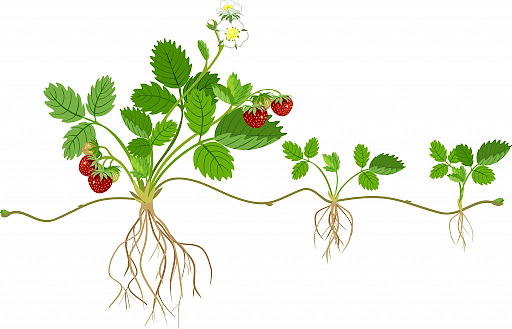
Runner – These are subaerial stem modifications where horizontal stems grow parallel to the ground. The stem has nodes which form buds and grow into new shoots. Example – Strawberry

Runner
Leaves: In many plants, adventitious buds grow along the leaf margins. When the buds fall on the ground they develop into new plants. Example – Bryophyllum, Begonia

Leaves
Artificial Methods of Vegetative Propagation
Some artificial methods are often used to produce new and unique plants.
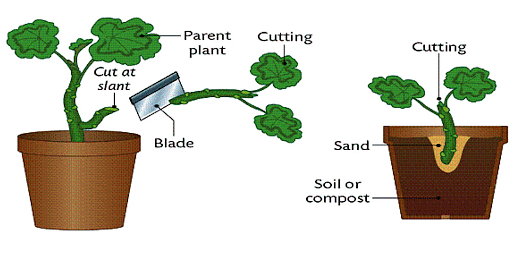
- Cutting – A healthy young branch of a plant having leaf buds is cut and planted in moist soil. The cutting grows roots and develops into a new plant. Example – Rose, Chrysanthemum
Cutting
- Layering – A branch of a plant is bent to touch the ground. It is layered with moist soil. Roots start developing from the covered plant. Then, the branch is cut off from the main plant. Example – Jasmine, Bougainvillea

Layering
- Grafting – Cutting of one plant (with buds) called the scion is kept over and tied with the cut stem of another part called the stock which is rooted in the soil. The tissues join together after sometime and form a new plant. Example – Mango, Rose, Citrus Plant

Grafting
Tissue Culture / Micropropagation
A small piece of tissue, called explant, is cut off from the growing tip of the plant and is grown under laboratory conditions. The cells divide rapidly to form a cell-mass called callus. Then, the callus divides and differentiates into different parts of the plant. This method is used to cultivate disease free, endangered and rare plant species. Example – Orchids

Tissue Culture / Micropropagation
Budding
In some plants, small outgrowths called buds develop on the body. The bud grows and then detaches from the parent plant and forms a new individual. Example – Yeast, Hydra

Budding in Hydra
Fragmentation
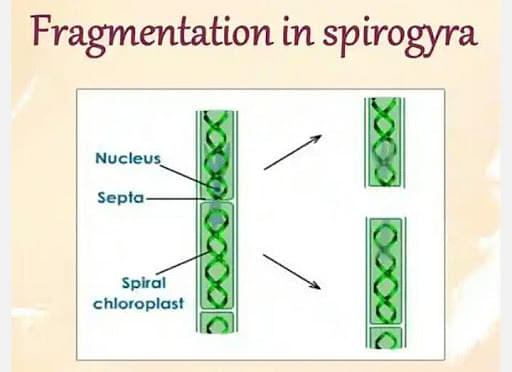
Some plants simply break into two or more fragments and each fragment grows into a new individual. Example – Spirogyra
Fragmentation
Spore formation
Plants like fungi reproduce by forming spores under unfavorable conditions. Spores are thick-walled, resistant asexual reproductive bodies. They germinate under favorable conditions and form new plants. Example – Bread mould, Mushroom

Spore Formation
Advantages of Asexual Reproduction in Plants
[Click Here for Sample Questions]
- The new plants produced are exact copies of the parent plant with no genetic variability. Such plants have better chances of survival.
- Less attention and care is required to the plants produced by asexual reproduction.
- A large number of new plants can be produced in a short period of time.
- Pollination and seed dispersal are not needed.
- Many seedless varieties of plants have been developed through this process. Example – Grapes, Banana and Pineapple.
Read More: Parts of a Seed
Sexual Reproduction in Plants
[Click Here for Sample Questions]
Sexual Reproduction involves two parents and formation of gametes. In plants, sexual reproduction occurs in angiosperms. Angiosperms are plants that produce flowers and bear their fruits in seeds. Their reproductive parts are present in the flower.
The flower has four parts – sepal, petal, stamen and carpel. Sepals and Petals are the non-reproductive parts whereas Stamens and Carpels are the reproductive parts of the plant.
Reproductive Parts of Flowers
[Click Here for Sample Questions]

Reproductive Parts of Flowers
Androecium
Androecium is the male reproductive part of the plant.
- It consists of Stamens which is the male reproductive organ.
- Each stamen is made up of a stalk or filament which supports an anther.
- The anther is a lobed structure. Most plants have bilobed anthers.
- Each anther lobe has two chambers called the pollen sacs. These pollen sacs produce the pollen grains or microspores.
- Pollen grains are yellowish powder like microscopic structures that carry the male reproductive cell of the plant.
- The male reproductive cell is also called the male germ-cell or the male gamete.
- A sterile stamen is known as a staminode.
Gynoecium
Gynoecium is the female reproductive part of a plant.
- It is made up of one or more Carpels (female reproductive organs). The carpel is present in the center of the flower.
- Each carpel consists of three parts– stigma, style and ovary.
- Ovary is the swollen and enlarged basal part of the carpel. Each ovary contains one or more ovules which bear the egg cell or the female reproductive cell.
- The egg cell is also called the female germ cell or the female gamete.
- A middle-elongated tube-like part called the style lies on the ovary. Style connects the ovary to the stigma.
- The terminal part at the tip of the style is the stigma. It receives the pollen grains during pollination and therefore it is sticky.

Structure of Stamen and carpel
Types of Flowers
Flowers can be categorized into two on the basis of presence or absence of the male and female reproductive parts –
Unisexual Flowers- Flowers which have only one reproductive part either stamen or carpel are called unisexual flowers. Example- Papaya and Watermelon
Bisexual flowers- The flowers which have both male and female reproductive parts (stamen and carpel) are called bisexual flowers. Example- Hibiscus and Mustard
Read More: Reproduction in organisms MCQs
Process of Sexual Reproduction in Plants
[Click Here for Sample Questions]
Pollination
For sexual reproduction in plants, male and female gametes need to fuse. This happens when the pollen grains reach the ovule. Pollination is the act of transferring the pollen grains from the male part (stamen) of the flower to the female part (carpel) of the same or another flower. Pollination is an important step for fertilization to take place. It can be of two types-
-
Self Pollination –
When the transfer of pollen grains takes place from the anther to the stigma of the same flower or another flower on the same plant, it is called self-pollination.

Self Pollination
-
Cross Pollination –
When the transfer of pollen grains from the anther of one flower to the stigma of another flower on another plant takes place, it is called cross-pollination.

Cross Pollination
Pollination can be done with the help of various agents like –
- Wind – In plants, where pollen grains are light, dry and are produced in large numbers, they get carried away by the wind and are deposited on sticky stigmas. Such flowers are inconspicuous and they do not produce nectar. Example – Maize, Wheat, Rice, etc.
- Water – In aquatic plants, pollen grains fall in water and reach the other flower by water currents. Example – Hydrilla, Coconut
- Insects – Brightly colored and nectar producing flowers attract insects like bees and butterflies. The pollen grains stick on the insects wings or feet and are transported to the stigma of another flower. Examples – Orchids, Sunflower, Pea.
- Birds – Hummingbirds, Sun birds, etc
- Reptiles – Garden lizards.
- Mammals – Squirrels, etc
Fertilization
The fusion of male and female gametes inside the ovary of the flower is called fertilization. The product formed after fertilization is called the zygote. Later, the zygote goes under a series of development and division to form the embryo which later grows into a new plant.
Steps of fertilization –
- When the pollen grains land on a suitable stigma, a tube grows out of one end of the pollen grain. It is called the pollen tube.
- The pollen tube travels down the style to reach the ovary where it enters the ovule through an opening called micropyle.
- This process is called the germination of pollen on the stigma.
- The pollen tube contains two male gametes which are deposited in the embryo sac of the ovule.
- In the embryo sac, one male gamete fuses with the female gamete or egg nucleus and forms a zygote.
- The other male gamete fuses with the nucleus of the central cell in the embryo sac to form the endosperm.

Pollen grain germination
Changes in Flower after Fertilization
- The fertilized ovum, i.e., the zygote, forms the embryo
- The ovules change into seeds
- The ovary grows into a fruit
- Other parts like sepals and petals fall-off (they might remain intact in some fruits)
- Seeds are dispersed and they give rise to new plants
Also Read:
| Chapter Related Topics | ||
|---|---|---|
| Pistil | Monocot dicot plants anatomy | Controlled Pollination |
| Sporulation | Pollen Grains | Oestrus Cycle |
| Budding | Fragmentation | Vegetative propagation in plants |
Things to Remember
- Reproduction in plants occur via two modes- asexual and sexual.
- Asexual mode of reproduction includes, vegetative propagation, budding, fragmentation and spore formation.
- Vegetative propagation occurs through vegetative parts of the plant. It can also be done by artificial methods.
- Sexual reproduction involves formation of gametes. In plants, the male gametes are pollen grains whereas the female gametes are eggs or ova.
- Pollination is achieved by the help of various agents like wind, water, insects etc. It can also be done artificially.
- Fusion of male and female gametes is called fertilization.
- After fertilization, zygote forms the embryo, ovule forms the seeds and ovary forms the fruit.
Important Questions
Ques: What is vegetative propagation? (All India 2009, 1 Mark)
Ans: Vegetative Propagation is the process in which new plants are formed from the vegetative parts of the plant. Vegetative propagation occurs through roots, stems, leaves or buds.
Ques: List two advantages of vegetative reproduction practised in case of an orange plant. (All India 2012, 1 Mark)
Ans: Two advantages of practising vegetative reproduction in orange plants are:
(i) The oranges produced will be similar in size and shape.
(ii) Many oranges do not produce viable seeds. So, vegetative methods can be considered as a good alternative.
Ques: Name an organism which reproduces by spore formation. List three conditions favourable for spores to germinate and grow. (All India 2012, 1 Mark)
Ans: Rhizopus are reproduced by spore formation. Three conditions favourable for spores to germinate and grow are:
(i)Cool place
(ii) Moist place
(iii) Dark place.
Ques: What is a fruit? (All India 2013, 1 Mark)
Ans: A Fruit is the ripened ovary of a flower. It is the seed-bearing structure of the flowering plant. The fruit has a fruit wall called pericarp and it may be fleshy, juicy, dry, stony or hard.
Ques: State the method used for growing rose plants. (All India 2013, 1 Mark)
Ans: Artificial vegetative propagation methods like cutting are used to grow rose plants.
Ques: List any four reasons for vegetative propagation being practised in the growth of some type of plants. (All India 2010, 2 Marks)
Ans: (i) Vegetative propagation is cheaper and easier to propagate a plant.
(ii) A good quality of plants are produced by this method.
(iii) The plants produced by vegitative propagation don't produce viable seeds or produce seeds with prolonged periods of dormancy.
(iv) The plants produced from vegetative propagation methods are more uniform and genetically similar to the parent plant.
Ques: List two advantages of practising vegetative propagation in plants. Select two plants raised by this method from the list given below:
Banana, Gram, Pea, Rose, Tomato, Wheat. (All India 2012, 2 Marks)
Ans: Two advantages of vegetative propagation are:
- The plants produced can bear fruits and flowers earlier.
- Plants produced are genetically similar to the parent plant.
Bananas and roses can be raised by vegetative propagation methods.
Ques: What are the advantages of vegetative propagation? (All India 2013, 2 Marks)
Ans: Vegetative propagation has multiple advantages –
- Rapid multiplication
- Genetically identical offspring
- Easy to grow
- Multiplication without seed formation
Ques: What is the role of non-reproductive parts of a flower? (All India 2014, 2 Marks)
Ans: Sepals and Petals are the non-reproductive parts of a flower. They do not take part in reproduction but they are important for the process of pollination. They attract insects and animals for pollination.
In some plants, sepals and petals also remain attached to the fruit after pollination.
Ques: What are the differences between insect pollinated and wind pollinated flowers? (All India 2014, 3 Marks)
Ans: The difference between insect pollinated and wind pollinated flowers are-
| Insect Pollinated Flowers | Wild Pollinated Flowers |
|---|---|
| Large, conspicuous and brightly colored | Inconspicuous and often white in color |
| They produce scent or nectar to attract insects | They do not have scent or nectar |
| Large, sticky and rough pollen grains, produced in small quantity | Small, dry and light pollen grains, produced in large quantities |
| Sticky, knob-like stigma | Large, feathery stigma |
| Well-developed and large sepals and petals | Reduced sepals and petals to expose androecium and gynoecium |
Ques: Differentiate between ‘self-pollination’ and ‘cross-pollination’. Describe double fertilisation in plants. (All India 2010, 5 Marks)
Ans: Difference between self-pollination and cross-pollination:
| Self-Pollination | Cross-Pollination |
|---|---|
| In self- pollination, pollen grains are transferred from the anther to the stigma of the same flower. | In cross-pollination, pollen grains are transferred from the anther to the stigma of a different flower. |
| It occurs in genetically identical flowers. | It occurs in genetically different flowers. |
| Increases genetic uniformity and decreases genetic variation. | Decreases genetic uniformity and increases genetic variation. |
| Causes inbreeding. | Causes outbreeding. |
| Produces and transfers limited amounts of pollen grains. | Produces and transfers large amounts of pollen grains. |
| Both the stigma and anther simultaneously mature | Stigma and anther mature at different times. |
| This process can be carried out even when the flowers are closed. | The flower should be open for cross pollination. |
| No need for pollinators to transfer pollen grains. | Require pollinators to transfer pollen grains. |
The following events take place during fertilisation in plants:
(i) One of the male gametes fuses with the female gamete which is present in the embryo sac.
(ii) The other male gamete fuses with the two polar nuclei.
(iii)The fusion of male and female gamete produces the zygote while the fusion of male gamete and two polar nuclei produces the endosperm.
This process of two fusions in the embryo sac is called double fertilisation.
Ques: Draw a longitudinal section of a flower and label the following parts:
(i) Part that produces pollen grain.
(ii)Part that transfers male gametes to the female gametes.
(iii) Part that is sticky to trap the pollen grain.
(iv) Part that develops into a fruit. (All India 2010, 5 Marks)
Ans: Longitudinal section of a flower-

Ques: With the help of suitable diagrams, explain the various steps of budding in Hydra. (All India 2011, 5 Marks)
Ans: The steps of budding in Hydra are-
- Hydra uses regenerative cells for the process of budding.
- Due to repeated cell division at one specific site, a bud develops as an outgrowth in Hydra.
- After the bud gets fully matured, it detaches itself from the parent body and develops as a new independent individual.

Ques: (a) What is spore formation?
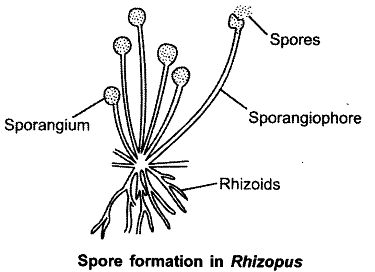
(b) Draw a diagram showing spore formation in Rhizopus.
(c) List two advantages for organisms to reproduce themselves through spores. (All India 2011, 5 Marks)
Ans: (a) Plants like fungi reproduce by forming spores under unfavorable conditions. Spores are thick-walled, resistant asexual reproductive bodies. They germinate under favorable conditions and form new plants.
(b) The Rhizopus contains a thread like projections called hyphae. The hyphae has a knob-like structure called sporangium. It is responsible for the reproduction as it contains spores that develop into new Rhizopus.
(c) Two advantages for organisms to reproduce themselves through spores are as follows:
(i) Spore formation is the fastest mode of reproduction.
(ii) Offsprings produced in spore formation are identical.
Also Read:



Comments