



Education Journalist | Study Abroad Lead
Asexual Reproduction is the mode of reproduction in plants that do not involve the fusion of male and female gametes. Individuals that are genetically identical to the parent are produced in the asexual mode of reproduction. In Asexual reproduction, no mating of male and female takes place, only one parent is needed in this type of reproduction. Some parts of the parent plant are cut or nurtured to produce offspring from it. Asexual reproduction occurs in a number of ways such as Budding, Grafting, Fragmentation, Spore Formation, etc. Some of the plants that undergo asexual reproduction are Potato, Garlic, Strawberry, Ginger, Tulip, Rubber etc.
| Table of Content |
Key Terms: Asexual Reproduction, Sexual Reproduction, Gametes, Identical Offsprings, Grafting, Budding, Fragmentation, Vegetative Propagation, Spore Formation
What is Asexual Reproduction?
[Click Here for Sample Questions]
Asexual reproduction is the process of reproduction in plants where no sexual interaction or fusion of male and female gametes is involved. The new offspring is produced by other means where either naturally or artificially some parts of the plant itself turn into new plants under certain conditions. The offspring produced are as genetically identical to the parent plant as in the case of sexual reproduction. This process requires no intermediate agents like butterflies to carry the nectar and so on.
Types of Asexual Reproduction
[Click Here for Sample Questions]
Asexual Reproduction in plants occur in two ways namely Natural and Artificial.
Natural Methods of Asexual Reproduction
[Click Here for Sample Questions]
Plants undergo asexual reproduction by natural methods using self-propagation where they grow from the body of the parent plant. The different ways of self-propagation by the plant are mentioned below:
- Plants such as ginger, potato, dahlia, onions, turmeric and many others grow from buds on the stems of the parent plant. These buds grow into small plants on the parent plant itself under suitable conditions.
- In plants such as sweet potatoes, roots develop on the stems. These roots then fix themselves in the soil to become a new plant.
- In plants such as Bryophyllum small buds develop on the sides of the leaves. These buds after growing to a certain extent detach themselves to grow into a new plant.
Read More: Plant Physiology
Budding
Budding is one of the natural methods of asexual reproduction by plants. Here, plants develop an outgrowth or extra part known as buds. Even without much care and nourishment, these buds develop into new plants. After growing to a certain extent, the mini plants from buds are detached and replanted as separate plants. The most common example is a potato that develops multiple buds also known as its eyes if left for a few days or weeks.
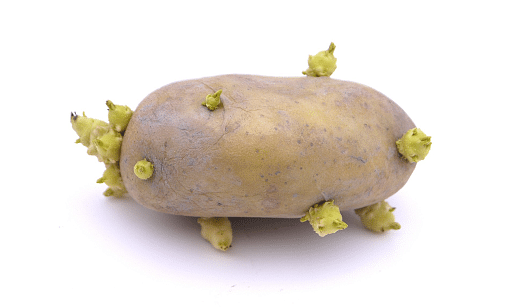
Budding in Potato
Vegetative Propagation
In this method new plants develop from specific parts of the plant such as roots, stems, leaves etc. Sometimes the new plant naturally develops from these parts of the plant or these parts are cut and then replanted where they grow into new plants. The offspring from vegetative propagation develop fruits and flowers faster than those with seeds. Division on the basis of plants grown from distinct parts of the plants:
-
Stems: Here, the stems grow almost horizontal to the ground. New shoots develop from the stems and are then fixed in the soil by developing roots at some distance away from the parent plant. The shoot then grows into a new plant and detaches itself from the parent stock.
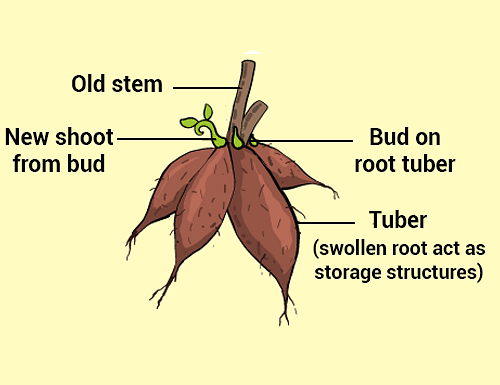
Vegetative Propagation through Stem
- Roots: Here, new plants grow from modified roots known as tubers. In many plants, roots themselves come out from the stems that eventually become new plants.
- Leaves: In this process, buds develop on the surface of the leaf or sometimes on the margin of the leaves. These leaves are then detached to become new plants as the buds develop roots and stems. Bryophyllum exhibit vegetative propagation using leaves.

Vegetative Propagation in Bryophyllum
Read More: Basic Internal Anatomy of Leaf
Fragmentation
Fragmentation is half understood from the name itself that it will result in fragments of the parent plant. In this process, some parts of the parent plant fall on the ground and begin growing as a new plant. This method is extensively used by nurseries to multiply the production without waiting for seeds.
One such example is algae, which multiply their presence in ponds and water bodies on gaining sufficient nutrients from the water.
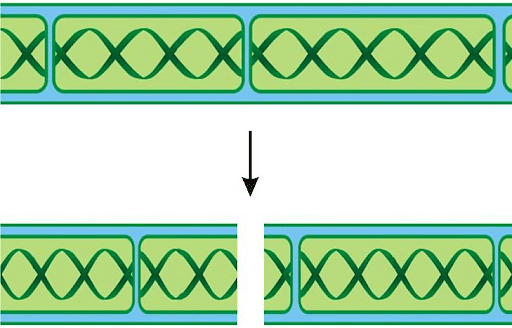
Fragmentation
Spore Formation
Spore formation mostly occurs in non-flowering plants that do not bear any flowers or fruit. It then develops minute particles known as spores that are protected by a hardcover to sustain the extreme temperatures. When favourable situations occur these spores burst and fall on the ground and grow as individual plants. Spore formation is more common in ferns, mosses, liverworts etc.

Spore Formation
Read More: Sexual Reproduction in Flowering Plants
Artificial Methods of Asexual Reproduction
[Click Here for Sample Questions]
The artificial methods of asexual reproduction are elaborated below:
Cutting
Here, a part of the plant bearing nodes and internodes is cut and planted separately as another plant. Regular water is to be given to the cut portion. Mostly it is the stem or modified roots known as tubers that are replanted.
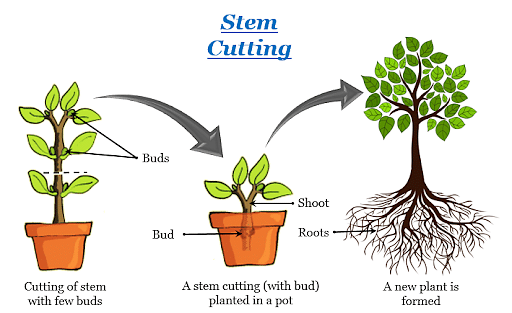
Cutting
Grafting
This is the technique that gives hybrid plants bearing hybrid fruits and flowers. Here, stems from two separate plants are cut and then joined. This joined stem is then planted, which grows to become a new plant. The new plant thus has characteristics combining both the parent plants. One of the two stems is known as a stock which contains the root while the other stem is known as a scion. Stock and scion are joined and stitched with a cloth or tape that keeps them together.
The joint stem must be protected from infections so cover it. After a few days or weeks, the scion stock develops roots, stems, and leaves.

Grafting
Read More: Modifications of Stem
Layering
In this process, the shoots or branches of a plant are lowered and buried in the soil with leaves above the ground. To keep the branch erect it is supported by a piece of wood. This new shoot in a matter of days of watering develops its own root system. The shoot is then detached from the mother plant.

Layering
Read More: Reproduction in Plants
Things To Remember
- Asexual reproduction is a mode of reproduction that involves only one parent only. No fusion of gametes happens in this mode of reproduction.
- In Asexual reproduction, there is no involvement of seeds, flowers, nectar, insects etc.
- The plants and their parts are used in various techniques to grow a new plant with identical genes to the parent plant.
- Asexual Reproduction is always not natural but also artificially done to get desired results.
- For getting hybrid varieties and mixing, asexual reproduction is the most convenient method than buying hybrid seeds. Plants like hibiscus, mango, and rubber plant all undergo hybridization using asexual reproduction.
Sample Questions
Ques. How does progeny formed from asexual reproduction differ from those formed by sexual reproduction? (3 Marks)
Ans. The progeny formed by asexual reproduction is identical to the parent plant as it involves only a single plant. On the other hand, progeny formed by sexual reproduction involves the fusion of male and female gametes which result in unique genes. And the plants formed to inhibit the characteristics of both the parent plant.
Ques. Difference between Sexual Reproduction and Asexual Reproduction. (3 Marks)
Ans. The difference between Sexual Reproduction and Asexual Reproduction is as follows:
| Sexual Reproduction | Asexual Reproduction |
|---|---|
| The fusion of male and female gametes takes place in this kind of reproduction. | No such fusion between male and female gamete occurs; only a single plant is enough. |
| The plants thus formed are unique genetically despite having matching characteristics of both the parent plant. | The plants thus formed have genes identical to the parent plant and inhibit all its characteristics. |
| It is quite a slow process. | It is much faster as compared to sexual reproduction. |
| Intermediaries like insects, wind, or animals are needed to transfer the pollen grains. | Here, no such intermediary is needed as everything happens within the parent plant. |
Ques. What makes Bryophyllum different from other artificial plants that exhibit asexual reproduction? Give a few commonly known bryophyllum. (3 Marks)
Ans. Usually most of the plants that exhibit asexual production either grow from stems, modified roots, shoots or outgrowth on their body. But Bryophyllum undergoes asexual reproduction through leaves. On the marginal sides of leaves bryophyllum develop buds. These buds grow to develop their own root systems, stems and shoots. Hence, the leaf is detached from the parent plant and grown as a separate plant.
Some common bryophyllum are the Air plant, Begonia, Mexican Hat Plant, etc.
Ques. Why are offsprings produced from Asexual Reproduction known as clones? (3 Marks)
Ans. Offsprings produced from Asexual Reproduction are known as clones because they are morphologically and genetically cent per cent identical to the parent plant. Thus, they also exhibit characteristics and features exactly the same as the parent plant without any uniqueness of their own.
Ques. What is Vegetative Propagation? (3 Marks)
Ans. In this method, new plants develop from specific parts of the plant such as roots, stems, leaves etc. Sometimes the new plant naturally develops from these parts of the plant or these parts are cut and then replanted where they grow into new plants. The offspring from vegetative propagation develop fruits and flowers faster than those with seeds.
Vegetative Propagation can occur from any of the vegetative parts i.e., stems, roots and leaves and plants are divided on this basis. For example, Bryophyllum undergoes vegetative propagation from leaves, sweet potato from roots and Strawberries from stems.
Ques. Explain the process of grafting with an example. (3 Marks)
Ans. Grafting is a process where stems from two separate plants are cut and then joined. This joined stem is then planted, which grows to become a new plant. The new plant thus has characteristics combining both the parent plants. One of the two stems is known as a stock which contains the root while the other stem is known as a scion.
Stock and scion are joined and stitched with a cloth or tape that keeps them together. The joint stem must be protected from infections so cover it. After a few days or weeks, the scion stock develops roots, stems, and leaves. Plants like mango, rubber, and hibiscus are grafted to get new varieties.
Ques. Explain why potato tubers are considered to be a stem? (3 Marks)
Ans. Even though a potato tuber is an underground part and is buried under the soil, it is considered to be a stem because it has nodes and internodes. The buds present over these nodes can develop into individual plants that grow their own roots, shoots, stems and leaves.
Ques. Why do some plants develop spores? (3 Marks)
Ans. Plants like sporangia develop spores to develop their offspring. Usually, spores are formed by plants that grow in extreme conditions where survival by usual methods is not possible. Such plants are devoid of any fruits or flowers that may help in sexual reproduction. When suitable conditions are found, the spores burst and get buried in the soil. To protect the spores from damage, they are covered with a hard layer.
For Latest Updates on Upcoming Board Exams, Click Here:https://t.me/class_10_12_board_updates
Check-Out:



Comments