



Content Writer
Nucleic Acids are macromolecules that store genetic information in them.. It is made of nucleotides like 5-carbon sugar, a phosphate group and a nitrogenous base. All these are monomer components.
- Nucleic Acids carry information within cells using the biomolecules in the chromosomes of the DNA.
- It was discovered by Friedrich Miescher in 1869.
- These are long-chain polymeric molecules.
- It is also known as nucleotides.
- The two main types of nucleic acids include deoxyribonucleic acid (DNA) and ribonucleic acid (RNA).
- They can create, encode, and store information in all living cells.
- Nucleic acids are responsible for the transmission of characteristics from one generation to another.
Key Terms: Nucleic Acid, Acid, Nucleotides, Polymeric Molecules, Chromosomes, DNA, RNA, Gene, Cell, Nucleotides, Monomer, Phosphate Group
What are Nucleic Acids?
[Click Here for Sample Questions]
Nucleic Acids are biomolecules that are made up of monomers, which are called nucleotides. It is a naturally occurring chemical compound. The nuclei acid is broken down to produce other organic bases.
- The cells of these acids decide what specific trait is going to be inherited by a descendant.
- Nucleic acids express and send information inside and outside the nucleus.
- It provides a ladders-step order of nucleotides within their molecules.
- The acid can be generated within the laboratory with the help of enzymes.
- Nucleic Acids is the foundation for genome and forensic science.
Read More:
Types of Nucleic Acids
[Click Here for Sample Questions]
There are two types of Nucleic Acids namely Deoxyribonucleic acid (DNA) and ribonucleic acid (RNA).
Deoxyribonucleic acid (DNA)
Deoxyribonucleic acid is a type of nucleic acid that is composed of two polynucleotide chains of acids. The polynucleotides are arranged in such a way that they form a helix-like structure.
- It carries genetic information for the development, growth and reproduction of organisms.
- It consists of four nitrogen-containing nucleobases, namely cytosine, guanine, adenine and thymine.
- Deoxyribonucleic acid also consists of a phosphate group.
- It exists in the form of a single strand.
Read More: Atoms and Molecules
Ribonucleic acid (RNA)
Ribonucleic acid is a type of acid that works as a type of non-coding RNA. It is also responsible for forming a template for the production of proteins. Ribonucleic acid consists of four nitrogen-containing nucleobases, namely cytosine, guanine, adenine and uracil.
- Ribonucleic acid has a hydroxyl group at the second position of ribosome sugar.
- It helps in sensing and communicating responses to required cellular signals.
- RNA is divided into three categories, namely m-RNA, t-RNA and r-RNA
- Organisms use messenger-RNA (mRNA) to transfer genetic information.
- The transfer-RNA (t-RNA) is responsible for delivering amino acids to the ribosome.
- Ribosomal-RNA (r-RNA) link amino acid to required proteins.
Chemical Composition of Nucleic Acid
[Click Here for Sample Questions]
The chemical composition of nucleic acid is as follows:
- When the Deoxyribonucleic acid (DNA) or the ribonucleic acid (RNA) is broken down into units.
- The cell produces certain protein compounds base.
- Specifically, the produced bases are phosphoric acid, pentose sugar and heterocyclic compounds.
- The DNA cell has a sugar moiety, which is called β-D-2-deoxyribose.
- RNA cell has β-D-ribose.
The chemical composition of DNA and RNA are as below.
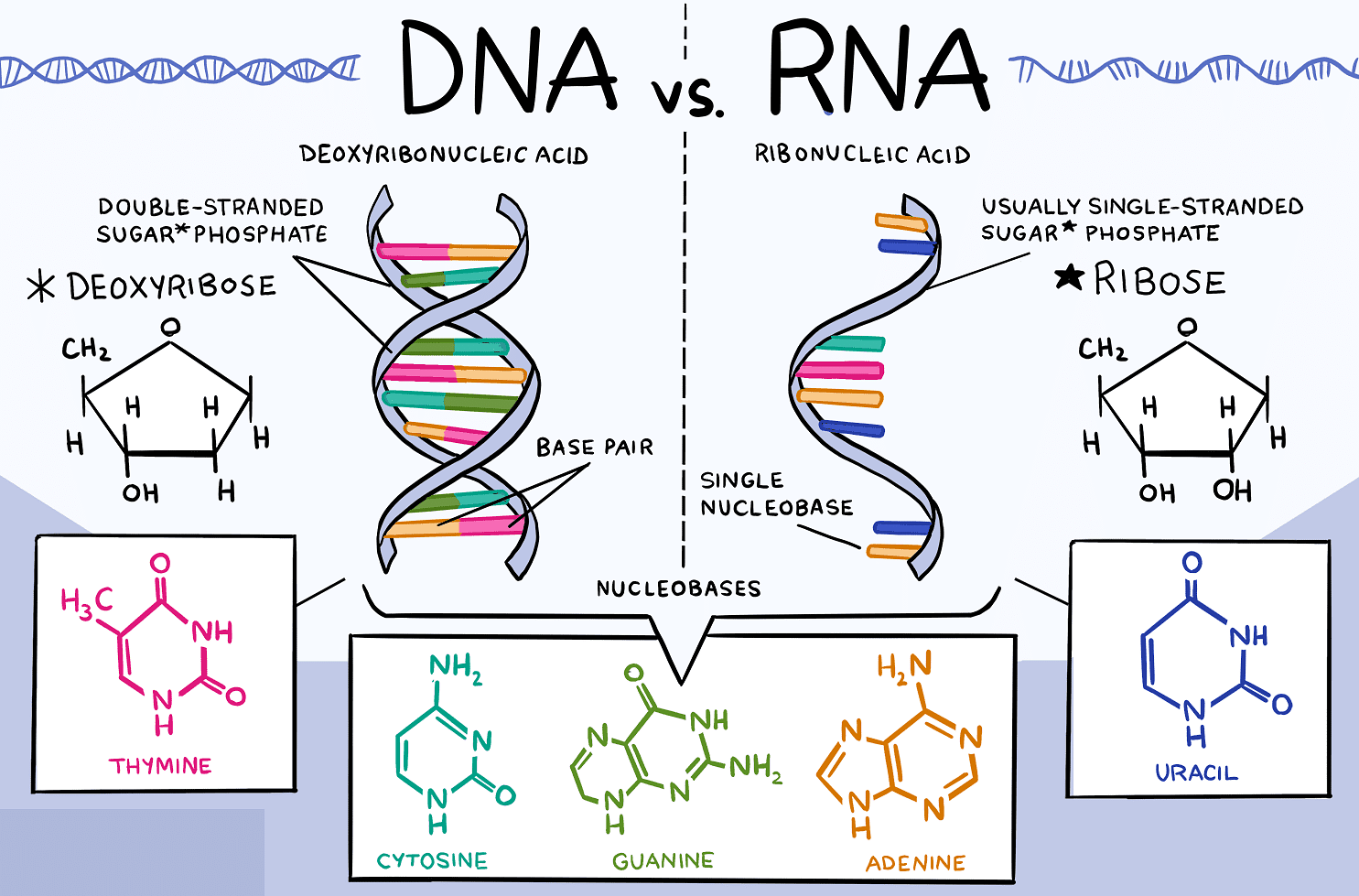
Chemical composition of Nuclei Acid
Functions of Nucleic Acids
[Click Here for Sample Questions]
The function of nucleic acids are as follows:
DNA and genetic information
Tests conducted on the strands of DNA have revealed that they are the carriers of genetic information in human beings. In simple words, they preserve the traits and identity of people through the generations.
- DNA cell replicates and multiplies itself into identical cells called daughter cells.
- While the DNA cell acts as a template, the daughter cell copies it into a new double-strand DNA cell.
RNA and hereditary information
Nucleic acids also perform an important function, like the synthesis of protein, which is done by the RNA cells. The process of synthesising protein is called transcription and translation. Together, it is known as gene expression.
- They act as the vehicle to carry DNA information from the DNA to the machine that synthesis protein.
- The transcription is done by the messenger RNA or mRNA.
- mRNA will come across ribosomes to continue the process of protein synthesis, which is called translation.
Read More: Chromosomes and genes
Diseases due to DNA damage
The presence of DNA in human beings is responsible for the transfer of genetic material to future generations. Experts have found that loss of DNA due to any reason leads to diseases in human beings.
- Importantly, DNAs have their own repair mechanisms to repair any damage.
- When the repair mechanism is not working, the DNA is damaged.
- Diseases here can range from mental retardation to cancer.
- Other diseases that have been observed are sunlight sensitivity and bone marrow deficiency.
Nucleotides have chemical energy in cells.
Adenosine triphosphate, or ATP, is another type of nucleic acid. It is the chemical store for cells. ATP has three phosphate groups attached to a ribose sugar. This acts as a battery for living beings.
- When food is consumed, the carbohydrates, protein and lipids get broken down into individual monomers.
- Further, the monomers get broken down into finer units.
- The chemical energy released from such action is stored in the ATP.
DNA Fingerprinting
DNA also helps with DNA fingerprinting. Fingerprint, as it is widely known, is unique to every human being. Similarly, the presence of bases at the end of DNA is unique to human beings, like the fingerprints of our hands. This is used to conduct DNA fingerprinting.
- While fingerprints can be altered with surgery.
- DNA fingerprinting cannot be changed.
- It is mainly used in forensic cases or to establish paternity.
Things To Remember
- Nucleic Acids, in simple terms, are the molecules that store genetic information in them.
- The main purpose of these acids is to carry information within cells using the biomolecules in the chromosomes of the DNA.
- It is used to send coded information to genes.
- Nucleic Acids are biomolecules that are made up of monomers, which are called nucleotides.
- It is a chemical compound that is broken down to produce other organic bases.
- There are two types of Nucleic Acids: Deoxyribonucleic acid (DNA) and ribonucleic acid (RNA).
- DNA cell replicates and multiplies itself into identical cells called daughter cells.
Read More:
Read More: Cathode Ray Discharge Tubes
Sample Questions
Ques: Define the following term: Nucleotide. (2 marks)
Ans: Nucleotide is a compound that is made up of a phosphate group, a pentose sugar and a nitrogen-containing base. RNA and DNA, mentioned above, are polymers that are made up of Nucleotides. Nucleic Acids are the polymers of nucleotides. It is composed of three subunits, namely a nucleobase, a five-carbon sugar, which is composed of ribose or deoxyribose, and a phosphate group consisting of one to three phosphates.
Ques: Name the base found in the nucleotide of RNA only. (2 marks)
Ans: Ribonucleic acid is a type of acid that has a hydroxyl group at the second position of ribosome sugar. It helps in sensing and communicating responses to required cellular signals. The base found only in the nucleotide of RNA is uracil, cytosine, guanine and adenine
Ques: State clearly what are known as nucleosides and nucleotides. (3 marks)
Ans: A nucleoside is a subunit of DNA and RNA. It has two parts: pentose sugar and nitrogenous sugar. When they are formed, one position of pyrimidine or the nine positions of the purine moiety links up with the C1 of the ribose by a β-linkage.

A nucleotide is similar to a nucleoside, a component of DNA and RNA. One difference is that it has a sugar attached to a phosphate group and also a nitrogen base. Nucleotide forms through the esterification of C5‘ – OH of the sugar of the nucleoside with phosphoric acid.

Ques: Name the bases present in RNA. Which one of these is not present in DNA. (3 marks)
Ans: Ribonucleic acid, also known as RNA, is made of phosphate acid, a pentose sugar and cycli group of nitrogen bases. It consists of single strands of RNA molecules that form double helix-like structures. RNA has the following bases:
- Purine – Adenine (A) and Guanine (G)
- Pyrimidines – Uracil (U) and Cytosine (C)
DNA does not have the Uracil base.
Ques: Write the main differences between DNA and RNA. Of the four bases, name those which are common to both DNA and RNA. (5 marks)
Ans: The main differences between DNA and RNA are as follows:
| DNA | RNA |
|---|---|
| DNA is made up of a double-strand α-helix structure. | RNA is a single strand α-helix structure |
| DNA has cytosine and thymine bases. | RNA has cytosine and uracil bases |
| The sugar in DNA is a 2-deoxy-(-)ribose. | Sugar in RNA is D-(-) ribose. |
There are bases that are common to DNA and RNA. They are as below.
- Adenine
- Guanine
- Cytosine
Ques: What are the different types of RNA found in cells of organisms? State the function of each type. (3 marks)
Ans: There are three types of RNA found in living organisms. The function of each type of RNA are as follows:
- Messenger RNA (mRNA): mRNA carries messages or information for the DNA during the protein synthesis process.
- Ribosomal RNA (rRNA): rRNA is the place where protein synthesis takes place.
- Transfer RNA (tRNA): tRNA helps in the transfer of amino acids to the rRNA or the side of the protein synthesis.
Ques: Name the base that is found in the nucleotide of RNA only and what is the linkage present in Nucleic Acids. (2 marks)
Ans: Nucleic Acids is a type of the acids that is used to carry information within cells using the biomolecules in the chromosomes of the DNA.It has phosphodiester linkage that is found in the nucleotide of RNA. The linkage present in the nucleic acid conists of uracil.
Ques: Explain the chemical composition of DNA and RNA. (3 marks)
Ans: The chemical composition of DNA and RNA are as follows:
- The process starts when the deoxyribonucleic acid (DNA) or the ribonucleic acid (RNA) is broken down it produces protein compounds.
- It will produce bases like phosphoric acid, a pentose sugar and heterocyclic compounds.
- It conisits of nitrogeous compounds.
- The DNA cell has β-D-2-deoxyribose.
- On the other hand, the RNA cell has β-D-ribose.
Ques: Name the four bases present in DNA. Which one of these is not present in RNA. (2 marks)
Ans: The four bases found in the DNA are as follows:
- Adenine
- Guanine
- Cytosine
- Thymine
The base which is not found in RNA includes the thymine base.
Ques: What are the functions of Nucleic Acid. (4 marks)
Ans: The function of nucleic acids are as follows:
- DNA and genetic information: Tests conducted on the strands of DNA have revealed that they are the carriers of genetic information in human beings. In simple words, they preserve the traits and identity of people through the generations.
- RNA and hereditary information: Nucleic acids also perform an important function, like the synthesis of protein, which is done by the RNA cells. The process of synthesising protein is called transcription and translation. Together, it is known as gene expression.
- Diseases due to DNA damage: The presence of DNA in human beings is responsible for the transfer of genetic material to future generations. Experts have found that loss of DNA due to any reason leads to diseases in human beings.
- Nucleotides have chemical energy in cells.: Adenosine triphosphate, or ATP, is another type of nucleic acid. It is the chemical store for cells. ATP has three phosphate groups attached to a ribose sugar. This acts as a battery for living beings.
Ques. What is the difference between transcription and translation. (4 marks)
Ans. The difference between transcription and translation are as follows:
| Transcription | Translation |
|---|---|
| Transcription is the first step of gene expression. | Translation is the second step of gene expression. |
| It uses RNA enzymes to produce copies of RNA from DNA. | It uses ribosomes to synthesis of RNA proteins. |
| In this only mRNA is involved. | In this m-RNA, t-RNA and r-RNA are involved. |
| Transcription take place in the nucleus of cell. | Translation take place in the cytoplasm. |
For Latest Updates on Upcoming Board Exams, Click Here: https://t.me/class_10_12_board_updates
Check-Out:



Comments