



Exams Prep Master
Magnesium chloride is a chemical compound formed by the combination of magnesium ions and chloride ions. It is a salt compound. It is formed by the element present in the group of halides. It is a compound which is highly soluble in water. This compound is mostly found in the seas and oceans or in the coastal areas. It is an inorganic compound. It is found in the seas but not in the pure form. Refining must be done to extract pure magnesium chloride. The formula of magnesium chloride is MgCl2. It has more uses in the industries and medical factories.
Read More: How to find Atomic Mass?
| Table of Content |
Key takeaways: ionic compound, inorganic compound, magnesium, chlorine, lime, halides, salts.
Valency of an Element
[Click Here for Sample Questions]
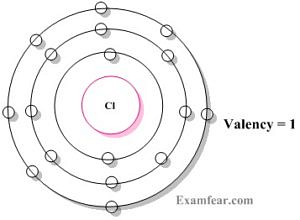
We have elements in our surroundings. Every element is having its own configuration. Every element distinct in number of electrons and protons. The elements are arranged in a certain format in different orbits. The last orbit is called as valency orbit. The number of electrons present in the valency shell is called valency electrons or valency of that particular element. All the properties and capability of the element is dependent on valency.
Ionic Compounds
[Click Here for Sample Questions]
The elements in the 8th group are called stable elements. All the elements having the configuration similar to the 8th group elements are also stable. Other elements are not that stable. Due their instability they try to attain stability by obtaining the 8th group elements configuration. This is done only by losing the electrons or by gaining the electrons. The element which loses or gain the electron is called as the ion. The ions are very effective in reacting with other elements. Thus, they try to react with other ions and results in a stable compound. The ions with negative charge are called anion and the ions with the positive charge is called cation. Anions are formed by gaining the electrons and cations are formed by losing the electrons. The compounds formed by the reaction of ions is called ionic compounds. These are highly stable.
Examples: Na+ is a cation formed by losing the electron.
Cl- is an anion formed by gaining the electron.
Na+ + Cl- à NaCl (ionic compound)
Read More: Isotopes and Isobars
Structure of Magnesium Chloride
[Click Here for Sample Questions]

Formation of Magnesium Chloride
[Click Here for Sample Questions]
- Magnesium i.e, Mg is having the valency electrons of 2. So, it has to lose the 2 electrons. After losing 2 electrons this forms a cation Mg+2.
- Chloride i.e, Cl is having the valency electrons of 7. So, it has to gain the 1 electron. After gaining 1 electron this forms a anion Cl-1.
- So, this results in combination of the 1 Mg+2 cation and 2 Cl- anions.
- It produces MgCl2 compound.
The formula of the magnesium chloride can be written by using the following steps:
- Write each and every element symbol.
- Find the configuration and valency of the elements.
- Check whether the charges are balanced or not.
- Add subscripts to the elements if necessary, so the charge for the entire compound becomes zero.
- Do the crisscross method and check whether it is done right or wrong.
Read More: Find Atomic Mass
Properties of Magnesium Chloride
[Click Here for Sample Questions]
- Molecular weight or the molar mass of the MgCl2 compound is 95.11 g/mol.
- Density of the magnesium chloride is 32 g/cm3.
- The boiling point of magnesium chloride is 1,412 degree celcius.
- The melting point of magnesium chloride is 714 degree celcius.
- It is very soluble in water and ethanol.
- The refractive index of magnesium chloride is 1.675, 1.59.
Occurrence of Magnesium Chloride
[Click Here for Sample Questions]
- It is mostly found in the sea water. It is available in the form salts.
- Magnesium forms around 3.7 percent of the total seawater mineral content.
- Dead sea minerals consist of 50.8 percent of MgCl2.
Read More: Carbon and Its Compound
Applications of Magnesium Chloride
[Click Here for Sample Questions]
- It is used in the wind erosion mitigation and dust control.
- These are used as the catalysts in producing polyolefins.
- It is used as a important industrial compound.
- It is used in the production of magnesium, textile, paper manufacture, cements, refrigerators, fireproofing etc.
Things to Remember
[Click Here for Sample Questions]
- Magnesium chloride is a salt compound found in seas and oceans.
- Magnesium chloride is formed by the ions.
- Magnesium chloride is a inorganic compound.
- One magnesium ion is combined with the two chloride ions.
- It is a compound have high industrial uses.
Read More: Aufbau Principle
Sample Questions
Ques: Write some good and bad forms of magnesium? (3 marks)
Ans: good forms:
- Magnesium citrate
- Magnesium palate
- Magnesium chloride
- Magnesium carbonate.
Bad forms:
- Magnesium oxide
- Magnesium sulfate
Ques: Write about ionic compounds and give an example of it? (2 marks)
Ans: An ionic compound is a chemical compound that is formed by the combination of the cations and anions that is ions. These can be metals and non metals.
ionic compounds are hard and brittle.
They have high melting and boiling points.
Example of ionic compound: MgCl2.
Mg+2 + 2Cl- à MgCl2
Ques: Uses of magnesium chloride? (2 marks)
Ans: it is useful in the preparation various drugs. It is used to cure the deficiency of magnesium in the human body. It is used in the medical purposes, mainly in the acidity, heartburn and indigestion.
Ques: Does MgCl2 undergo hydrolysis? (4 marks)
Ans: The hydrolysis of pure liquid MgCl2 and of the liquid NaCl-MgCl2 (X-MgCl2 approximate to 0.62) mixture have been investigated at 730 and 675 degrees C. he equilibrium constant for the reaction MgCl2(1) + H2O(g) = MgOHCl(1) + HCl(g), K' = X-MgOHClPHCl/a(MgCl2PH2O), was determined by linear regression. It was found that in pure MgCl, K' = 0.67 +/- 0.07, while in the NaCl-MgCl2 mixture K' = 0.35 +/- 0.04. K' was constant in the temperature range 675 < T/degrees C < 730.
Ques: Where the different forms of MgCl2 available? (2 marks)
Ans: magnesium chloride is found in different forms in different places and at different parts of the world. Some of them are:
Sea water, Dead sea minerals, corals, coralline algae, clams, mangroves.
Ques: Write some compounds formed by magnesium and chloride? (2 marks)
Ans: Compounds formed by the magnesium:
Magnesium fluoride
Magnesium bromide
Magnesium iodide
compounds formed by the chloride:
beryllium chloride
calcium chloride
strontium chloride
barium chloride
radium chloride
Ques: Explain how magnesium chloride is used in dust and erosion control? (2 marks)
Ans: Magnesium chloride is the one of major substances used in controlling dust, stabilization of soil and wind erosion mitigation. When magnesium chloride is applied to roads and bare soil areas, both positive and negative performance issues occur which are related to many application factors.
Ques: Explain the laboratory preparation of MgCl2? (2 marks)
Ans: Measure the amount of dilute hydrochloric acid and magnesium ribbon according to ratio (2:1). Drop the magnesium strip into the hydrochloric acid.
- the overall reaction is Mg(s) + 2HCl(aq) à MgCl2(aq) + H2(g)
- the only product left in solution is MgCl2
- the H2 that is hydrogen gas will escape in to the atmosphere.
Ques: Write the chemical properties of Magnesium? (5 marks)
Ans:
- It burns in air with a bright white light.
- Upon heating, magnesium reacts with halogens.
- Magnesium alloys are light, but it is very strong.
- It combines with oxygen at room temperature to form a thin skin of magnesium oxide.
- The different compounds are oxides, hydroxides, chlorides, carbonates, sulphates.
Ques: Write the physical properties of magnesium? (4 marks)
Ans: It has a silvery-white colour.
It is found in the form of solid.
It is having the hexagonal crystalline structure.
It can be beaten into extremely thin sheets.
It exhibits a shine and glow.
It is very soft.
| Chemistry Related Links: | |
| Magnesium Bicarbonate | Chemical Reactions Formula |
| Sodium Chloride | Magnesium Carbonate |
| Group 15 Elements | Salt Analysis |



Comments