



Content Writer
Mitochondria are cytoplasmic filamentous, granular structures that are responsible for cellular respiration and ATP production. These are organelles found in the cells of eukaryote organisms, such as plants, animals and fungi.
- Mitochondria are called the powerhouse of the cell.
- They are also popular with the name mitochondrion.
- The term was first invented by Carl Benda in 1898.
- Mitochondria are involved in functions such as cellular respiration, signalling, cellular differentiation, and cell death.
- These organelles are the root cause of several human disorders, such as mitochondrial diseases, heart failure, and cardiac dysfunction.
- This article will help you understand mitochondria, their function, and structure, as this is one of the highest-scoring topics for examinations.
Key Terms: Mitochondria, Mitochondria Diagram, Respiration, Membrane, Organelles, Eukaryote Organisms, Cytoplasm, Prokaryotic, Cell, Mitochondrion
What are Mitochondria?
[Click Here for Sample Questions]
Mitochondria are double membrane-bound organelles found in the cytoplasm of most Eukaryotic organisms' cells. This small energy-generating centre digests nutrients and releases chemical energy in the form of ATP (Adenosine Triphosphate) in the cell.
- Apart from producing ATP molecules, mitochondria also control cell development and death, send out signals, and generate heat.
- The term 'mitochondrion' is derived from the Greek words "mitos" and "chondrion", meaning "thread" and "granules-like", respectively.
- Anaerobic fermentation is another way the body generates ATP; however, it does not take place in mitochondria.
- Mitochondria require oxygen and glucose for the formation of ATP molecules.
- The energy produced by this process is greater than that produced by anaerobic fermentation.
- The number of mitochondria in a cell depends on the type of tissue, organism, and cell type.
- It is composed of several regions such as outer membrane, intermembrane space, inner membrane, and matrix to carry out specialized functions.
Also Read:
Mitochondria Diagram
[Click Here for Sample Questions]
The diagram of mitochondria are as follows:
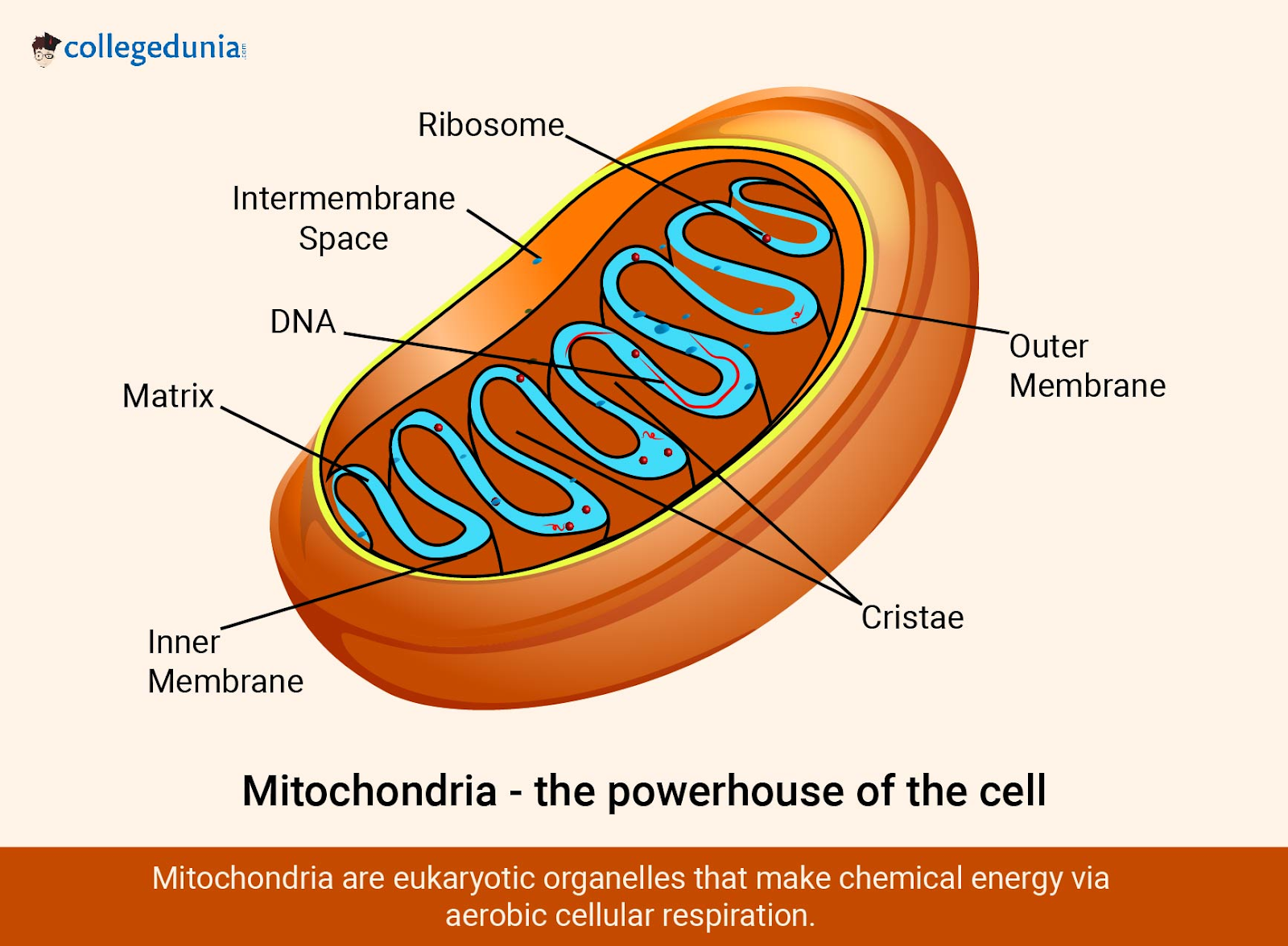
Mitochondria Diagram
Structure of Mitochondria
The structure of mitochondria includes various parts such as granules, ribosomes, cristae, outer membrane, and inner membrane. It has two membranes, one inner and one outer, separated by an intermembrane gap.
- Porins are proteins found in the outer membrane of the mitochondrion that allow ions to flow in and out.
- The outer membrane also contains enzymes involved in the elongation of fatty acids and the oxidation of adrenaline.
- They usually have a diameter of 0.2-1.0 m (average 0.5 m) and a 1.0-4.1 m length.
- The detailed analysis of each of the components of mitochondria is as follows:
Outer Membrane
The outer membrane of mitochondria is the smooth membrane that is composed of a phospholipid bilayer containing proteins. The layer is responsible for holding the required number of enzymes and helping in the process of fission and fusion of mitochondria.
Intermembrane Space
The next compartment in the mitochondria is the inter membrane space. It is the area between the outer and inner membranes. The region help in the transportation of molecules and modification of proteins.
- Intermembrane space helps regulate respiratory chain complexes.
- It is further divided into two sub-compartments, the lumen and the intra cristae space.
- Since the outer membrane surrounding it is permeable to molecules, this area also contains tiny molecules such as ions and carbohydrates.
Inner membrane
The inner mitochondrial membrane is divided into cristae to improve the surface area accessible for oxidative phosphorylation energy production.
- This region helps in the production of ATP from the energy released via the electron transport chain.
- It is also known as a special membrane transporter as it is impermeable to ions and small molecules.
Matrix
The matrix is a region within the mitochondrion's inner membrane that includes Krebs (TCA) and fatty acid cycle enzymes, as well as DNA, RNA, ribosomes, and calcium granules.
- The mitochondrial matrix can produce its RNA and proteins due to the presence of genetic material.
- Without the matrix enzymes that facilitate the most important chemical cycles, ATP generation would be incomplete.
Cristae
The inner membrane is divided into cristae to improve the surface area accessible for oxidative phosphorylation energy production. These knob-like structures found on the cristae are called the oxysomes or elementary particles. They help in the synthesis of ATP.
Function of Mitochondria
[Click Here for Sample Questions]
Some important functions of mitochondria are as follows:
- Mitochondrial energy is stored and released in the form of ATP and helps in the oxidation of carbs, proteins, and lipids.
- It aids in the production of haemoglobin's heme.
- The organelles produce a variety of intermediate metabolites during cellular respiration.
- They're used to make cytochromes, chlorophyll, ferredoxin, steroids, alkaloids, and pyrimidines, among other things.
- The mitochondria can store and release calcium and aid in the synthesis of amino acids.
- It aids in the production of some testosterone and estrogen hormone components.
- The organelles help in the production of fatty acid and yolk during the oogenesis process.
- They aid in the production of the middle section of the sperm during the spermatogenesis process.
- Mitochondria can also be seen in liver cells, which help detoxify ammonia.
- These features are passed down from mothers to their children through the maternal inheritance process.
Disorders Associated With Mitochondria
[Click Here for Sample Questions]
Mitochondria are colourless organelles that cannot be seen under a microscope. Damage to mitochondria is an important factor in a range of human diseases, which, in turn, affects the metabolism of the cell.
- Some of the mitochondrial diseases include Alpers disease, Barth syndrome and Kearns-sayre syndrome.
- Nuclear mutations of oxidative phosphorylation enzymes cause other disorders in this organelle.
- It causes diseases such as schizophrenia, bipolar disorder, dementia and Alzheimer's disease.
- Other dysfunctions of mitochondrial proteins include Parkinson's disease, epilepsy, stroke, cardiovascular disease, and diabetes mellitus.
Things to Remember
- Mitochondria have a lipoprotein framework to conduct energy metabolism.
- The shape of these organelles depends on the physiological state of the cell.
- The liver cells of the rat contain just 500 to 1600 mitochondria.
- The amount of mitochondria in green plants is lower than in animal cells.
- This is due to the presence of chloroplast in green plants, which perform the same function as mitochondria.
- Sarcosomes are the mitochondria found in the cardiac muscle cells of animals.
Sample Questions
Ques. What happens if the mitochondria stop working? (3 marks)
Ans. Any abnormality in mitochondrial activity can have a direct impact on human health, but it can be difficult to diagnose because symptoms vary from person to person. Mitochondrial disorders can be very serious, and in certain situations, they can even lead to organ failure. You will be less able to turn food into ATP if your mitochondria are not functioning properly. This is an issue for cells that require a lot of ATP, such as your muscles, and they may get weaker and exhausted faster as a result.
Ques. What would happen without mitochondria? (2 marks)
Ans. Mitochondria are considered the cell's powerhouse. Many oxidative enzymes are found in these organelles, which oxidize food and turn it into cell energy in the form of A.T.P. Food oxidation and energy release do not occur in the absence of mitochondria in the cell. As a result, the cell may perish.
Ques. Can mitochondria survive by themselves? (2 marks)
Ans. Mitochondria, on the other hand, cannot survive outside of the cell. Mitochondria split autonomously in a way similar to prokaryotic binary fission. Mitochondria, in particular, are not generated from scratch by a eukaryotic cell; instead, they proliferate within the cell and are divided between two cells when the cell divides. Mitochondria are not completely self-contained.
Ques. What causes mitochondria to malfunction? (3 marks)
Ans. Mitochondrial disorders are caused by faulty proteins or other molecules in the mitochondria as a result of defective genes. Changes in distinct genes create various subtypes, which result in worn-down cells in diverse regions of the body.
- Exposure to specific environmental conditions (such as certain pharmaceutical medicines, occupational toxins, and cigarette smoke) or genetic defects cause mitochondrial malfunction on a physiological level (of both mitochondrial and nuclear DNA).
Ques. What diseases do the mitochondria cause? (2 marks)
Ans. Mitochondrial illness can cause gastrointestinal issues, diabetes, and kidney problems in patients. Some of these disorders are caused by mitochondrial deficiencies in the digestive system, pancreas (in diabetes), or kidneys directly, while others are caused by mitochondrial defects in other tissues indirectly.
Ques. How did cells get mitochondria? (3 marks)
Ans. Mitochondria and chloroplasts are thought to have evolved from enveloped prokaryotes that were originally self-contained creatures. A eukaryotic cell swallowed an aerobic prokaryote, which developed into a mitochondrion after forming an endosymbiotic association with the host eukaryote.
- The endosymbiotic hypothesis proposes that mitochondria (and chloroplasts) are descended from specialized bacteria (most likely purple nonsulfur bacteria) that somehow survived endocytosis by another prokaryote or cell type and became absorbed into the cytoplasm.
Ques. Can mitochondria divide? (2 marks)
Ans. During cell proliferation, mitochondria divide and are split among the daughter cells. Their division can be divided into two basic events: mitochondrial nuclei division and matrix division (the so-called mitochondrial division, or mitochondriokinesis). In most eukaryotic cells, mitochondria, unlike the ovoid forms shown in most textbooks, are dynamic organelles that fuse and divide to produce continually changing tubular networks.
Ques. Why is mitochondrion called the power generator of the cell? (2 marks)
Ans. Mitochondria (plural: mitochondrion) are rod-shaped organelles that are thought to be the cell's power generators. During cellular respiration, mitochondria convert glucose and oxygen into adenosine triphosphate (ATP), the cell's molecular energy "currency" for performing all of its functions. The process of producing ATP utilizing the chemical energy available in glucose and other foods is known as cellular respiration.
Ques. What is the autonomy of mitochondria? (3 marks)
Ans. Mitochondria have DNA that can reproduce on its own. The organelles DNA generates mRNA, tRNA, and rRNA on its own. They have ribosomes of their own. Mitochondria make some structural proteins on their own.
- The majority of mitochondrial proteins, on the other hand, are synthesized in response to instructions from the cell nucleus.
- Some of the enzymes essential for organelle function are synthesized by the organelles.
- The division/binary fission of pre-existing mitochondria results in the formation of new mitochondria.
Ques. What is the shape and size of mitochondria? (2 marks)
Ans. Mitochondria are typically cylindrical. They come in a variety of sizes. The organelles usually have a diameter of 0.2-1.0 m (average 0.5 m) and a length of 1.0-4.1 m. Proteins account for 60-70 percent, lipids for 25-35 percent, RNA for 5-7 percent, and DNA for 5-7 percent. Small quantity. Minerals. Traces, Granules Manganese, and Calcium phosphate.
Ques. What is the role of ribosomes in mitochondria? (3 marks)
Ans. The ribosomes found in the mitochondria are called "mitoribosome" or "mitochondrial ribosome". They are involved in protein synthesis and energy conversion. Because of their somewhat distinct structure, mitochondrial ribosomes differ from those found in the cell's cytoplasm. The ability of mitochondria to synthesize proteins required for their operation is facilitated by the presence of their own ribosomes. It is a protein complex that translates mtDNA-encoded mitochondrial mRNAs.
Do Check Out:
| Class 11 Biology Study Guides | ||
|---|---|---|
| Biology MCQs | Biology Study Notes | Class 11 Notes |
| Comparison Topics in Biology | NCERT Solutions for Class 11 Biology | NCERT Class 11 Biology Book |



Comments