



Education Journalist | Study Abroad Lead
Mitochondria are the powerhouses of the cell as they produce and control energy for the cell. Mitochondria diagram can help us in understanding its structure in a comprehensive manner.
- They are double membraned organelles with the outer membrane being smooth and inner membrane being folded.
- Mitochondria organelles are mostly found in eukaryotic cells.
- They produce energy in the form of ATP (adenosine triphosphate) through cellular respiration.
- Mitochondria independly reproduce through fission.
- Mitochondria also help in regulating the metabolism of the cell and controling calcium signaling.
Key Terms: Prokaryotes, Unicellular organisms, mitochondria diagram, nucleus, eukaryotes, cellular respiration, ATP
What are Mitochondria?
[Click Here for Sample Questions]
Mitochondria are cell organelles that are involved in metabolic cell activities such as cellular respiration, cell senescence, cell growth, etc. Mitochondria are double membraned organelles that are shaped like rods and are present in both animal as well as plant cells.
- Mostly found in eukaryotes, these organelles are found within the cytoplasm of the cell in the living cells.
- The diagram of Mitochondria is one of the highest scoring topic for the examinations.
- They are the powerhouse of the cell as mitochondria supply the cell the necessary energy by oxidising the available substrates.
- The energy is produced in the form of ATP in mitochondra through enzymatic oxidation of chemical compounds.
Functions of Mitochondria
Mitochondria have several important cellular functions which are as follows:
- Mitochondria produce ATP (adenosine triphosphate) through cellular respiration. Glucose and other molecules are broken down in this process to produce energy in the form of ATP.
- It also helps in regulating the cell metabolism, including the metabolism of lipids and amino acids.
- Mitochondria regulate calcium signaling within the cell. It is important for muscle contraction and cell death.
- Mitochondria can release pro-apoptotic factors in respose to certain signals, triggering cell death.
Also Read:
Mitochondria Diagram
[Click Here for Sample Questions]
Mitochondria have a unique structure within the cell that can be demonstrated through a well-labelled diagram of mitochondria.
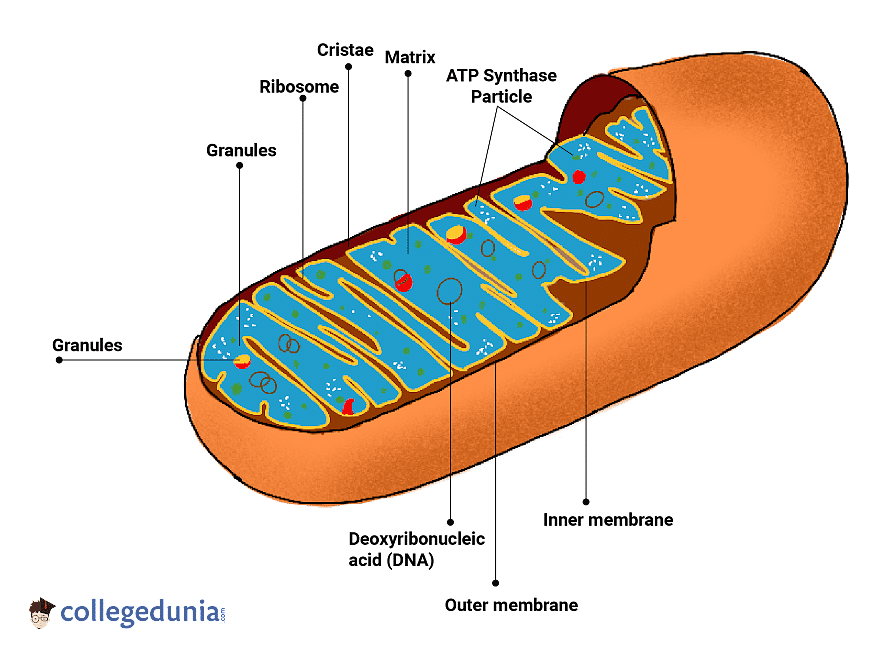
- The outer membrane of the organelle is smooth while the inner membrane is folded into cristae.
- The space between the two membranes of mitochondria is known as the intermembrane space.
- The space surrounded by the inner membrane is known as the mitochondrial matrix.
- Mitochondria’s unique structure allows them to carry out important cellular functions such as producing energy.
- The above mitochondria diagram shows the double membrane, cristae, intermembrane space, mitochondrial matrix, and location of enzymes and electron transport chains involved in cellular respiration.
Structure of Mitochondria
[Click Here for Sample Questions]
The shape and number of mitochondria and cristae in them, can significantly vary from one cell type to another. Tissues with high rate of oxidative metabolism such as muscle tissue have mitochondria with a high number of cristae. Both membranes of mitochondria have a high concentration of proteins.
Parts Of Mitochondria
Matrix
- Matrix is a gel like viscous fluid with a mixture of ribosomes, enzymes, mitochondrial DNA, inorganic ions, organic molecules and nucleotide cofactors.
- It plays an important role in cellular respiration and producing ATP which is the energy currency of the cell.
- Ribosomes and circular DNAs are also present inside the matrix of the mitochondria.
- The presence of Riboflavin makes the matrix pale yellow in color.
Ribosomes
- Ribosomes present in the mitochondria are known as the mitoribosome or mitochondrial ribosome.
- The function of ribosomes in the mitochondria is the synthesis of proteins and energy conversion
- Mitochondrial ribosomes are different from the ones in the cytoplasm of the cell, as they have a slightly different structure.
- The presence of their own ribosomes allows mitochondria to produce proteins that are necessary for their function.
- It is a protein complex which functions by translating mitochondrial mRNAs encoded in mtDNA.
Cristae
- The inner membrane of the mitochondria surrounded by the folds of mitochondrial matrix, as shown in the mitochondria diagram, is known as the cristae.
- They help in increasing the surface area of the inner membrane which in turn increases the Adenosine Triphosphate (ATP) synthesis.
- The knob-like structures present on the cristae are called the oxysomes or elementary particles. These structures assist in the synthesis of ATP.
Inner membrane
- The inner mitochondrial membrane is a folded membrane containing proteins involved in oxidative phosphorylation.
- It is the process of ATP production from the energy released via electron transport chain.
- The inner membrane is impermeable to most ions and small molecules, thus is known as special membrane transporters.
- These transporters are necessary to maintain electrochemical gradient across the membrane, important for the ATP generation.
Outer Membrane
- The outer membrane of mitochondria is the smooth membrane that surrounds the organelle.
- It is made up of a phospholipid bilayer containing proteins called porins allowing small molecules to diffuse in and out of the mitochondria.
- The outer membrane also plays a role in the fusion and fission of mitochondria.
- It also holds a number of enzymes with a wide variety of functions.
Inter membrane Space
- Mitochondia is made up of 2 compartments – the inter membrane space and the mitochondrial matrix.
- The region between the inner and outer membrane of mitochondria is called the intermembrane space.
- The intermembrane space is further divided into two sub-compartments, the lumen, and the intra cristae space.
- This space is primarily responsible for the modification of proteins, transportation of molecules, and the regulation of respiratory chain complexes.
Also Read:
Things to Remember
- Mitochondria are organelles found in most eukaryotic cells that produce energy in the form of ATP through cellular respiration.
- The outer membrane of mitochondria is smooth and the inner membrane is folded into structures called cristae.
- The cristae provide a large surface area for enzymes and electron transport chains involved in cellular respiration, in the mitochondrial matrix.
- Dysfunction of mitochondria has been linked to metabolic disorders, neurodegenerative diseases, and cancer.
- A mitochondria diagram shows its double membrane, cristae, intermembrane space, and mitochondrial matrix.
- Mitochondria is responsible for the synthesis of ATP and is therefore called the powerhouse of a cell.
Sample Questions
Ques 1. Which type of ribosome is present in the mammalian mitochondria? State its sub-parts and function. (3 mark)
Ans. The mammalian mitochondria contain 55S types of ribosomes.
The two sub-parts are: the larger sub-part is 38S, and the smaller subpart is 28S.
The function of ribosomes in the mitochondria is the synthesis of proteins and energy conversion
Ques 2. What is a Matrix? Name and explain the purpose of divalent ions present in the matrix? (2 marks)
Ans. Matrix is the material present inside the inner membrane of the mitochondria. The matrix is embedded with enzymes initiating the cellular aerobic respiration and divalent ions like Mg2+, Mn2+, and Fe2+. The divalent ions activate the enzymes responsible for the cellular respiration
Ques 3. Name the chemical responsible for the pale yellow color of the matrix? (1 mark)
Ans. The presence of riboflavin accounts for the pale yellow color of the matrix.
Ques 4. Name the eukaryotic cells in which mitochondria are absent? (1 mark)
Ans. Mitochondria is absent in the mature Red Blood Cells.
Ques 5. Name the enzyme responsible for ATP synthesis? (1 mark)
Ans. The enzyme ATP Synthase is responsible for the synthesis of ATP in the mitochondria.
Ques 6. Which membrane of mitochondria is more permeable? (1 mark)
Ans. The outer membrane of mitochondria is more permeable compared to the inner membrane due to the low content of protein present.
Ques 7. State the reason why mitochondria are termed as the powerhouse of a eukaryotic cell? (1 mark)
Ans. In a eukaryotic cell, mitochondria are the site of aerobic respiration through which the cell produces its energy. For this very reason, mitochondria are called the powerhouse of a cell.
Ques 8. Point out the importance of the existence of cristae in the matrix of mitochondria? (1 mark)
Ans. The numerous folding or cristae present in the matrix increases the surface area which in turn acts as the site for aerobic respiration.
Ques 9. Write a short note on mitochondria. (2 mark)
Ans. Mitochondria is referred to as a double-membrane-bound cellular organelle which is present in most of the eukaryotic cells. They are generally found in oval or round shapes. The aerobic respiration in eukaryotic cells mainly occurs in mitochondria. They are responsible for producing the maximum amount of energy required by the cells in order to power the biochemical reactions. The chemical energy produced by the mitochondria is kept in a molecule known as the adenosine triphosphate (ATP).
Check Out:



Comments