



Content Curator
Lamina refers to the entire levelled and extended section of the leaf. In a nutshell, the lamina of a leaf is the leaf blade. It is the most crucial section of the leaf since it contains all the chloroplasts, the reaction centres of the photosynthesis process that the leaves use to make their sustenance. The enlarged structure of the lamina plant leaf helps it catch and absorb photons from the sunlight, which are then used in the photosynthesis process to provide necessary energy and nutrients to the plants. Given below are the complete details about the parts of lamins, their function along with their importance.
| Table of Content |
Key Terms: Lamina, Petiole, Photosynthesis, Transpiration, Xylem, Phloem, Vascular Tissues, Apex, Midvein, Epicuticular Wax, Yabby Genes, Pinnate, Leaves
Lamina of a Plant Leaf
[Click Here for Sample Questions]
The photosynthesis process is carried out by the lamina plant leaf, which is extended and levelled section of the leaf above ground. The thin and levelled region of the lamina structure benefits the plants to absorb considerable quantities of sunlight, which is necessary for the plant's growth and development. The lamina's large surface area permits for wider covering to the chloroplasts found in the leaf’s chlorenchyma. Because sunlight can fully permeate the leaf, this property of the lamina allows sunlight to get deep into the tissue.
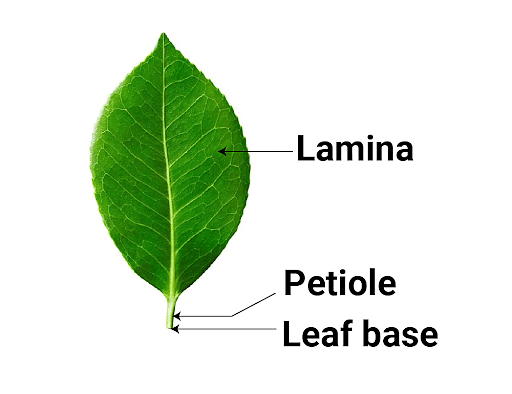
Lamina of a Plant Leaf
Also Read: Plant Tissues
Parts of Lamina
[Click Here for Previous Year Questions]
The lamina comprises several components of a basic plant's leaf, such as the veins, apex and so on. Here's a quick rundown of what they're all about:
- Apex: The apex refers to the leaf's very tip.
- Midvein or Principal Vein: The primary vein or midvein is the major vascular bundle that runs through the mid of the leaf.
- Secondary Vein: The extensions of the principal vein that encompass the whole leaf blade are the secondary veins. The midvein and these veins transport food, water and nutrients to the whole plant.
- Leaf Margin: The leaf margin is the border area that follows the leaf’s edges.
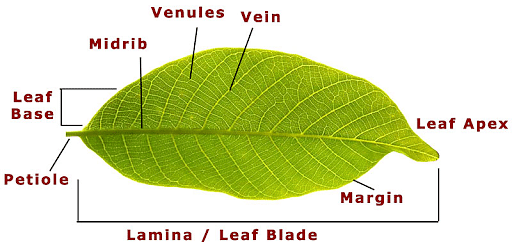
Parts of a Lamina
Apart from these features, the lamina is split into two surfaces: ventral (the meaning surface which is facing the stem) and dorsal (the meaning surface which is faced opposite from the stem). Adaxial refers to the ventral surface, whereas abaxial refers to the dorsal surface. This may be false in many circumstances, a typical contrast between them both is that the dorsal side is somewhat brighter than the ventral surface.
Aside from colour, there are distinctions in the structure and amount of epicuticular wax and hairiness. The epicuticular wax is a hydrophobic organic substance present on the lamina that prevents the lamina from getting wet and preventing moisture loss.
Read more: shrubs
Types of Leaf Determined by Lamina
[Click Here for Sample Questions]
The structure of the lamina classifies leaves into:
- Simple Leaf: The lamina, or leaf blade, is undivided in a simple leaf. Small divisions do not reach the midrib and split the lamina, even if they are there.
- Compound Leaf: The leaf blade is separated into two or more segments from the midrib. These separated portions can sometimes be used as distinct leaves.
Read more: Getting to know plants
Functions of Lamina
[Click Here for Previous Year Questions]
- The major purpose of the lamina is to absorb sunlight for photosynthesis. Distinct plants have different types of laminas. However, the lamina structure is a levelled structure in virtually all plants, whether thin or broad, allowing it to absorb photons from different wavelengths of sunlight. The chlorophyll subsequently uses these photons in the lamina's chloroplasts to produce nutrients and food, then transferred to various plant areas via the vascular network.
- The leaf stomata, like the chloroplasts, are a component of the lamina. Stomata are pores found in the stems, epidermis of plant leaves, and other different parts that regulate gaseous interchange between the surrounding environment and the plant. For photosynthesis, the carbon dioxide is taken in through the stomata into the leaves. The stomata regulate water vapour and oxygen diffusion from the leaf to the environment. The interchange of water vapour and gases is crucial in the plants and surrounding temperature fluctuations. As a result, another function of the lamina is to regulate temperature changes via the stomata.
- The YABBY genes regulate the length of the lamina. These genes control the ultimate expansion or extension of the lamina, hence limiting the number of gases and sunlight taken in by the plant. The surface area of the lamina, while not essential, is a significant component in plant development and growth. Depending on the habitat, the lamina area has a principal role in maintaining plant viability through modulating lamina function.

Structure of Stomata
Check More
Importance of Lamina
[Click Here for Sample Questions]
- Leaves are the necessary component of all a plant's lateral structures.
- The plant's kitchen is best known for performing photosynthesis and thereby forming the plant's most vital vascular organs.
- They are autotrophic because they catch the sunlight, which is converted into nutrients and chemical energy by chloroplasts in the leaf.
- These nutrients and energy molecules are delivered to the whole plant via the xylem and phloem vascular networks. The leaf is split into multiple portions to perform various purposes.
Also Read: Difference Between Xylem And Phloem
Relation between Lamina and Photosynthesis
[Click Here for Previous Year Questions]
- Lamina's role in photosynthesis Leaf is regarded as the kitchen of the plant because it contains chloroplast, which gives it its green colour.
- Petiole links the lamina to the whole plant.
- It has a network of stomata for carbon dioxide oxygen intake and exhaustion.
- The stomata open and close in response to the plant's needs for food preparation, and major and secondary veins link them.
- The midrib and many other different lateral ribs provide the lamina's structure and form.
- Chlorophyll is found in the lamina and is in charge of trapping the energy gained from sunshine.
- This stored energy is then utilised to produce glucose from carbon dioxide and water.
- The glucose generated is the plant's nourishment, and it is transported to various areas of the plant via the phloem, or vascular tissue, which is also found in the Lamina.
- Photosynthesis is the name for the entire process, and it is the primary function of green leaves.
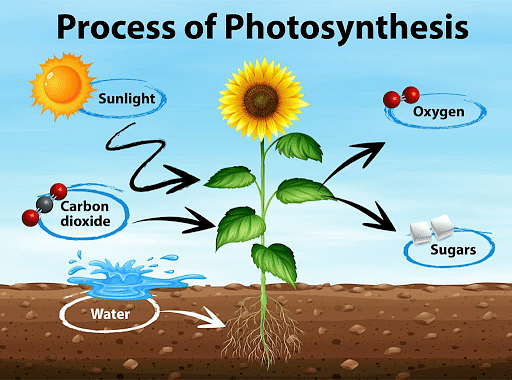
Photosynthesis
Things to Remember
[Click Here for Sample Questions]
- The extended and levelled section of the leaf above the ground is called the lamina.
- The lamina plant leaf's extended structure helps it receive and intake photons from sunlight, which are then used in the photosynthesis process.
- The YABBY genes regulate the extent of the lamina.
- There are two kinds of leaves depending upon the structure of the lamina: simple and complex.
- Despite its importance, the area of the leaf lamina is an essential determinant in plant development and growth.
Also read:
Previous Year Questions
- Thorns, spines, prickles in plants are utilized as….
- The lower surface of leaf will have more number of…
- In alternate (or spiral) phyllotaxy, only one leaf is borne on….
- Spines present on the areoles of Opuntia represent…..
- Hydathodes are meant for… [UPSEE 2017]
- The type of leaf in Daucus carora is….[AMUEEE 2015]
- Reserve food material of algae is…? [BCECE 2006]
- Cycas belongs to gymnosperms due to…? [BCECE 2006]
- In Bryophyta, a specialized organ of the sporophyte for attachment to the gametophyte…? [UPSEE 2017]
- In Pinus, male cone bears a large number of…? [BCECE 2016]
- Coralloid root is the feature of…? [BHU UET 2008]
- 'Club moss' belongs to…? [BHU UET 2006]
- Vessels are absent in this angiosperm….[JKCET 2007]
- The vascular bundles in the stem are generally….
- Cambium is a lateral meristem that takes part….
- Which of the following is made up of dead cells?
- Grass leaves curl inwards during very dry weather…
- Growth rings are formed due to activity of...
Sample Questions
Ques. What is the definition of a leaf's lamina? What is the distinction between a leaf blade and a leaf lamina? (3 Marks)
Ans. Chloroplast and stomata are found in the lamina, which is a thin, levelled surface made up of mesophyll tissues bordered by the lower and upper epidermis. The veins of the complex vascular system are indeed located in the lamina of a leaf, in addition to supplying food, water, and nutrients. All of them may be seen in the lamina. The leaf blade is the entire structural component of the stem-linked lamina, while the leaf lamina is merely the levelled portion. In botanical terms, the leaf blade is the perfectly levelled and thin portion of the plant that is linked to the stem (petiole).
Ques. What are the distinctions between a leaf blade and a leaf apex? (3 Marks)
Ans. Various portions of the Leaf have been classified or labelled by biologists or botanists for ease of recognition and understanding of their activities. A Leaf, too, has several components with varied names. The Leaf blade is the leaf's whole levelled structure, attached to the stem or branch by a tiny protrusion known as the petiole. While the Leaf Apex is merely the leaf's outward tip. For leaves of various plants, the structure of the apex varies.
Ques. What is the purpose of the stomata on leaves? (3 Marks)
Ans. Stomata are tiny apertures found on the surface and the inside of any leaf. The stomata's primary job is to perform respiration and carbon dioxide intake in the air. The transpiration occurs when water vapour leaves through these holes. The guard cells surrounding the entrance open and close depending on the quantity of water available. When there is sunshine, only during the day do the leaves perform photosynthesis. The guard cell becomes turgid and twisted apart as it fills with water. Because of the shrinking of the guard cell, it closes at night.
Ques. Explain the leaf's interior structure. (3 Marks)
Ans. Palisade mesophyll is present immediately under the epidermis, and the upper epidermis is formed of a single layer of cells covered by a cuticle with holes that enable gas and water molecules to flow through. The spongy mesophyll is the second type of mesophyll, and it consists of tightly packed irregular shape cells surrounded by spaces. The lower epidermis, which includes vascular bundles and stomata, lies under the spongy mesophyll. Stomata are pore-like holes on the leaf's underside. Each stoma has two guard cells that control the opening and closing of the stoma.
Ques. What are the many kinds of leaves? Also, why are leaves such an important element of the plant? (3 Marks)
Ans. Simple and complex leaves are the two kinds of leaves that exist. Simple leaves are split or lobed, but they lack discrete leaflets. Whereas, a complex leaf is split into separate leaflets, each with its little petiole. Photosynthesis, in which plants nourish themselves, is mostly carried out by leaves. They assist with the transportation of food and water to various portions of the plant. As a result, they play a critical part in a plant's survival. They also aid in exchanging gases through the opening and shutting of stomata and the removal of surplus water from plants through transpiration.
Ques. What is the purpose of a plant's leaf? (5 Marks)
Ans. The various purposes of the leaf of a plant are as follows:
- The major function of leaves is photosynthesis. Photosynthesis is how they transform UV light, water, carbon dioxide into glucose.
- The transfer of surplus water from plants into the atmos is transpiration. The opening of stomata in the leaves causes this to happen.
- Guttation is the process of removing surplus water from the xylem at the margins of the leaves while the stomata are closed.
- Photosynthesis takes place on the leaves. As a result, they conserve water and nutrients. The succulent, thick leaves are especially well-suited to water storage.
- Certain leaves have been converted into spines to prevent them from being harmed or devoured by animals. Opuntia, for example.
Ques. Explain about the leaves with a Palmately Compound Shape. (5 Marks)
Ans. The leaflets of a palmately complex leaf are linked to the petiole at the tip. Silk cotton, for example. These can be classified as follows:
- Unifoliate leaves are those that have a single leaflet. Citrus, for example.
- Bifoliate has two leaflets. For example, Balanites
- Trifoliate has three leaflets that emerge from the same place. For example – Oxalis.
- Quadrifoliate has four leaflets that emerge from the same place. For example, Marsilea.
- Multifoliate has numerous leaflets growing from a single pint. Bombax, for example.
Ques. Give the details about the Leaves with a Pinnately Compound Leaf. (5 Marks)
Ans. The midrib of a pinnately complex leaf is split into several leaflets linked by a common axis. Take, for example, Neem. Furthermore, they are divided into the following categories:
- Pinnate leaf: A pinnate leaf is a complex leaf with an axis on either side of the midrib.
- The leaf having leaflets on both sides of the axis is known as unipinnate. Cassia, for example.
- The primary axis produces a secondary axis that bears the leaflet in bipinnate plants. Acacia, for example.
- A tertiary axis containing leaflets arises from the secondary axis, making the plant tripinnate. For example, Moringa.
- Leaf with more than three pinnate is decompounds. Old coriander leaves, for example.
- A leaf lacking a terminal leaflet is called a parapinnate leaf. Cassia, for example.
- Imparipinnate: A leaf with an unusually shaped terminal leaflet. Peas, for example.
Do Check Out:



Comments