



Content Writer
According to Standard Temperature and Pressure (STP), the molar volume formula can be defined as the volume occupied by one mole of a chemical element or a chemical compound.
- It is denoted by (Vm).
- The molar volume formula of a chemical element can be calculated by dividing the molar mass (M) by mass density (ρ).
- It is directly proportional to the substance mass.
- On the other hand, it is inversely proportional to the density of the substance.
- The molar volume follows the perfect gas equation.
- Molar gas volume is one mole of any gas occupying a fixed volume at a specific temperature and pressure.
- A hot air balloon, which is inflated with cold air, fills the air in the balloon using the molar volume concept.
| Table of Content |
Key Terms: Molar Volume Formula, Molar Volume, Molar Gas, Ideal Gas Equation, Temperature, Pressure, Molar Mass, Density, Mole, Volume, Avogadro Number, Mass, Element
What is Molar Volume?
[Click Here for Sample Questions]
The molar volume can be defined as the volume occupied by one mole of a particular element or substance at STP, i.e., (Standard Temperature and Pressure).
- In 1811, a scientist named Avogadro provided the statement.
- According to the statement, the volumes of all gases can easily be determined.
- It states that equal volumes of all gases at an equivalent temperature and pressure contain equal numbers of particles.
- The SI unit of molar volume is written as cubic meters per mole.
- It is denoted by (m3/mol)
Although having a large volume, the other units are also used for this purpose. The SI unit for solids and liquids can be written as cubic centimetres per mole, i.e.,(cm3/mol).
- On the other hand, the SI unit for gas is used as cubic decimetres per mole, i.e. (dm3/mol).
- The density of the mixture is obtained by adding the molar volume of all individual components.
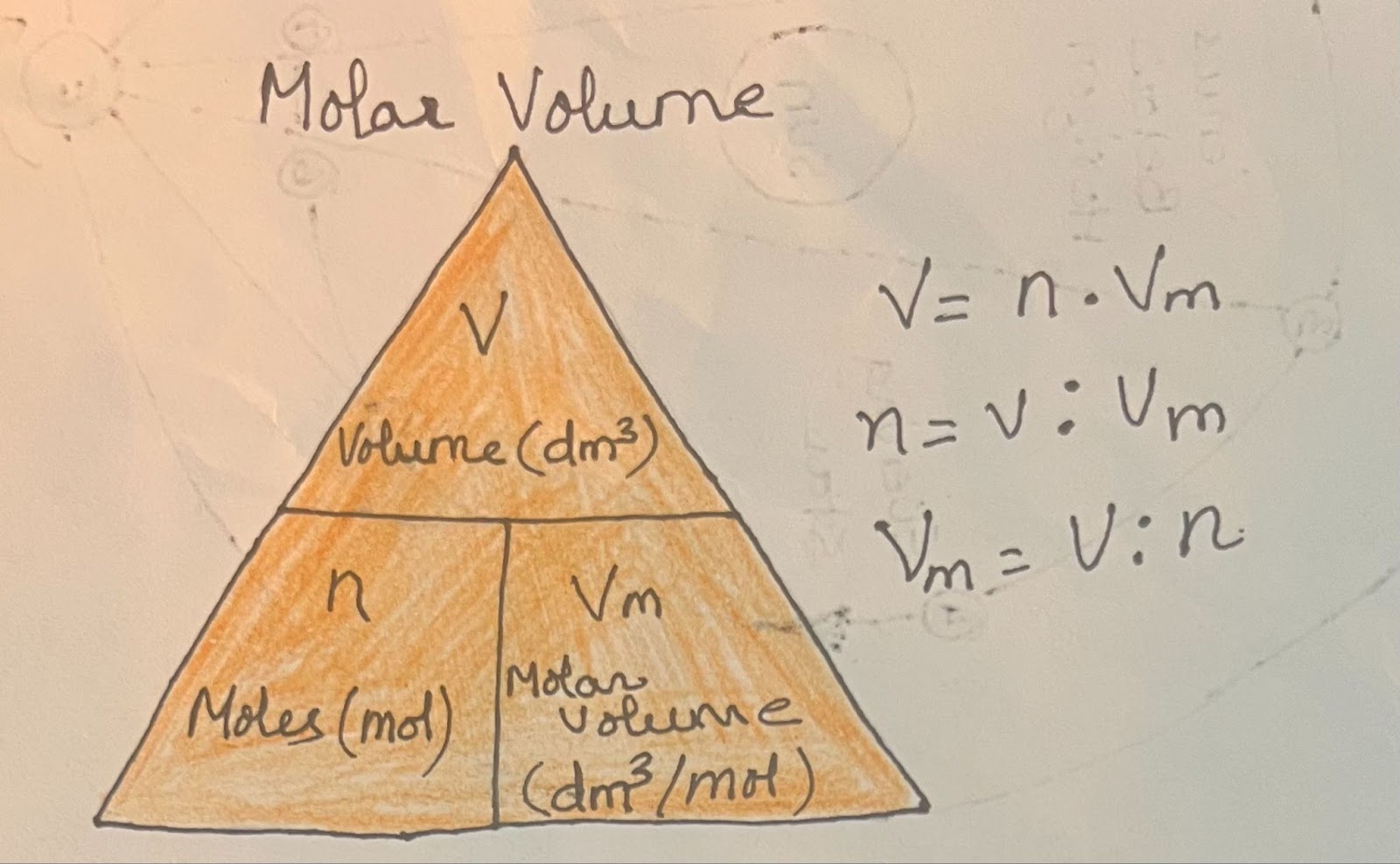
Molar Volume Formula
Read More:
| Chapter Related Concepts | ||
|---|---|---|
| Calcium Chloride | Hydrogen Chloride | Non-Metals |
| Avogadro’s Law: Statement, Formula, Derivation | Born-Haber Cycle | Oxidizing Agent |
Molar Volume Formula
[Click Here for Sample Questions]
The Molar volume formula of the chemical element is directly proportional to molar mass and inversely proportional to the density of the element. The formula can be calculated by dividing the molar mass (M) by mass density (ρ).
- Molar gas volume is one mole of any gas at a particular temperature and pressure that has a fixed volume.
- Here, the formula of the molar volume is expressed by some of the following terms.
Vm = M/ρ
Vm= \(\frac{Molar Mass}{Density}\)
- where Vm = Molar volume of the substance.
- m is the molar mass of the substance.
- ρ is the density of that substance.
So, the standard temperature used is 273 Kelvin or 0°C. The standard pressure is 1 atmosphere, which is equal to 760 mm Hg. One mole of any particular gas occupies a volume of 22.4 litres at STP.
- According to STP, 1 mole of gas = 22.4 litres of gas (at Standard Temperature and Pressure)
Example of Molar Volume FormulaExample 1. Calculate the density of a gas if its molar volume is 44 L and molar mass is 50 g? Ans. As we know, Vm = 44
Example 2. Calculate the molar volume of 7 moles of a gas? Ans. As we know,
|
Things to Remember
- The molar volume can be defined as the volume occupied by one mole of an element or substance.
- The volume of a substance is directly proportional to the molar mass and inversely proportional to the density of the substance.
- SI unit is written differently for solid, liquid or gaseous substances.
- It can be measured by the process of X-ray crystallography.
- The molar volume formula for an ideal gas can be explained with the help of the ideal gas equation.
Read More:
| Class 11 Chemistry Related Concepts | ||
|---|---|---|
| Properties of Matter | Mole Concept | Isotopes of Hydrogen |
| Three States of Matter: Definition, Properties and Sample Questions | Valency | Structure of an Atom |
Sample Questions
Ques.What do you mean by the molar volume of a substance? (2 marks)
Ans. The volume occupied by one mole of the compound or substance is known as molar volume. The molar volume is denoted by (Vm).
The formula for molar volume is given by,
Vm =\(\frac{Molar Mass}{Density}\)
Ques.What is the molar volume for a given sample of the molar mass of the N2? The density of the N2 is given = 1.250 g/L? (3 marks)
Ans. Vm = Molar mass/ Density
So, the molar mass of Nitrogen = 28.01 g/mol
According to the molar volume formula,
Vm = (28.01)/(1.250)
Vm = 22.408 L
Therefore, the molar volume of N2 is 22.408 L
Ques.Calculate the mass of ammonia which will exert the same pressure when placed in the same container. As 12 g of H2S(g) is placed in the same vessel under the similar conditions of temperature? (3 marks)
Ans. Under the identical conditions of T and V, p n
Equal moles of ammonia as that of H2S(g) will exert same pressure, when it is placed in
the same container,
Therefore,
Moles of H2S = 12/34 = moles of ammonia
Since,
Mass of ammonia = (12/34) 17 = 6g
Hence, the mass of ammonia is 6g.
Ques.Suppose a sample of pure helium gas occupies a volume of 6.8 L at 0°C and 100 kPa. Calculate the no. of moles of helium gas which are present in the sample?(2 marks)
Ans. Volume of (He(g) = 6.8L
A/c to Standard temperature and pressure
Temperature = 0°C and 100 kPa
So, Vm = molar volume of gas
Vm = 22.71 L mol-1
Therefore, 0.30 mol of (He) gas is present.
Ques. Calculate the amount of CO2 gas, which is occupied by 5 moles of the gas occupy at Standard Temperature and Pressure. Identify it by using the Molar Volume Formula? (2 marks)
Ans. Volume of CO2 = no. of moles of CO2 × 22.4 L
= 5 × 22.4 …..(5 moles is given)
= 112 L
Therefore, the quantity of CO2 gas is 112 Litre.
Ques.What do you mean by molality? (2 marks)
Ans. Molality can be defined as the amount of a substance dissolved in a particular mass of solvent. So, a perfect definition for molality is the moles of a solute per kilograms of a solvent. The SI unit of molality are mol/kg or m.
Ques.What do you mean by molarity? (2 marks)
Ans. Molarity is defined as the moles of a solute per litres of a solution. This is known as Molarity. This is also known as the molar concentration of a solution. The SI units for Molarity are mol/L or M.
Ques. Calculate the molar volume for oxygen if the density of the gas is 1.1 g/L? (2 marks)
Ans. As we know, M = 32
- D = 1.1
- Vm = M/D
- 32/1.1
- 29.09 L
Ques. Calculate the molar volume for sulfur dioxide if the density of the gas is 3 g/L? (2 marks)
Ans. As we know, M = 32 + 2 (16) = 64
- D = 3
- Vm = M/D
- 64/3
- 11.33 L
Ques. Calculate the density of a gas if its molar volume is 44.80 L and molar mass is 54 g? (2 marks)
Ans. As we know, Vm = 44.80
- M = 54
- Vm = M/D
- D = M/Vm
- D = 54/44.80
- D = 1.205 g/L
Ques. Calculate the molar volume of 5 moles of a gas? (2 marks)
Ans. As we know,
- n = 5
- Using the formula we have,
- V = 22.4 n
- 22.4 (5)
- 112 L
Ques. Calculate the molar volume of 20 moles of a gas? (2 marks)
Ans. As we know,
- n = 20
- Using the formula we have,
- Vm = 22.4 n
- 22.4 (20)
- 448 L
For Latest Updates on Upcoming Board Exams, Click Here: https://t.me/class_10_12_board_updates
Also Check:



Comments