



Education Journalist | Study Abroad Lead
Solids are rigidly packed structures that could not be easily affected by external forces. They also have a fixed mass, volume, and shape. Solids cannot flow, though. Solid-state physics and solid-state chemistry deals with the physical and chemical aspects of solids. There are 4 states of matter in nature. They are classified as solids, liquids, gases, and plasma, based on their intermolecular binding and the nature of the constituent particles.
| Table of Content |
Key Takeaways: Solids, Liquid, Gas, Amorphous solids, Crystalline solids, Kinetic energy, States of matter, Fluid, Plasma, Intermolecular binding, Forces
Solids Definition
[Click Here for Sample Questions]
Solids can be defined as one of the three states of matter with a rigidly packed structure as well as a fixed volume and shape. The rigid structure can be attributed to chemical bonding which holds the molecules tight. Since the molecules are tightly bound, their kinetic energies are comparatively lower than liquids and gases. This feature helps them in resisting the actions of external forces and hence to have a fixed volume and shape unlike liquids and gases, which are highly volatile.

Also Read:
| Related Articles | ||
|---|---|---|
| Hydrostatic Pressure | Amorphous and Crystalline Solids | Crystal Lattices and Unit Cells |
| Packing Efficiency | Imperfections in Solids | Magnetic Properties |
Solids Properties
[Click Here for Sample Questions]
The properties of solids can be summarized as follows:
- They are rigid structures
- Molecules are tightly held by chemical bonding in a three-dimensional space inside the solid (strong intermolecular forces)
- They have a fixed volume and shape
- They cannot flow
- They are incompressible
- The arrangement of molecules inside a solid determines its shape
- Short intermolecular distances make their constituent particles have fixed positions which means that they can only oscillate about their mean positions.
Most of the properties of solids can be attributed to their rigidity arising from strong intermolecular forces operating in shorter intermolecular distances.
Differences between Solids, Liquids and Gases
[Click Here for Sample Questions]
| Solids | Liquid | Gases |
|---|---|---|
| Rigid structure | Free flowing | Highly volatile |
| Have a definite volume and shape | Constant volume but no shape | Do not have a specific shape and volume |
| Constituent particles are bound tightly in a regular pattern | Randomly arranged molecules | Chaotic arrangement of molecules |
| Particles display constant vibration and twisting but can only oscillate about mean | Moderate movement | High Movement |
| Short Intermolecular distances | Medium intermolecular distances | Large Intermolecular distances |
| Maximum intermolecular forces | Moderate Intermolecular forces | Lowest Intermolecular forces |
| Cannot flow | Can flow | Can flow |
| Incompressible | Medium Compressibility | Highly Compressible |
| Low Kinetic energy | Medium Kinetic Energy | High Kinetic Energy |

Examples of Solids
[Click Here for Sample Questions]
- Brick
- Pencil
- Rod
- Apple
- Sand
- Rock
- Sheet
- Glass
Types of Solids
[Click Here for Sample Questions]
Solids can be classified in three different ways based on the nature of the arrangement of constituent particles, chemical bonding, and composition. Let us examine each classification

Nature of arrangement of constituent molecules
Based on this, solids can further be classified into crystalline and amorphous

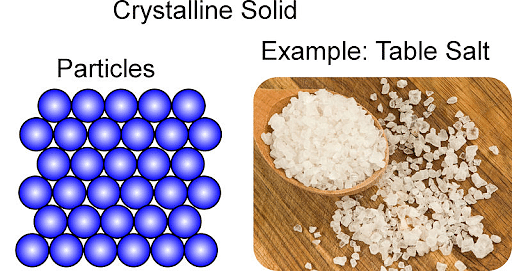
Crystalline Solids: They are an array of smaller crystals with each crystal having a similar characteristic geometric shape. The arrangement of constituent particles is in a regular pattern of long-range order. Throughout the crystal, this pattern repeats in the same manner periodically. This symmetrical three-dimensional arrangement of atoms inside a crystal is called a crystal lattice. In a crystal lattice, the constituent particles are represented as points. Sugar and common salt(NaCl) are examples of crystalline solids
Amorphous Solids: An amorphous solid as the name implies has no shape and is made up of particles of irregular shape. In contrast to crystalline solids, the arrangement of particles are in short-range order. Though they also have regular repeating patterns, these patterns are only observed in shorter distances. As a result, the arrangement of particles here is highly disordered. Examples of amorphous solids are glass, rubber, and plastic.

Differences Between Crystalline and Amorphous Solids
[Click Here for Sample Questions]
| Crystalline Solids | Amorphous Solids |
|---|---|
| Regular characteristic geometric shape | Irregular in shape |
| Regular solids | Tendency to flow makes it a pseudo solid or supercooled liquid |
| Anisotropic in Nature | Isotropic |
| Sharp Melting Point | Soften over a range of temperatures. Could turn to crystalline with heating |
| Packed in long-range order | Packed over short-range |
| Cleavage generates regular shapes | Cleavage generates irregular shapes |
| Heat of fusion is definite and characteristic | No definite heat of fusion |
Further Classifications of Crystalline solids
[Click Here for Sample Questions]
Crystalline Solids can be further classified based on their chemical bonding and composition
By Chemical Bonding
Ionic Solids: Ionic solids have ions as the building particles. These ions could be either cations or anions which are held in three-dimensional arrangements by strong electrostatic forces. Resembling metals, they are hard and brittle with high melting and boiling points. But in their solid state, they are inactive as the ions are localized. However, with temperature(they become molten) or when dissolved in water, they can conduct electricity as ions are free to move. NaCl and MgO are examples.
Molecular Solids: Molecular solids can be subdivided into non-polar, polar, and hydrogen-bonded solids. All these three are formed using covalent bonds held by weak dispersion forces, dipole-dipole interactions, and hydrogen bonding. They have comparatively lower melting points and are mostly non-conductors of electricity. CO2 and H2O are examples.
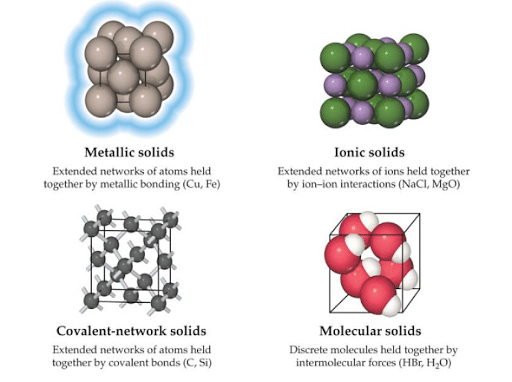
Network Covalent Solids: They are giant molecules that are crystalline solids of non-metals formed from strong covalent bonds. Though they have high melting points, they do not conduct electricity as they are mostly not soluble. SiO2 and SiC are examples
Metallic Solids: Metallic atoms are held together by strong forces of polarization arising between positive ions surrounded by a sea of electrons. The uniformity and mobility of these free electrons make these solids have high electrical and thermal conductivity. They also contribute to the metallic luster and color along with malleability and ductility. Cu and Fe are examples.
By Composition
Solids can be divided into metals, minerals, ceramics, organic solids, semiconductors, composites, bio, and nanomaterials on the basis of their composition.
Things to Remember
- Solids form part of one of the four states of matter with a rigidly packed structure
- Solids have a fixed volume and shape
- Solids are incompressible and cannot flow
- Constituent particles in solids are packed together by strong intermolecular forces
- Solids can be subdivided into crystalline and amorphous based on the nature of the arrangement of constituent particles
- Crystalline solids have regular geometric shapes, anisotropic and sharp melting points
- They also have characteristic heat of fusion and cleavage properties
- Amorphous solids are pseudo solids or supercooled liquids with a disordered shape
- They are isotropic with no cleavage properties
- They soften over wider ranges of temperatures and could turn crystalline when heated
- NaCl and SiO2 are examples of crystalline and amorphous solids respectively
- Crystalline solids can be classified further into ionic, molecular, metallic, and covalent solids based on chemical bonding
- Ionic solids have cations or anions as the building particles which are held in three-dimensional arrangements by strong electrostatic forces
- Ionic solids have strong melting and boiling points and they conduct electricity when molten
- Molecular solids can be subdivided into non-polar, polar, and hydrogen bonding formed using covalent bonds.
- They are held by weak dispersion forces, dipole-dipole interactions, and hydrogen bonding. and are mostly non-conductors of electricity.
- Covalent network solids are giant molecules that are crystalline solids of non-metals formed from strong covalent bonds.
- Metallic solids are metallic atoms that are held together by strong forces of polarization arising between positive ions surrounded by a sea of electrons
- Metallic solids are malleable, ductile, have a metallic luster and have high electrical and thermal conductivity.
- Solids can be subdivided into metals, minerals, ceramics, organic solids, semiconductors, composites, bio, and nanomaterials based on composition
Also Read:
Sample Questions
Ques: Why is sugar rigid compared to water and air? (3 marks)
Ans: Sugar is a crystalline solid and its constituent molecules are closely packed in a three-dimensional space. In this three-dimensional space, they are held together, tight by strong intermolecular forces over a long-range in regular patterns. This restricts the movement of these molecules and they can only oscillate over a mean position.
In contrast, Water and gas are liquid and gas respectively. Their molecules are held by moderate and weak intermolecular forces respectively. This makes them have kinetic energies and hence move. So, they are less rigid when compared to sugar.
Ques: What kind of solid is glass? Why is it called a supercooled liquid? (3 marks)
Ans: Glasses are amorphous solids because they do not have a characteristic shape and are formed of molecules held by comparatively weaker forces. Though they also have regular repeating patterns, these patterns could only be observed in shorter distances As a result, the arrangement of particles becomes highly disordered.
They are hence called pseudo solids or supercooled liquids as they tend to flow owing to the disordered arrangement of constituent particles.
Ques: Why is graphite a good conductor of electricity compared to diamond? (2 marks)
Ans: To conduct electricity, a compound must have free or delocalized electrons inside its structure. In graphite, each carbon is attached to three other carbon atoms close to it. This makes the fourth electron free to move. In contrast, Diamond does not have free electrons owing to its tetrahedral structure arising from strong covalent bonds. These free electrons make graphite conduct electricity compared to diamond which has no free electrons.
Ques: Distinguish between ionic and molecular solids? (3 marks)
Ans: Ionic solids are formed by ions that could be positive (cation)or negative(anion) and are held together by strong electrostatic forces. Molecular solids on the other hand are formed from atoms or molecules. They are held together by either of the following 3 forces -- weak dispersive forces, dipole-dipole interactions, or hydrogen bonding. Ionic solids have high melting points and can conduct electricity in molten form. Whereas molecular solids have weak melting points and are insulators.
Ques: Is plastic Isotropic? Justify your answers (2 marks)
Ans: Materials whose properties do not change when tested in different directions are called Isotropic.., Plastic is an amorphous solid and its property does not change in different directions owing to the arrangement of constituent particles in a disordered manner. It is highly flexible and can take any shape. As the properties of its constituents are the same in any orientation, its behavior is also highly predictable. All these properties make it isotropic.
Ques: Why is graphite fragile compared to diamond? (2 marks)
Ans: Diamond and graphite are carbon compounds. What makes them unique is the nature of the bonding of constituent particles. Inside diamond, carbon atoms are held together close in a lattice structure by strong covalent bonds. In this tetrahedral structure, each carbon is linked to four others and there are no free electrons. Hence diamonds are harder. Whereas in graphite, free electrons are arising from the linking of carbon atoms. Each carbon is attached to only 3 others close to it. This property makes graphite fragile compared to diamond.
For Latest Updates on Upcoming Board Exams, Click Here: https://t.me/class_10_12_board_updates
Check-Out:



Comments