


NCERT Solutions for Class 10 Maths Chapter 2 Polynomials Exercise 2.3

Jasmine Grover logo

Jasmine Grover

Education Journalist | Study Abroad Lead

NCERT Solutions for Class 10 Maths Chapter 2 Polynomials Exercise 2.3 is provided in this article with step by step explanation. Class 10 Maths Chapter 2 Exercise 2.3 has 5 exercises that covers division algorithm for polynomials.

Download PDF: NCERT Solutions for Class 10 Maths Chapter 2 Exercise 2.3

Check out the solutions of Class 10 Maths NCERT solutions chapter 2 Polynomics Exercise 2.3
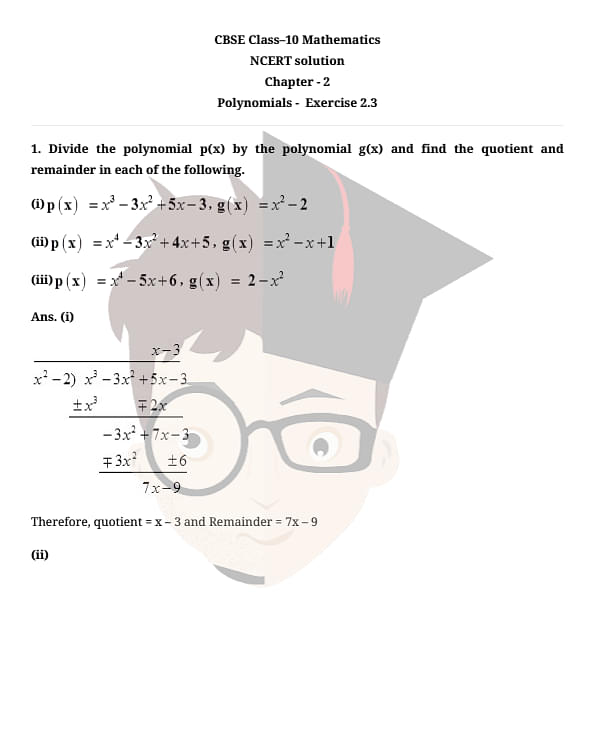
Read More: NCERT Solutions For Class 10 Maths Polynomials

Check out other exercise solutions of Class 10 Maths Chapter 2 Polynomials


Class 10 Chapter 2 Polynomials Topics:

CBSE Class 10 Maths Study Guides:

CBSE X Related Questions

  • 1.
    A chord of a circle, of radius 14 cm, subtends an angle of $60^\circ$ at the centre. Find the area of the smaller sector and perimeter of the smaller segment.


      • 2.
        \(ABCD\) is a parallelogram such that \(AF = 7 \text{ cm}\), \(FB = 3 \text{ cm}\) and \(EF = 4 \text{ cm}\), length \(FD\) equals

          • \(\frac{21}{4} \text{ cm}\)
          • \(\frac{28}{3} \text{ cm}\)
          • \(\frac{12}{7} \text{ cm}\)
          • \(5.5 \text{ cm}\)

        • 3.
          The first term of an AP is $p$ and the common difference is $q$, then its 10th term is :

            • $q - 9p$
            • $p - 9q$
            • $p + 9q$
            • $2p + 9q$

          • 4.
            Prove that: $\frac{\tan \theta}{1 - \cot \theta} + \frac{\cot \theta}{1 - \tan \theta} = 1 + \tan \theta + \cot \theta$


              • 5.
                The natural number 1 is :

                  • a prime number.
                  • a composite number.
                  • prime as well as composite.
                  • neither prime nor composite.

                • 6.
                  Assertion (A) : H.C.F. \((36 m^{2}, 18 m) = 18 m\), where \(m\) is a prime number.
                  Reason (R) : H.C.F. of two numbers is always less than or equal to the smaller number.

                    • Both Assertion (A) and Reason (R) are true and Reason (R) is the correct explanation of the Assertion (A).
                    • Both Assertion (A) and Reason (R) are true, but Reason (R) is not the correct explanation of the Assertion (A).
                    • Assertion (A) is true, but Reason (R) is false.
                    • Assertion (A) is false, but Reason (R) is true.

                  Comments


                  No Comments To Show
