


NCERT Solutions for Class 10 Maths Chapter 2 Polynomials Exercise 2.4

Jasmine Grover logo

Jasmine Grover

Education Journalist | Study Abroad Lead

NCERT Solutions for Class 10 Maths Chapter 2 Polynomials Exercise 2.4 is given in this article. Class 10 Maths Chapter 2 Exercise 2.3 has 5 exercise questions that cover various important concepts of polynomials such as degree of a polynomial, zeroes of a polynomial and roots of polynomials

Download PDF: NCERT Solutions for Class 10 Maths Chapter 2 Exercise 2.4

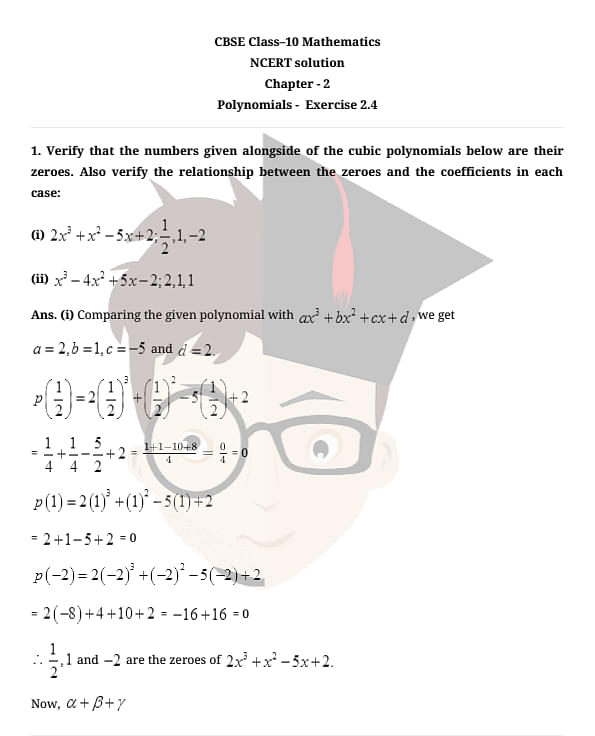
Check out the solutions of Class 10 Maths NCERT solutions chapter 2 Polynomics Exercise 2.4
Read More: NCERT Solutions For Class 10 Maths Polynomials

Check out other exercise solutions of Class 10 Maths Chapter 2 Polynomials

Class 10 Chapter 2 Polynomials Topics:

CBSE Class 10 Maths Study Guides:

CBSE X Related Questions

  • 1.
    In an A.P., if $a_{14} - a_8 = 24$, then the common difference of the A.P. is

      • $6$
      • $4$
      • $\pm 4$
      • $3$

    • 2.
      In the given figure, $PQ$ is tangent to the circle with centre $O$. $S$ is a point on the circle such that $\angle SQT = 55^\circ$. The $m\angle QPS$ is

        • $55^\circ$
        • $20^\circ$
        • $35^\circ$
        • $70^\circ$

      • 3.
        For an acute angle \(\theta\), if \(\sin \theta = \frac{1}{9}\), then value of \(\frac{9 \csc \theta + 1}{9 \csc \theta - 1}\) is

          • \(0\)
          • \(\frac{80}{81}\)
          • \(1\)
          • \(\frac{82}{80}\)

        • 4.
          Which of the following graphs represents a polynomial with both zeroes being positive?


          • 5.
            If the zeroes of the polynomial \(p(x) = 2x^2 - 7x + 6\) are \(\alpha\) and \(\beta\), then the value of \(\frac{1}{\alpha} + \frac{1}{\beta}\) is

              • \(\frac{7}{2}\)
              • \(\frac{6}{7}\)
              • \(\frac{-7}{6}\)
              • \(\frac{7}{6}\)

            • 6.
              Case Study - 1 : A model of Leafy Ball Fountain is made to be kept on the tabletop. Water gently cascades down the ball into a decorative cylindrical pool where it is recycled. The diameter of spherical ball is 21 cm. Cylindrical pool - Outer diameter is 50 cm and inner diameter is 40 cm. Height of solid base is 14 cm. Height of water filled is 7 cm. Observe the figure and answer the following questions : (i) Determine the total height of the fountain. (ii) Find the volume of the ball. (iii) (a) If one-third of the ball is submerged in the water, find the volume of the water filled in the pool. OR (iii) (b) Find the sum of the outer curved surface area of the cylindrical part and surface area of the ball.

                Comments


                No Comments To Show
