NCERT Solutions for Class 9 Maths Chapter 6 : Lines and Angles

Collegedunia Team logo

Collegedunia Team

Content Curator

The NCERT Solutions for Class 9 Maths have been provided in this article. Lines are dots spaced together that extend infnitely in two directions. Angles are shapes that form once two rays meet at the endpoint.

Class 9 Maths Chapter 6 Lines and Angles belong to Unit 4 Geometry which has a weightage of 27 marks in the Class 9 Maths Examination. NCERT Solutions for Class 9 Maths for Chapter 6 cover the following important concepts: 

  • Angle Sum Property of a Triangle
  • Lines and Angles
  • Parallel Lines and a Transversal

Download: NCERT Solutions for Class 9 Mathematics Chapter 6 pdf


NCERT Solutions for Class 9 Mathematics Chapter 6

The Chapter 6 Class 9 Maths are given below:
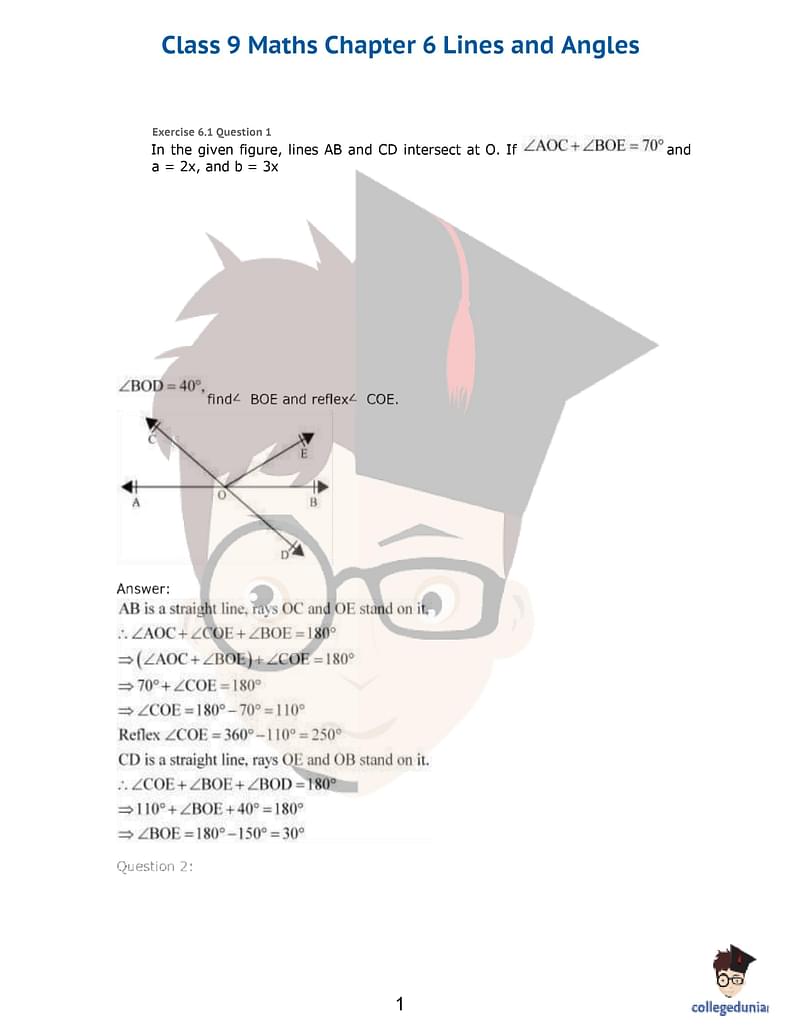
NCERT Solutions Mathematics NCERT Solutions Mathematics NCERT Solutions Mathematics NCERT Solutions Mathematics NCERT Solutions Mathematics NCERT Solutions Mathematics NCERT Solutions Mathematics NCERT Solutions Mathematics NCERT Solutions Mathematics NCERT Solutions Mathematics NCERT Solutions Mathematics NCERT Solutions Mathematics NCERT Solutions Mathematics NCERT Solutions Mathematics NCERT Solutions Mathematics NCERT Solutions Mathematics NCERT Solutions Mathematics NCERT Solutions Mathematics

Important Topics in Class 9 Maths Chapter 6 Lines and Angles

Important Topics in Class 9 Maths Chapter 6 Lines and Angles are elaborated below:

Angle Sum Property of a Triangle

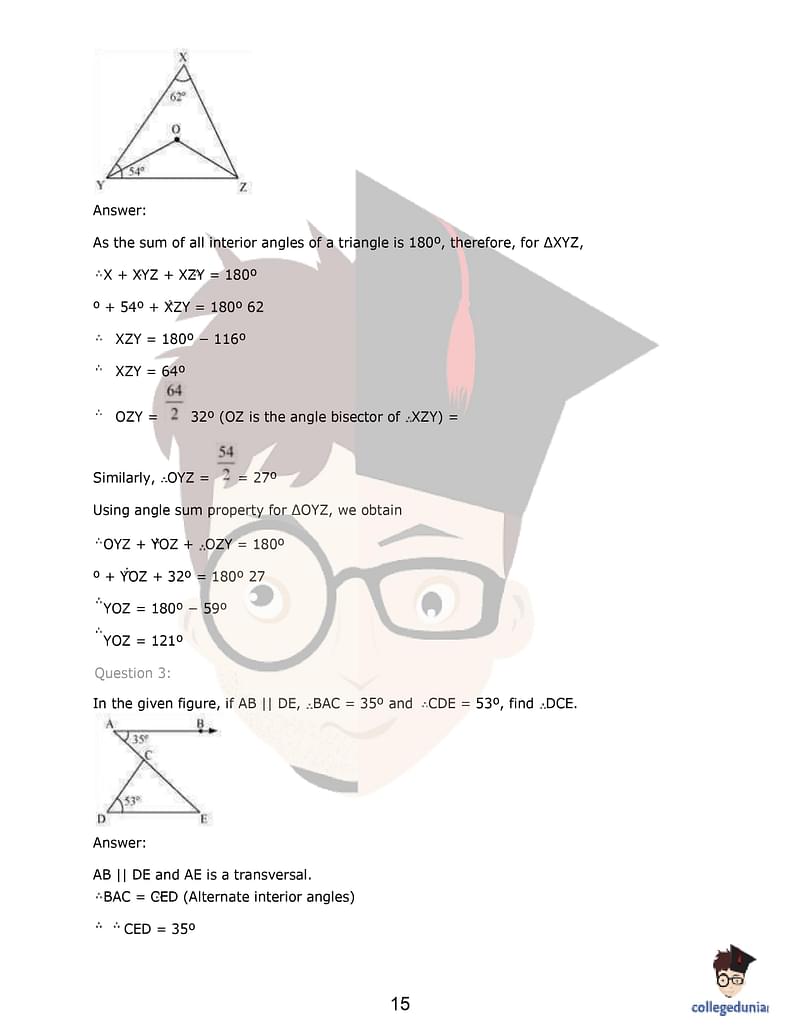
Angle sum property of a triangle claims that the sum of interior angles of a triangle is 180°. It is used to determine the measure of an unknown interior angle when the values of the other  angles are known.

Angle Sum Property of a Triangle can be expressed by the following formula:
S = ( n − 2) × 180°

Lines and Angles

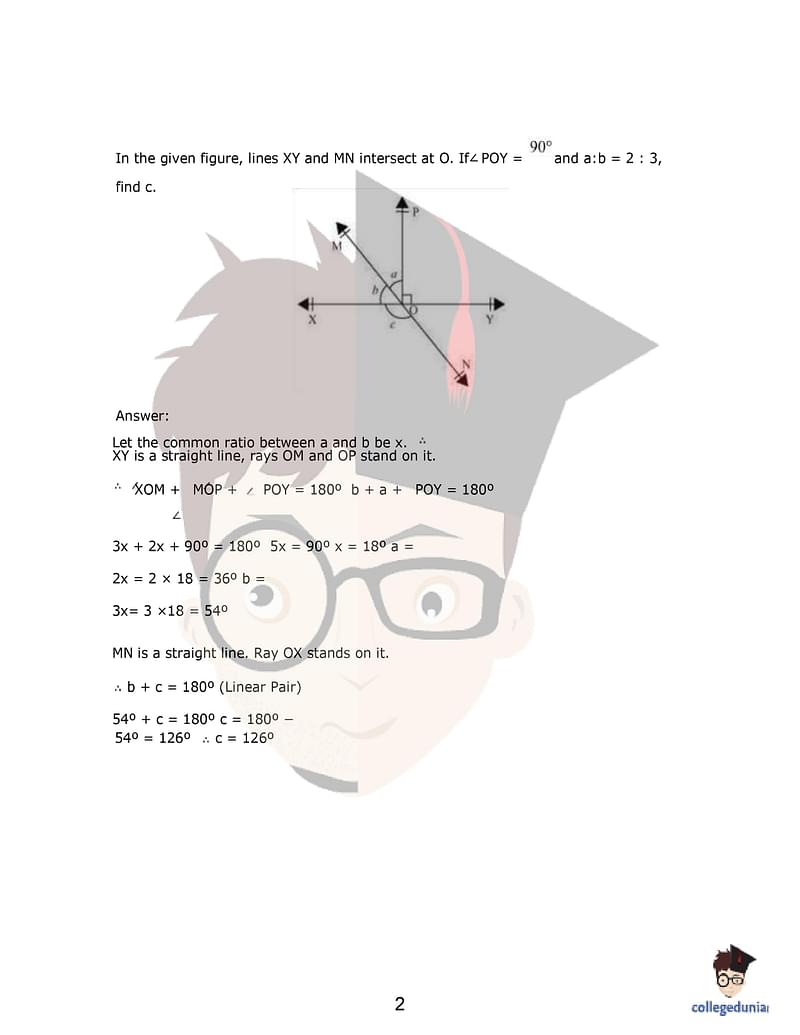
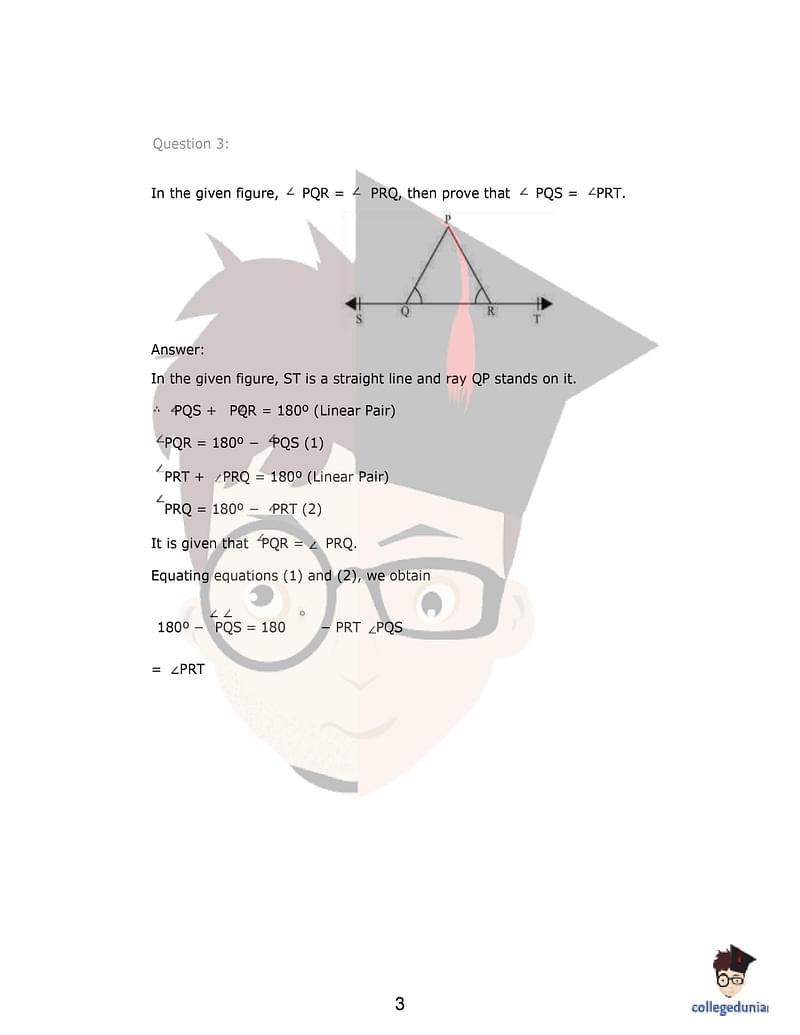
A line is a straight one-dimensional shape that extends infinitely in two directions. Angles form when two lines intersect one another. It can be represented by the symbol ∠.

Example: List what happens when two parallel lines are intersected by a transversal?

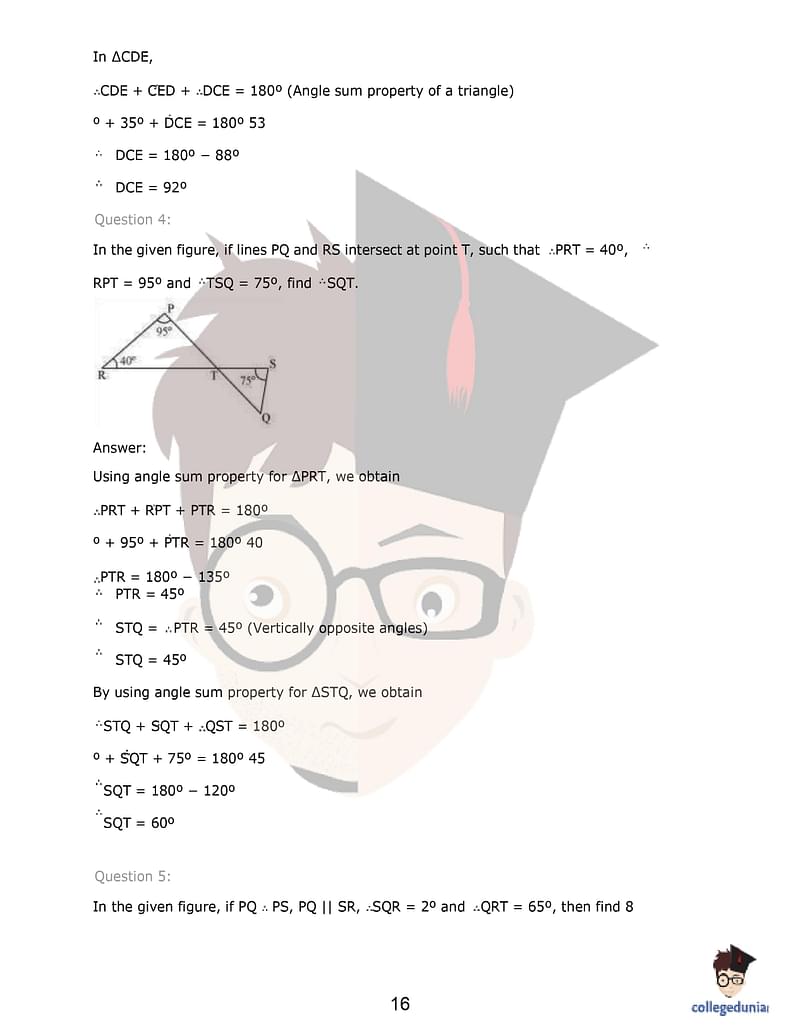
Solution: Assuming that two parallel lines are intersected by a transversal, the following occurs:

  • The vertically opposite angles are equal.
  • The corresponding angles are equal as well.
  • The alternate exterior and interior angles are equal too.

Parallel Lines and a Transversal

Parallel lines always remain the same distance apart and actually never meet. While, a transversal is any line that intersects two or more lines.

Example: What are some properties of a Transversal?

Solution: Some properties of a transversal are:

  • Its corresponding angles are always equal.
  • Its vertically opposite angles are found equal.
  • Its alternate interior angles are equal too.
  • Its alternate exterior angles are equal too.

NCERT Solutions for Class 9 Maths Chapter 6 Exercises:

The detailed solutions for all the NCERT Solutions for Lines and Angles under different exercises are:

Also check:

Also Read:

CBSE X Related Questions

  • 1.
    Mean and Median of a frequency distribution are 43 and 40 respectively. The value of mode is

      • 34
      • 43
      • 38.5
      • 41.5

    • 2.
      In an A.P., if $a_{14} - a_8 = 24$, then the common difference of the A.P. is

        • $6$
        • $4$
        • $\pm 4$
        • $3$

      • 3.
        It is given that \(\triangle ABC \sim \triangle EDF\). Which of the following is not true?

          • \(\frac{\text{Perimeter of } \triangle ABC}{\text{Perimeter of } \triangle EDF} = \frac{AB}{ED}\)
          • \(\frac{AB}{ED} = \frac{AC}{EF}\)
          • \(\angle A = \angle D, \angle C = \angle F\)
          • \(\frac{AB + BC}{AC} = \frac{ED + DF}{EF}\)

        • 4.
          Which of the following graphs represents a polynomial with both zeroes being positive?


          • 5.
            Assertion (A) : H.C.F. \((36 m^{2}, 18 m) = 18 m\), where \(m\) is a prime number.
            Reason (R) : H.C.F. of two numbers is always less than or equal to the smaller number.

              • Both Assertion (A) and Reason (R) are true and Reason (R) is the correct explanation of the Assertion (A).
              • Both Assertion (A) and Reason (R) are true, but Reason (R) is not the correct explanation of the Assertion (A).
              • Assertion (A) is true, but Reason (R) is false.
              • Assertion (A) is false, but Reason (R) is true.

            • 6.
              If for a data, median is 5 and mode is 4, then mean is equal to :

                • 7
                • 11
                • \(\frac{11}{2}\)
                • \(\frac{14}{3}\)

              Comments


              No Comments To Show