



Content Curator
Null Hypothesis can be used when using data and statistical tests to make judgments. H0 is used to denote the null hypothesis, which states that there is no difference in the features of the two samples.
- A null hypothesis is a statement of no difference, in statistics.
- Accepting the alternative hypothesis is the same as rejecting the null hypothesis.
- This hypothesis is either rejected or not rejected on basis of the viability of the given population or sample.
- Simply, the null hypothesis is a hypothesis wherein the sample observations result from chance.
- It can be expressed as a statement where the surveyors examine the data.
Key Terms: Null Hypothesis, Alternative Hypothesis, Variables, Independent Variable, Simple Hypothesis, Composite Hypothesis, Exact Hypothesis, Inexact Hypothesis
What is Null Hypothesis?
[Click Here for Sample Questions]
According to the null hypothesis, there is no discernible difference between the observed properties in the two sample sets.
- According to the null hypothesis, all samples have the same observed population characteristics or variables.
- There is no correlation between both the sample parameters, the dependent variable, and the independent variable, according to the null hypothesis.
- When there are no differences between the two means or if the difference is not very significant, it is said to be a null hypothesis.
The representation of Null Hypothesis and Alternative Hypothesis is shown below.
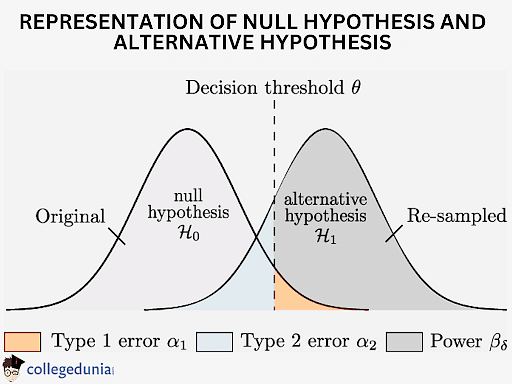
Null Hypothesis and Alternative Hypothesis
- It is true if the experimental result matches the predicted theoretical result.
- The null hypothesis is disproved and we examine an alternative one if there are any variations in the observed parameters between the samples.
- Usually, the null hypothesis is used to gauge the strength of the evidence.
The two strategies utilised in statistics are null hypothesis and Alternative hypothesis. According to the alternative theory, there is a large variation in the parameters between the samples. The opposite of the null hypothesis is the alternative hypothesis.
Errors in the experiment or the sampling are a significant factor in rejecting the null hypothesis and considering the Alternative hypothesis.
Also Read:
| Concept-Related Articles | ||
|---|---|---|
| Interquartile range | Statistical Inference | Mode of Grouped Data |
| Absolute Values | Sampling Error Formula | Venn Diagrams |
Null Hypothesis Principle
[Click Here for Sample Questions]
The idea behind null hypothesis testing is to gather data and calculate the probabilities of a particular set of data during an experiment on a random sample, presuming that the null hypothesis is correct.
- In case the given data does not give the expected null hypothesis, making the outcome weaker.
- Researchers conclude by mentioning that the given data set does not provide strong evidence against the null hypothesis due to insufficient evidence.
- Finally, that is generally rejected by researchers.
Null Hypothesis Rejection
The null hypothesis can also be rejected too. In case of the rejection of the hypothesis, it means that the research could be invalid.
Many researchers, therefore, will start to neglect this type of hypothesis as it is barely the opposite of the Alternative hypothesis. It is a better choice to create a hypothesis and further test it.
Hypothesis Testing
[Click Here for Sample Questions]
The parameters from the sample is used in hypothesis testing to derive information about the population. An educated guess about a sample is called a hypothesis, and it can be tested by an experiment or an observation. An initial null hypothesis is formed as a preliminary assumption about the sample.
To do a hypothesis test, follow these four steps. As follows:
- Find the contrarian theory.
- Explain the definition of the null hypothesis.
- Select the test that will be run.
- Accept the alternative theory or the null hypothesis.
The procedure of testing the hypothesis frequently contains flaws. The following are the two main mistakes that were found during hypothesis testing.
- Type I error: This occurs when one rejects the null hypothesis even though it is valid. The likelihood of committing a type I error is significantly equal to the alpha level.
- Type II error: When the null hypothesis is untrue, one fails to reject it, and this is what happens. The test's power is determined by the likelihood that a type II error will be made.
Also Read:
| Other Important Concepts | ||
|---|---|---|
| Union of Sets | Types of Sets | Universal Set |
Importance of Hypothesis testing
In statistics, the fundamental goal of a hypothesis statement is to ascertain if a population parameter's associated hypothesis is true or untrue. It is a crucial component of statistical techniques.
- A hypothesis test compares two propositions that are incompatible and finds which proposition is best supported by the available facts.
- When supported by a hypothesis test, a discovery or fresh finding has significant value. Because the hypothesis test gives enough proof to verify the reliability of the provided data.
- In the real world, researchers take a random sample from the population and use null and alternative hypotheses to conduct a hypothesis test on the sample data.
Read Also: Chemiosmotic Hypothesis
Difference Between Null Hypothesis and Alternative Hypothesis
[Click Here for Sample Questions]
The following examples will help you understand the distinction between a null hypothesis and an Alternative hypothesis.
| Alternative Hypothesis | Null Hypothesis |
|---|---|
| Alternative hypothesis is a statement, but with a relationship between two measured phenomena. | The null hypothesis can be considered as a statement as well but there is no relation between the two variables. |
| The Alternative hypothesis contends that there is a sizable difference between the two samples of the population. | The null hypothesis contends that the two samples of the population are identical. |
| H1 stands for the alternative hypothesis. | H0 represents the null hypothesis. |
| The observations of the Alternative hypothesis are the result of the real effect. | The observations concluded in the Null hypothesis are the result of chance. |
| For an Alternative hypothesis, there is a notable difference between the parameters and variables of the observed population across all samples. | For a null hypothesis, the parameters and variables of the observed population are the same across all samples. |
Types of Null Hypothesis
[Click Here for Sample Questions]
The term "Null hypothesis" refers to four main sorts. The explanations for each are followed by examples.
Simple Hypothesis
A simple hypothesis is one that predicts the relationship between two variables. Both are variables, but only one is an independent variable. The population distribution is completely specified by a simple hypothesis. A simple hypothesis example can be shown by the statement, "Daily consumption of sugary beverages causes weight gain."
Composite Hypothesis
The relationship between two or more independent variables and two or more dependent variables is described by a composite hypothesis. The population distribution is not described in this idea. The following is an illustration of the Composite Hypothesis:
"People who regularly drink sugary beverages and have a family history of health problems are more prone to gain weight and have diabetes."
Exact Hypothesis
The precise value of the parameter or variable is stated in this hypothesis. The precise hypothesis satisfies every presumption established throughout the hypothesis's derivation. An exact hypothesis would be something like, "Students in a division average 17 out of 25 on tests. Hence, μ=17."
Inexact Hypothesis
The exact value of the parameter or variable is not specified in the inexact type of hypothesis, in contrast to the exact hypothesis. Instead, the parameter's precise range or interval is provided. For instance, on exams, students in the class often receive scores between 12 and 15 out of 20. Hence, 12< μ< 15.
Also Read:
Null Hypothesis Formula
[Click Here for Sample Questions]
The null hypothesis formula can be shown as:
| H0: p = p0 |
The alternative hypothesis is expressed by the formula Ha = p >p0 and p not equal to p0.
The test static formula is represented by:

Note: The null hypothesis, in this case, is p0.
Also Read: Population Sample
Things to Remember
- A hypothesis aids the researcher in translating any given issue into an understandable justification for the study's findings.
- Null Hypothesis is often utilized while using data and statistical tests to make judgments.
- H0 is the symbol that helps to denote the null hypothesis.
- The types of Null hypotheses are: Simple Hypothesis, Composite Hypothesis, Exact Hypothesis, and Inexact Hypothesis.
- The Null hypothesis formula is H0: p = p0.
Also Read:
Sample Questions
Ques. What does the term "null hypothesis" mean? (1 mark)
Ans. A null hypothesis is a type of hypothesis used in statistics to examine the validity of the provided experimental results by explaining the population parameter.
Ques. What is the Null Hypothesis formula? (1 mark)
Ans. The formula for null hypothesis is H0: p = p0.
Ques. What advantages do hypothesis tests offer? (1 mark)
Ans. A type of inferential statistics known as hypothesis testing allows drawing generalisations from a sample typical of the population.
Ques. What circumstances both accept and reject a null hypothesis? (1 mark)
Ans. According to the available facts, the null hypothesis is either accepted or rejected. The null hypothesis is disregarded in favour of the alternative hypothesis if P-value is less than, and it is accepted in place of the alternative hypothesis if P-value is larger than.
Ques. What is Composite Hypothesis? (2 marks)
Ans. The relationship between two or more independent variables or two or more dependent variables can be explained via a composite hypothesis. In hypothesis testing, a composite hypothesis can simply be defined as a hypothesis that helps to cover a set of values from the parameter space
Ques. What in mathematics is a null hypothesis and Alternative hypothesis? (3 marks)
Ans. In statistics, the null hypothesis is used to determine whether there is a significant difference between the two samples. The null hypothesis is accepted when there is no discernible difference between the two samples.
The Alternative hypothesis must be accepted because the null hypothesis was rejected and the two samples are distinct. H0 stands for the alternative hypothesis, while Ha stands for the null hypothesis.
Ques. According to a study, people recovering from knee surgery would need to attend physical therapy twice weekly rather than three times. Patients undergoing knee surgery are given 8.2 weeks to recover on average. (5 marks)
Ans. Step 1: To begin, we must separate the hypothesis from the issue. Most of the time, the hypothesis is a word problem that you have to solve. The statement "I predict the average recovery duration to be larger than 8.2 weeks" is the hypothesis that has been made in the aforementioned query.
Step 2: is to translate the hypothesis into numbers. Keep in mind that the average might occasionally be written as.
H1: μ > 8.2(average) (average)
Step 3: Describe what will occur if the hypothesis is incorrect. There are only two alternatives if the recovery period does not exceed the average, which is 8.2 weeks: either it is equal to 8.2 weeks or it is shorter than 8.2 weeks.
H0: μ ≤ 8.2
The average (the null hypothesis) is that it is less than or equal to 8.2
H0 -> µ1= µ2 in which
The null hypothesis is H0.
- µ1 is the population's mean, and
- µ is the population's mean
Ques. List examples of Null Hypothesis. (3 marks)
Ans. Here are some null hypothesis example:
- An example of a null hypothesis is that a person's pay is unrelated to his profession. Another possibility is that a person's wage depends on their line of work.
- A null hypothesis is that there is no difference in the math performance of the pupils in the two classes. Another example of an Alternative hypothesis is that each class's pupils perform differently.
- The null hypothesis is that the nutritional value of a mango and a mango milkshake is equal. The Alternative hypothesis test is used to demonstrate that the two foods have different nutrient contents.
Ques. To see if a specific medicine can act as a Covid-19 vaccination and prevent the development of Corona, a medical experiment and trial are done. Describe the situation's null hypothesis and Alternative hypothesis in writing. (5 marks)
Ans. The topic in question concerns a potential new medicine and whether it functions as a Covid-19 vaccination or not. For this medical test, the Alternative hypothesis (Ha) and null hypothesis (Ho) are as follows.
- H0: Using the new medication won't help with Covid-19 prevention.
- Ha: The new medication works as a vaccination and aids in Covid-19 prevention.
The teacher gives the student a list of crucial questions and explains that practising them would help them achieve a grade point average of greater than 60% on their board exams.
The teacher who claimed that her key questions helped students earn more than 60% on board exams is the subject of the incident. Following are the null hypothesis (Ho) and alternative hypothesis (Ha) for this case.
- Ho: The teacher's essential questions don't actually assist the students in achieving a score of more than 60% on the board exams.
- Ha: The teacher's key questions enable the pupils to achieve a grade of at least 60% on the board exams.
If two samples are taken from the same population, a stronger null hypothesis states that the variances and shapes of the distributions are also equal.
Ques. Represent Null Hypothesis through three instances of different organisations. (5 marks)
Ans. Let's say a botanist predicts that a particular fertiliser will lead plants to grow more than they do over the course of a month. They can now reach a height of 20 inches. The botanist fertilises all of the plants in her lab for a month to evaluate the fertilizer's efficacy. Then applies the following hypothesis to a hypothesis test:
- H0: = 20 inches because fertiliser has no impact on the average plant growth at all.
- HA: > 20 inches (the fertiliser will cause mean plant growth to increase) The null hypothesis will be rejected if the test's p-value is significantly less, which causes the fertiliser to promote faster plant growth.
Hypothesis tests are frequently used in clinical trials to ascertain whether a novel therapy, medication, procedure, etc. leads to better patient outcomes and raises the level of therapy.
Let's say a physician wants to examine a novel medication that lowers blood pressure in people who are obese. The physician may take blood pressure readings from 40 individuals before and after they take the new medication for a month to assess its efficacy.
- H0: "after = before" indicates that the drug's average blood pressure was the same before and after use.
- HA: "after" and "before" (the mean blood pressure is less after using the drug)
In commercial organisations, hypothesis testing is frequently performed to ascertain whether a new advertising campaign will generate more leads and boost sales.
Let's say an organization's leadership team thinks that increasing expenditure on digital advertising will result in higher sales. The company could increase its spending on digital advertising for three months while gathering data to determine whether or not total sales have grown. The following hypothesis can be put to the test in a hypothesis test.
- H0: After = Before denotes that even after spending more on advertising, the mean sales are the same.
- HA: Before > after (the mean sales increased spending more on advertising).
Check Out:



Comments