



Education Content Expert
Ordinal Numbers are those numbers that represent the precise position of an object in a particular space. If a number of things or people are given as a list, ordinal numbers are used to determine their order or rank in the list. The adjective terms first, second, third, fourth, fifth, and so on are used to indicate the place of an object or person in the hierarchy. The order or sequence of the ordinal numbers changes depending on the criteria used to mark the positions, such as size, weight, markings, etc. Ordinals is another name for ordinal numbers. An example of ordinal numbers would be “Raj stood first in his class.” Here, First (1st) is the ordinal number describing the position of Raj in his class. Ordinal, Nominal, and Cardinal Numbers are the three types of numbers used to represent objects in Maths.
Read More: Number System
| Table of Content |
Key Terms: Ordinal Numbers, Cardinal Numbers, Position, Rank, Ordinals, Natural Numbers, Positioning Numbers, Nominal Numbers
What are Ordinal Numbers?
[Click Here for Sample Questions]
Ordinal numbers are used to specify the position of an object or a person in a certain situation or place.
- Ordinal numbers are used to establish the order of the objects or individuals in a given list.
- The adjective terms used to denote the order of something/someone are 1st- First, 2nd- Second, 3rd- Third, 4th- Fourth, 5th- Fifth, 6th- Sixth, and so on.
- Ordinal Numbers are also known as ranking or positioning numbers.
- The order of ordinal numbers varies depending on the factors like weight, height, marks, size, etc.
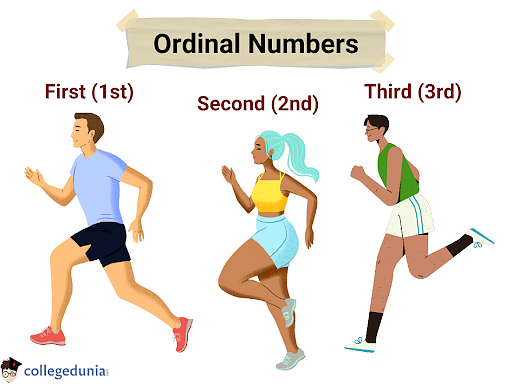
Ordinal numbers
Read More:
| Relevant Concepts | ||
|---|---|---|
| Types of Numbers | Numbers in Words | Prime Numbers |
| Numbers in General Form | Complex Numbers | Composite Numbers |
Examples of Ordinal Numbers
[Click Here for Sample Questions]
Here are some real-life examples of ordinal Numbers:
- Max always ranks 3rd (third) in the class. Here the ordinal number is 3rd because it tells us about the position secured by the person.
- I stay on the sixth floor of the apartment. Here the ordinal number will be sixth (6th) as it describes the position of the floor where I stay.
- The chair is placed at the fourteenth position in the display of the shop. Here the ordinal number will be fourteenth (14th) because the position of the chair is described by this number.
- In the letter ‘WINTER’, N is at the third position, and therefore the ordinal number of N in this word would be third (3rd).
- The second month of the year is February. Here the ordinal number will be second (2nd) as it tells about the position of the month where it is placed.
Ordinal Numbers 1 to 100
[Click Here for Sample Questions]
Given below is the list of ordinal numbers from 1 to 100.
Ordinal Numbers 1 to 50
Ordinal Numbers from 1 to 50 are as follows:
| Ordinal Numbers 1 to 50 | |
|---|---|
| 1st- First | 26th- Twenty Sixth |
| 2nd- Second | 27th- Twenty Seventh |
| 3rd- Third | 28th- Twenty Eighth |
| 4th- Fourth | 29th- Twenty Ninth |
| 5th- Fifth | 30th- Thirtieth |
| 6th- Sixth | 31st- Thirty First |
| 7th- Seventh | 32nd- Thirty Second |
| 8th- Eighth | 33rd- Thirty Third |
| 9th- Ninth | 34th- Thirty-Fourth |
| 10th- Tenth | 35th-Thirty Fifth |
| 11th- Eleventh | 36th- Thirty-Sixth |
| 12th- Twelfth | 37th- Thirty-Seventh |
| 13th- Thirteenth | 38th- Thirty Eighth |
| 14th- Fourteenth | 39th- Thirty-Ninth |
| 15th- Fifteenth | 40th- Fortieth |
| 16th- Sixteenth | 41st- Forty-First |
| 17th- Seventeenth | 42nd- Forty Second |
| 18th- Eighteenth | 43rd- Forty Third |
| 19th-Nineteenth | 44th- Forty-Fourth |
| 20th-Twentieth | 45th- Forty FIfth |
| 21st- Twenty First | 46th- Forty Sixth |
| 22nd- Twenty Second | 47th- Forty-Seventh |
| 23rd- Twenty Third | 48th- Forty-Eighth |
| 24th- Twenty Fourth | 49th- Forty Ninth |
| 25th- Twenty Fifth | 50th- Fiftieth |
Ordinal Numbers 51 to 100
Ordinal Numbers from 1 to 50 are as follows:
| Ordinal Numbers 51 to 100 | |
|---|---|
| 51st- Fifty First | 76th- Seventy Sixth |
| 52nd- Fifty Second | 77th- Seventy Seventh |
| 53rd- Fifty Third | 78th- Seventy Eighth |
| 54th- Fifty Fourth | 79th- Seventy Ninth |
| 55th- Fifty Fifth | 80th- Eightieth |
| 56th- Fifty Sixth | 81st- Eighty First |
| 57th- Fifty Seventh | 82nd- Eighty Second |
| 58th- Fifty-Eighth | 83rd- Eighty-Third |
| 59th- Fifty Ninth | 84th- Eighty Fourth |
| 60th- Sixtieth | 85th- Eighty Fifth |
| 61st- Sixty First | 86th- Eighty-Sixth |
| 62nd- Sixty Second | 87th- Eighty-Seventh |
| 63rd- Sixty-Third | 88th- Eighty Eighth |
| 64th- Sixty-Fourth | 89th- Eighty Ninth |
| 65th- Sixty Fifth | 90th- Ninetieth |
| 66th- Sixty Sixth | 91st- Ninety One |
| 67th- Sixty-Seventh | 92nd- Ninety Second |
| 68th- Sixty Eighth | 93rd- Ninety-Third |
| 69th- Sixty-Ninth | 94th- Ninety Fourth |
| 70th- Seventieth | 95th- Ninety Fifth |
| 71st- Seventy First | 96th- Ninety Sixth |
| 72nd- Seventy second | 97th- Ninety Seventh |
| 73rd- Seventy-Third | 98th- Ninety Eighth |
| 74th- Seventy Fourth | 99th- Ninety-Ninth |
| 75th- Seventy-Fifth | 100th- Hundredth |
Difference between Cardinal, Nominal and Ordinal Numbers
[Click Here for Sample Questions]
There are three categories of numbers used to represent objects or people which are as follows:
- Ordinal Numbers
- Cardinal Numbers
- Nominal Numbers
Cardinal Numbers
Cardinal numbers are those numbers that denote the count of any object. Any natural number such as 1, 2, 3, 4, 5, etc., is referred to as a cardinal number.
Examples of Cardinal Numbers are
- Five people are standing on the road.
- There are ten apples in the basket.
Nominal Numbers
Nominal numbers are the numbers that are applied to name the objects in a group. It is easy to identify objects or a thing in a collection of things with the help of nominal numbers.
Examples of Nominal Numbers are
- Vehicle numbers like HB 23 1560.
- Pin Codes of Cities.
Ordinal Numbers
Ordinal numbers on the other hand are numbers that denote the position or place of an object such as 1st, 2nd, 3rd, 4th, etc.
Examples of Ordinal Numbers are
- The boy is standing in the third position.
- Delhi is ranked first in the most polluted cities.
Also Check:
| Related Topics | ||
|---|---|---|
| Large Numbers | Number Lines | Irrational Numbers |
| Even and Odd Numbers | Rational Numbers | Real Numbers |
Ordinal Numbers Chart
[Click Here for Sample Questions]
The term "Ordinal Chart" refers to a visual depiction of ordinal numbers. A chart of the ordinal number from 1 to 20 is given below:
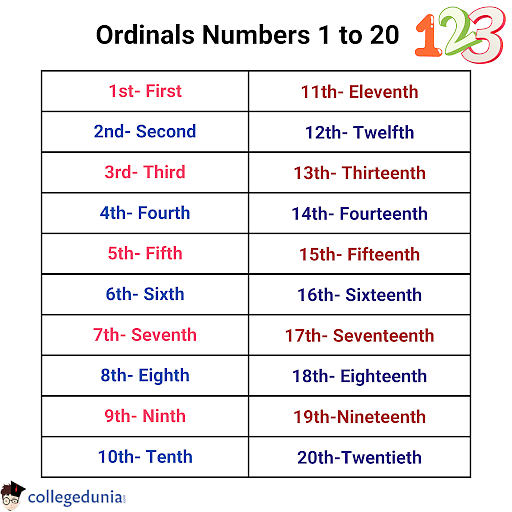
Ordinal Numbers Chart
Things to Remember
- Ordinal Numbers represent the position or rank of an object or a person.
- They are also referred to as positioning numbers or ordinals.
- Ordinal numbers can be expressed using prefixes of numerals and suffixes of adjectives, such as 1st, 2nd, 3rd, 4th, 5th, and so on.
- Ordinal numbers are employed when we need to sort a given data in a sequence.
- Ordinal numbers are used to indicate the sequence of dates or the sequence of events.
Sample Questions
Ques. Define ordinal numbers along with examples. (3 Marks)
Ans. The location of a certain person or thing within a space is indicated by an ordinal number. If the number of items or people is given as a list, the order of the items or people is determined using ordinal numbers. The adjectives first, second, third, fourth, fifth, sixth, and so on are used to indicate something or someone's place in the hierarchy. All of these expressions employ ordinal numbers.
Here are some examples:
- 1- First (1st)
- 5- Fifth (5th)
- 7- Seventh (7th)
- 32- Thirty-Second (32nd)
Ques. Write the numbers in ordinal number form from 1 to 10. (3 Marks)
Ans. The numbers in ordinal number form from 1 to 10 are
- 1st- First
- 2nd- Second
- 3rd- Third
- 4th- Fourth
- 5th- Fifth
- 6th- Sixth
- 7th- Seventh
- 8th- Eighth
- 9th- Ninth
- 10th- Tenth
Ques. What is the ordinal number for 50, 62, 76, 54, and 33? (3 Marks)
Ans. The ordinal numbers for the given set of numbers are
- The ordinal number for 50 is Fiftieth (50th).
- The ordinal number for 62 is Sixty-Second (62nd).
- The ordinal number for 76 is Seventy-Sixth (76th).
- The ordinal number for 54 is Fifty-Fourth (54th).
- The ordinal number for 33 is Thirty- Third (33rd).
Ques. Mary, Tina, Jack, and Jill are standing in a row. Who is in the third position? (2 Marks)
Ans. From the given information, we can say that Mary is in the first place, Tina is in second place, Jack is in third place, and Jill is in fourth place. Therefore, Jack is standing in the third position. Here, 3rd is an ordinal number because it denotes the position of Jack.
Ques. State the difference between cardinal numbers and ordinal numbers. (3 Marks)
Ans. The main difference between cardinal numbers and ordinal numbers is as follows:
| Cardinal Numbers | Ordinal Numbers |
|---|---|
| Cardinal Numbers are counting numbers that represent quantity. | Ordinal Numbers are based on the rank or position of an object in a given list or order. |
| Cardinal numbers give us the answer to the question 'how many?'. | Ordinal numbers give us the answer to the question 'where?'. |
| Examples of cardinal numbers are 1, 2, 3, 4, 5, 10, etc. | Examples of ordinal numbers are 1st, 2nd, 3rd, 4th, 5th, 10th, etc. |
Ques. In the word ‘COLLABORATION’ which is the first, fifth, and the first letter? (3 Marks)
Ans. The word ‘COLLABORATION’ had 13 letters.
- The first (1st) represents the ordinal number of the letter ‘C’.
- The fifth 5th), representing the ordinal number of the letter ‘A’.
- The first (1st), representing the ordinal number of the letter ‘C’.
Ques. Express the ordinal number for 100, 88, 99, 77, 66, and 45. (3 Marks)
Ans. The ordinal number 100 is represented by the words "one hundredth" or "the hundredth."
- For 88- Eighty Eighth
- For 99- Ninty Ninth
- For 77- Seventy Seventh
- For 66- Sixty-sixth
- For 45- Forty Fifth
Ques. What is the difference between nominal and ordinal numbers? (3 Marks)
Ans. The difference between nominal and ordinal numbers is given below:
| Nominal Numbers | Ordinal Numbers |
|---|---|
| The numbers that name the objects in a group, are called nominal numbers. | Ordinal numbers are the numbers that express the positions of an object or a person |
| Social Security numbers, zip codes, bank codes, routing numbers, and car model numbers are examples of nominal numbers. | Ordinal numbers include things like the first footman, the third Saturday of the month, the third of October, the eighth child in the family, and so on. |
Ques. How can we use ordinal numbers in everyday life? (2 Marks)
Ans. We use ordinal numerals to indicate the sequence of dates or the sequence of events. Ordinal numbers should only be employed when sorting needs to be done for provided data. Ordinal numbers are used to rank students based on their marks, rank players in a race, and various related fields.
Ques. What is the fourth letter in the word ‘WINTER’? (2 Marks)
Ans. In the given word, WINTER, the first letter is 'W’. The second letter is 'I’. Similarly, we count the position of the letters in order, like, first, second, third, and so on which denotes ordinal numbers. So, we can see that the letter 'T' comes in the 4th position. Therefore, the fourth letter in the given word is 'T'.
Check-More:



Comments