



Content Curator
The perimeter of a Rhombus formula is 4 x s (Here, s = the side length of the rhombus). Rhombus is a flat-shaped two dimensional structure having four equal angles and four equal sides. The four angles are not 90 degrees necessarily.
This shape is also considered to be a diamond-shaped structure. The perimeter of the rhombus is actually the total distance covered along the border of it.
| Table of Content |
Key Terms: Rhombus, Perimeter, Pythagoras Theorem, Adjacent Angles, Bisect, Diagonals
Perimeter of Rhombus
[Click Here for Sample Questions]
According to the definition of the Rhombus,
| Perimeter of Rhombus = 4 x s |
Where,
s = the side length of the rhombus.
Hence, P = s + s + s + s = 4s
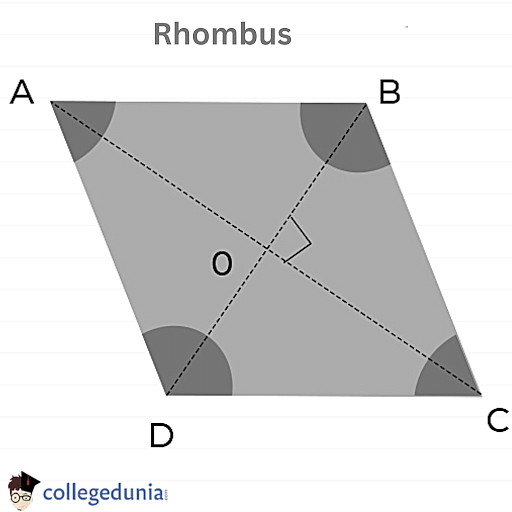
Rhombus
Area of the Rhombus
[Click Here for Sample Questions]
The area of rhombus can be determined in two ways:
i) By multiplying the height & base of the rhombus
Area = b x h [b = base of rhombus; h = height of rhombus]
ii) By determining the product of the diagonal of the rhombus & dividing it by 2
Area = ½ x d1 x d2 [d1 & d2 are the diagonals of the rhombus]
Read More:
Derivation of the Area of Rhombus
[Click Here for Sample Questions]
If MNOP is considered a Rhombus with base MN = b, PN ⊥ MO, MO is a diagonal of rhombus = d2; PN is a diagonal of rhombus = d1; altitude from O on MN is OZ which is = h.
- Then, the area of the rhombus MNOP = 2 x area of ∆ MNO
= 2 x ½ MN x OP
= 2 x ½ b x h (sq. Units)
- The area of the rhombus = 4 x Area of ∆ MZP
= 4 x ½ x MZ x ZN
= 4 x ½ x d2 x ½ d1 (sq. Units)
= 4 x 1/8 d1 x d2
The area of a rhombus = ½ x d1 x d2
Finding Perimeter of Rhombus Using Diagonal Lengths
Given, in a rhombus PQRS, a as the horizontal diagonal length and b as vertical diagonal length and center o.
Let’s take triangle POS, then the length of
OP = a/2
OS = b/2
If we assume the side of the rhombus as = X
Using Pythagoras theorem,
X2 = a2/2 + b2/2
X2 = (a2 + b2)/4
X = \(\sqrt{ \frac{( a^2+b^2)}{2}}\)
By substituting the value of X in the rhombus formula = 4X, we get,
4 x \(\sqrt{ \frac{( a^2+b^2)}{2}}\)
So, the perimeter will be = 2 x \(\sqrt{ \frac{( a^2+b^2)}{2}}\)
Properties of Rhombus
[Click Here for Sample Questions]
Rhombus is known to be a square due to the following properties of Rhombus:
- It’s all sides have equal length
- It’s opposite sides are parallel
- Its diagonals bisect each other at 90 degrees.
- Two adjacent angles forms a total of 180 degree
- It’s altitude is the distance at right angles between the two parallel sides
Things to Remember
- Diagonals of a rhombus divide each other at right angles or 90 degrees.
- The perimeter of a rhombus is said to be the sum of all four sides
- The sum of all the angles of a rhombus is 360 degrees
- The rhombus share the same properties as that of a square. Hence, rhombus is also said to be a square.
- Rhombus differs from rectangle in a way as rhombus has opposites angles as equivalent while rectangle has opposite sides as equivalent
Sample Questions
Ques. What is the perimeter of a rhombus with side 8 cm? (2 marks)
Ans: Given, side of the Rhombus = 8 cm
Perimeter of rhombus = 4 x s
= 4 x 8 cm = 32 cm
Ques. The diagonals of a rhombus are 44 cm and 15 cm. Find the area of the rhombus. (2 marks)
Ans: Let’s take, a = 44 cm; b = 15 cm
Area of the rhombus (A) = ½ x a x b
= ½ x 44 cm x 15 cm
= 330 cm2
Ques. The side of a rhombus is 2.5 cm. What is the perimeter of the rhombus? (2 marks)
Ans: Let’s take, s = 2.5 cm
Perimeter of rhombus (given) = 4 x s
Hence, (P) = 4 x 2.5 cm
= 10 cm
Ques. The diagonals of a rhombus are 24 cm and 10 cm. Find the area of the rhombus. (2 marks)
Ans: Let’s take, a = 24 cm; b = 10 cm
Area of the rhombus (A) = ½ x a x b
= ½ x 24 cm x 10 cm
= 60 cm2
Ques. What is the perimeter of a rhombus with side 16 cm? (2 marks)
Ans: Given, side of the Rhombus, s = 16 cm
Perimeter of rhombus = 4 x s
= 4 x 16 cm = 64 cm
Ques. What is the perimeter of a rhombus having two diagonals of 6cm & 8 cm respectively? (3 marks)
Ans: Given, d1 = 6 cm; d2 = 8 cm
According to the formula,
Perimeter of rhombus = 2 x \(\sqrt{ \frac{( a^2+b^2)}{2}}\)
= 2 x \(\sqrt{ \frac{( 6^2+8^2}{2}}\)
= 2 x 10
= 20 cm
Ques. Find the perimeter of a rhombus having two diagonals of 4 cm & 6 cm respectively? (3 marks)
Ans: Given, d1 = 4 cm; d2 = 6 cm
According to the formula,
Perimeter of rhombus (P) = 2 x \(\sqrt{ \frac{( a^2+b^2)}{2}}\)
= 2 x \(\sqrt{ \frac{( 4^2+6^2}{2}}\)
= 2 x 5.8 cm
= 11.6 cm
Ques. The Perimeter of a rhombus is 48 cm. Find the side of a rhombus. (3 marks)
Ans: Given, perimeter of the Rhombus (P) = 48cm
Hence, P = 4 x s [according to formula]
s = p/4
s = 48/4 cm = 12 cm
So, the side of the rhombus is 12 cm
Ques. Find the perimeter of a rhombus with a given side of 5 cm. (3 marks)
Ans: Given, side of a rhombus, s = 5 cm
According to the formula, perimeter of the rhombus is
P = 4 x s
= 4 x 5 cm
= 20 cm
Ques. The perimeter of a rhombus is 60 cm. Find the side of a rhombus. (3 marks)
Ans: Given, perimeter of the Rhombus (P) = 60 cm
Hence, Perimeter of the rhombus, P = 4 x s [according to the formula]
s = p/4
s = 60/4 cm = 15 cm
So, the side of the rhombus is 15 cm
Read More:



Comments