



Content Curator
Periodic motion is the physics nomenclature for momentum that cycles itself over and again, and the time necessary for one repetition is termed as time period, which is typically written as the letter T. (The sign P is not used because it could be confused with momentum.) A cycle is a whole recurrence of the motion. The number of iterations per unit time is referred as frequency. Angular Frequency is a scalar physical quantity that measures how fast an object rotates or oscillates with respect to time. Angular frequency is denoted by the Greek letters Ω or ω . It is measured in radians per second, the SI unit, or rpm (revolutions per minute).
| Table of Content |
Key Terms: Periodic Motion, Frequency, Time Period, Angular Frequency, Oscillations, wave, Pendulum, Motion, Velocity, Vibrations.
What is Frequency?
[Click Here for Sample Questions]
A sinusoidal wave's frequency is defined as the number of complete revolutions made by any wave constituent per unit of time. We may comprehend that if a component is in periodic motion, it has completed each cycle after going through a sequence of occurrences or locations and resuming to its original condition using the notion of frequency. As a result, frequency is a quantity that represents the rate at which oscillations and vibrations occur.
SI Unit= Hertz
The following equation describes the relationship between frequency and period:
f=1/T
For a sinusoidal wave represented by the equation:
y (0,t) = -a sin (ωt)

Frequency Wave
The formula of the frequency with the SI unit is given as:
| Formula: \(f = \frac{1}{T} = \frac{\omega}{2 \pi}\) SI Unit: Hertz |
Also Read: Frequency and Wavelength
What is Time Period?
[Click Here for Previous Year Questions]
The molecules moving around the mean equilibration or mean location with the flow of time in sinusoidal wave movement, as seen in the illustration. The particles climb until they hit the crest, which is the highest peak, and then descend until they touch the trough, which is the lowest position. The cycle follows a predictable pattern. A wave's time phase is determined as the amount of time it takes any constituent of the thread to accomplish one oscillation. For a sinusoidal waveform, use the following equation:
| y (0, t) = -a sin(ωt) |
Time Period and Amplitude
Also Read: Velocity
What is Angular Frequency?
[Click Here for Sample Questions]
The frequency refers to the proportion of full cycles of waves crossing a location in unit time, whereas the time period is the time required for a full rotation of waveforms to pass a point. The angular shift of any wave constituent per unit time is known as angular frequency. In wave terms, the angular rate of a sinusoidal wave corresponds to the angular motion of any constituent of the wave in unit time. The letter 'w' stands for it.
The oscillation rate 'f,' defined in revolutions per second, multiplied by the angle across which the person moves, is the expression for angular frequency. For an item that fulfils a full oscillation or revolution, the angular frequency ratio is: \(\omega =2\pi f\)
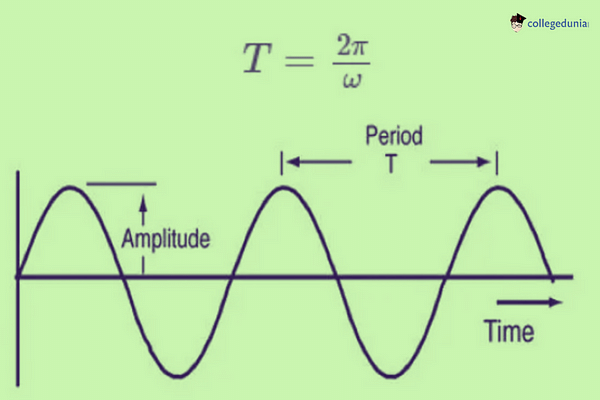
Time Period and Amplitude
Also Read: Angular Speed
Angular Frequency Formula
The frequency of rotation i.e. how many rotations take place in a certain amount of time can be computed as:
\(f = \frac{1}{T}\)
In the case of the Earth, one rotation takes 365 days, thus
\(f = \frac{1}{365}\)
The formula for angular frequency is the oscillation frequency ‘f’ measured in oscillations per second, multiplied by the angle through which the body moves. The angular frequency formula for an object which completes a full oscillation or rotation is computed as:
\(\omega = 2 \pi f\)
Also in terms of the time period, we compute angular frequency as:
| \(\omega = \frac{2\pi}{365}\) |
Parameters of a Wave
[Click Here for Previous Year Questions]
Frequency is the number of complete cycles of waves passing a point in unit time. Time Period refers to the time taken by a complete cycle of the wave to pass a point. Angular frequency is the angular displacement of any element of the wave per unit of time.
Consider the graph shown below. It represents the displacement y of any element for a harmonic wave along a string moving in the positive x-direction with respect to time. Here, the string element moves up and down in simple harmonic motion.
Applications of Frequency, Time Period & Angular Frequency
[Click Here for Sample Questions]
The applications of Frequency, Time period & Angular Frequency are stated below:
- The rate of a pendulum, a swing-like resonator, is the count of "swings" every minute. Its frequency is related to the sum of squares of gravity's descending acceleration (32 ft or 9.8 m/sec 2) split by the pendulum's wavelength. This indicates that the frequencies of the clock may be changed by modifying the length of the swing: if the pendulum size is decreased, the clock will travel faster; if the pendulum position is stretched, the clock will run slower.
- The loudness of any sound is proportional to the intensity of the sound waves. The pitch or tone, on either extreme, is determined by frequency. Although there's no direct relationship between severity and pitch, a person must encounter very low-frequency sounds above a particular decibel level in order to perceive it.
- The Human Ear can hear frequencies ranging from 20 to 20,000 Hz. However, the ideal frequency range for listening is between 3,000 and 4,000 Hz. This puts the piano's 88 keys, which span from 27 Hz to 4,186 Hz, comfortably within human hearing range.
- Simple harmonic mobility is a periodic motion in which the restoring force is proportional to the elevation (i.e., it obeys Hooke's Law). It can be used as a mathematical formula for a number of motions, including spring resonance. Other processes, including the movement of a pendulum bob or molecular resonance, can also be represented by a simple harmonic oscillator.
Previous Year Questions
- A hollow cylinder with both sides open generates a frequency… [WBJEE 2008]
- A pipe open at both ends and a pipe closed at one end have same length… [MHT CET 2019]
- A wave travelling along a string is described by the equation… [MHT CET 2008]
- A tuning fork with frequency 800Hz produces resonance in a resonance… [NEET 2019]
- A 5.5 metre length of string has a mass of 0.035kg… [NEET 1989]
- If the amplitude of sound is doubled and the frequency reduced to one fourth… [NEET 1989]
- 4.0 g of a gas occupies 22.4 litres at NTP. The specific heat capacity of the gas… [NEET 2015]
- In a guitar, two strings A and B made of same material are slightly… [NEET 2020]
- Velocity of sound waves in air is 330 m/s. For a particular sound wave in air… [NEET 1990]
- A transverse wave is represented by the equation… [NEET 1998]
Things to Remember
- Periodic motion is defined as motion that occurs itself on a constant schedule. A cycle is defined as one complete recurrence of a motion. The time is the number of each cycle.
- The number of cycles accomplished in a certain time span is referred to as the frequency. It is the period started reciprocal and may be determined using the formula f=1/T.
- The angular frequency of some motions is the easiest way to describe it (w). The angular frequency is determined from the rate and relates to the rotational motion per unit time.
- While an object vibrates to the right and left, it must experience a leftward pressure when on the right-hand side and a shift to the right force when on the left side.
- An oscillating item's restoring force will cause it to return to its steady position of balance, in which the resultant force on it is zero.
Sample Questions
Ques. What is Hooke’s law? (2 Marks)
Ans. Hooke's Law is a quantitative model that connects the hardness of a spring attached to two spheres to its resonant frequency and the compositions of the spheres. A covalent bond's reverberations are assumed to be comparable to those of the aforementioned system. The Hooke's Law can perhaps be utilised to covalent bond interactions. If all other factors are equal, the former the link, the faster it vibrates. If all other factors are equal, the bond will vibrate quicker if the atoms joined by it are lighter.
Ques. What is the Difference between Angular velocity and Angular Frequency? (2 Marks)
Ans. Angular velocity is the velocity that acts on a body's movement or rotation when it is at an inclination to an axis with a proper radius. i.e. the speed at which angular rotation changes. Angular frequency, often referred to as radial or circle frequency, is a method of measuring time that represents angular displacement. As a result, its measurements are degrees (or radians) every second. The main distinction is that one is a vector value and the other is a scalar value.
Ques. What is the Relation between Newton’s law & Restoring Force? (3 Marks)
Ans. According to Newton's first law, an item swaying back and forth is subjected to forces. Instead of oscillating, the thing would proceed in a straight path at a steady speed if it weren't for the force. It's crucial to comprehend how the pressure on an object is affected by its position. While an object vibrates to the right and left, it must experience a leftward pressure while on the right side and a rightward push when on the left side. We can use a positive or negative marker to describe the flow of the current in one axis, and since the force goes from positive to negative, there must be a position in the centre where another force is zero.
Ques. What is the meaning of Mass Attached to the Spring? (3 Marks)
Ans. The movement of an object subjected to a pressure proportional to the item's displacement is known as simple harmonic motion (SHM). The movement of a mass linked to a spring is an illustration of SHM. Hooke's Evaluate the correlation between the spring pressure and the displacement in this example. A mass linked to a spring move in a simple harmonic motion if:
if the mass's motion from its steady state at x = 0 is "small" and there is no resistance The dislocation must be minimal enough to avoid stretching the spring outside its limit of proportionality and causing it to become deformed.
Ques. Relation between Moment of Inertia & Compound Pendulum. Explain. (3 Marks)
Ans. A compound pendulum is a structure that revolves rigidly around over a pivot and is made up of an assemblage of fragments or unbroken shapes. Its inertia moments are the aggregate of the inertia events of every one of the components it is made up of. A compound pendulum, also known as a physical swing, is a swaying rigid body that is free to spin around a predetermined horizontal axis. The range from the fulcrum to the centre of oscillation is the relevant relative measurement L for computing the duration of any such pendulum. The flow time, mass, and range from the equilibrium position to the item's centre of mass can all be used to compute the body's Moment of Inertia.
Ques. What is the Difference between Simple Pendulum & Compound Pendulum? (3 Marks)
Ans. A pendulum is classified as either a simple or a compound pendulum (physical pendulum). The biggest distinction between a simplistic and a compound pendulum is that in a simplistic pendulum, the spacing between both the suspension body's central area of gravitational force and the alignment of suspended sentence is large in comparison to the suspended bodies natural dimensions, however in a compound pendulum, the suspension body's dimensions are significant compared to the range between the body's central area of gravitational pull and the alignment of suspension. However, because there is no clear-cut concept to distinguish between a basic and a complex pendulum, this is a subjective distinction.
Ques. What is the Moment of Inertia? (3 Marks)
Ans. The moment of inertia of an inflexible body, also widely recognized as mass moment of inertia, angular density, second point in time of mass, or, more precisely, angular momentum, is a volume that ultimately decides the torque required for a requested angular acceleration about an axis of rotation, in the same way that mass calculates the force required for a desired velocity.
It relies on the widespread distribution of the body and the direction selected, with higher moments necessitating more torque to affect the rate of spin. It is an extended (additive) characteristic: the moment of inertia for a mass m is simply the mass instance of the square of the perpendicular line to the rotation axis.
Ques. Explain the Difference between Frequency & Period. (5 Marks)
Ans. The quantity period is sometimes misunderstood with the amount frequency. The term "period" alludes to the amount of time it requires to complete a task. When an occurrence repeats itself, we call it periodic and reference to the time it takes for the activity to replicate itself as the period. A wave's duration is the amount of time it takes a component on a substance to complete one whole vibrational cycle. The length of a period is usually expressed in the seconds, hours, days, or years.
Period and frequency are two distinct but related numbers. The frequency with which something occurs is referred to as frequency. The term "period" pertains to the amount of time it takes for something to occur. Frequency is a statistic that has a rate. A period is a unit of time. Frequency is defined as the number of cycles per second. The period is measured in seconds each cycle.
Ques. Explain the Relation between Resonant Angular Frequency & RLC Circuit. (5 Marks)
Ans. At a given frequency, both XL and Xc remain equal in intensity, which is known as resonant angular intensity. At resonance angular frequency, inductance and capacitive reactances are 180° in sync and wipe each other out. So, at the resonance frequency, Z = R gives the whole resistance of an RLC circuit, which indicates the circuit remains entirely resistive. A resistance, inductor, and capacitor make up an RLC circuit. It's designed to be powered by an Ac supply. The characteristics of the inductance and capacitor change with frequency.
The RLC circuit has been used in a spectrum of uses owing to its capacity to function at resonance. A bandpass filter works on the resonant frequency concept, allowing signals at a specific frequency to pass through it while attenuating sounds at higher and lower frequencies. In TV sets and cellphones, the same principle is applied.
Read Also:



Comments