



Education Content Expert
Young's Modulus and Bulk Modulus are two important mechanical properties of solids along with the Shear Modulus.
- Young’s Modulus is the ability of any material to resist the change in length for linear elastic solids such as rods and wires.
- Bulk Modulus is the ability of any material to resist the change in volume.
- Young’s Modulus is denoted by the symbol ‘Y’ or ‘E’ while Bulk Modulus is denoted by ‘K’ or ‘B’.
Relation Between Young's Modulus and Bulk Modulus is given as:
| \(K=\frac{Y}{3(1-\frac{2}{µ})}\) |
Where K is Bulk Modulus, Y is Young’s Modulus and µ is the Poisson’s Ratio.
Read More: NCERT Solutions for Class 11 Physics Mechanical Properties of Solids
Key Terms: Young’s Modulus, Bulk Modulus, Longitudinal Stress, Volumetric Stress, Bulk Modulus Formula, Young’s Modulus Formula
What is Young’s Modulus?
[Click Here for Sample Questions]
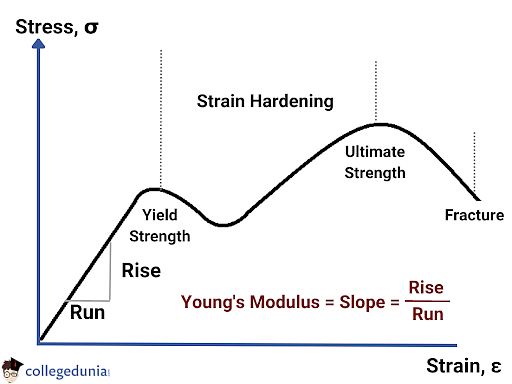
Young’s Modulus is defined as the mechanical property of a material to withstand compression or elongation with respect to its length.
- It is the ratio of longitudinal stress to the longitudinal strain.
- It is also referred to as the ‘Modulus of Elasticity’.
- The SI unit of Young’s Modulus is Nm-2 or Pascal (Pa).
- The dimensional formula of Young’s Modulus is [ML-1T-2].
Young’s Modulus
Young’s Modulus Formula is given as:
\(Y=\frac{Longitudinal Stress}{Longitudinal strain}\)
Y = Longitudinal StressLongitudinal Strain
| \(Y= \frac{ σ}{Ɛ}\) |
Where
- Y is Young’s Modulus in Pa.
- σ is Uniaxial Stress in Pa.
- ε is Strain or Proportional Deformation.
Read More:
What is Bulk Modulus?
[Click Here for Previous Year Questions]
Bulk Modulus is defined as a measure of the resistance of a substance to uniform compression.
- It is the ratio of volumetric or bulk stress to the volumetric or bulk strain.
- It is also referred to as ‘Volume Strain Modulus’.
- The SI unit of Bulk Modulus is Nm-2 or Pascal (Pa).
- The dimensional formula of Bulk Modulus is [M1L-1T-2].
Bulk Modulus Formula is given as:
\(K=\frac{Volumetric/Bulk Stress}{Volumetric/Bulk Strain}\)
| \(K= \frac{Δ P}{\frac{Δ V}{V}}\) |
Where
- K is Bulk Modulus.
- ΔP is the Change in the Pressure or Force Applied Per Unit Area.
- V is the Initial Volume of the Material.
- ΔV is the Change in the Volume of the Material due to the compression.

Bulk Modulus
Read More: Mechanical Properties of Solids Important Questions
Relation Between Young’s Modulus and Bulk Modulus
[Click Here for Sample Questions]
Young’s Modulus and Bulk Modulus are two mechanical properties of solids. Young's Modulus is defined as the ability of any material to resist the change along its length while Bulk Modulus is the ability of any material to resist the change in its volume.
Relation between Young’s Modulus and Bulk Modulus is expressed as
| \(K=\frac{Y}{3(1-\frac{2}{µ})}\) |
Where
- K denotes Bulk Modulus.
- Y denotes Young’s Modulus.
- μ denotes Poisson’s Ratio.
Relation Between Young’s Modulus and Bulk Modulus Derivation
[Click Here for Previous Year Questions]
Young’s Modulus is defined as the ratio of longitudinal stress to longitudinal strain. It is denoted by Y and is mathematically given as:
\(Y=\frac{Longitudinal Stress}{Longitudinal Strain}\)
\(Y= \frac{ σ}{Ɛ}\)
On rearranging:
\(x = {-b \pm \sqrt{b^2-4ac} \over 2a}\)
When the deforming force is along the x direction, then,
\(x = {-b \pm \sqrt{b^2-4ac} \over 2a}\) – \(x = {-b \pm \sqrt{b^2-4ac} \over 2a}\)\(x = {-b \pm \sqrt{b^2-4ac} \over 2a}\)– \(x = {-b \pm \sqrt{b^2-4ac} \over 2a}\)\(x = {-b \pm \sqrt{b^2-4ac} \over 2a}\)
Here, the negative sign expresses the reduction in diameter when longitudinal stress is along the x-axis.
1/m arises because of the compression along the other two directions.
When the deforming force is along the y-direction, then,
Ɛy =\(x = {-b \pm \sqrt{b^2-4ac} \over 2a}\) – \(x = {-b \pm \sqrt{b^2-4ac} \over 2a}\)\(x = {-b \pm \sqrt{b^2-4ac} \over 2a}\) – \(x = {-b \pm \sqrt{b^2-4ac} \over 2a}\)\(x = {-b \pm \sqrt{b^2-4ac} \over 2a}\)
When the deforming force is along the z-direction, then,
Ɛz = \(x = {-b \pm \sqrt{b^2-4ac} \over 2a}\) – \(x = {-b \pm \sqrt{b^2-4ac} \over 2a}\)\(x = {-b \pm \sqrt{b^2-4ac} \over 2a}\) – \(x = {-b \pm \sqrt{b^2-4ac} \over 2a}\)\(x = {-b \pm \sqrt{b^2-4ac} \over 2a}\)
Volumetric Strain is given as
Ɛv = Ɛx + Ɛy + Ɛz
Substitute the corresponding values to Ɛx , Ɛy, Ɛz
Ɛv =
Bulk Modulus is defined as the ratio of volumetric or bulk stress to volumetric or bulk strain. It is represented by K and is mathematically given as
K = Volumetric/Bulk StressVolumetric/Bulk Strain
K = Ɛv
Substituting
Ɛv = 3Y [1 - 2m]
In the above equation, it is obtained that
K =3σY [1 - 2m]
Thus, the mathematical relation between the Bulk Modulus (K) and Youngs Modulus (E) is given by:
K = Y3 [1 - 2m]
Check More:
Things to Remember
- Young’s Modulus is a measure of the ability of a material to withstand changes in length under compression.
- Young’s Modulus is the ratio of longitudinal stress to longitudinal strain.
- Bulk Modulus is defined as the change in the volume of a body produced when it undergoes compression on all sides.
- Bulk Modulus is the ratio of volumetric stress to volumetric strain.
- The S.I. unit for both Young’s Modulus and Bulk Modulus is Nm-2 or Pascal (Pa).
- Relation Between Young's Modulus And Bulk Modulus is: \(x = {-b \pm \sqrt{b^2-4ac} \over 2a}\)
![]()

Previous Years’ Questions
- Bulk modulus of water is 2×10 9 N/m2. The change in pressure… (Punjab PMET - 2011)
- Young modulus of a perfectly rigid body is… (KCET - 2020)
- The relation between Shear modulus (G), Young modulus… (J & K CET - 2019)
- The bulk modulus of a perfectly rigid body is…
- The bulk modulus of a fluid is inversely proportional to… (JIPMER - 1996)
- Bulk modulus of elasticity (K) represents incompressibility…
- How does the isothermal bulk modulus…
- The relationship between Young's modulus Y, bulk modulus…
- The dimension of the modulus of rigidity is… (AIIMS - 1994)
- The ratio of shearing stress to the shearing strain is defined…
Sample Questions
Ques. What will be the bulk modulus of a liquid compressed in a cylinder from 0.0125 m3 volume at 80 N/cm2 pressure to 0.0124 m3 volume at 150 N/cm2 pressure? (3 Marks)
Ans. Given that
- ΔP = 150 – 80 = 70 N/cm2
- ΔV = 0.0124 – 0.0125 = -0.0001 m3
- V = 0.0125 m3
Using the Bulk Modulus Formula,
K = ΔP × V / ΔV
K = 70 × 0.0125 / 0.0001
K = 8750 N/cm2
Therefore, the bulk modulus of the liquid is calculated as 8750 N/cm2.
Ques. What will be Young’s Modulus of a material whose elastic stress and strain are 4 N/m2 and 0.15, respectively? (3 Marks)
Ans. Given that
- Stress, σ = 4 N/m2
- Strain, ε = 0.15
Using Young’s Modulus Formula,
E = σ / ϵ
E = 4 / 0.15 =26.66 N/m2
Ques. What is Young’s Modulus? (3 Marks)
Ans. Young’s Modulus is defined as the ratio of longitudinal stress to the longitudinal strain. It is represented by Y. It describes the relationship between stress (force per unit area) and strain (proportional deformation in an object). It is measured in Pascals (Pa).
Young’s Modulus Formula is given as
\(x = {-b \pm \sqrt{b^2-4ac} \over 2a}\)
\(x = {-b \pm \sqrt{b^2-4ac} \over 2a}\)
Ques. What is Bulk Modulus? (3 Marks)
Ans. Bulk Modulus is defined as the ratio of volumetric or bulk stress to the volumetric or bulk strain. It is represented by K. It is defined as the change in the volume of a body produced when it undergoes compression on all sides.
Bulk Modulus Formula is given as
\(x = {-b \pm \sqrt{b^2-4ac} \over 2a}\)
K =
σ / ƐvQues. What is the value of Young’s modulus for a perfectly rigid body? (1 Mark)
Ans. The value of Young’s modulus for a perfectly rigid body is infinite.
Ques. The change in pressure is 80 N/Cm2, and the actual volume of the object is 0.128 m3. What will be the volume change if the bulk modulus is 7390 N/cm2? (3 Marks)
Ans. Given that,
- ΔP = 80 N/cm2
- K = 7390 N/cm2
- V = 0.128 m3
Using the Bulk Modulus Formula,
K = ΔP × V / ΔV
ΔV = ΔP × V / K
ΔV = 80 × 0.128 / 7390
ΔV = 10.24 / 7390
ΔV = 0.0013 m3
Ques. How does Young’s modulus change with a rise in temperature? (1 Mark)
Ans. Young’s modulus of a material decreases with a rise in temperature.
Ques. Why is a spring made of steel, not copper? (2 Marks)
Ans. A spring will be a better one if a large restoring force is set up in it on being deformed, which in turn depends upon the elasticity of the material of the spring. Since Young’s modulus of elasticity of steel is more than that of copper, hence steel is preferred in making springs.
Ques. Determine Young’s modulus of a material whose elastic stress and strain are 10 N/m2 and 0.15, respectively. (3 Marks)
Ans. Given that
- σ = 10 N/m2
- Strain, ε = 0.15
Using Young’s Modulus Formula,
\(x = {-b \pm \sqrt{b^2-4ac} \over 2a}\)
Y = 10 / 0.15
Y = 0.66 x 10² N/m2
Ques. What pressure should be applied to a lead block to reduce its volume by 20% if the Bulk Modulus is 5 × 10¹⁰ N/m2? (3 Marks)
Ans. Given that
- Volumetric Strain = 20 % = 20 × 10-2
- Bulk Modulus of Elasticity (K) = 5 × 10¹⁰ N/m²
- Pressure Intensity or Volumetric Stress =?
Using Bulk Modulus Formula,
K = Volumetric stress / Volumetric strain
Volumetric Stress = K x Volumetric Strain
Volumetric Stress = 5 × 1010 x 20 × 10-2 = 1010 N/m²
For Latest Updates on Upcoming Board Exams, Click Here: https://t.me/class_10_12_board_updates
Check-Out:



Comments