



Content Curator
Atrial natriuretic factor (ANF) is also known as the hormone of the heart. This is a hormone-like substance that is present in the two atrial walls of the heart specifically in the right atria. The ANF is a hormone that is based on protein, produced and released by the cardiac muscle cells.
- ANF is a vasodilator involved in the homeostatic management of body fluids, fats, potassium, and sodium in adipose tissue, a central metabolic organ in the body that supports energy homeostasis.
- The atrial natriuretic factor is a 28-amino acid polypeptide hormone made and released by the walls of the heart’s atria when stretched in an abnormal way.
- ANF changes the way the kidneys work to make more sodium and water leave the body.
- There are various types of Atrial Natriuretic factors such as urodilatin, B-type natriuretic peptide (BNP), C-type natriuretic peptide (CNP), and Dendroaspis natriuretic peptide (DNP). These are related paracrine hormones.
- The first member of the Natriuretic Peptide is the AtrB-type Natriuretic peptide is secreted from ventricles.
- Atrial natriuretic factor is also called Atrial natriuretic peptide (ANP), Atrial natriuretic hormone, or Atriopeptin (ANH).
Read More: Pancreas
| Table of Content |
Key Terms: ANF, Chromosome, Heart, Vasodilator, Atrial Natriuretic Factor, Polypeptide Hormone, ANH
Atrial Natriuretic Factor
[Click Here for Sample Questions]
Atrial natriuretic factor (ANF) is known as the heart hormone. It is a protein-based hormone that heart muscle cells secrete and release.
- Through cardiac muscle cells, hormones are generated and delivered into the atrium to counteract high blood pressure.
- Atriopeptin is another name for Atrial Natriuretic Factor.
- ANF is a crucial vasodilator involved in the homeostatic regulation of bodily fluids, salt, potassium, and adipose tissue fats.
- The main function performed by the Atrial Natriuretic Factor is that it controls and reduces the expanded extracellular fluid (ECF) volume in the body by increasing the renal sodium excretion.
- It is synthesized and produced by the cells of cardiac muscles in the atria walls of the human heart.
- The Volume receptors contained by the cardiac muscle cells help in responding to increased stretching of the atrial wall which happens due to increased arterial blood volume.
- Atrial Natriuretic factor acts as an essential Vasodilator involved in the regulation of body fluids and fats as well as sodium and potassium.
- It inhibits the renin from JGA (Juxtaglomerular apparatus)
- One of the most essential roles of the Atrial Natriuretic factor is it regulates kidney function by resisting the regulation of the Renin-Angiotensinogen Aldosterone system.
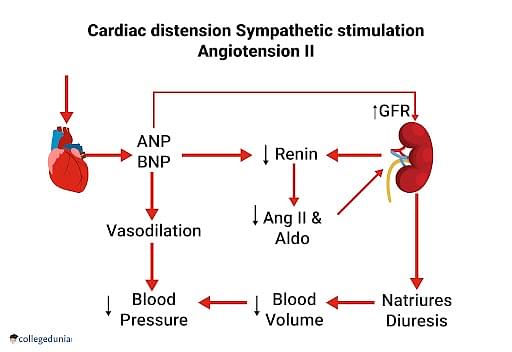
Cardiac Distension
Read More:
| Topic-Relevant Concepts | ||
|---|---|---|
| Difference Between RBC and WBC | Artery | Blood Vessels |
| Rh Grouping | Endocrine Glands | Circulatory System |
Production of ANF
[Click Here for Previous Year Questions]
The Atrial Natriuretic Factor (ANF) is synthesized as the inactive peptide hormones which are encoded by the human natriuretic peptide A (NPPA), which is a gene located on the short arm of chromosome.
The ANF is produced and released in response to:
- Mental Stress or injury
- Due to increased sodium concentration that is Hypernatremia
- It is produced, stored, and released by cardiac myocytes of the atria of the heart.
- Due to the stretching of the atrial wall induced by the exercise, hypervolemia, and caloric restriction, the ANF is released.
- Due to Increased sympathetic stimulation of adrenoceptors
- Due to Acute Kidney Injury (AKI)
ANP Controlling Abnormally High Blood Volume
The ANP is released for the most potent stimulus of an atrial stretch which is due to the abnormally high circulating blood volume. To normalize and restabilize this condition, ANF leads to the enhanced elimination of water and sodium in the urine. Thus,
- When the glomerulus' afferent arteriole is widened, filtration and blood flow increase. Water and urine volume increase as reabsorption slows and glomerular filtration increases. It's diuresis.
- ANP reduces salt in the inner medullary collecting duct and other nephron segments. Natriuresis is the excretion of filtrate sodium in urine if sodium reabsorption is blocked.
- Also, the ANP inhibits Na+/Cl- reabsorption in the distal tubule and Na+/H+ exchange in the proximal tubule, both of which enhance the excretion of sodium.
The atrial natriuretic factor can lead to about a 3-10 times increase in renal or kidney excretion of sodium when it is completely released into the circulating blood.
As a result of the loss of sodium, there is a slight decrease in the volume of the extracellular fluid and blood. However, it is believed that the ANF plays a significant role in stabilizing and regulating the blood volume in the body.
Physiological Effects of Atrial natriuretic factor
[Click Here for Sample Questions]
Atrial natriuretic factor acts on various organs as well as on the functions of the human body and it is mainly involved in the following physiological effects.
- It acts as an anti-hypertensive hormone.
- To reduce the blood pressure, it dilates the blood vessels.
- The atrial natriuretic factor helps in the reduction of reabsorption of sodium by acting on several nephron segments and other inner medullary collecting ducts.
- ANF has also been involved in the increase of the flow of renal blood along with an increase in the rate of glomerular filtration through the Vasodilation process or we can simply say the widening of blood vessels.
- Atrial Natriuretic factors decrease the blood pressure throughout the body.

ANP production
- Atrial Natriuretic factor is secreted which causes dilation of the blood vessels and therefore it decreases the blood pressure in the circulatory circulation.
- As the excretion of sodium increases ANP reduces ECF (Extracellular fluid) volume.
- When there is a loss of sodium, there is a slight decrease in the volume of the extracellular fluid and blood. It is believed that the ANF plays a significant role in stabilizing and regulating the blood volume in the body.
- So this follows with certain side effects such as a decrease in the extracellular fluid it improves cardiac ejection fraction, and lowers blood pressure.
- ANF blocks renal vasoconstriction and inhibits renin secretion.
- For the treatment of Individuals suffering from Hypertension.
- In vitro, it relaxes Angiotensin II.
Therapeutic Perspectives of ANF
[Click Here for Previous Year Questions]
Atrial natriuretic factor decreases systemic blood pressure and increases the quantity of sodium expelled. Therefore, ANF is a potential candidate for usage as a drug in the treatment of hypertension and congestive heart failure.
- ANF can only be administered intravenously and its half-life is only three to four minutes.
- There are currently no drugs that can be utilised to stimulate ANF secretion.
- It has been claimed that decreasing the rate at which endogenous ANF is catabolized may result in an increase in plasma ANF levels.
Frequently Asked QuestionsQues: What is the effect of the Atrial Natriuretic Factor on the Glomerular filtration rate? Ans: ANF decreases the Glomerular Filtration rate and has a Natriuretic effect on Kidney’s blood flow. Ques: Give the therapeutic use of Atrial Natriuretic Factor. Ans: Atrial Natriuretic factor lowers both the blood pressure and the level of sodium when it is in excess. It also increases the level of sodium that is excreted. |
Read More: Systolic and Diastolic Blood Pressure
Role of ANF in Kidney Function
[Click Here for Sample Questions]
ANF is the hormone for the heart. This molecule is found in the right atrium. It acts like a hormone. The protein-based ANF hormone is sent out by the heart muscle cells.
- Increasing arterial pressure strains the atrial wall. ANF is a 28-amino acid polypeptide hormone secreted by squeezed atria.
- ANF increases Glomerular filtration and renal salt excretion. It prevents renal blood channels from narrowing and renin production.
- ANF relaxes arteries and transfers cardiac fluid.
- ANF stops the adrenal glands from making aldosterone.
- ANF is a reaction to both short-term and long-term volume overload.
- The ability of ANF to move fluid from the vascular to the interstitial compartments acts as a buffer, keeping the volume of plasma from rising too much when extracellular fluid levels rise.
- Through natriuresis, ANF changes GFR and salt loss.
Atrial Natriuretic Factor Blood Pressure
[Click Here for Previous Year Questions]
In intact animals, atrial natriuretic factor (ANF) lowers blood pressure and acts as a vasodilator. ANF relaxes angiotensin II-contracted arteries in a lab setting.
Renin-dependent models of renovascular hypertension appear to be more responsive to the blood pressure-lowering effects of ANF in vivo as compared to other experimental hypertensive models.
Also Read:
Things to Remember
- ANF is administered intravenously with a half-life is only three to four minutes.
- The presence of ANP was the first NP to be identified in heart tissue.
- Atrial natriuretic factor (ANF) is a peptide that was found in the secretory granules of atrial muscle cells.
- Atrial tissues contain similar-structured peptides. These peptides all share the same precursor consisting of 152 amino acids.
Previous Year Questions
- Erythropoiesis starts in….[Neet 2015]
- Globulins contained in human blood plasma are...[Neet 2009]
- If due to some injury the chordae tendinae of the tricuspid valve?...[Neet 2010]
- Blood pressure in the pulmonary artery is...[NEET 2016]
- Blood capillaries are made of...[NEET 1993]
- Blood group AB has...[NEET 1991]
- An adult human with average health has systolic and diastolic… [NEET 1998]
- Arteries are best defined as vessels which....[NEET 2018]
- Arteries carry oxygenated blood except...[NEET 1989]
- Breakdown product of haemoglobin is...[NEET 1988]
- Bundle of His is a network of...[NEET 2003]
- Cells formed in bone marrow include...[NEET 1992]
Sample Questions
Ques: How is ANF used therapeutically? (1 marks)
Ans: Both the overall blood pressure and the quantity of sodium that is excreted are lowered by the ANF. Additionally, the amount of sodium that is excreted is increased.
Ques: What are the effects of ANF on Blood pressure? (2 marks)
Ans: The ANF reduces blood pressure. Vasodilator in intact mammals is ANF. ANF relaxes angiotensin II-contracted arteries in vitro. Renin-dependent models of renovascular hypertension appear to be more susceptible to the blood pressure-lowering impact of ANF in vivo than other experimental hypertensive models.
Ques: What releases ANF? (2 marks)
Ans: ANF(Atrial natriuretic factor) is a protein hormone secreted by the atrial wall in response to excessive blood volume and blood pressure in the circulatory circulation. By attaching to an ANP Receptor -Antagonist, ANP maintains the balance of electrolytes.
Binding results in a rise in renal sodium excretion, which reduces ECF and blood volume. As a result, the Heart releases Atrial natriuretic factor.
Ques: Which mechanisms involve vasodilation? (2 marks)
Ans: ANF (Atrial natriuretic factor) is a protein hormone secreted by the atrial wall in response to excessive blood volume and blood pressure in the circulatory circulation.
ANF induces vasodilation (vasodilation of blood vessels) and decreases blood pressure as a result. Therefore, the ANF mechanism serves as a check on the renin-angiotensin mechanism.
Thus, the right response is 'ANF'.
Ques: Define Atrial Natriuretic Factor. (3 marks)
Ans: Atrial natriuretic factor (ANF) regulates kidney function by opposing the regulation by the Renin-Angiotensinogen Aldosterone system (RAR's).
Atrial Natriuretic Factor- (ANF) is a protein-based hormone and is also known as the Hormone of the Heart. It is an essential peptide hormone that is secreted by the four walls of the heart and is encoded by the NPPA gene which is a protein-coding gene. Atrial Natriuretic Factor was found in heart tissue and there are various types of Atrial Natriuretic factors such as urodilatin, B-type natriuretic peptide(BNP), C-type natriuretic peptide (CNP), Dendroaspis natriuretic peptide (DNP)
Atrial Natriuretic factor is released by the heart's atria in response to an increase in blood pressure and volume. ANF inhibits the release of renin from the JGA, which in turn inhibits the Na+ reabsorption by the collecting duct and reduces the release of aldosterone from the adrenal gland. It also increases urine Na+ excretion.
Ques: Atrial natriuretic factor is released in response to which activity? (2 marks)
Ans: In response to high blood pressure, the atrial wall produces ANF, also known as the atrial natriuretic factor, which inhibits RAAS activity (Renin Angiotensin Aldosterone System).
A decrease in GFR is what actually activates RAAS (Glomerular Filtration Rate). Vasodilation is a result of the action of the ANF. In addition to this, it prevents Renin-Aldosterone and ADH from being released.
Ques: Consider the following four statements (i-iv) and select the option that correctly identifies the true (T) and false (F) ones.
(i) Atrial natriuretic factor can cause vasodilation( dilation of blood vessels) and thereby decrease the blood pressure.
(ii) On an average, 60−70 gm of urea is excreted out per day.
(iii) Sebaceous glands eliminate certain substances like NaCl , urea and lactic acid through sebum.
(iv) PCT is lined by a simple cuboidal brush border epithelium which increases the surface area for reabsorption. (4 marks)
Ans: (i) An increase in blood flow to the atria of the heart causes the release of atrial natriuretic factor (ANF). ANF causes vasodilation and therefore, decreases blood pressure. [T]
(ii) On an average 25−30 gm of urea is excreted out per day. [F]
(iii) Sebaceous glands eliminate certain substances like sterols, hydrocarbons and waxes through sebum. [F]
(iv) Maximum reabsorption takes place in PCT. PCT is lined by a simple cuboidal brush border epithelium which increases the surface area for reabsorption. [T]
Ques: Why ANF decreases blood pressure? (4 marks)
Ans: ANF lowers blood pressure. Atrial natriuretic peptide (ANP), also called atrial natriuretic factor (ANF), is a natriuretic peptide hormone released by the cardiac atria and encoded by the NPPA protein-coding gene.
ANP, BNP, and CNP are related paracrine hormones. By boosting renal sodium excretion, ANP reduces ECF volume.
ANP is produced and secreted by heart atria muscle cells. These cells contain volume receptors that respond to atrial wall stretching from increasing blood volume.
Reducing extracellular fluid (ECF) volume, improving cardiac ejection fraction, lowering blood pressure, and increasing serum potassium are side effects.
Atrial natriuretic factor (ANF) is a polypeptide hormone released by the atria in response to atrial strain. ANF increases kidney salt excretion and GFR, blocks renal vasoconstriction, and inhibits renin secretion.
ANP promotes renal sodium and water excretion and vasodilation to regulate salt-water balance and blood pressure. ANP has an anti-hypertrophic function in the heart in addition to decreasing blood pressure.
Ques: State the effect of blood pressure on Atrial Natriuretic factor. (1 mark)
Ans: Atrial Natriuretic factors decrease the blood pressure throughout the body and therefore ANF acts as an Antihypertensive hormone. It dilates the blood vessels to reduce blood pressure.
Ques: Mention various types of Atrial Natriuretic factors? (1 mark)
Ans: The various types of Atrial Natriuretic factors are urodilatin, B-type natriuretic peptide(BNP), C-type natriuretic peptide (CNP), and Dendroaspis natriuretic peptide (DNP)These are related paracrine hormones.
Check-Out:



Comments