



Content Curator
Seaweed is any red, green, or brown marine algae that grow along seashores. The "holdfasts" that tie seaweeds to the sea floor or other solid objects resemble roots.
- They only serve the purpose of attaching rather than drawing nutrients from the soil like the roots of higher plants.
- A variety of seaweed species are edible and are also valuable to people commercially.
- Some are utilised as sources of polysaccharides or as fertilizers.
- Seaweed primarily develops as a result of the buildup of shallow water or dense growth on the rocky shoreline edges.
- Seaweed, along the coasts of the sea, shows a distinctly developed zonation when the depth of the water may be 50 meters or less.
| Table of Content |
Key Terms: Algae, Seaweed, Chlorophyta, Carbon, Saltwater Plants, Rhodophyta, Phaeophyta, Microbiology, Plant Kingdom
What is Seaweed?
[Click Here for Sample Questions]
Thousands of microscopic, multicellular, marine algae are referred to as Seaweed or acroalgae. It is any red, green, or brown marine algae which grows along seashores
- Some varieties of Rhodophyta (red), Phaeophyta (brown), and Chlorophyta (green) macroalgae are part of Seaweeds.
- Other species, including planktonic algae, play a crucial role in collecting carbon, creating at least 50% of Earth's oxygen.

Seaweed
- Seaweed species, like kelps, provide crucial nursery habitats for fisheries and other marine creatures, protecting food sources.
- It forms due to the accumulation of shallow water or thick growth on the rocky outskirts of the seashores.
Origin of Seaweeds
[Click Here for Previous Year Questions]
Typically, plant-like debris that washes up on the shore is considered seaweed. Around the world, seaweeds are primarily found along coastlines in a variety of climate zones, from the warm tropics to the freezing poles.
- There are many different types of seaweed, and some of them can even withstand extreme weather.
- The main hazard to naturally occurring seaweeds comes from human activity.
- For instance, the mechanical dredging of these species has harmed the resources and the fisheries that depend on them.
- There are numerous species of seaweed as well, some of which are found growing next to the high tide mark in the open.
- These are distinct from the species that are found at low elevations with little or no exposure to light.
Check Out:
Uses of Seaweeds
[Click Here for Sample Questions]
Some uses of Seaweeds are:
As Food
Seaweed is eaten all over the world.
- The places Seaweeds are most famous include East Asia, Southeast Asia, the Canadian Maritimes, Scandinavia, South West England, Ireland, Wales, Hawaii and California, and Scotland.
- Gim, nori, and zicai are sheets of dried Porphyra used in soups, sushi, and onigiri, respectively, in Korea, Japan, and China (rice balls).
- Along with Kappaphycus and Gigartinoid seaweed, Chondrus crispus (also known as "Irish moss" or carrageenan moss) is used as an ingredient in food additives.
- Wales uses porphyra to manufacture laverbread (sometimes with oat flour).

Seaweed as Food
- To produce "dulce," (sweet), seaweed is combined with milk, nutmeg, cinnamon, and vanilla in northern Belize.
- The gelatinous seaweed compounds alginate, agar, and carrageenan are together referred to as hydrocolloids or phycocolloids. Food additives are hydrocolloids.
- Their ability to gel, retain water, emulsify, and have other useful physical qualities are all used by the food business.
- Agar is a food additive that is used in moulded foods, confectionary, meat and poultry items, desserts, and beverages.
Medicine and Herbs
Alginates are used in dental moulds and as wound dressings.
- Agar is used as a culture medium in microbiology.
- Along with other macroalgal polysaccharides, carrageenans, alginates, and agaroses have biomedical uses.
- Delisea pulchra might prevent bacteria from colonising.
- Some DNA and RNA-enveloped viruses are inhibited by sulfated saccharides from red and green algae.
- Some diet pills contain seaweed extract.
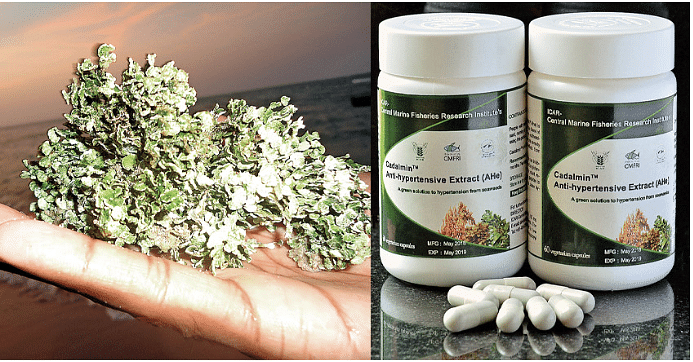
Seaweed as Medicine
- Other seaweed supplements uses the same strategy as gastric bands, expanding in the stomach to increase the feeling of fullness.
Other uses:
- Seaweed can be buried in coastal dunes to stop beach erosion or used as compost for landscaping or fertilizer.
- The use of seaweed as a potential source of bioethanol is being considered.
- The top of the algae scrubber/cultivator is lifted to remove the seaweed, which is then either thrown away or used as food, fertilizer, or skin care.
- Alginates are employed in industrial operations like paper sizing, textile printing, hydro-mulching, and drilling as well as in goods like paper coatings, adhesives, dyes, gels, and explosives.
- Toothpaste, cosmetics, and paint all contain seaweed as an ingredient. The manufacture of bio yarn uses seaweed (a textile).
- Through the process of bio-refining, some of these resources can be produced from seaweed.
- The procedure of gathering, drying, and pressing seaweed is known as seaweed collecting.
Read more:
Things to Remember
- Seaweed is a red, green, or brown marine algae which is known to grow along the seashores.
- Algae are saltwater plants that include seaweed. They live in a marine setting and have unique components that enable photosynthesis.
- Stike, holdfast, and blade or frond are the corresponding seaweed sections.
- Seaweed has a high fibre content, which makes it a natural laxative. Additionally, it can help digestion and promote intestinal health.
- The foundation of the food chain is microalgae, which are a crucial source of nutrition for crustaceans, young fish, and molluscs.
Previous Year Questions
- In Pinus/Cycas/gymnosperms, the endosperm … [NEET 1998]
- Strobili or cones are found in … [NEET 2020]
- Turpentine oil is obtained from … [JIPMER 2003]
- A gymnospermic leaf carries 16 chromosomes … [NEET 1996]
- Correct position of floral parts over thalamus in mustard plant … [NEET 2020]
- The lack of fruit formation in gymnosperm is due to … [JIPMER 2003]
- Which part of Ephedra yields ephedrine? … [MU OET 2011]
- The seeds of Cycas are … [JIPMER 1999]
- Gymnosperms are also called soft wood spermatophytes … [NEET 2012]
- In gymnosperms, the pollen chamber represents … [NEET 2007]
Sample Questions
Ques. What affects growth of seaweeds? (1 mark)
Ans. Different varieties of seaweed require different kinds of environmental conditions in order to develop. In general, regions with adequate nutrients and light for growth, as well as salinity and temperatures that are not restricting to the species being farmed, are needed for seaweed cultivation.
Ques. State the ecological importance of seaweed. (1 mark)
Ans. Different varieties of seaweed require different kinds of environmental conditions in order to develop. In general, regions with adequate nutrients and light for growth, as well as salinity and temperatures that are not restricting to the species being farmed, are needed for seaweed cultivation.
Ques. What does seaweed taste like? (2 marks)
Ans. Since seaweed is a good source of iodine, which gives food a delightful and addictive umami flavour, it is naturally briny and salty. If you choose a dry variety, seaweed can have a crispy and crunchy texture. However, if you would rather have seaweed that matches the texture of a certain recipe, you can be inventive and use our new pureed version of seaweed into any dish.
Ques. State the health benefits of seaweed? (2 marks)
Ans. One of the plants on Earth with the highest nutritious content is seaweed. Seaweed is naturally low in calories and packed with nutrients, including iodine, iron, magnesium, and vitamins A and B. Seaweed contains antioxidants, essential nutrients, and a variety of health-promoting substances such dietary fibre, lipids, minerals, and peptides, all of which can support cardiovascular health. As a result, seaweed can also improve heart health.
Ques. What are the four parts of seaweed? (2 marks)
Ans. The four parts of seaweed are as follows:
- Blade: A seaweed's flattened, leaf-like portion.
- Holdfast: The root-like base of seaweed that fastens it to a rock.
- Stipe: The seaweed stalk that lies between the holdfast and the blade and resembles a stem.
- Float: Air bladder that allows the seaweed to float closer to sunlight.
Ques. Enlist the commercial significance of seaweeds. (3 marks)
Ans. The following benefits of using seaweed in business are listed:
- Seaweeds that are edible and high in vitamins, minerals, and nutrients are good for you to eat. Even as dried seaweed, these can be eaten.
- There are some seaweeds that have potent anti-cancer properties.
- Some types of seaweed are anti-inflammatory and anti-microbial.
- Seaweeds work well as emulsifiers or as binding agents. Because of this, they are utilised in a variety of consumer goods, including fruit jellies, toothpaste, and softeners.
- Many organic skincare and cosmetic products contain seaweed.
Ques. State the importance of seaweed farming. (3 marks)
Ans. There are several benefits of seaweed cultivation for the nation's economy. The specifics are described below:
- It is a powerful tool in the fight against increasing sea pollution and aids in reducing the impacts of CO2, a factor in global warming.
- People who live close to the seaside and in coastal areas have work to do because of it.
- For the sectors that depend on seaweeds, it ensures a steady flow of raw materials.
- Seaweed food growing is also environmentally beneficial.
Ques. Explain green seaweeds and their species. (3 marks)
Ans. There are various species of green seaweed, sometimes known as green algae. Although the majority of them are mostly freshwater species, several also have saltwater counterparts. The common species of green algae are listed below.
- Marimo: The algae grows into a sizable green ball in a unique growth that has a velvety texture. These species have been found in the lakes and rivers of Europe and Japan.
- Ulva Lactuca: A member of the family Ulvaceae, is the scientific name for sea lettuce. It is also known as sea lettuce since it is a type of edible seaweed.
The most well-known term for green fleece is the oyster thief. This occurs as a result of the plant's attachment to an oyster or scallop, which allows air bubbles produced during photosynthesis to cause the plant and mollusc to float above the bottom. The organism eventually perishes as a result of this.
Ques. What are red seaweeds? Show its diagrammatic representation. (5 marks)
Ans. Red seaweeds are red algae with the genus name Rhodophyta and family name Rhodophyceae. One of the oldest kinds of eukaryotic algae, these peculiar seaweed species are often found in freshwater lakes.
This seaweed has a red tint due to the presence of several pigments such phycoerythrin, phycocyanin, and chlorophyll A. Our ecosystem depends on red algae, which are also edible seaweeds.
They serve as food for a variety of fish, crabs, and even people. The red algae, often known as seaweed, is used to make vitamin supplements and is a great source of nutrients including calcium.

Red Seaweed
Ques. What are brown algae? Show its diagrammatic representation. (5 marks)
Ans. The brown algae are members of the Phaeophyceae class, which can be found in various seaweeds like kelp and fucus.
The largest algae are primarily kelps, with some species, such Macrocystis and Nereocystis, found in the Pacific and Antarctic areas, respectively, reaching lengths of 33 metres.
Laminaria is another type of kelp that is common on the Atlantic and Pacific coasts. A species of free-floating plant found in the Sargasso Sea and Gulf Stream, sargassum is also referred to as gulfweed. Another prominent brown algae used in foods and cosmetics is rockweed.
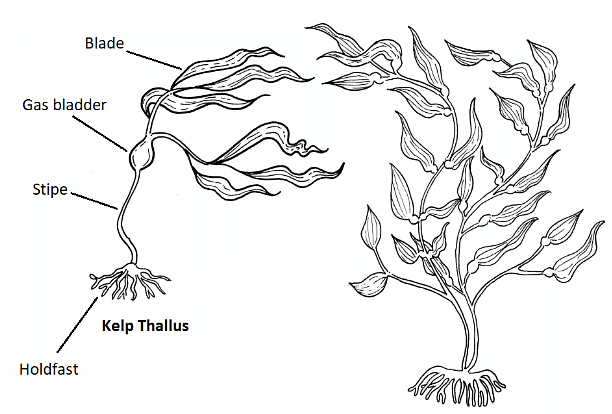
Brown Algea
Check-Out:



Comments