



Education Journalist | Study Abroad Lead
Inflorescence is the arrangement of the cluster of flowers on the axis of the plant. In a flowering plant, the flowers may grow as a single flower or as a group of many flowers at the same point on the floral axis. Such clustering of flowers arranged themselves in one particular pattern that we call inflorescence. The arrangement of flowers or inflorescence can be either Racemose type or Cymose type.
- If a flower cluster is pear-shaped with an opening at the tip, it is called hypanthodium.
- Based on the arrangement of flower clusters, the pattern or a type of inflorescence can be identified.
- Determination of the inflorescence is easy and can be done with some simple steps.
- It does not require any high-cost equipment and dedicated set-up.
| Table of Content |
Key Terms: Inflorescence, Flowering plants, Racemose, Cymose, Identification of flower arrangement.
Read more: Androecium
Types of Inflorescence
[Click Here for Sample Questions]
The arrangement of flower clusters on the axis can be differentiated as follows.
Racemose:
In this type of arrangement, the main axis continues to grow and it does not terminate in flower. The flowers are arranged in a way that older flowers are present at the base and the younger or newer flowers bloom towards the top (acropetal growth).
- Flower grouping is less common
- Flowers may grow laterally in an acropetal manner.
- Newly grown fruits are not protected by flowers.
- Racemose further can have spike,spadix, spikelets, panicle spikelet and catkin types of arrangements.
Pictorial representation of racemose inflorescence

Schematic Representation of Racemose Inflorescence.

Racemose inflorescence
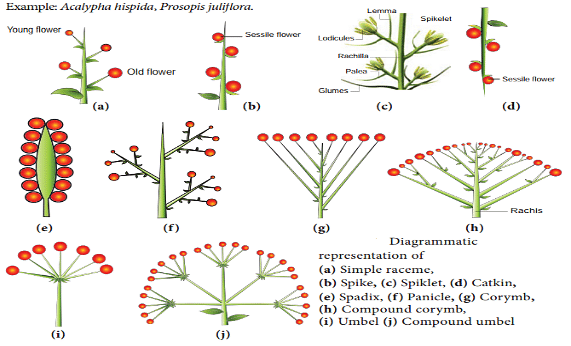
Various subtypes of racemose inflorescence.
Cymose:
In cymose type of inflorescence, the main axis growth is stopped once the flower is born. Flowers are arranged in a basipetal manner i.e. flower grows from apex or top towards the base of stem.
- Unlike racemose, the Main axis shows limited or finite growth.
- Therefore, such a pattern is also called a definite inflorescence.

Schematic representation of cymose inflorescence.

Cymose inflorescence
Also Read:
| Related Articles | ||
|---|---|---|
| Interdependence of plants and animals | Plant Cell | Why are plants green? |
| Conservation of Plants and Animals | Biology difference between and comparison | Human Body |
Identification of Different Types of Inflorescence (Racemose/Cymose)
[Click Here for Sample Questions]
To determine the type of inflorescence, a simple experiment can be performed from which an easy identification of arrangement pattern can be made.
Purpose of an Experiment
[Click Here for Sample Questions]
The purpose or the aim of the experiment is to study and identify the types of inflorescence.
Materials Required
[Click Here for Sample Questions]
Necessary materials for conducting the experiment are listed below.
- Inflorescence of any local plant
- Hand lens
- Water
- Beaker
Also Read: Seed Dispersal
Procedure
[Click Here for Sample Questions]
To perform the experiment of identification of different inflorescence, following steps are required.
- Collect a few locally available flowering plants and pick up the inflorescence present in them.
- Place the inflorescences in a beaker filled with water.
- Sort them in racemose and cymose types.
- Go through the various subtypes of racemose and cymose patterns.
- Identify the different patterns with proper justification.
- Make a note and interpret the location of inflorescence on the plant. It could be terminally, or axillary.
- Sketch a labeled diagram of all patterns observed and positions of flowers in the axis.
- Study the location of flowers or the cluster on the main axis. Determine the pattern of growth.
- Interprets the locally available inflorescence types on the basis of this study.
Things to Remember
- The pattern in which a flower or a group of flowers grows is called inflorescence.
- This arrangement can be of different types.
- Two common and broadly classified types of inflorescence are Racemose and Cymose.
- Racemose is the type where the main axis has no definite growth. It grows continuously.
- Cymose is also termed as definite inflorescence as the main axis in this type has limited growth.
- The differentiation of these two types can be done with the help of simple exercise.
- By studying the pattern and location of the flower clusters, one can determine the type of inflorescence.
Read More:
Sample Questions
Ques. How many types of inflorescence are there? Define each type. (5 marks)
Ans. There are two common types of inflorescence; Racemose and Cymose. Racemose have further subtypes like spike,spadix, spikelets, panicle spikelet and catkin.
- Racemose:
It is the type where the main axis grows indefinitely and the flowers are born in an acropetal manner which means the older flowers are at the base and newer ones are positioned at top.
In the racemose type pattern, the fruits are not protected by flowers.
- Cmose:
In a cymose pattern, the main axis does not grow limitlessly. It has definite growth and flowers born on the terminal of the axis.
It is also called definite inflorescence.
Cymose pattern has the basipetal sequence of flower growth.
Flower grows from the apex or top towards the base of the main axis.
Ques. Define the procedure to study different types of inflorescence. (4 marks)
Ans. To study the different types of inflorescence, a simple exercise can be performed.
- Collect locally available flowering plants.
- Pick the inflorescence from them.
- Place them into a beaker full of water.
- Sort them into racemose and cymose by visible observation of pattern.
- Identify the arrangements of flowers.
- Make a note on different patterns observed and also on the location of the flowers on the axis.
- Lastly, sketch a labeled diagram of observed inflorescences.
- Interpret the available inflorescence obtained from local flowering plants.
Ques. Which of the following is not a subtype of racemose type? (1 mark)
(a) Spike
(b) Spadix
(c) Spikelet
(d) SINEs
Ans. d. SINEs
Explanation: SINE stands for short interspersed nucleotides element. That has nothing to do with racemose or any other type of inflorescences. Rest three are the subtypes of racemose. Therefore, the correct answer is option d.
Ques. What is inflorescence? (1 mark)
Ans. Flowers on plants either grow as a single or in a group. The arrangement of the cluster or a group of plants is called inflorescence.
Ques. How does the racemose differ from the cymose? (2 marks)
Ans. Racemose and the cymose are two different types of inflorescence observed in flowering plants. The racemose is the type where the main axis has continued growth and the flower does not terminate it. Whereas in cymose, flower terminates the axis growth. Due to this reason, cymose is also termed as definite inflorescence. Another difference between racemose and cymose is that racemose hase acropetal manner of flower growth while the later one has a basipetal sequence of flower growth.
Ques. What among the following is not required for the study of the inflorescence? (1 mark)
(a) Beaker
(b) Microscope
(c) Flowers
(d) Water
Ans. b. Microscope
Explanation: Inflorescence is the arrangement of flower clusters on plants which can be visibly observed by eyes. Microscope is not required for this study or identification. Hence, the correct answer is option d.
Ques. Determination of different inflorescences requires what? (1 mark)
(a) Knowledge of different types of inflorescences.
(b) Some flowering plant
(c) Some non-flowering plants
(d) Stationeries
(e) a,b,d
Ans. e. a,b,d.
Explanation: To identify the inflorescences, one need to know about the types and subtypes of the same. To perform identification activity, flowers from local plants are the major requirement. After identification, sketching and note taking is another important step of the study. Therefore, option e is the correct answer.
For Latest Updates on Upcoming Board Exams, Click Here: https://t.me/class_10_12_board_updates
Also Check:



Comments