



Content Curator
Sunflowers (Helianthus annuus), the crop grown for its edible oil, are a member of the genus Helianthus. Sunflowers are native primarily to North and South America, and some species are cultivated as ornamentals for their spectacular size and flower heads and for their edible seeds.
The Jerusalem artichoke (Helianthus tuberosus) is cultivated for its edible underground tubers. Helianthus, a genus containing almost 70 species of herbaceous plants in the Aster family (Asteraceae).
| Table of Contents |
Key Takeaways: Sunflower, Botany, Tracheophytes, Helianthus agrestis, Angiospermae, Helianthus tuberosus
Classification of Sunflower
[Click Here for Previous Year Questions]
The characteristics of Sunflower is given below:
| Type | Classification |
|---|---|
| Kingdom | Plantae |
| Class | Magnoliopsida |
| Phylum | Vascular Plant |
| Order | Asterales |
| Division | Tracheophyta |
| Family | Asteraceae |
| Genus | Helianthus |
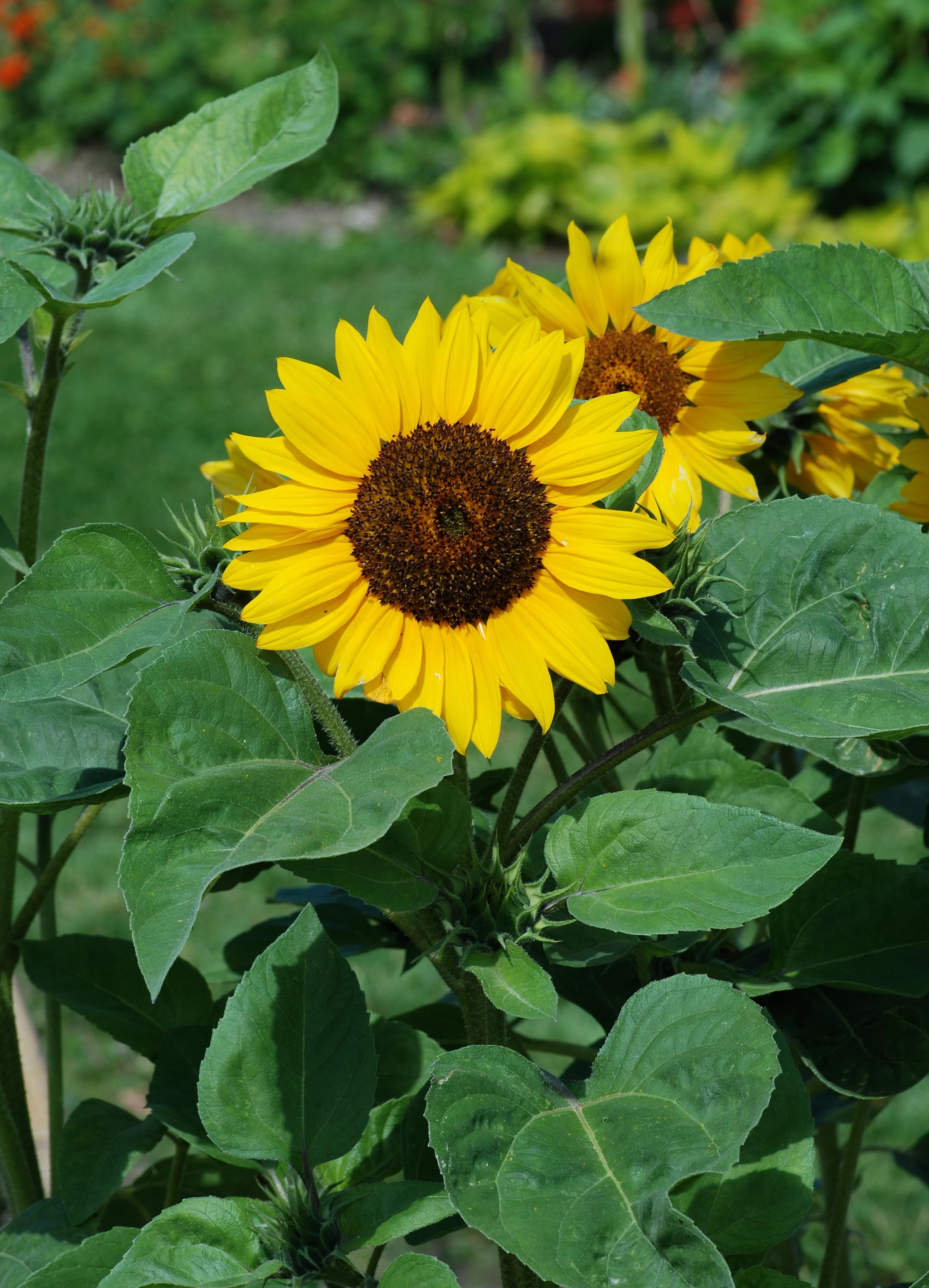
Helianthus annuus
Characteristics of Sunflower
[Click Here for Sample Questions]
- It is an annual plant of large proportions, which can reach over 3 meters high.
- It is a plant with few branches and the stem is thick, erect and massive.
- It has deep roots formed by a main taproot and abundant secondary roots.
- Its leaves, between 5 and 30 cm long and half as wile, are large, oval, discreetly toothed, petiolated, with three main veins and rough to the touch.
- The upper leaves are alternate and lower ones opposite.
- The inflorescence, also known as floral head, is large, 10 to 30cm in diameter and consists of hundreds of tiny tubular flowers.
- In the outer section it is found that the ligulas or external infertile flowers are in one or two rows that look like petals.
- These flowers, on display from summer to fall, are golden yellow and have no direct reproductive function, but they serve as attraction for insects, which help the plant in the process of pollination.
- The back of the flower head is made up of a series of green bracts, like the stem.
- The floral head presents heliotropic movement which is produced by twisting the stem in a process that is called nutation. At dusk, the stem returns slowly to its upright position.
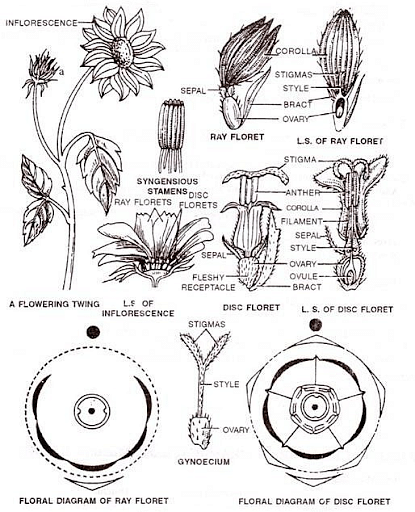
Sunflower Diagram
Geographical Distribution & Habitat of Sunflower
[Click Here for Previous Year Questions]
- Helianthus annuus is a species originating in an area between South America and North America.
- Species are grown all over the world. In Italy it is widespread in cultivations, especially in the central north, and present in the spontaneous state as a naturalized exotic plant.
- Its typical habitat is areas near vegetable gardens and abandoned areas, ruderal environments, rural roads and slopes, in both calcareous and siliceous soils with neutral pH and high nutritional values of the soil that must be moderately humid.
- It is found up to 1500 metres, from above the sea level to the hilly and partly mountainous ones.
Learn More About:
| Concepts Related to This Topic | ||
|---|---|---|
| Morphology of Flowering Plants | Photosynthesis and Chemiosmotic Hypothesis | Prokaryotic Cell |
| Shrubs | Neuron | Difference between herbs and shrubs |
Common Species of Sunflower
[Click Here for Sample Questions]
- Southeastern Sunflower (Helianthus agrestis), is a popular plant amongst humans that is used for cosmetic and decorative purposes.
- Swamp Sunflower (Helianthus angustifolius), attracts a wide variety of pollinators, including bees and butterflies. The plant serves as a host for the caterpillars of the silvery checkerspot butterfly, among others.
- Cusick's Sunflower (Helianthus cusickii), some Plateau Indian tribes used the roots of cusick's Sunflower to treat erectile dysfunction, wasting, and tuberculosis.
- Silverleaf Sunflower (Helianthus argophyllus), is grown for their daisy-like usually yellow flower heads.
Floral Formula of Sunflower
[Click Here for Previous Year Questions]
A floral formula is a numerical representation of the several floral components that make up a flower. It is used to denote different floral sections by describing a flower using various signs and symbols.
The Helianthus annuus flower formula is as follows:
Ca x(0) Co 5 A 5 G 2
Uses of Sunflower
[Click Here for Sample Questions]
- This species is also used as food for livestock as well as for ornamental purposes in domestic gardens.
- Sunflower plants are usually tall, reaching over 9 feet in height. The tallest ever recorded sunflower measured over 30 feet in height.
- Sunflower seeds are also harvested and offered for sale as a common snack in addition to oil.
- Sunflowers are beneficial to the environment as well since they can remove heavy metals and radioactive particles from the air.
- The leaves are used as fodder, the flowers yield a yellow dye, and the seeds contain oil and are used for food.
- Sunflower oil cake is used for stock and poultry feeding.
- The oil is also used in soap and paints and as a lubricant.
Also Check:
Things to Remember
- The sunflower (Helianthus annuus) is an annual herbaceous species belonging to the Asteraceae family.
- Scientific name of the Sunflower is - Helianthus annuus.
- The growth of a sunflower depends strictly on its genetic makeup and background.
- Sunflower seeds are indicated to ensure a good functioning of the intestine and for the prevention of respiratory diseases.
- Before blooming, Helianthus plant heads tilt during the day to face the sun. This movement is referred to as heliotropism, which continues for a short time when flower buds form and young Helianthus heads track the Sun.
- At night, the flower heads reorient their position and face East in anticipation for the sunrise.
Sample Questions
Ques. What is the botanical name of Sunflower? (1 Mark)
Ans. The botanical name for the sunflower is Helianthus annuus. The genus is Helianthus.
Ques. What is Taxonomy? (1 Mark)
Ans. Taxonomy can be defined as the science of naming , describing, and classifying all the species of living organisms, like- plants, animals, microorganisms etc.
Ques. What is the difference between Botany and Zoology? (2 Marks)
Ans. Botany is the study of plants while Zoology is the study of animals.
Ques. What angiospermae means? (2 Marks)
Ans. Angiosperms are plants that produce flowers and bear their seeds in fruits. They are the largest and most diverse group within the kingdom Plantae, with about 300,000 species. Angiosperms represent approximately 80 percent of all known living green plants.
Ques. What is the kingdom of Sunflower? (1 Mark)
Ans. The kingdom of Sunflower is Plantae.
Ques. Sunflower’s fruit is known as. (1 Mark)
Ans. Sunflower’s fruit is known as Achene.
Ques. How many flowers does a sunflower have? (2 Marks)
Ans. A mature, blooming sunflower is a composite flower since it is made up 1,000 to 4,000 small individual flowers in each head. These individual florets are arranged in two, opposite helixes that begins at the center of the flowering head.
Ques. Are sunflowers attracted to the sun? (2 Marks)
Ans. Sunflowers face the rising sun because increased morning warmth attracts more bees and also helps the plants reproduce more efficiently.
Also check:



Comments