



Education Content Expert
Surface Area Formula is a list of the mathematical formulas used for calculating the lateral and total surface areas of various geometrical shapes. Surface Area is the total area occupied by the surfaces of an object. It is calculated in square units.
Surface Area is classified into two major categories:
- Lateral Surface Area or Curved Surface Area (CSA)
- Total Surface Area (TSA)
The total surface area is the area of all the faces of the shape while the curved surface area includes the area of the side faces of the shapes only. Surface Area Formula includes formulas for 3D shapes such as Cube, Cuboid, Cone, Cylinder, etc.
Read More: NCERT Solutions for Class 9 Maths Surface Areas and Volumes
Key Terms: Surface Area, Surface Area Formula, Cube, Cuboid, Cone, Curved Surface Area, Cylinder, Total Surface Area
What is Surface Area?
[Click Here for Sample Questions]
Surface Area is the total area occupied by the surfaces of an object. The three-dimensional shapes in Geometry have different surface areas that can be easily calculated using the Surface Area Formulas. In Geometry, Surface Area is divided into two types mainly:
- Curved Surface Area (CSA)
- Total Surface Area (TSA)
Curved Surface Area is the area of only the curved surfaces, leaving the top and base. Total Surface Area is the total area covered by the surface of the object including the top and base.
Read More:
What is Surface Area Formula?
[Click Here for Sample Questions]
Surface Area Formula refers to the list of lateral and total surface areas of different geometrical objects.
- Surface Area of an object is the total area of the outside surfaces of three-dimensional objects.
- Surface Area is measured in terms of square units such as m2, cm2, in2, etc.
- Total Surface Area considers all the faces of the 3D shape including the flat surfaces and the curved surfaces.
- Lateral Surface Area includes the curved surface of the shape and does not include the area of the bases.
Here are the important Surface Area Formula for common three-dimensional shapes:
| Shape | Lateral Surface Area (LSA) | Total Surface Area (TSA) |
|---|---|---|
| Cuboid | 2h(l + b) | 2(lb + bh + lh) |
| Cube | 4a2 | 6a2 |
| Right Prism | Base Perimeter × Height | LSA + 2 (Area of One End) |
| Right Circular Cylinder | 2πrh | 2πr(r + h) |
| Right Pyramid | (1/2) Perimeter of Base × Slant Height | LSA + Area of Base |
| Right Circular Cone | πrl | πr(l + r) |
| Solid Sphere | 4πr2 | 4πr2 |
| Hemisphere | ½ × 4 × πr2 | 3πr2 |
Surface Area Formula of Cube
[Click Here for Sample Questions]
Cube is a three-dimensional shape with six square faces. Since each square face has the same side length, all faces are the same size. A cube has twelve edges and eight vertices. Each vertex represents a cube corner where three edges meet.
Surface Area of Cube is the total area covered by the cube's six faces.
- The total surface area of a cube is the sum of the area of the cube's vertical surfaces and the area of the base. TSA of Cube = 6a2 where "a" is the side length.
- The lateral surface area of a cube is the sum of the areas of all its lateral side faces. LSA of Cube = 4a2, where "a" is the side length.

Cube
Solved ExampleExample: Find the total and curved surface area of a cube of side 5 cm. Solution: Given, Side of Cube a = 5 cm Total Surface Area of a Cube = 6a2 = 6 × 52 cm2 = 6 × 25 cm2 = 150 cm2 Curved Surface Area of a Cube = 4a2 = 4 × 52 cm2 = 4 × 25 cm2 = 100 cm2 Thus, the total surface area of the cube is 150 cm2 and its curved surface area is 100 cm2. |
Read More: Surface Areas and Volumes Revision Notes
Surface Area Formula of Cuboid
[Click Here for Sample Questions]
Cuboid is a three-dimensional solid shape in Geometry. A cuboid is a convex polyhedron bounded by six rectangular faces, eight vertices, and twelve edges.
The surface area of a cuboid is expressed in terms of its three dimensions namely length (l), breadth (b), and cuboid height (h) as
- Total Surface Area of Cuboid, S = 2 (lb + bh + lh) units2
- Lateral Surface Area of Cuboid, L = 2h (l + b) units2
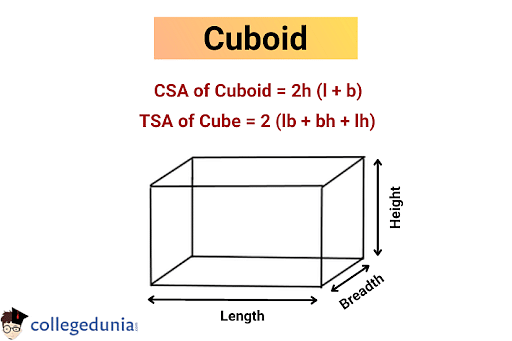
Cuboid
Solved ExampleExample: What will be the total and curved surface area of a cuboid whose length is 5 cm, width is 2 cm, and height is 3 cm? Solution: Given dimensions are:
Total Surface Area of Cuboid = 2(lb + bh + lh) = 2 (5 x 2 + 2 x 3 + 3 x 5) = 2 (10 + 6 + 15) = 62 sq. cm. Curved Surface Area of Cuboid = 2h (l + b) = 2 x 3 (5 + 2) = 6 x 10 = 60 sq. cm. |
Surface Area Formula of Cone
[Click Here for Sample Questions]
Cone is a distinct three-dimensional geometric figure with a flat and curved surface pointing upward. It has a circular base with a radius "r" and a diameter "d".
If the radius of the cone's base is "r" and the slant height is "l," the surface area of a cone is given as
- Total Surface Area of Cone, T = πr(r + l)
- Curved Surface Area of Cone, S = πrl
Solved ExampleExample: Determine the curved and total surface area of a cone whose base radius is 7 cm and slant height is 15 cm. Solution: Given that,
Curved Surface Area of Cone = πrl = (22/7)× 7 ×15 = 330 cm2 Total Surface Area of Cone = πr(r + l) = (22/7) x 7 (7 + 15) = 22 x 22 = 484 cm2 |
Read More: Surface Areas and Volumes Important Questions
Surface Area Formula of Cylinder
[Click Here for Sample Questions]
Cylinder is a three-dimensional solid figure with two identical circular bases connected by a curved surface at a specific distance from the center, which is the cylinder's height. A cylinder has a curved surface and two circular bases at either end.
If the radius of the cylinder's base is "r" and the height is "h," the surface area of a cylinder is given as
- Total Surface Area of Cylinder, T = 2πr(h + r)
- Curved Surface Area of Cylinder, S = 2πrh

Cylinder
Solved ExampleExample: Find the area of the sheet required to make a closed cylindrical vessel of height 1 m and diameter 140 cm. Solution: Given,
Total Surface Area of Closed Cylindrical Tank = 2 π r (r + h) = 2 × 22/7 × 0.7 m × (0.7 m + 1 m) = 4.4 m × 1.7 m = 7.48 m² Hence, 7.48 m² of the sheet is required to make a closed cylindrical vessel of height 1 m and diameter 140 cm. |
Surface Area Formula of Sphere
[Click Here for Sample Questions]
Sphere is a three-dimensional round-shaped geometrical figure. Each point of the sphere is an equal distance from the center, just like a circle.
The surface area of a sphere is the total area of the faces that surround it. The surface area formula of the sphere is as follows:
Surface Area of Sphere, S = 4πr2 Square Units
Solved ExampleExample: Calculate the surface area of a sphere having a radius equal to 3.5 cm. Solution: The radius of the sphere is 3.5 cm. Curved Surface Area of Sphere = 4 πr2 Square Units = 4 × (22/7) × 3.5 × 3.5 Therefore, the curved surface area of a sphere is 154 cm2. |
Read More: Surface Areas and Volumes MCQs
Surface Area Formula of Hemisphere
[Click Here for Sample Questions]
Hemisphere is half of a sphere. The surface area of a hemisphere is the total area covered by its surface.
- Curved Surface Area of Hemisphere = ½ (curved surface area of a sphere) = ½ (4πr2) = 2πr2 , where "r" is the radius of the hemisphere.
- Total Surface Area of Hemisphere = 3πr2, where "r" is the radius of the hemisphere.
Solved ExampleExample: Find the curved and total surface area of a hemisphere whose radius is 4 cm. Solution: Given that, Radius, r = 4 cm Curved Surface Area of Hemisphere = 2πr2 = 2 × 3.14 × 4 × 4 = 3.14 × 32 = 100.48 cm2 Total Surface Area of Hemisphere = 3πr2 = 3 × 3.14 × 4 × 4 = 3.14 × 48 = 150.72 cm2 Therefore, the curved and the total surface area of the hemisphere are 100.48 cm2 and 150.72 cm2, respectively. |
Surface Area Formula of Prism
[Click Here for Sample Questions]
Prism is a three-dimensional solid object with two identical ends. It is made up of flat faces, identical bases, and equal cross-sections. The prism's faces are parallelograms or rectangles without bases. Prism's bases could be triangles, squares, rectangles, or any other n-sided polygon.

Prism
The lateral surface area of a prism is the sum of the areas of its lateral faces, whereas its total surface area is the sum of its lateral area and the area of its bases.
- Lateral Surface Area of Prism = Base Perimeter × Height
- Total Surface Area of Prism = Lateral Surface Area of Prism + Area of Two Bases = (2 × Base Area) + Lateral Surface Area Or (2 × Base Area) + (Base {erimeter × Height)
Solved ExampleExample: What will be the surface area of the triangular prism if the base and height of a triangular prism are 8 units and 14 units respectively along with the height of the equilateral triangular bases being 9 units? Solution: Given that,
Surface Area of Triangular Prism = (bh + (a + b + c)H) We know that all three sides of an equilateral triangle are equal. Therefore, a = b = c = 8 units Surface Area = (8 × 9) + (8 + 8 + 8) × 14 = 72 + 24 × 14 = 72 + 336 = 408 units2 Therefore, the surface area of the given triangular prism is 408 units2. |
Check More:
Surface Area Formula of Pyramid
[Click Here for Sample Questions]
Pyramid is a three-dimensional structure that has a polygon as its base. Every corner of this polygon is connected to a single apex, giving it the appearance of a distinct shape.
Consider a regular pyramid with a base perimeter of 'P,' a base area of 'B,' and a slant height of (the height of each triangle).
- Lateral Surface Area of Pyramid (LSA) = (1/2) Ps
- Total Surface Area of Pyramid (TSA) = LSA + Base Area = (1/2) Ps + B
Solved ExampleExample: Find the lateral surface area of a regular pyramid with a triangular base if each edge of the base measures 8 inches and the slant height is 5 inches. Solution: Perimeter of the base is the sum of the sides. P = 3(8) = 24 Inches Lateral Surface Area of Pyramid (LSA) = (1/2) Ps =1/2 (24)(5) inches2 = 60 inches2 Thus, the lateral surface area of pyramid is 60 inches2. |
Things to Remember
- Surface Area is the total area covered by all the faces of a three-dimensional object.
- Surface Area is divided into two types namely Total Surface Area and Curved Surface Area.
- Total Surface Area is the area of all of the faces or surfaces that enclose the solid.
- Curved Surface Area is the area of only the curved surface excluding the circular top and base.
- TSA of Cube is 6a2 while CSA of Cube is 4a2.
- TSA of Cuboid is 2(lb + bh + lh) while CSA of Cuboid is 2h(l + b).
- TSA of Cone is πr(l + r) while CSA of Cone is πrl.
- TSA of Cylinder is 2πr(r + h) while CSA of Cylinder is 2πrh.
- TSA or CSA of Sphere is 4πr2.
- TSA of Hemisphere is 3πr2 while CSA of Hemisphere is ½ × 4 × πr2.
Sample Questions
Ques. What is the difference between Curved and Total Surface Area? (3 Marks)
Ans. Surface Area of an object can be classified into two major types namely Curved Surface Area and Total Surface Area.
- Curved Surface Area refers to the surface area of those curved parts.
- Total Surface Area is the sum of all the surface areas of an object.
Ques. Hameed has built a cubical water tank with a lid for his house, with each outer edge 1.5 m long. He gets the outer surface of the tank excluding the base, covered with square tiles of side 25 cm. Find how much he would spend on the tiles if the cost of the tiles is Rs. 360 per dozen. (3 Marks)
Ans. Given that, Edge of Cubical Tank (a) = 1.5 m = 150 cm
Curved Surface Area of Tank (4 Walls) = 4a2 = 4 × 150 × 150 cm2 = 90,000 cm2
Area of Lid = Side × Side = 150 × 150 = 22500 cm2
Thus,
Total Surface Area of Tank to be Painted = 90,000 + 22500 = 112,500 cm2
Now,
Side of Square Tile = 25 cm
Area of Square Tile = Side × Side = 25 × 25 cm2 = 625 cm2
Required Number of Tiles = (Surface Area of Tank)/(Area of Each Tile)
= (112,500)/(625)
= 180 Tiles
Cost of Tiles Per Dozen = Rs. 360
Cost of Each Tile = Rs. 360/12 = Rs. 30
Hence, the total cost of 180 tiles = 180 × Rs. 30 = Rs. 5400
Ques. The hollow sphere, in which the circus motorcyclist performs his stunts, has a diameter of 7 m. Find the area available to the motorcyclist for riding. (3 Marks)
Ans. Given,
- Diameter of Sphere = 7 m
- Radius (r) = 7/2 = 3.5 m
Now, the riding space available for the motorcyclist is equal to the surface area of the sphere.
Surface Area of Hollow Sphere = 4πr2
= 4 × (22/7) × 3.5 × 3.5
= 154 m2
Thus, the area available to the motorcyclist for riding is 154 m2.
Ques. The slant height and base diameter of a conical tomb are 25 m and 14 m respectively. Find the cost of white-washing its curved surface at the rate of Rs.210 per 100 sq.m. (3 Marks)
Ans. Given,
- Slant Height of Cone (l) = 25 m
- Diameter of Base of Cone = 2r = 14 m
- Thus, Radius, r = 7 m
Curved Surface Area of Conical Tomb = πrl
= (22/7) x 7 x 25
= 22 × 25
= 550 sq.m
Cost of White-Washing 100 sq.m = Rs. 210
Total cost of white-washing for 550 sq.m = (Rs. 210 × 550)/100 = Rs. 1155
Ques. Find the surface area of a cylindrical tank with a radius of 4 yards and a height of 8 yards using the cylinder surface area formula. What is the total cost of painting if the cost of painting a cylindrical tank is Rs 6 per yd2? (3 Marks)
Ans. Given that,
- Radius of Cylindrical Tank = 4 Yards
- Height of Cylindrical Tank = 8 Yards
Total Surface Area of Cylindrical Tank =2πr(r + h)
= 2 × 22/7 × 4 × (4 + 8)
= 301.68 yd2
Cost of Painting at Rs. 6 per yd2 = 301.68 x 6 = Rs 1810.08
Ques. Given that a cone's radius is 6 inches and its slant height is 9 inches. Calculate the surface area of the cone using the total surface area formula. (3 Marks)
Ans. Given that,
- Radius = 6 inches
- Slant Height = 9 inches
Total Surface Area Formula of Cone = T = πr(r + l)
=3.14 × 6 × (6 + 9)
=282.6 inches2
Ques. The length, breadth, and height of a room are 5 m, 4 m, and 3 m respectively. Find the cost of whitewashing the walls of the room and the ceiling at the rate of Rs.7.50 per sq.m. (3 Marks)
Ans. Given,
- Length of the room (l) = 5 m
- Breadth of the room (b) = 4 m
- Height of the room (h) = 3 m
Area of Walls of the Room = Lateral Surface Area of a Cuboid
= 2h(l + b)
= 2 × 3(5 + 4)
= 6 × 9
= 54 sq.m
Area of Ceiling = Area of Base of the Cuboid
= lb
= 5 × 4
= 20 sq.m
Area to be Whitewashed = (54 + 20) sq.m = 74 sq.m
Given that, the cost of whitewashing 1 sq.m is Rs. 7.50.
Therefore, the total cost of whitewashing the walls and ceiling of the room = 74 × Rs. 7.50 = Rs. 555
Ques. The curved surface area of a right circular cylinder is 4.4 sq.m. If the radius of the base of the cylinder is 0.7 m, find its height. (3 Marks)
Ans. Let h be the height of the cylinder.
- Radius of the base of the cylinder (r) = 0.7 m
- Curved surface area of the cylinder = 4.4 m2
Thus,
2πrh = 4.4
2 × 3.14 × 0.7 × h = 4.4
4.4 × h = 4.4
h = 4.4/4.4
h = 1
Therefore, the height of the cylinder is 1 m.
Ques. The height of a cone is 16 cm and its base radius is 12 cm. Find the curved surface area and the total surface area of the cone. (3 Marks)
Ans. Given
- Height of a cone (h) = 16 cm
- Radius of the base (r) = 12 cm
Now,
Slant height of cone (l) = √(r2 + h2)
= √(256 + 144)
= √400
= 20 cm
The curved surface area of cone = πrl
= 3.14 × 12 × 20 cm2
= 753.6 cm2
Total surface area = πrl + πr2
= (753.6 + 3.14 × 12 × 12) cm2
= (753.6 + 452.16) cm2
= 1205.76 cm2
Ques. Find the total surface area of a cone, if its slant height is 21 m and the diameter of its base is 24 m. (3 Marks)
Ans. Given,
- Diameter of Cone = 24 m
- Radius of Cone (r) = 24/2 = 12 m
- Slant Height of Cone (l) = 21 m
Total surface area of a cone = πr(l + r)
= (22/7) × 12 × (21 + 12)
= (22/7) × 12 × 33
= 1244.57 m2
Ques. Find the total surface area of a cone, if its slant height is 21 m and the diameter of its base is 24 m. (3 Marks)
Ans. Given that,
- Diameter of Cone(d) = 24 m
- Radius of Cone(r)= diameter/ 2 = 24/2 m = 12m
- Slant Height of Cone(l) = 21 m
T.S.A = Curved surface area of cone + Area of circular base
= πrl+ πr2
= (22/7 x 12 x 21) + (22/7 x 12 x 12)
= 1244.57
Therefore, the total surface area of the cone is 1244.57 m2.
For Latest Updates on Upcoming Board Exams, Click Here: https://t.me/class_10_12_board_updates
Check More:



Comments