



Content Curator
Surface area and volumes formula of a given object represent a region or an area that is being occupied by the object's surface and space. There are different shapes like spheres, cubes, cones, and more. The different three-dimensional shapes have their own surface area and volume.
Surface areas are of two different types: total surface area, curved surface area, or lateral surface area. The capacity of a solid item is determined mathematically by its volume.
- For two-dimensional figures like squares or rectangles volume cannot be calculated only the area can be calculated.
- Surface area can be calculated for any three-dimensional figure.
- Surface area is measured in square units.
Read More: Surface Area of Right Circular Cone
Key terms: Volume, Surface Area, Length, Circular Cone, Lateral Surface Area, Solid, Frustum, Cubic, Prism
What is Surface Area?
[Click Here for Sample Questions]
The surface area of an object is the total area that the object occupies including its base. It is also defined as the total area of all the faces of the object. Its unit is usually the square of any length unit. The surface area of any three-dimensional object can be calculated.
There are two types of surface area:
- Curved/ Lateral Surface Area
- Total Surface Area
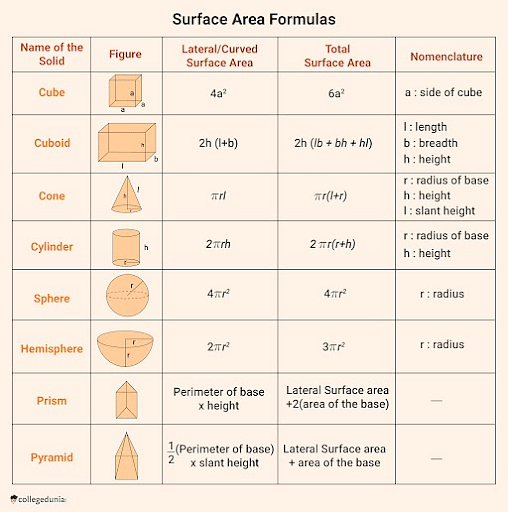
Surface Area Formula List
The video below explains this:
Surface Area and Volume Detailed Video Explanation:
What is Volume?
[Click Here for Sample Questions]
Volume is the measure of space inside a given solid figure. Its unit is always “cubic” which is the elements of little elements of the cube that could fit inside it. Volume is the space that the three-dimensional figure occupies. An object can be either solid or hollow.
Perimeter Definition
The perimeter of a figure is considered the length of the boundary of any figure. Its unit is similar in length like m, cm, km, etc.
Also Read:
Surface Area of Cube and Cuboid
[Click Here for Sample Questions]
Following is the table for the formula of the given surface area and volume of different figures:
| Type | Formula |
|---|---|
| Surface Area of a cuboid with Length, Breadth and Height | 2(LB+BH+LH) |
| Lateral surface area of Cuboids | 2(L+B) H |
| Diagonal of a cuboid | √(L² + B² + H²) |
| Volume of the cuboid | LBH |
| Length of 12 edges of the cuboid | 4(L+B+H) |
| Surface area of cube of side L | 6L2 |
| Lateral surface area of Cube | 4L2 |
| Diagonal of a cube | √3 a (a = length of the edge) |
| Volume of a Cube | a3 (a= length of the edge) |
Surface Area of Right Circular Cylinder
[Click Here for Sample Questions]
The radius of a Cylinder- The radius of the circular base of a cylinder is called the radius of a cylinder. The radius is usually denoted by “r”.
- Height- The length of a cylinder's axis is the height of the cylinder. The height is denoted by “h”.
- Lateral Surface- The lateral surface is the curved surface joining the two bases of the right circular Cylinder.
| Type | Formula |
|---|---|
| Curved or the lateral surface area | 2πrh |
| Total surface area of the cylinder | 2πrh+2πr2 or 2πr (r+h) |
| Volume of the cylinder | πr2h |
Surface Area of Right Circular Cone
[Click Here for Sample Questions]
The radius of a cone- The radius of the circular base of the cone is its Radius(r).
Height of the cone- The length of the line segment that joins the cone's vertex to the center in its base is called the height (h) of the cone.
Slant Height of the Cone- The length of the line segment that joins the vertex to any point on the circular edge of the cone is known as the cone's slant height. It is denoted by “L”.
Lateral Surface Area- The curved surface that joins the base and the uppermost part of a right circular cone is known as its Lateral Surface Area.
| Type | Formula |
|---|---|
| Curved/ Lateral Surface Area of Cone | πrL |
| Total Surface area of Cone | πr (L+r) |
| Volume of Cone | πr2 (h/3) |
Surface Area of Sphere and Hemisphere
[Click Here for Sample Questions]
A sphere is a spherical, three-dimensional object. Three axes—the x, y, and z axes—are used to define the sphere. While, a plane through the center of a circle sphere divides it into two parts. Each part of the sphere is known as its Hemisphere.
- Radius- As usual the radius of the circle that is formed.
- Lateral Area for Sphere- Total surface area of the sphere.
- Lateral Surface Area of the hemisphere- It is the curved surface area leaving the circular base.
| Type | Formula |
|---|---|
| Surface Area of Sphere | 4πr2 |
| Volume of the sphere | \(\frac{4}{3}\)πr3 |
| Curved Surface area of Hemisphere | 2πr2 |
| Total surface area of a Hemisphere | 3πr3 |
| Volume of a Hemisphere | \(\frac{2}{3}\) πr3 |
| Volume of a spherical shell (Where outer Radius is “R” and inner Radius is “r”) | \(\frac{4}{3}\) π(R3 - r3) |
Surface Area of Frustum of Cone
[Click Here for Sample Questions]
H- This is denoted as the vertical height of the frustum.
I- The slant height of the Frustum is denoted by l.
The radii of the two bases of a frustum are denoted by r1 and r2.
| Type | Formula |
|---|---|
| Volume of Frustum of cone | 12πh (r12+r22+r1r2) |
| Slant Height of the Frustum | (h2+(r1+r2)2)1/2 |
| The curved surface area of the frustum | πl(r1-r2) |
| Total Surface area of the frustum | πlr1+r2+ π(r12+r22) |
Surface Area of Prism
[Click Here for Sample Questions]
A prism is defined as an object which is three dimensional and made up of two polygon shaped bases and rectangular shaped lateral faces. The prism has two types of surface area: lateral and total surface area.
The Lateral Surface Area of a Prism: base x perimeter x height
Total surface area of a prism: is lateral surface area + area of two bases
There are 7 types of a prism based on their shape. Hence the surface area of the different types of a prism are-
The formula for the volume of a prism is: V = Bh
Where B is the area of the base.
And the perimeter of a prism: Sum of all the Lengths of the Sides
Things to Remember
- Surface area of any object is defined as the area or region which it occupies including its base.
- Surface areas are of two types: curved or lateral surface area and total surface area.
- To find the surface area of any solid given, add the areas of all the faces of the solid.
- Volume of a prism is calculated as the area of its base times height.
- Volume of a pyramid is given by one-third of the area of its base times height.
- Any sphere can be cut into two equal halves known as Hemisphere.
Read More:
Sample Questions
Ques: Find the total surface area of a cylinder if the radius is 2.5 units and the height is 5 units. (2 marks)
Ans: The formula to calculate the surface area of the cylinder is: 2π r(r + h)
= 2 * 22/7 * 2.5 * (2.5 + 5)
= 2 * 22/7 * 2.5 * 7.5
= 117.85 unit2
Ques. Two cones have their heights in the ratio 1 : 3 and the radii of their bases in the ratio 3:1.Show that their volumes are in the ratio 3: 1. (2 marks)
Ans: The heights should be 1x and 3x, while the radii should be 3y and 1y.
Ratio = Volume of cone1/volume of cone2
= [⅓*π(3y)2x]/[⅓*π(1y)23x]
= 9y2*x/y2*3x
= 3
Ques. A cone of 4 cm base Radius is divided into two parts by drawing a plane through the midpoint of its height and parallel to its base. Now compare the volume of 2 parts. (2 marks)
Ans:
a+ABC~a+ADE, h2h=BC4
∴BC=2cm
Ratio of volumes of two parts
=13π*22*h13π*22+42+2*4*h
=428=17 or 1:7 (7:1 can also be accepted)
Ques. The surface area and volume of a solid hemisphere are equal in terms of numeric. Then what will be the diameter of the hemisphere? (2 marks)
Ans:
Volume (Hemisphere)= 2/3πr3
Surface Area= 3πr3
∴3πr3= 2/3 πr3
=> r= 9/2
=> 2r= 9
=> d= 9
Thus, the Diameter of the hemisphere is 9 cm.
Ques: Find the total surface area of a cone whose radius is r/3 and slant height is 3l. (2 Marks)
Ans: Total surface area of a cone = πr (r+l)
Given, radius = r/3 and slant height = 3l
Hence, the surface area will be: π * r/3 (r/3 +3l)
= π ( r2/ 9 + rl)
= πr (l + r/9)
Ques: If the ratio of the volume of two spheres is 1: 27. Then what will be the ratio of their surface area? ( 3 marks)
Ans: volume of a sphere = 4/3 πr3
Let r1 be the radius of the first sphere and r2 be the radius of the second sphere.
The ratio given for the volumes is v1: v2 = 1:27
4/3 πr13 : 4/3 πr23 = 1:27
r13: r23 = 1:27
r1:r2 = 1:3
Surface area of a sphere = 4πr2
So the ratio of the surface area will be= S1:S2
= 4πr12 : 4πr22
= r12: r22
= 12: 32
= 1:9
Ques. What is perimeter? (1 mark)
Ans: The perimeter of a figure is considered the length of the edge of each figure. Its unit is similar in length, etc. For example, m, cm, km, etc.
Ques. Find out the number of solid spheres, each of 6cm, which can be created by melting a solid metal cylinder of 45cm in height and 4cm in diameter. (3 marks)
Ans:
Solid sphere volume (v)= 4/3πr3
r v= 4/3 x 22/7 x 33 cm3
r (v= 4xπx9=36π cm3)
Volumes of Cylinder= πR2= π*422*45 cm
Or, v= 180π cm3
N= number of spheres= v*v= 180π cm 336π cm3
=> n= 5
Thus, the number of solid spheres created is 5.
Ques. Hypothetically, the total surface area of a solid hemisphere is 462cm2 (square), and then its volume will be. (3 marks)
Ans:
The total surface area of the hemisphere= 462cm2
The total surface area of the Hemisphere= 2πr2
=> 462 = 3πr2
=> r= 7cm
Volume of Hemisphere= 23*227*73
V= 718.67cm3
Thus, the volume of the hemisphere is 718.67cm3
Ques. Define the following: (2 marks)
(A) Surface Area
(B) Volume
Ans: (A) Surface Area: The area of an object is the total area that the object occupies. Its unit is usually the square of any unit of length. For example, the surface area of a cube is 6a2.
(B) Volume: Volume is a measure of the space within a Its unit is always a cube, meaning the elements of the small cube pieces that fit inside.
Also Check-Out:



Comments