



Content Writer
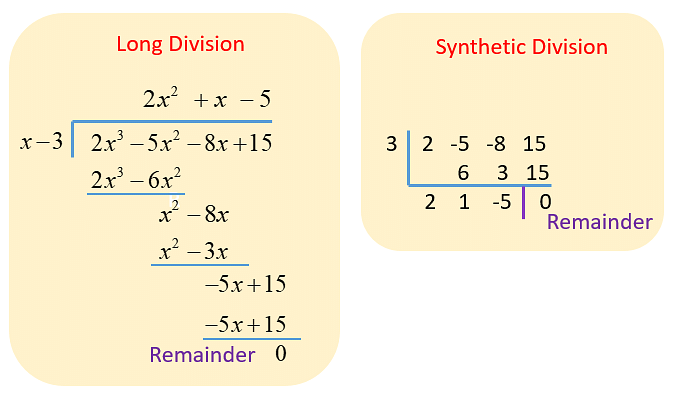
Synthetic Division is one of the ways to perform Euclidean division of polynomials. Polynomials can be divided by two methods, viz: long division method and synthetic division method.
- Synthetic division method is a shorter form of dividing the polynomials.
- The long division method is a longer form of dividing the polynomials.
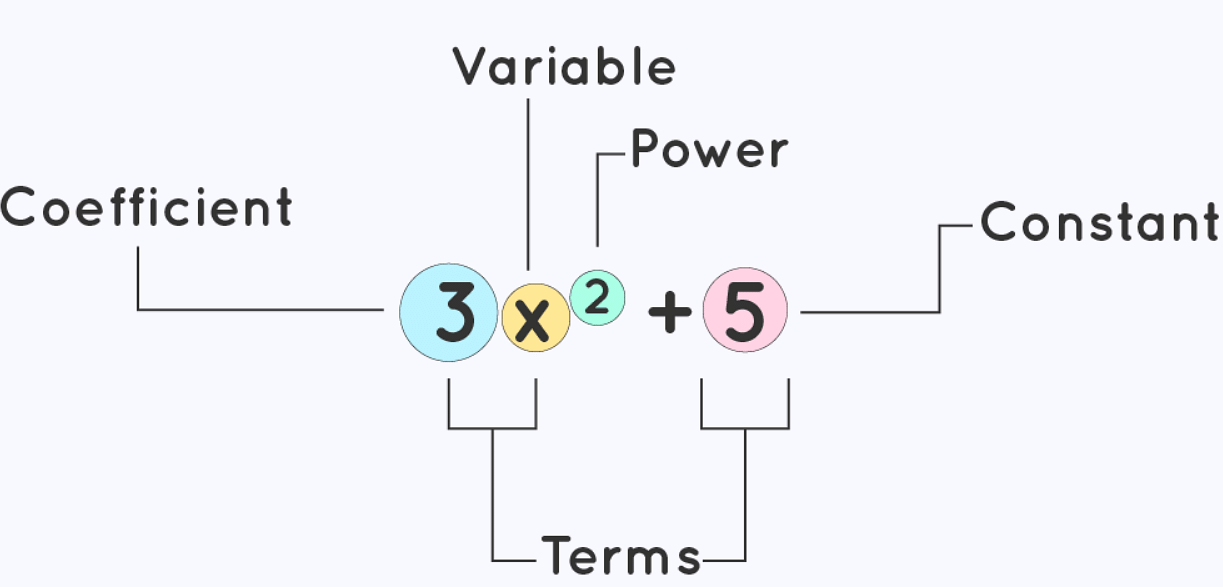
- A polynomial is an expression made of variables, constants and exponents.
- It requires fewer calculations and less time to solve the problem.
- It helps in finding zeros or the root of the polynomial.
- The synthetic division method is the shorter form of dividing polynomials when dividing by a linear factor.
- It is used to fix algorithms in CD players and telephones.
- It involves adding the required polynomial expression.
Read More Polynomials Formulas
Key Terms: Synthetic Division, Euclidean division, Polynomials, Long division method, Linear factor, Whole number, Coefficient, Degree
Synthetic Division of Polynomials
[Click Here for Sample Questions]
Synthetic division method is a method that involves divison of polynomials with another polynomial equation with degree one. The method is used to count the number of zeroes of polynomials.
- It involves division of polynomial p(x) by a linear factor (x - a), which is a polynomial of degree 1.
- Q(x) is the required quotient polynomial with a remainder R.
- Mathematically, Synthetic division method can be represented as:
p(x)/q(x) = p(x)/(x- a) = Quotient + (Remainder/(x - a))
p(x)/(x - a) = Q(x) + (R/(x - a))
Read More: Quadrant
What are Polynomials
[Click Here for Sample Questions]
Polynomial is a type of expression in mathematics in which exponents of all variables are a whole number. The degree of the polynomial is calculated by determining the highest value of the exponent.
- It involves various operations like addition, subtraction, multiplication and division.
- The power of any variable has to be a non-negative integer.
Solved Example
Polynomials |
Read More: Rationalize the Denominator
The video below explains this:
Polynomials Detailed Video Explanation:
Read More:
| Related Articles | |||
|---|---|---|---|
| Remainder Theorem | Degree of polynomial | HCF and LCM | |
| Quadratic Equations | Real Numbers | Polynomials | |
What is the Division of Polynomials?
[Click Here for Sample Questions]
Division in Polynomials is an arithmetic operation, where a higher degree polynomial is divided by a lower degree or equivalent degree polynomial. It may result as a polynomial or as a constant in answer. It is usually done to find out the roots or zeros of the Polynomials
Polynomial Division
Read More: Nature of Roots
What Is Linear Factor?
[Click Here for Sample Questions]
Linear Factor of a polynomial is a first degree polynomial which is the building block of higher degree polynomials. It appear in the form of ax+b. A linear factor of a polynomial is univariate meaning having one variable affecting the function.
Read More: Polynomials Formula
How To Perform Synthetic Division
[Click Here for Sample Questions]
Synthetic Division method is a shorter form of dividing polynomials. It is generally used to find out zeros or roots of the polynomials. This division method is performed with less effort.
- For synthetic Division method, the divisor of the polynomial should be degree 1 meaning it should be a linear factor.
- The coefficient of the divisor variable should also be equal to 1.
- Divide using the remainder theorem in conjunction with synthetic division.
- Set up the coefficient and then divide.
Read More: Eccentricity
Steps of Synthetic Division
[Click Here for Sample Questions]
The steps included in solving the synthetic division of polynomials are as follows:
Step 1
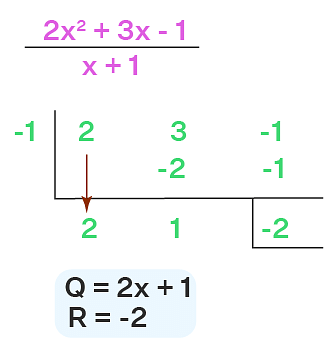
The setup is usually done as we divide in non-algebraic form. The divisor goes outside the box(divisor means the polynomial with which we are dividing) and the dividend goes inside the box.
- Dividends are always written in descending order and insert zeros for the missing terms.
- For example: (2x2 – 3x – 1) divided by (x+1) starts with degree four and degree three and degree two is missing so we put zeros on that place.
- The said equation will be written as:
-
Setting this said equation up as a synthetic equation:
Step 2
Bring down the first coefficient of the dividend.
Step 3
Multiply the coefficient of divisor with the brought down first coefficient of dividend then put the value just below the next coefficient.
Step 4
Add the column created.
Step 5
Repeat the steps that are multiplying the divisors coefficient with the previous dividends coefficient then add the same with the next coefficient.
Step 6
The numbers in the last row are coefficients of the quotient as well as the remainder. The final value on the right is the remainder.
- Working right to left, the next number is your constant.
- The next is the coefficient for x, the next is the coefficient for x squared and so on.
- The degree of the quotient is one less than the degree of the dividend.
- For example, if the degree of the dividend is 4, then the degree of the quotient is 3.
Read More:
Advantages of Synthetic Division
[Click Here for Sample Questions]
- Synthetic Division is a form of dividing polynomials.
- It is generally used to find out the zeros of the polynomial.
- Linear factor of a polynomial is a one degree polynomial.
- In synthetic division method, coefficient of the polynomials plays the most important part.
- When calculating synthetic division the next degree coefficient is absent then we put zeroes at that place.
- In the final equation, answer is always one degree less than the dividend.
Read More: Types of Functions
Things to Remember
- Synthetic division method is a shorter form that involves the division of polynomials with another polynomial equation with degree one.
- It involves the division of polynomials with the linear factor.
- It is an error-prone method that can be solved without variables.
- Linear Factor is in the form of ax+b.
- The method is used to manually solve the Euclidean division of polynomials.
Read More: Types of Relations
Sample Questions
Ques: Divide 2x3-3x2 +4x-1 by x+1 (2 marks)
Ans: (x+1) / 2x3 -3x2+4x -1

Ques: Given f(x) = 3x3 +x2 -7x -5 and other expression is 3x – 5, find the result using remainder theorem? (2 marks)
Ans: f(x) = 3x3 +x2 -7x -5

0 is the remainder
Ques: Use Synthetic Division method to find out zeros of polynomial x3 +2x2 -5x -6 by x-2. (2 marks)
Ans: Write the coefficients of the polynomial

Here the remainder is 0 that means x-2 is a factor of the given polynomial.
Ques: Divide 2x3 -5x2 +3x +7 by x+ 2. (2 marks)
Ans: Putting the coefficients in the place

9 is the remainder
(2x2 -x+1 +9by x-2 )
Ques: Use synthetic division method to divide x3+x2−5x+3 is divided by x2+2x−3. (2 marks)
Ans: Put the coefficient of polynomials in synthetic form

Ques: Suppose x4+x3−2x2+x+1 is divided by x-1, the remainder obtained is 2 and the quotient is q(x). Find q(x). (2 marks)
Ans: x4+x3−2x2+x+1 is divided by x-1

Ques: When x3+5x2+ax−7 is divided by x−3, the remainder obtained is 47. Find a. (2 marks)
Ans: Let f(x)=x3+5x2+ax−7 and required divisor is x−3
- Now put x=3 in f(x)
- f(3)=33+5(3)2+a(3)−7
- 27+5(9)+3a−7
- 27+45+3a−7
- 65+3a
- But remainder = 47
- So, 65+3a=47 as [p(3)=47]
- 3a=47−65
- 3a=−18
- a=−6
Ques: Consider the equation (x3 - 2x3 - 8x - 35). Divide the equation by (x - 5) using synthetic division method. (2 marks)
Ans: Given the equation (x3 - 2x3 - 8x - 35) .
- Now divide it by x – 5 which is as follows:

Ques: The distance covered by erika in his car is given by the expression 9a2 - 39a - 30. The time taken by her to cover the required distance is given by the expression (a - 5). Find the speed of the car. (3 marks)
Ans: Speed of the car is given as the ratio of the distance to the time.
- So to calculate the speed simly divide the distnace equation with time equation
- Speed = (9a2 - 39a - 30)/(a - 5)

Spped of the car is calculated as 9a + 6
Ques: Divide (6x2 + 7x - 20) by (2x + 5) using synthetic division method. (2 marks)
Ans: In this the expression (6x2 + 7x - 20) is divided by (2x + 5) which is as follows:

The quotient of the equation is 3x – 4
Ques: Divide x2 + 5x + 6 by x − 1 using synthetic division method. (2 marks)
Ans: In this the expression x2 + 5x + 6 is divided by x − 1 to obtain the quotient.

Ques: The volume of anu’s storage box is 8x3 + 12x2 - 2x - 3. She knows that the area of the box is 4x2 - 1. What could be the height of the box. (3 marks)
Ans: As we known that Area = length × breadth
- we are given Area = 4x2 - 1.
- The area is in the form of a2 - b2 = (a + b)(a - b)
- As a result it can be expressed as, A = (2x + 1)(2x - 1)
- V = l × b × h = A × h
- h = (V/A) = (8x3 + 12x2 - 2x - 3)/[(2x + 1)(2x - 1)]

Ques. Divide x3+2x2–3 is divided by x – 2. (2 marks)
Ans. Suppose f(x) = x3+2x2–3.

For Latest Updates on Upcoming Board Exams, Click Here: https://t.me/class_10_12_board_updates
Also Check:



Comments