


The valency of barium in barium chloride is

Collegedunia Team logo

Collegedunia Team

Content Curator

Valency of an element in a compound refers to the number of electrons in the outermost shell of an atom that is involved in chemical bonding with another atom. The valency of barium in barium chloride can be calculated by using the chemical formula of the compound, which is BaCl2.
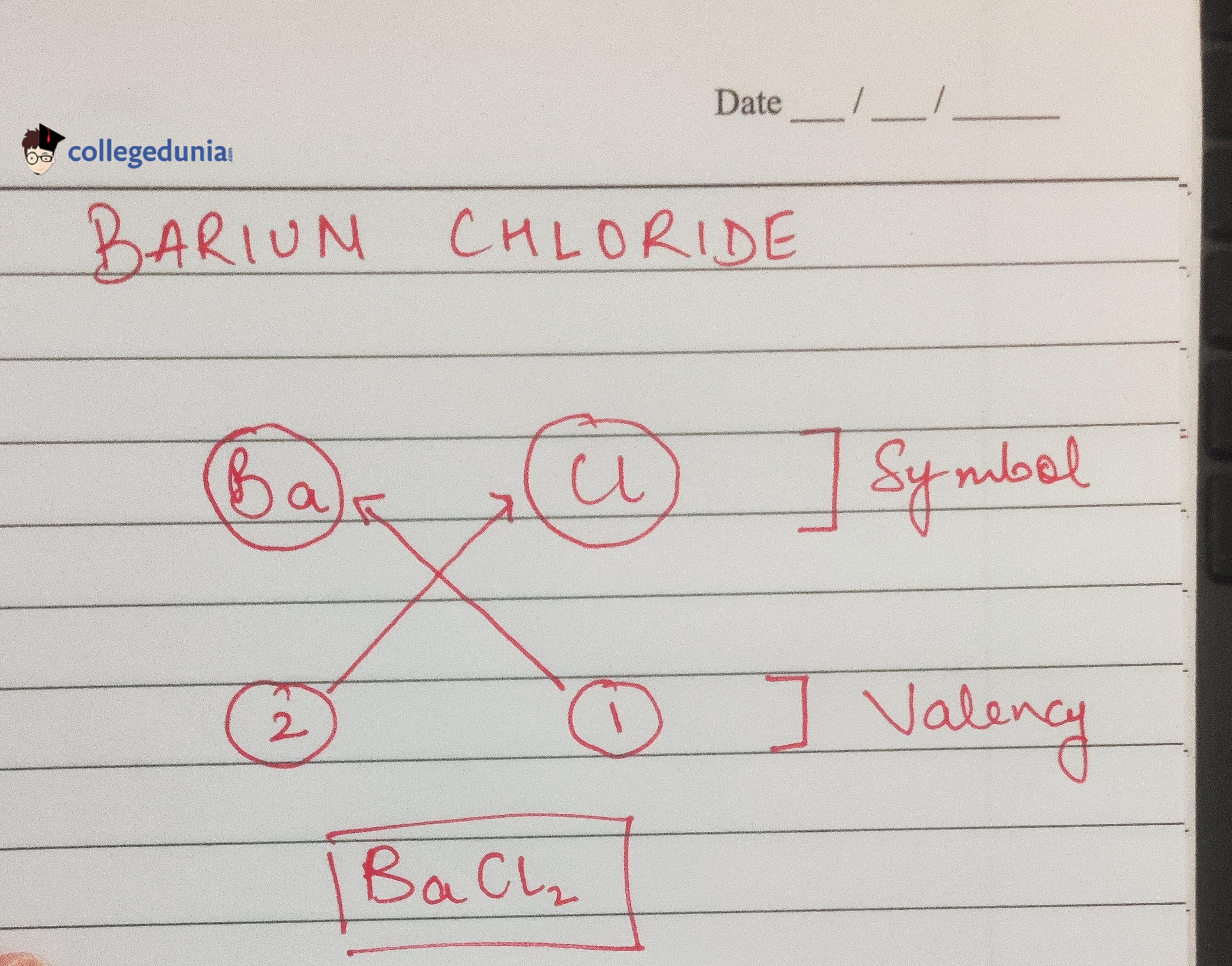
barium chloride valency

Barium Chloride Valency

  1. Step 1: Determine the number of electrons in the outermost shell of each element in the compound. Barium (Ba) has 2 electrons in its outermost shell, and chlorine (Cl) has 7 electrons.
  2. Step 2: Calculate the total number of electrons involved in bonding between the two elements. In BaCl2, there are 2 chloride ions, each with 7 electrons, so the total number of electrons involved in bonding is 7 x 2 = 14.
  3. Step 3: Subtract the number of bonding electrons from the number of electrons in the outermost shell of barium. The valency of barium in barium chloride is calculated as follows: 2 electrons in the outermost shell of barium - 14 bonding electrons = -12.
  4. Step 4: Determine the absolute value of the result. The absolute value of -12 is 12, so the valency of barium in barium chloride is 12.

Therefore, the valency of barium in barium chloride is 12.

Also check:

CBSE CLASS XII Related Questions

  • 1.
    Which of the following curve represents the first order reaction?

      • A
      • B
      • C
      • D

    • 2.
      Draw the structure of 'X' in the following reaction:


        • 3.
          The chelating ligand used for the treatment of lead poisoning is :

            • Ethane-1,2-diamine
            • Oxalate ion
            • Dimethylglyoxime
            • EDTA

          • 4.

            (a) Write two structural differences between DNA and RNA.

            (b) Which component of starch is a branched chain polymer of \( \alpha \)-D-(+)-glucose ? Write its one characteristic feature.

            (c) Which types of bonds hold the polypeptide chains in fibrous proteins ?


              • 5.

                (a) Define 'Denatured Protein' with an example.

                (b) What happens when glucose reacts with HCN ? Write the reaction involved.

                (c) Name the disease caused by the deficiency of Vitamin C.


                  • 6.
                    Consider the decomposition of hydrogen peroxide \( (\mathrm{H_2O_2}) \) as per the equation given below : \[ 2\mathrm{H_2O_2} \xrightarrow[\text{Alkaline medium}]{I^-} 2\mathrm{H_2O} + \mathrm{O_2} \] The mechanism for this reaction was found to be : Step I : \( \mathrm{H_2O_2} + I^- \longrightarrow \mathrm{H_2O} + IO^- \) (slow) Step II : \( \mathrm{H_2O_2} + IO^- \longrightarrow \mathrm{H_2O} + I^- + \mathrm{O_2} \) (fast) (a) Write the rate law expression. (b) Determine the order of reaction with respect to \( \mathrm{H_2O_2} \), \( I^- \) and overall order of reaction. (c) What is the molecularity of the reaction in Step II ?

                      CBSE CLASS XII Previous Year Papers

                      Comments


                      No Comments To Show
