


The valency of barium in barium chloride is

Collegedunia Team logo

Collegedunia Team

Content Curator

Valency of an element in a compound refers to the number of electrons in the outermost shell of an atom that is involved in chemical bonding with another atom. The valency of barium in barium chloride can be calculated by using the chemical formula of the compound, which is BaCl2.
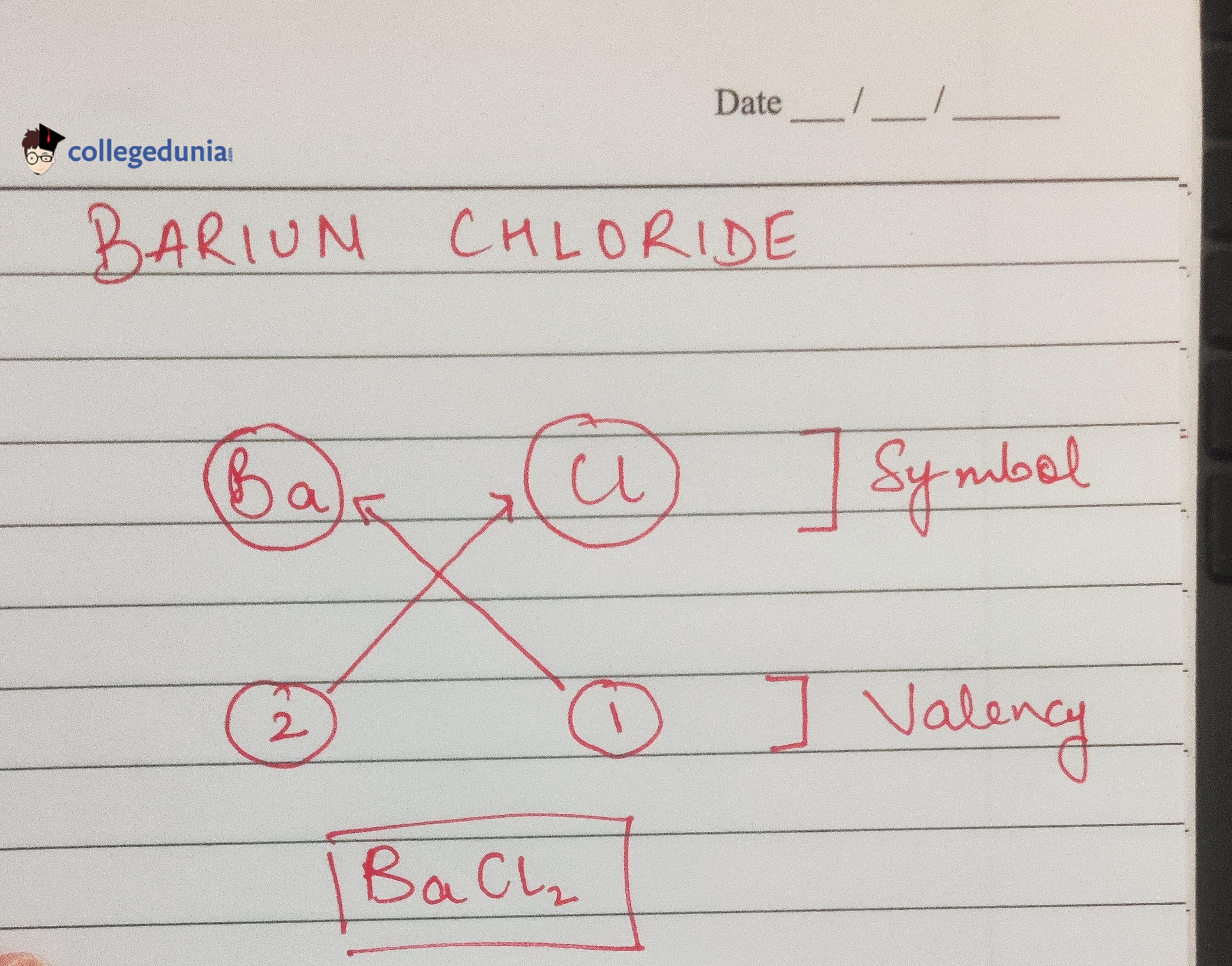
barium chloride valency

Barium Chloride Valency

  1. Step 1: Determine the number of electrons in the outermost shell of each element in the compound. Barium (Ba) has 2 electrons in its outermost shell, and chlorine (Cl) has 7 electrons.
  2. Step 2: Calculate the total number of electrons involved in bonding between the two elements. In BaCl2, there are 2 chloride ions, each with 7 electrons, so the total number of electrons involved in bonding is 7 x 2 = 14.
  3. Step 3: Subtract the number of bonding electrons from the number of electrons in the outermost shell of barium. The valency of barium in barium chloride is calculated as follows: 2 electrons in the outermost shell of barium - 14 bonding electrons = -12.
  4. Step 4: Determine the absolute value of the result. The absolute value of -12 is 12, so the valency of barium in barium chloride is 12.

Therefore, the valency of barium in barium chloride is 12.

Also check:

CBSE CLASS XII Related Questions

  • 1.
    Write the name of basic building units of proteins and nucleic acids. How can you differentiate between Fibrous and Globular proteins on the basis of their structures ?


      • 2.
        Draw the structure of 'X' in the following reaction:


          • 3.

            (a) Write two structural differences between DNA and RNA.

            (b) Which component of starch is a branched chain polymer of \( \alpha \)-D-(+)-glucose ? Write its one characteristic feature.

            (c) Which types of bonds hold the polypeptide chains in fibrous proteins ?


              • 4.
                An organic compound (X) has the molecular formula \(C_5H_{10}O\). Draw structures for (X) if it:
                (I) does not give Tollen's test but gives a positive iodoform test.
                (II) does not give Tollen's test and iodoform test but undergoes Aldol condensation.
                (III) undergoes Cannizzaro's reaction.


                  • 5.

                    Conductivity of \( 2.5 \times 10^{-4} \) M methanoic acid solution is \( 5.25 \times 10^{-5} \) S cm\(^{-1}\).

                    (a) Calculate its molar conductivity.

                    (b) Calculate its degree of dissociation.

                    [Given : \( \lambda^{\circ}_{(\mathrm{H^+})} = 349.5 \) S cm\(^2\) mol\(^{-1}\) and \( \lambda^{\circ}_{(\mathrm{HCOO^-})} = 50.5 \) S cm\(^2\) mol\(^{-1}\)]


                      • 6.

                        Explain the Finkelstein reaction.

                          CBSE CLASS XII Previous Year Papers

                          Comments


                          No Comments To Show
