



Content Writer
Tin, as per the modern periodic table, belongs in the p-block. This element belongs to the fourteenth group of the fifth period. It is a chemical element with the symbol ‘Sn’ and has an atomic number of 50.
- In terms of colour, tin is a metal that mainly has a faint silvery white tincture with a bluish hue.
- Excavating the chemical composition, it generally comprises 92% of tin, 7% antimony, and 1–2% copper.
- It also sometimes comes with a varying amount of bismuth or silver as an addition to the aforementioned compounds.
- The compound presents a mirror-like appearance similar to most metal
- During bending, tin seemingly releases a suppressed crackling ‘cry’ as its crystals collide and crush each other.
- This typically eerie cry is referred by many as the “Tin Cry.”
- Saucepans and frypans used in the kitchen have thin plating of tin.
Key Terms: Tin, p-Block Elements, Oxidation State, Periodic Table, Atomic Number, Silver, Bismuth, Antimony, Metal, Corrosion, Melting Point, Electrodes, Battery, Transition Metal
What is Tin?
[Click Here for Sample Questions]
Tin is a chemical compound that belongs to group 14 of the modern periodic table. It is the part of the carbon family that exhibits a chemical similarity to two of its neighbouring elements in the fourteenth group, namely Germanium and Lead.
- Tin has two main oxidation states, +2 and +4 if more stability is considered.
- It generally occurs in two forms, namely organic tin and inorganic tin.
- The element is naturally found in the earth’s crust in the form of igneous rocks.
- Tin is also known as Stannum in Latin.
- Organic tin is evidently seen to be more toxic in mature than inorganic tin.
- The compound is so soft that it can easily be cut into two with little force.
- Toxicity of the element is exhibited by the larger the chain of the alkyl group.
Read More:
| Chapter Related Concepts | ||
|---|---|---|
| Ionic Bond (Electrovalent Bond) | Group 15 Elements | Dinitrogen |
| Enthalpy | Electrophoresis | Ammonia |
Structure of Tin
[Click Here for Sample Questions]
Tin is a malleable compound that forms a tetragonal crystal structure. The atom within the compound is joined by a metallic bond. The atoms are kept in distorted, close-packed arrangement within the structure.
- In this, each atom is surrounded by 12 different atoms.
- The attractive forces found inside the atom are quite strong.
- Molecules of tin have a small degree of freedom due to a strong, attractive force.
- It forms a diamond structure that crystallizes in the cubic Fd̅3m space.
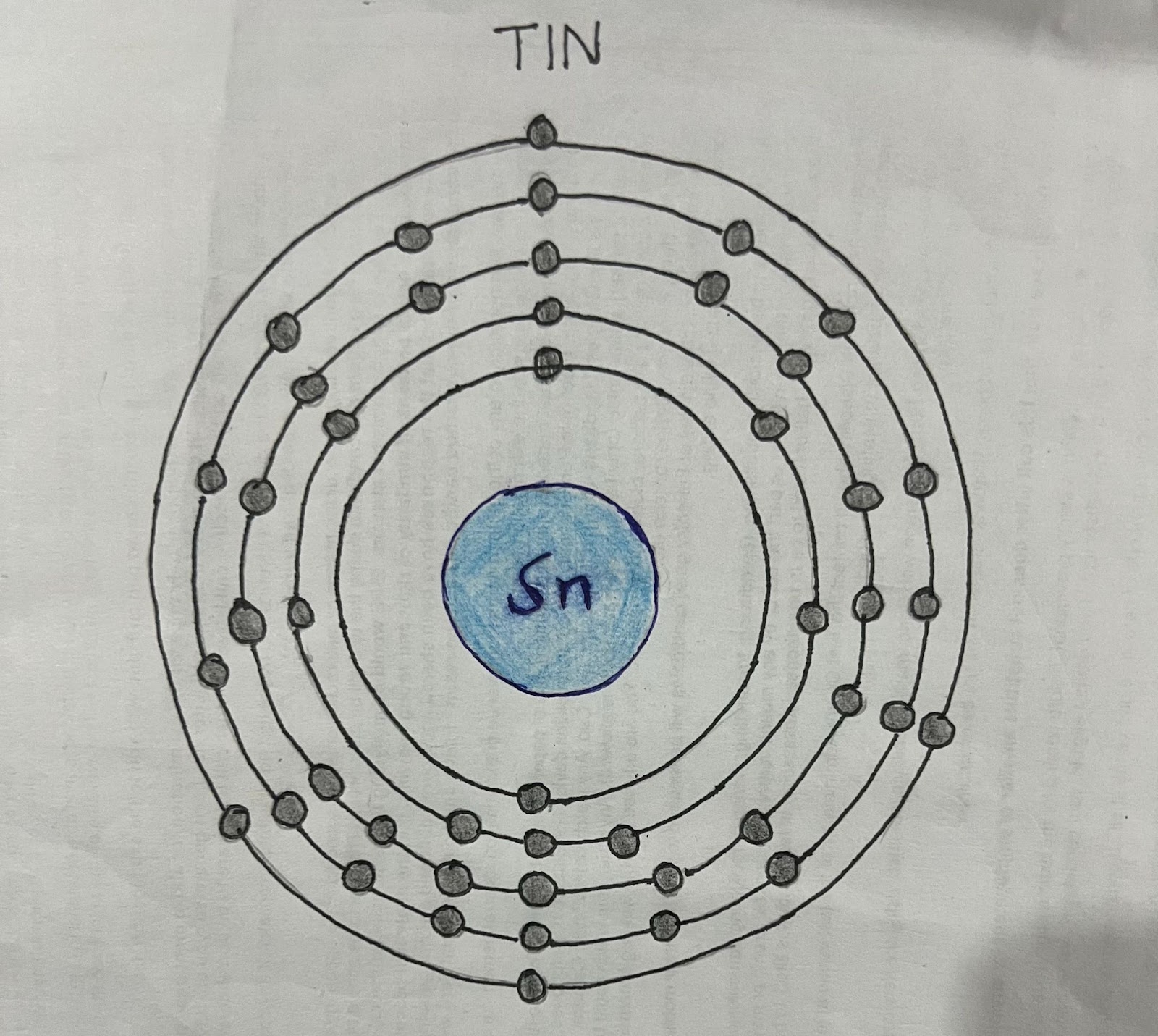
Tin
Properties of Tin
[Click Here for Sample Questions]
The important properties of tin are as follows:
- With an atomic number of 50, tin is widely known to be both a soft and malleable metal.
- It has a typical bluish-white tincture.
- Tin is widely referred to as a post-transition metal belonging to group 14 of the modern periodic table.
- This metal can be acquired from the mineral cassiterite, which typically contains stannic oxide or, simply, SnO2.
- The concentration of this element is about 0.001 per cent, which is considered slightly scarce.
- About two parts of the earth’s crust are known to be composed of tin.
- It is found in abundance with other neighbouring elements of the same group, like cobalt, nickel, copper, and lead.
- Tin generally does not exhibit any effect if exposed to either oxygen or water at room temperature.
- It is visibly resistant to corrosion, which is one reason it is used in coating other metals.
- Tin forms oxides at typically higher temperatures, especially when it reacts with oxygen and water.
The table below highlights the important properties of tin which are as follows:
| Element | Tin |
|---|---|
| Atomic Mass | 118.710 |
| Melting point of mercury | 231.928°C, 449.47°F, 505.078 K |
| Density of mercury | 7.287 |
| Crystal Structure | white (β)- body-centered tetragonal gray (α)- face-centered cubic |
| Boiling point of mercury | 2586°C, 4687°F, 2859 K |
| Electronic shell of mercury | [Kr] 4d10 5s2 5p2 |
| Isotopes of Tin | 10 |
| Energy of first ionisation | 708.6 kJ/mol |
| Energy of second ionisation | 1411.8 kJ/mol |
Physical Properties of Tin
Some major physical properties of Tin:
- The atomic number of tin is 50.
- The relevant atomic weight of tin is recorded at 118.69.
- The melting and boiling points of the metal are 231.97 °C (449.54 °F) and 2,270 °C (4,100 °F) respectively.
- The oxidation states of the element are +2, and +4 (if more stable).
- The electronic configuration of Tin is [Kr] 4d10 5s2 5p2.
- Its atomic radius is 217 pm.
Chemical Properties of Tin
The chemical properties of Tin are as follows:
- Tin can gradually be destroyed by weak acid like hydrochloric acid and sulphuric acid.
- The compound is quickly dissolved when solution of hot and strong acid is added to it like potassium hydroxide.
Sn2+KOH→K2SnO2+H2
- It react with halogens to form compound like tin chloride and tin bromide.
- Stannous chloride is the most significant tin halide which is formed when chlorine combines with the tin metal.
SnCl4+Sn→2SnCl2
- Stannanes are organic compounds that is formed by tin-carbon bonds.
SnCl4+R4Sn→2SnCl2R2
- Tin Hydrides are well-known organotin hydrides.
- At about 50 degrees Celsius, the conversion to grey tin by white tin becomes extremely fast.
- Most essentially, strong acids or alkalis can usually attack tin, but neutral solutions are generally not seen to affect it.
Uses of Tin
[Click Here for Sample Questions]
Some major uses of Tin are as follows:
- Tin is generally used for the coating of metals to inhibit the rates of corrosion.
- It is also used to manufacture other alloys, from bronze to copper.
- Tin is broadly used in the process of soldering steel since it is known to have high magnetic strength and a lower melting point.
The compound is used as a dyeing agent for materials like ceramics, glass, and sensors, with typical properties related to being a reducing agent. It also helps in the manufacturing of window glass.
- One of its major compounds, Stannous fluoride, is widely used in the making of toothpaste.
- Tin is used in the shipping industry as an antifouling agent, mainly for purposes related to ships and boats.
- It is known to inhibit boats and ships from barnacles.
- The element is used to make the electrodes of batteries, such as what we usually witness in Li-ion battery cells.
Read More:
| Class 11 Chemistry Related Concepts | ||
|---|---|---|
| Transuranium Element | Cis Trans Isomerism | Mole fraction |
| Emulsions | Oxides of Nitrogen | Isotopes and Isobars |
Allotropes of Tin
[Click Here for Sample Questions]
There are three allotropes that Tin (Sn element) has namely grey tin (cubic), white tin (tetragonal), and white tin (rhombic). As per the general properties, white tin usually converts to grey tin if there is a respective voluminous increment.
Grey Tin
Grey tin is also referred to by many as alpha tin. It converts to white tin at 13.2 degrees Celsius, while white tin can be converted into brittle tin at about 161 degrees Celsius.
White Tin (Tetragonal)
White tin, which is silvery white in colour and is typically harder than lead, generally has a very ordinary form. White tin is highly malleable and ductile in nature.
- This element can also likewise be folded into thin foils, if found necessary.
White Tin (Rhombic)
White tin usually has a body-centred tetragonal crystal structure, while grey tin comes with a face-centred cubic structure. Grey tin, unlike the former, has a lower density, making it quite brittle and prone to be powdered.
Environmental Effects of Tin
[Click Here for Sample Questions]
The environmental effects of tin are as follows:
- Organic compounds of tin remain in the environment for a long time and are not biodegradable.
- If organic particles of tin is absorbed on sludge materials, it will spread throughout the water systems.
- They seriously affect aquatic ecosystems including fungus, algae, and phytoplankton.
- Phytoplankton are sensitive towards triphenyltin.
- Tin can cause irritation in eyes and skin.
Things to Remember
- Tin is seen to be both a soft and malleable metal with a typical bluish-white tincture.
- It can be cut with a very minimal force.
- This element is situated in the fourteenth group of the fifth period.
- It has a chemical symbol ‘Sn’.
- The three allotropes that Tin (Sn element) has are known to be grey tin (cubic), White tin (tetragonal), and White tin (rhombic).
- In general, grey tin converts to white tin at 13.2 degrees Celsius.
- White tin can be converted into brittle tin at about 161 degrees Celsius.
Sample Questions
Ques: State the general characteristics of the element, Tin. (4 marks)
Ans: Here are some general characteristics of the element Tin:
- Tin, as per the modern periodic table, is known to have about 10 naturally occurring isotopes with several different mass numbers.
- It is broadly known as a post-transition metal belonging in the fourteenth group of the modern periodic table.
- Tin can be extracted from the mineral cassiterite, which is known to contain stannic oxide, or simply, SnO2.
- The compound generally displays a chemical similarity to two of its neighbouring elements in the fourteenth group, Germanium and Lead.
Ques: State where Tin is used. (4 marks)
Ans: Tin element, or simple Tin, is known to be a chemical element that belongs in the carbon family of the fourteenth group of the modern periodic table. Tin is a metal that mainly has a faint silvery white tincture with a bluish hue.
- The Sn element is commonly used for the purposes of manufacturing food containers.
- It is also used for bearings and for soldering purposes too.
- Tin is used as a dyeing agent for materials like ceramics, glass and sensors.
- Alongside, it exhibits typical properties related to being a reducing agent as well.
Ques: State whether or not the Tin element is harmful to humans. (3 marks)
Ans: The Sn element, or Tin, has had no recognized forms of adverse effects on biologically diverse animals. However, animals and humans are not exposed to consuming it easily.
- The low toxicity of the element is considered highly significant for the widespread manufacture of canned foods and containers related to storing food.
- It can rather cause breathing issues if inhaled.
- If directly in touch, it is prone to causing issues such as Eye and skin irritations, Headaches, dizziness, extreme sweating alongside arising problems related to urination.
Ques: Define the process by which the Sn element is derived. (3 marks)
Ans: The Sn element, or Tin, can be derived from the mineral cassiterite (SnO2). Further, it is known to be extracted in a carbon furnace from the raw properties involved in the Sn element, Cassiterite.
- The concentration this element generally exhibits reads about 0.001 per cent, which is typically considered slightly scarce if not directly rare.
- Tin is generally mined in Malaysia.
- Grey tin converts to white tin at 13.2 degrees Celsius, while white tin can be converted into brittle tin at about 161 degrees Celsius.
Ques: What makes Tin, or Sn Element, one of the most important metals of the carbon family. (3 marks)
Ans: There are several reasons behind why Tin is considered a major metal in the carbon family:
- In general, Tin does not exhibit or display any kind of effect if exposed to either oxygen or water, only under the room temperature.
- It is visibly resistant to corrosion, which is one reason why it is used in the coating of other metals.
- One of its major compounds, Stannous fluoride, is seen to be broadly used in the making of toothpastes.
Ques: Name the allotropes of tin. (3 marks)
Ans: There are three allotropes of tin which are as follows:
- Grey tin is also referred to by many as alpha tin. It converts to white tin at 13.2 degrees Celsius, while white tin can be converted into brittle tin at about 161 degrees Celsius.
- White tin, which is silvery white in colour and is typically harder than lead, generally has a very ordinary form. White tin is highly malleable and ductile in nature. This element can also likewise be folded into thin foils, if found necessary.
- White tin usually has a body-centred tetragonal crystal structure, while grey tin comes with a face-centred cubic structure. Grey tin, unlike the former, has a lower density, making it quite brittle and prone to be powdered.
Ques: What are the 10 stable isotopes that are seen to naturally occur. (2 marks)
Ans: Tin is broadly referred to as a post-transition metal that is situated in the group 14 of the modern periodic table. Tin, or the Sn element, is known to have 10 stable isotopes that are seen to occur in the following percentages: tin-112: 0.97; tin-114: 0.65; tin-115: 0.36; tin-116: 14.53; tin-117: 7.68; tin-118: 24.22; tin-119: 8.58; tin-120: 32.59; tin-122: 4.63; and tin-124: 5.79.
Ques: Explain the production and extraction process of tin. (3 marks)
Ans. The tin can be extracted from various sources which are as follows:
- Tin can be extracted by the process of mining and smelting.
- It is prepared by reducing oxide ore by carbothermal method using carbon or coke.
- Electric and reverberatory furnaces can be used for production of tin.
- Pure tin is created by heating cassiterite with charcoal.
Ques: What are the reactions involved when tin chloride reacts with
(A) Potassium permanganate
(B) Potassium dichromate
(C) Mercuric chloride
(D) Auric chloride. (4 marks)
Ans: The reactions involved when tin chloride reacts with following compounds are as follows:
(A) Potassium permanganate: When tin chloride reacts with potassium permanganate it will form tin tetrachloride.
SnCl2+KMnO4→SnCl4+Mn+2
(B) Potassium dichromate: When tin dichloride reacts with potassium dichromate it will form tin tetrachloride.
SnCl2+K2CrO7→SnCl4+Cr+3 (green colour)
(C) Mercuric chloride: When mercuric chloride react with tin dichloride it will form white precipitate of mercuric chloride.
SnCl2+HgCl2→Hg2Cl2 (white ppt)
(D) Auric chloride: When tin dichloride react with auric chloride it will form tin tetrachloride and aurous precipitate.
SnCl2+AuCl3→SnCl4+Au
Ques: How is tin formed. (3 marks)
Ans: Tin is found in both primary and secondary deposits of ore. Granite intrusive rocks, which originate when magma bodies cool (solidify) beneath the Earth's surface as opposed to on it as in the case of volcanic rock, are usually linked with primary deposits.
- Granite, pegmatites, and aplites that are connected to the granite can all contain primary deposits.
- Veins, disseminations, and other deposits can also be found in the rocks that encircle the intrusions' edges.
Ques: Explain the history of tin. (4 marks)
Ans: The use of tin dates back to medieval age where it is used in Egyptian tomb of the eighteenth dynasty (1580–1350 BC). In the year 700 BC, the Chinese began mining tin in the Yunnan province.
- The Inca mountain fortress of Machu Picchu is another place where pure tin has been discovered.
- Bronze was created when copper was alloyed with around 5% tin.
- This combination produced a metal that was more tougher and perfect for tools and weapons.
- It also melted at a lower temperature, making it easier to work with.
- The Bronze Age is widely acknowledged as a significant period in the history of civilization.
Read More:



Comments