



Content Curator
The elements that partly fill the ‘d’ and ‘f’ subshells are termed as Transition Elements or simply Transition Metals. In general, IUPAC clearly elaborates that in a transition element ‘d’ shells which partly are covered with electrons. Most essentially, these elements also have the capability to form certain stable cations that have incomplete ‘d’ shells.
Read Also: Periodic Classification of Elements
| Table of Content |
Key Terms: Transition metals, Electronic configuration, Transition elements, Ionization enthalpy, Oxidation states, Electrons, d shells, Zinc, Cadmium, Mercury
Introduction to Transition Metals
[Click Here for Sample Questions]
Transition metals are known as d-block elements and are categorized into 3 series, namely, 3d series (Sc to Zn), 4d series (Y to Cd) and 5d series (La to Hg, except Ce to Lu). Such elements have partially filled or incompleted orbitals either in-ground state or excited state. Since, Zinc, Cadmium, and Mercury of group 12 possess completely filled d orbitals, they are not referred to as transition metals.
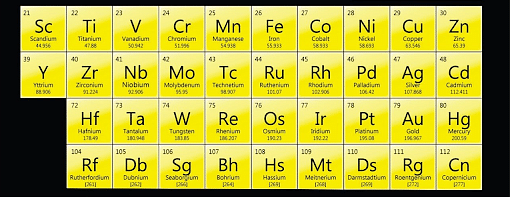
Introduction to Transition Metals
Read More: F-Block Element
Position of Transition Metals in Modern Periodic Table
[Click Here for Sample Questions]
The transition elements are commonly located between the ‘s’ and ‘p’ block elements in the modern periodic table, or, in other words, the d-block occupies the largest middle section of the modern periodic table. Group 3 - Group 12 elements are the transition elements. The d-block comprises 3 transitions series which are formed due to acceptance of electrons by the penultimate energy levels of the atoms.

Position of Transition Metals in Modern Periodic Table
Check Important Notes for Electron Gain Enthalpy
General Electronic Configuration
[Click Here for Sample Questions]
The general electronic configuration of transition elements is represented by (n-1) d1–10 ns1–2. The (n–1) denotes the inner d orbitals that may have anything from between 1 to 10 electrons, while outermost ns orbitals can usually have 1 or 2 electrons in general. The half or completely filled orbitals are generally more stable.
The very first row of transition metals depicts similar electronic configuration. The electronic configurations that are involved in elements like Zn, Cd and Hg are usually denoted by the general formula (n-1) d10ns2, which is to say that the orbitals of these elements are generally filled in their ground states, alongside their common oxidation states as well.
It follows an exception in the case of Chromium and Copper, where an electron from the 4s shell takes entrance to the 3d shell.

General Electronic Configuration
Read Also: Organic Compounds
Atomic and Ionic Size
[Click Here for Sample Questions]
Generally, the atomic radii of transition elements belonging in the 3d-series are seen to decrease in radius with an increase in atomic number. The reason behind this occurrence is that the d-orbitals commonly serve poor shielding effects, leading to the nuclear charge attracting all the electrons strongly. It consequently results in a contraction in size of the element. This trend is observed within elements of a given series. The increase in atomic mass and decrease in atomic radius leads to significant increase in atomic density.

Atomic and Ionic Size
Read More: What Are Noble Gases?
Ionisation Enthalpies
[Click Here for Sample Questions]
Ionization enthalpy can be defined as the amount of energy required to eliminate the loosely bound electron from an isolated gaseous atom or molecule. Since there is an increment in the nuclear charge of d-block elements mainly leading to fill the inner d orbitals, the ionization enthalpy tends to increase from the left to right in the periodic table.
Transition elements come with a relatively smaller size, leading them to have high ionization energies. In the first ionization enthalpy, we can generally witness irregular identities that occur mainly due to the removal of an electron that further alters the relative energies of 4s and 3d orbitals. That being said, it is quite clear that the uni positive ions furnish dn configuration with no 4s electrons.

Ionisation Enthalpies
Check Also: Valency of Carbon
Oxidation State
[Click Here for Sample Questions]
Transition elements possess varying oxidation states such as +2, +3, +4, +5, +6, etc which is one of the most important characteristics. This variability arises due to incomplete filling of d-orbitals. Out of all the elements, Mn possesses oxidation states from +2 to +7 whereas Cr possesses oxidation states from +2 to +6. The elements present at the extreme show fewer oxidation states.

Oxidation State
Read Further: Versatile Nature of Carbon
Properties
[Click Here for Sample Questions]
Some of the important properties of transition elements are mentioned below:
- Copper, Iron and Silver generally top the list of transition elements, while elements like Mercury, Cadmium and Zinc, because of distinct dissimilar properties, vary completely from other transition metals. This usually occurs because of different electronic configurations.
- The general properties of the elements of ‘d’ shell are quite similar to one another, making a clear resemblance.
- The elements belonging from this group generally are colored compounds and ions. It is further determined by the d-d element transition.
- There are several paramagnetic elements that result from certain of these elements, mainly due to the unpaired electrons belonging in the ‘d’ orbital.
- These elements arrive with acutely high boiling and melting points, mostly because of the participation of delocalized electrons in metallic bonding.
- These elements also have high density and are relatively hard in form.The density generally slopes upwards beginning from scandium to copper.
- The transition metals and their compounds also possess catalytic properties, which means that they adopt multiple oxidation states and to form complexes. Vanadium Oxide, Finely divided Iron, Nickel are a few examples.
- These metals also possess the ability to form interstitial compounds due to their high melting point, metallic conductivity and hardness and are chemically inert.
- Alloy formation is also one of the most important properties of transition elements. Some of them are stainless steel, brass, bronze etc.
Also Read: Soaps and Detergents
Things to Remember
[Click Here for Sample Questions]
- Transition metals generally give rise to compounds that have catalytic activities because of the difference in their orbital. Transition metals are extremely crucial because they are utilized as catalysts in more than a way.
- Transition elements arrive with a display of alternating oxidation points, which is mainly because these variable valencies use penultimate d shell electrons.
- These elements generally arrive with both high boiling and melting points due to the constant overlapping of (n-1)d orbital with the d orbitals of unpaired electrons involved in covalent bonding.
- Since the transition elements usually have a lesser number of electrons in their outermost shells, they are commonly deemed as metals, leading them to be good conductors of heat and electricity.
- These elements also possess the ability to show colored compounds and ions.
- Oxides and Oxoanions of Metals such as Potassium Dichromate (K2Cr2O7), Potassium Permanganate (KMnO4) are some of the most important compounds formed by transition metals.
Also Read:
Sample Questions
Ques. State the major reason why scandium (Z = 21) is a transition element but zinc (Z = 30) is not? (3 marks)
Ans. Scandium comes with incompletely filled 3d orbitals in its ground state which makes up as the major reason why it has been termed as a transition element (or a transition metal), while zinc (Z = 21) does not have incompletely filled 3d orbitals, neither in its ground state nor in any of the given oxidized states, clearly excluding it from the list of transition elements. Hence, this is the reason why zinc (Z = 30) is not termed as a transition element.
Ques. If a Silver atom has completely filled d orbitals (4d10) in its ground state, what possibly makes it a transition element? (3 marks)
Ans. Since Silver (Ag) is from the group 11 of d-block elements and has a ground state electronic configuration as 4d10 5s1, it can be deemed as a transition element. Mostly, the oxidation state of the element is +2 in compounds like AgO and AgF2, with an electronic configuration of d9, further proving it to be a transition element.
Ques. State why CuF2 is a colored ion formed by transition elements? (3 marks)
Ans. In general, transition metal ions, with respect to having partially filled d orbitals, are known to exhibit colors when in aqueous solutions and in crystals as well since they have d-d transitions. It happens only if an electron belonging from the lower energy d orbital becomes excited with respect to a higher energy d orbital. Now, the excitation energy normally corresponds with the frequency of the light that is absorbed. CuF2 generally represents color because it has partially filled d orbitals.
Ques. What is the reason behind Cr2+ being a reducing agent and Mn3+ an oxidising when both of them have a d4 configuration? (3 marks)
Ans. Cr2+ has been claimed as a reducing agent because its configuration changes from d4 to d3, helping it to oxidise to Cr3+. in simple words, the d3 configuration comes with a half-filled t2g level which is seen to be extremely stable, in nature. While, on the contrary, the reduction of Mn3+ to Mn2+ can normally be witnessed because of a half-filled (d5) configuration that rather comes with an extra hand of stability than the former, helping it act as an oxidizing agent.
Ques. Name a few metallic properties of transition metals. (3 marks)
Ans. There are several elements that showcase metallic qualities such as ductility, malleability, high tensile strength, metallic lustre and more. They are commonly good conductors of heat and electricity. The reason behind why they exhibit metallic qualities is because they come with low ionization energies, as well as numerous empty orbitals in their outer shells.
Ques. State the reason behind why transition elements form interstitial compounds? (3 marks)
Ans. An interstitial compound, or simply an interstitial alloy, is a compound that forms when a small atom lays foundation in an interstitial hole in a metal lattice. There are several interstitial compounds formed by help of transition metals since the vacant spaces of the transition elements are seen to become filled by small atoms. Transition metals are renowned for forming interstitial compounds since they have a closed structure with several voids present in them.
For Latest Updates on Upcoming Board Exams, Click Here: https://t.me/class_10_12_board_updates
Check-Out:



Comments