



Education Journalist | Study Abroad Lead
Chlorine is a chemical element that is denoted by the symbol Cl and has the atomic number 17. It is the second lightest element in the category of halogens, that appears between fluorine and bromine in the periodic table.
| Table of Contents |
Key Terms: Element, Chemical Reaction, Reactant, Periodic Table, Structure Of Atom, Reactive Element, Chlorine, Chemical Properties, Physical Properties
What Is Chlorine?
[Click Here for Sample Questions]
Chlorine is a yellow-green gas at room temperature and has an extremely reactive element and a strong oxidizing agent. Chlorine has a pungent smell.
It plays an important role in the experiments which involve the heating of chloride salts like ammonium chloride and sodium chloride.
Liquid chlorine can cause skin burn and chlorine in its gaseous form irritates mucous membranes.
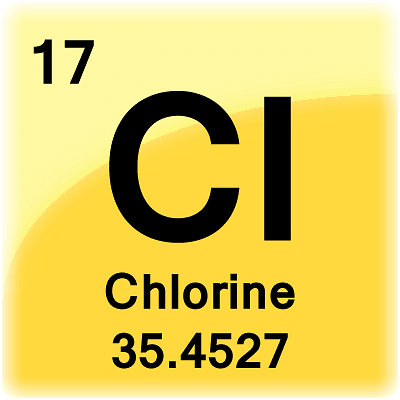
Chlorine
Also Read:
| Related Articles | ||
|---|---|---|
| Praseodymium | Dysprosium | Promethium |
| Group 16 Elements | Lawrencium | Periodic Classification of Elements |
Properties Of Chlorine
[Click Here for Previous Year Questions]
Chlorine is the second halogen in the periodic table. It has properties similar to fluorine, bromine, and iodine. Properties of chlorine are given below:
| Properties | Chlorine |
|---|---|
| Atomic Number | 17 |
| Atomic Weight | 35.453 |
| Melting Point | -101.5 Degree Celsius |
| Boiling Point | -34.04 Degree Celsius |
Structure Of Chlorine
[Click Here for Sample Questions]
The atomic number of Chlorine is 17. This implies that it contains 17 electrons and 17 protons in its atomic shell. These electrons are arranged into 3 primary electrons shells.
The first shell contains 2 electrons and the second shell contains 8 electrons and the outermost shell contains the remaining 7 electrons.

Structure Of Chlorine
Preparation Of Chlorine
[Click Here for Previous Year Questions]
Chlorine can be prepared by any of the following processes:
-
Deacon’s Process
The gas is manufactured by the oxidation process of hydrochloric acid in the presence of cuprous chloride at 723k and pressure of 1 atmosphere.
| 4HCl + O2 → 2H2O + 2Cl2 (On Reaction with CuCl2 at 723k) |

-
Electrolysis Process
Nelson cell is used in the process of electrolysis and it is the least expensive technique and gives the purest form of gas.
| Conc. NaCl + H2O → NaOH + ½ H2 + ½ Cl2 (On Electrolysis) |
Chemical Properties Of Chlorine
[Click Here for Sample Questions]
The Chemical properties of Chlorine are stated below:
- Chlorine breaks up in water to give a firm smell, due to the arrangement of a blend of hydrochloric acid and hypochlorous acid.
- Chlorine joins with all non-metals except nitrogen, carbon, and oxygen. It reacts very fast with most metals. This reaction leads to the formation of chlorides.
- Chlorine reacts with hydrogen in the presence of light with a blast to form hydrochloric acid.
- Chlorine produces bleaching powder when reacts with slaked lime.
Physical Properties Of Chlorine
[Click Here for Previous Year Questions]
The Physical Properties of Chlorine are stated below:
- Boiling point of chlorine is 239.11K
- Melting point of chlorine – 171.6K.
- Chlorine is harmful to nature.
- It is 2 to 5 times denser as compared to air.
- It has a valency of 7.
- Chlorine is dissolvable in water.
- It is effectively condensed.
Reaction Of Metals And Non-Metals
[Click Here for Sample Questions]
Chlorine reacts with many metals and non-metals to form chlorides:
-
Reaction Of Chlorine With Ammonia
When treated with ammonia, chlorine gives nitrogen and ammonium chloride whereas when excess chlorine reacts with ammonia, nitrogen trichloride is formed.
8NH3 + 3Cl2 → 6NH4Cl + N2
NH3 + Cl2 → NCl3 + 3HCl
- Reaction Of Chlorine With NaOH
Cold diluted NaOH:
Cl2 + 2NaOH → NaCl + NaOCl + H2O
Hot Concentrated NaOH:
Cl2 + 6NaOH → NaCl + NaOCL + H2O
- Reaction Of Chlorine With Slaked Lime
When reacted with slaked lime it gives bleaching powder:
2Ca(OH)2 + 2Cl2 → Ca(OCl)2 + 2H2O
It has a good bleaching action due to its oxidizing nature:
Cl2 + H2O → 2HCl + O

Reaction In Chlorine
Uses Of Chlorine
[Click Here for Previous Year Questions]
Chlorine is used in many ways, some are given below:
- Chlorine is used as an antiseptic
- Chlorine is used to clean swimming pools
- Chlorine is used as a disinfectant
- Chlorine is used in the production of paper products
- Chlorine is used to produce drugs
- Chlorine is used as bleaching powder
- Chlorine is used in sterilizing drinking water
Things To Remember
- Chlorine is the second lightest element in the category of halogens, that appears between fluorine and bromine in the periodic table.
- The first shell contains 2 electrons and the second shell contains 8 electrons and the outermost shell contains the remaining 7 electrons.
- Chlorine produces bleaching powder when reacts with slaked lime.
- Chlorine is used in the production of paper products
- Chlorine has a good bleaching action due to its oxidizing nature
Also Read:
Previous Year Questions
- A Group ‘13’ Element X Reacts With Chlorine Gas To Produce a compound… [JEE Main- 2018]
- Which Among The Following Is Correct For Electrolysis…. [MHT CET- 2019]
- Which One Of These Metals The Change In Oxidation State… [MU OET 2010]
Sample Questions
Ques. Explain the electrolysis process included in the preparation of chlorine? (3 Marks)
Ans. Electrolysis refers to the decomposition of a substance by an electric current. For example – When the current is passed through the molten sodium chloride, sodium and chlorine are deposited at different Electrodes. Thus, Sodium chloride is decomposed into sodium and chlorine.
Ques. How is chlorine poisonous? (2 Marks)
Ans. Chlorine is poisonous when someone takes in or breathes in the chemical. It reacts with water and incorporates the water into the digestive tract. Hydrochloric acid and hydrochloric acid. Both of these substances are very harmful to our bodies.
Ques. How does the blend of hydrochloric acid and hypochlorous acid combine? (1 Marks)
Ans. Chlorine gas rapidly reacts with water to form two compounds – Hypochlorous acid (HOCL) and Hydrochloric acid (HCL). At 25 degrees Celsius and has a pH of 7.5 which is half of the total chlorine present as HOCL and another half as OCL-.
Ques. How can we say that chlorine is volatile? (2 Marks)
Ans. Chlorine is considered to be volatile because it is unstable as a result of fairly unlikely secondary exposure from exposed persons, but chlorine gas can condense on the skin and contaminates others through dermal contact.
Ques. Explain the electronegativity of Chlorine? (3 Marks)
Ans. Chlorine is intermediate in the electronegativity between fluorine and bromine (the electronegativity of fluorine is 3.98, the electronegativity of chlorine is 3.16, and the electronegativity of bromine is 2.96). Hence the element is less reactive than fluorine and more reactive than bromine in the periodic table.
Ques. Why is the deacon’s process one of the best processes for the preparation of chlorine? (2 Marks)
Ans. Deacon’s process is one of the best processes for the preparation of chlorine because it reduces the HCL emissions that occur by the Alkali act. In this process, hydrogen chloride is oxidized over a Chloride catalyst, resulting in the production of chlorine.
Ques. List 5 uses of chlorine? (5 Marks)
Ans. Uses of chlorine are as follows:
- Chlorine is used as an antiseptic
- Chlorine is used to clean swimming pools
- Chlorine is used as a disinfectant
- Chlorine is used in the production of paper products
- Chlorine is used to produce drugs
Ques. State the reaction of chlorine with ammonia. (3 Marks)
Ans. Reaction Of Chlorine With Ammonia is:
When treated with ammonia, chlorine gives nitrogen and ammonium chloride whereas when excess chlorine reacts with ammonia, nitrogen trichloride is formed.
8NH3 + 3Cl2 → 6NH4Cl + N2
NH3 + Cl2 → NCl3 + 3HCl
Ques. what are the physical properties of chlorine? (5 Marks)
Ans. The Physical Properties of Chlorine are stated below:
- Boiling point of chlorine is 239.11K.
- Melting point of chlorine – 171.6K.
- Chlorine is harmful to nature.
- It is 2 to 5 times denser as compared to air.
- Chlorine is dissolvable in water.
Ques. What is chlorine? (3 Marks)
Ans. Chlorine is a chemical element that is denoted by the symbol Cl and has the atomic number 17. It is the second lightest element in the category of halogens, that appears between fluorine and bromine in the periodic table.
Chlorine is a yellow-green gas at room temperature and has an extremely reactive element and a strong oxidizing agent. It plays an important role in the experiments which involve the heating of chloride salts like ammonium chloride and sodium chloride.
For Latest Updates on Upcoming Board Exams, Click Here: https://t.me/class_10_12_board_updates
Check-Out:



Comments