



Education Content Expert
Antimony is a semi-metallic chemical element with the symbol Sb and atomic number 51. It is known as Stibium in Latin. It is a semimetallic chemical element existing in two different types, metallic and non-metallic.
- In its metallic form, Antimony exists as a bright, silvery, hard, and brittle element.
- In its non-metallic form, it appears as a grey powder.
- It is a poor conductor of heat and electricity and is stable in dry air.
- Antimony and some of its alloys expand when cooled.
- Its compounds are used to make flame-proofing materials, paints, ceramic enamels, glass, and pottery.
Antimony can have harmful effects on body tissues and their functioning when inhaled or ingested in specific formulations.
Read More: NCERT Solutions For Class 12 Chemistry The p-Block Elements
Key Terms: Antimony, Elements, Atomic Number, Metals, Metalloid, Non-Metal, Cosmetics, Melting Point
What is Antimony?
[Click Here for Sample Questions]
Antimony is a chemical element with atomic number 51 and the symbol Sb in the Modern Periodic Table.
- It is also referred to as ‘Stibium’ in Latin.
- Stibnite, a beautiful grey metalloid, is mostly found in nature as a sulfide mineral (Sb2S3).
- Antimony and its compounds were first studied by Nicolas Lémery, a French chemist.
- It can be found naturally in the Earth's crust layer in the ores stibnite and valentinite.
- China is the leading producer of antimony and its compounds, with the majority of production coming from a mine in Hunan.
- Antimony compounds have been powdered for use in cosmetics and medicinal, earning them the Arabic name kohl.

Antimony
Read More: The p-Block Elements Important Questions
Properties of Antimony
[Click Here for Previous Year Questions]
The properties of Antimony are listed as follows:
Physical Properties of Antimony
- Antimony is an element that is silvery-white in color.
- It is a shining element that appears to be a metal.
- It has a scaly surface and is hard and brittle like a nonmetal.
- Because of its gleaming brilliance, it can also be produced as a black powder.
- Antimony has a melting point of around 630°C (1,170°F) and a boiling point of 1,635°C (2,980°F).
- It is a somewhat soft substance that can be scratched by glass.
- The density of Antimony is 6.68 grams per cubic centimeter.
- It has a relative atomic mass of 121.76.
Read More:
Chemical Properties of Antimony
- Antimony is a medium-reactive element.
- At room temperature, it does not associate with oxygen in the air.
- It also does not react with the coldest acids or cold water.
- It can, however, dissolve in some hot acids in aqua regia.
- It frequently reacts with compounds that do not react individually with either acid.
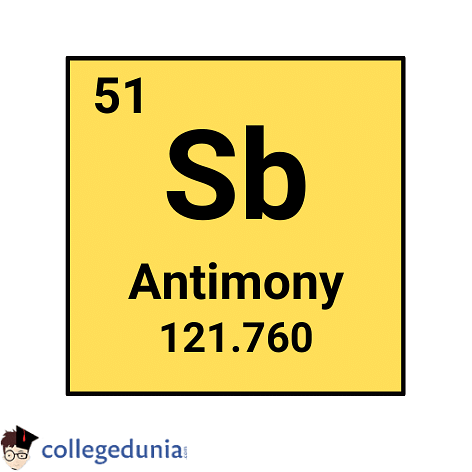
Antimony
Given below is a summary of the properties of Antimony:
| Properties of Antimony | |
|---|---|
| Group | 15 |
| Period | 5 |
| State at 20°C | Solid |
| Atomic Number | 51 |
| Electron Configuration | [Kr]4d105s25p3 |
| Block | p |
| Melting Point | 630.628°C, 1167.13°F, 903.778 K |
| Boiling Point | 1587°C, 2889°F, 1860 K |
| Key Isotopes | 7Sb |
| Relative Atomic Mass | 121.76 |
| Density (g/cm3) | 6.68 |
Uses of Antimony
[Click Here for Sample Questions]
Given below are the important uses of Antimony:
- Pure antimony is used in the production of semiconductors such as infrared detectors and diodes.
- It is used to harden lead and make it more durable.
- Antimony is used in batteries to ensure proper operation.
- It is also used in the manufacture of small guns and projectiles.
- It is an excellent flame retardant.
Read More: MCQs on P-Block Elements
Health Effects of Antimony
[Click Here for Previous Year Questions]
Here are some health effects of Antimony:
- Antimony is toxic, however, it does not have any harmful effects.
- Constant exposure to Antimony may cause lung diseases, heart problems, and stomach ulcers.
- The adverse effects of antimony on body tissues and functions usually occur through inhalation or ingestion of certain antimony compounds.
- Antimony poisoning can also be due to acidic fruit juices containing antimony oxide dissolved from the glaze of enamelware containers.
- Cardiotoxicity and Pancreatitis are the major toxic side effects of antimony as a result of therapy and are seen commonly in HIV and visceral leishmaniasis coinfections.
Check More:
Things to Remember
- Antimony is a semi-metallic chemical element with the symbol Sb and atomic number 51.
- It exists in the metallic form as a bright, silvery, and hard element and as a grey powder in non-metallic form.
- Antimony has a melting point of approximately 630°C and a boiling point of 1,635°C.
- It is used as an excellent flame retardant.
- Antimony and its alloys have the unusual ability to expand when cooled.
- It is used as a component in cosmetics since ancient times.
Previous Years’ Questions
- Which one has the lowest boiling point… (NEET - 1989)
- When orthophosphoric acid is heated to 600… (NEET - 1989)
- Urea reacts with water to form A which will decompose to form… (NEET - 2020)
- Argon is used… (KCET - 2009)
- Extraction of chlorine from brine solution is based on… (KCET - 2017)
- The product/s formed when diborane is hydrolysed is/are… (KEAM)
- Which hydride amongst the following has the least boiling point… (KEAM)
- Boron compounds behave as Lewis acids, because of their… (NEET - 1996)
- Which one of the following statements about the zeolites is false… (NEET - 2004)
- Which of the following species is not stable… (NEET - 2019)
Sample Questions
Ques. What are the applications of Antimony? (3 Marks)
Ans. The following are the uses of Antimony:
- Antimony alloys are also used as type metal (in printing machines), bullets, and cable sheathing.
- Flame-retardant materials, paints, enamels, glass, and ceramics are all made with antimony compounds.
- A lead-antimony alloy is used in lead batteries.
Ques. Is Antimony soluble in water? (1 Mark)
Ans. Antimony powder appears as a silvery or grey solid in the form of dust. It is denser and less soluble in water than in water.
Ques. Is Antimony combustible? (1 Mark)
Ans. In bulk, antimony is not flammable. Antimony powder and dust, on the other hand, may be combustible.
Ques. What is the Significance of Antimony in Biology and Physiology? (2 Marks)
Ans. The use of antimony compounds for therapeutic purposes was briefly forbidden due to the numerous fatalities they had caused. Tartar emetic, also known as hydrated potassium antimonyl tartrate, is currently used in medicine as a diaphoretic, expectorant, and emetic. Similar to arsenic, antimony dust has a maximum acceptable quantity in the air of 0.5 milligrams per cubic meter.
Ques. What is the color of Antimony? (1 Mark)
Ans. Antimony is a glossy silvery bluish-white solid that is extremely brittle and flaky. It is most commonly found as the grey sulfide mineral stibnite (Sb2S3).
Ques. What is the scope of Antimony? (2 Marks)
Ans. Although substantial amounts of antimony have been used in the production of alloys and flame retardants, it is anticipated that its use will be enhanced more. The demand for antimony may rise as research advances, markets expand, or new applications for the element are discovered.
Ques. Why is Antimony named so? (1 Mark)
Ans. The term antimony comes from the Greek words anti and monos, which mean "not found alone." The chemical symbol Sb was inspired by the element's historical name, stibium.
Ques. What are the chemical properties of Antimony? (3 Marks)
Ans. The chemical properties of Antimony are as follows:
- In its pure form, antimony is a brittle element with no structural applications.
- The electronic band of the antimony structure is either semiconductor or semimetal.
- It has an ionization energy of 831 kJ/mol, which is within the range of metalloid ionization energies of 750-1,000 kJ/mol.
- Its chemistry is primarily weak and nonmetallic, but it can create alloys with metals.
- It has a 2.05 intermediate electronegativity.
- Antimony trioxide is the most stable oxide and is somewhat acidic.
- In an aqueous solution, antimony does not appear to form a simple cation.
Ques. How can antimony enter the human body? (1 Mark)
Ans. Water, food, dirt, and other antimony-containing substances can all enter the human body. If one breathes antimony-contaminated air or dust, it can also enter the body.
Ques. What is the environmental impact of Antimony? (3 Marks)
Ans. Antimony is a chemical element found in trace levels in soils, air, and water. It primarily pollutes the soil. It can migrate further distances through groundwater to other surface waters and locales.
- Few laboratory investigations on rats, guinea pigs, and rabbits have revealed that excessive levels of Antimony can kill tiny animals.
- Animals who breathe in less Antimony volumes for a set time may endure eye irritation, lung damage, and hair loss.
- When dogs are exposed to low quantities of antimony, they may develop heart issues.
- Animals that breathe Antimony continuously for a few months may have significant fertility issues.
Ques. Is Antimony harmful to humans? (2 Marks)
Ans. Antimony poisoning can occur as a side effect of therapy or through occupational exposure. Occupational exposure can cause gastrointestinal difficulties, antimony skin spots, respiratory irritation, and pneumoconiosis. Antimony trioxide has also been connected to human cancer.
Ques. Where is Antimony found the most? (2 Marks)
Ans. Antimony resources are unevenly distributed throughout the world. China has the majority of the world's antimony resources. Other countries that have identified antimony resources include Bolivia, Canada, Mexico, Russia, South Africa, Tajikistan, and Turkey.
Ques. What are the health effects of Antimony? (5 Marks)
Ans. Humans can be exposed to Antimony through the air they breathe, the water they drink, and the food they eat. Health consequences are primarily caused by inhaling antimony bonded to hydrogen in the gaseous phase.
- Severe health impacts, such as heart issues, lung ailments, severe vomiting, diarrhea, and stomach ulcers, may manifest as the exposure progresses.
- Antimony's potential to cause cancer or reproductive problems is unknown.
- Despite being poisonous, it has no negative side effects. But constant exposure to this can result in conditions like heart disease, stomach ulcers, and lung disorders.
- Drinking acidic fruit juices that included antimony oxide that had dissolved from the glaze of enamelware containers has led to antimony poisoning.
- Cardiotoxicity and pancreatitis are the main toxic side effects of antimony medication and are frequently observed in HIV and visceral leishmaniasis coinfections.
Check-Out:



Comments