



Education Content Expert
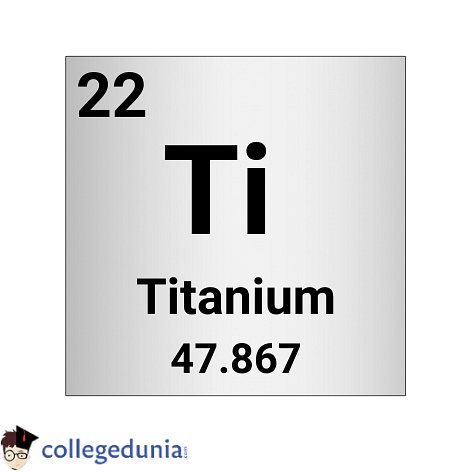
Titanium is a chemical element denoted by the symbol Ti and atomic number 22. It is located in the 4th Group and 4th Period in the modern periodic table.
- Titanium is a transition element and the 2nd element of the first series of transition metals.
- In the 1st series of transition metals, Scandium (Sc) is before titanium and Zirconium (Zr) is after titanium.
- Both the Ti and Zr do not possess similar properties even though they have the same number of valence electrons.
- It is a d block element as it is placed in the 4th group.
- It was discovered by William Gregor in 1791 in Cornwall.
- It is the same in strength as steel but is quite less dense and 9th in the world’s most abundant metals present on the earth.
- It is a lustrous metal which is of silver color.
| Table of Content |
Key Terms: Titanium, Electronic Configuration, Conductivity, Atomic Mass, Atomic Number, Elements, Compounds
What is Titanium?
[Click Here for Sample Questions]
Titanium is a chemical element with the symbol Ti and atomic number 22. It is a silvery-white, strong, and light metal that is highly corrosion-resistant.
- It is commonly used in the aerospace and medical industries for its strength and lightness.
- It is also used in jewelry, as well as in consumer goods like eyeglasses, laptops, and mobile phones.
- It is found in minerals such as ilmenite and rutile, and extracted through a process known as the Kroll process.
- Due to its biocompatibility, it has been used for implants in the human body.
- It has low thermal and electrical conductivity and a high strength-to-weight ratio.

Titanium
Read More:
Electronic Configuration of Titanium
[Click Here for Sample Questions]
The electronic configuration of Titanium is 1s2 2s2 2p6 3s2 3p6 3d2 4s2.
- It could also mean that the electronic configuration of Titanium can be Ar 3d2 4s2.
- Through its electronic configuration, one can say that it consists of 2 electrons in the K-shell, 8 electrons in the L-shell, 10 electrons in M–shell, and 2 electrons in the outermost shell N.
Properties of Titanium
[Click Here for Sample Questions]
The Properties of Titanium are as follows:
- Titanium is ductile, a lustrous element with high strength, non-magnetic, and has the highest strength to density ratio.
- It is corrosion resistant even when reacted with dilute sulphuric acid and hydrochloric acid.
- It has low electrical and thermal conductivity and is therefore paramagnetic.
- Its electronegativity is 1.54 according to the Pauling scale.
- At standard temperature and pressure, it is solid.
- It appears as a silver-gray-white metal.
Titanium
- Titanium has a total of 5 oxides 46Ti, 47Ti, 48Ti, 49Ti, and 50Ti that occur naturally and are stable.
- The atomic weight of titanium tends to be 47.867.
- The melting point of titanium is 1668 оC while the boiling point is 3287 оC.
- It shows a low density of around 4.506 g cm-3 and shows a hexagonal closed-packed structure.
| Properties of Titanium | |
|---|---|
| Block | d |
| Atomic Number | 22 |
| Atomic Mass | 47.867 |
| Electronic Configuration | [Ar] 3d2 4s2 |
| Melting Point | 1941 K, 3020 F, 1668 оC |
| Crystal Structure | Hexagonal Closed Pack |
| Boiling Point | 5949 оF, 3560 K, 3287 оC |
| Disadvantages | It is explosive as it can be a reason for fire and explosion. |
| Other Properties | Highest strength to density ratio; Corrosion Resistance |
Compounds of Titanium
[Click Here for Sample Questions]
The Compounds of Titanium are as follows:
- Reaction with Oxygen: Titanium when reacts with oxygen in the air at a temperature of 1200 оC forms Titanium Dioxide.
Ti + O2 1200 оC \( \rightarrow\) TiO2
- Reaction with Nitrogen: Titanium when reacted with pure nitrogen gas gives results to titanium nitride at a temperature of 800 оC.
2Ti + N2 \( \rightarrow\) TiN
- Reaction with Water: Titanium when reacts with water forms titanium dioxide and releases 2 units of hydrogen gas. Although the reaction is slow.
Ti + 2H2O \( \rightarrow\) TiO2 + 2H2
- Reaction with Halogens: Titanium on reacting with halogens like Cl, I, Br, and F from the various compounds. When reacting with chlorine at the temperature of 550 оC, it forms titanium tetrachloride.
Chlorine: Ti + 2Cl2 \( \rightarrow\) TiCl4
Fluorine: Ti + 2F2 \( \rightarrow\) TiF4
Bromine: Ti + 2Br2 \( \rightarrow\) TiBr4
Iodine: Ti + 2l2 \( \rightarrow\) Til4
Uses of Titanium
[Click Here for Sample Questions]
The uses of Titanium are as follows:
- Paints: It is used as the main constituent used to form paints.
- Being corrosion-resistant, it can be used around salty water. Some pieces of titanium are used in the process of converting seawater to freshwater by desalination plants.
- Rocks and Minerals: Similar to paints, it is one of the compounds that is used in industries for different purposes after purification.
- Star Sapphire: Titanium is present in costly gems such as star sapphires.
- Aircraft: As titanium is lightweight and one of the strongest elements, it is used in aircraft, missiles, and jet engines to lift and fly.
- Medicine: In health concerning areas, it is used in dental implants and joint replacements.
- Due to its strength, it is used to produce golf clubs and fishing rods.
- It is also used in pieces of jewelry as it is corrosion-resistant and is an inert element.
- The oxide of titanium, TiO2, is used in the manufacturing of gemstones and cement.
- The other fields where titanium is used are white papers, cosmetics, electronics, plastics, and toothpaste.
Effects of Titanium
[Click Here for Sample Questions]
Although being a non-toxic element, titanium is not very harmful as it is not absorbed by the tissues present in the human body, and so when ingested in the human body through various methods, it passes out.
- There is no absorption of titanium in the human body and thus is non-toxic.
- The only adverse effect of titanium is that it can cause fire and is explosive.
Things to Remember
- Titanium is located in the 4th group and 4th period of the periodic table and is denoted by Ti with an atomic number of 22.
- It is a transition element, being the 2nd element of the first series of transition metals.
- Titanium has a high strength-to-density ratio and is corrosion resistant, making it useful in a variety of industries such as aerospace, medicine, and jewelry.
- Titanium compounds, such as titanium dioxide, have various uses including in paints, gemstones, and toothpaste.
- While titanium is generally considered safe, it can be explosive and must be handled with care.
Check More:
Sample Questions
Ques. Write some important uses of Titanium. (5 Marks)
Ans. Important uses of titanium are as follows:
- Medical: Titanium implants are used due to their biocompatibility and resistance to corrosion.
- Jewelry: Titanium is used to make jewelry due to its durability and resistance to tarnishing.
- Consumer Goods: Titanium is used in products such as eyeglasses, laptops, and mobile phones.
- Industrial: Titanium is used in process equipment in the chemical and petrochemical industries due to its resistance to corrosion.
- Sporting Goods: Titanium is used in golf clubs, tennis rackets, and bicycles for its strength and lightweight.
- Defense: Titanium is used in armor plating and military equipment due to its high strength-to-weight ratio.
Ques. Which properties of Titanium make it different from other elements? (3 Marks)
Ans. Some of the distinctive and important properties of titanium are
- It is corrosion resistant.
- It has low density.
- It depicts the highest strength-to-density ratio.
- It also has high strength and is ductile.
Ques. State the electronic configuration of Titanium. (3 Marks)
Ans. The electronic configuration of Titanium is 1s2 2s2 2p6 3s2 3p6 3d2 4s2.
- The electronic configuration of titanium is [Ar] 4s2 3d2.
- It has 22 electrons and 22 protons in its nucleus.
- The first electron layer is filled with 2 electrons in the 4s orbital, and the second electron layer has 10 electrons in the 3d orbital.
- The electronic configuration of titanium in the excited state is [Ar] 3d2 4s2.
Ques. What are the atomic numbers and crystal structure of Titanium? (2 marks)
Ans. The atomic number to which Titanium belongs is 22 and it has a Hexagonal Closed Pack type of crystal structure.
Ques. State the melting point of Titanium in Celsius, Kelvin, and Fahrenheit. (2 Marks)
Ans. The melting point of Titanium in Celsius, Kelvin, and Fahrenheit is
- The melting point of Titanium in Celsius is 1668°C.
- The melting point of Titanium in Kelvin is 1941.15 K.
- The melting point of Titanium in Fahrenheit is 3034°F.
Ques. Name the process through which Titanium is obtained. (3 Marks)
Ans. Being a reactive metal, titanium forms a carbide when reacted with oxygen or nitrogen at high temperatures. The process of obtaining Titanium is called the Kroll process.
- The Kroll process is a method of reducing titanium tetrachloride (TiCl4) to titanium metal using magnesium (Mg) as a reducing agent.
- The process involves several steps, including the preparation of TiCl4 through the chlorination of titanium ore, the reduction of TiCl4 to titanium using Mg in a reactor, and the purification of the titanium through vacuum distillation.
- The Kroll process is the most widely used method for producing titanium metal and is considered to be the most cost-effective method as well.
Ques. State the uses of Titanium in the field of medical science. (5 Marks)
Ans. In health concerning areas or the domain of medical sciences, Titanium is used in dental implants and joint replacements. Titanium is widely used in the field of medical science due to its biocompatibility, high strength-to-weight ratio, and resistance to corrosion. Some specific uses of titanium in medical science include
- Orthopedic Implants: Titanium is commonly used to make orthopedic implants such as artificial hips, knees, and spine implants due to its biocompatibility and durability.
- Dental Implants: Titanium is used to make dental implants, which are used to replace missing teeth. Titanium is biocompatible and can fuse with the jawbone, making it a good choice for dental implants.
- Surgical Instruments: Titanium is used to make surgical instruments such as scissors, forceps, and needles due to its strength and resistance to corrosion.
- Cardiovascular Implants: Titanium is used to make cardiovascular implants such as heart valves and stents due to its biocompatibility and durability.
- Maxillofacial Prosthetics: Titanium is used to make maxillofacial prosthetics such as jaw and cheekbone replacements due to its strength and biocompatibility.
- Bone Grafts: Titanium is used to make bone grafts. Its biocompatibility and strength make it a suitable material for this purpose.
- Artificial Joints: Titanium is used to make artificial joints such as hip and knee replacements.
- Cranial Plates: Titanium is used to make cranial plates, which are used to fix skull fractures.
Ques. Give certain reactions that Titanium possesses with halogens. (5 Marks)
Ans. Titanium possesses many reactions with halogens. Some of these are
- Titanium reacts with chlorine to form titanium tetrachloride (TiCl4) through a redox reaction.
Ti + 2Cl2 \( \rightarrow\) TiCl4
- Titanium also reacts with bromine and iodine to form titanium tribromide (TiBr4) and titanium diiodide (TiI2), respectively.
Bromine - Ti + 2Br2 \( \rightarrow\) TiBr4
Iodine - Ti + 2l2 \( \rightarrow\) Til4
- In the presence of water, titanium tetrachloride reacts to form titanium dioxide (TiO2) and hydrochloric acid (HCl)
- Titanium also reacts with fluorine gas to form titanium tetrafluoride (TiF4)
Fluorine - Ti + 2F2 \( \rightarrow\) TiF4
- The reactivity of titanium with halogens increases as the atomic number of the halogen decreases.
Ques. What are the chemical properties of Titanium? (5 Marks)
Ans. Titanium is a chemical element with the symbol Ti and atomic number 22. It is a light, strong, lustrous, corrosion-resistant transition metal with a silver color.
- Titanium is a very stable element and is resistant to most forms of corrosion, including seawater, aqua regia, and chlorine.
- It exhibits a metallic luster and has a low density, high strength, and excellent corrosion resistance.
- It has a relatively low melting point and is non-toxic and non-magnetic.
- It reacts with oxygen at high temperatures to form titanium dioxide, which is used as a white pigment in paints and as a UV-protective agent in sunscreens.
- Titanium can also react with chlorine, sulfur, and carbon to form titanium chloride, titanium sulfide, and titanium carbide, respectively.
- It can also form alloys with many other metals, including iron, aluminum, nickel, and molybdenum.
- These alloys have a range of properties and can be used in aerospace, medical, and industrial applications.
- Titanium is not found as a pure metal in nature but is usually found in minerals such as ilmenite and rutile, which must be extracted and purified before they can be used.
Ques. What are the physical properties of Titanium? (5 Marks)
Ans. The Physical properties of Titanium are as follows:
- Titanium is a silver-gray metal with a low density and high strength-to-weight ratio.
- It has a melting point of 1,660 degrees Celsius (3,020 degrees Fahrenheit) and a boiling point of 3,287 degrees Celsius (5,951 degrees Fahrenheit).
- Titanium has excellent corrosion resistance, especially in seawater and chlorine environments.
- It has a high resistance to fatigue and crack propagation.
- Titanium is paramagnetic, meaning it is weakly attracted to a magnetic field.
- It has a relatively low thermal conductivity and a low electrical conductivity.
- It has a hexagonal close-packed crystal structure.
- Titanium is a poor conductor of heat and electricity.
- Titanium alloy is used in aerospace, medical, and dental implants, as well as in sporting goods, jewelry, and other consumer products.
For Latest Updates on Upcoming Board Exams, Click Here: https://t.me/class_10_12_board_updates
Check-Out:



Comments