



Education Journalist | Study Abroad Lead
Platinum has been in use since the ancient period. Its chemical symbol is Pt. The name Platinum is derived from the Spanish term “platino”, which means "little silver". It is mostly found as a by-product in copper and nickel mining. Platinum is less reactive and is considered a noble metal along with the other 5 elements in the PGE group. Platinum is used as a catalyst in many chemical reactions.
| Table of Content |
Keyterms: Platinum, Silver, Metal, Catalyst, Nickel, Copper, Noble metal, Chemical reaction, Temperature, Catalytic converters, Electrodes, Electrical equipment, Thermometers, Jewellery
What is Platinum?
[Click Here for Sample Questions]
Platinum is very less reactive with elements. So, it is considered a noble metal along with the other 5 elements in the PGE group. They resist any chemical attack even at high temperatures. So, Platinum is used as a catalyst in many chemical reactions.

Platinum
It was discovered by Antonio de Ulloa in the alluvial sands of South Africa. Because of its resistant properties, it is used in catalytic converters, electrodes, electrical equipment, Platinum resistance thermometers, and jewellery. As a heavy metal, it may show harmful effects on health if consumed.
Also Read:
| Related Articles | ||
|---|---|---|
| Group 15 elements | Dinitrogen | Oxides of Nitrogen |
| Nitric Acid | Phosphine | Oxoacids of Phosphorus |
| Oxoacids of Sulphur | Hydrogen chloride | Interhalogen compounds |
Platinum Group of Elements
[Click Here for Sample Questions]
There are six Platinum groups of elements (PGE) in the periodic table. They are Platinum, palladium, rhodium, ruthenium, iridium and osmium. So, Platinum belongs to PGE. It belongs to the 10th group and 6th period.
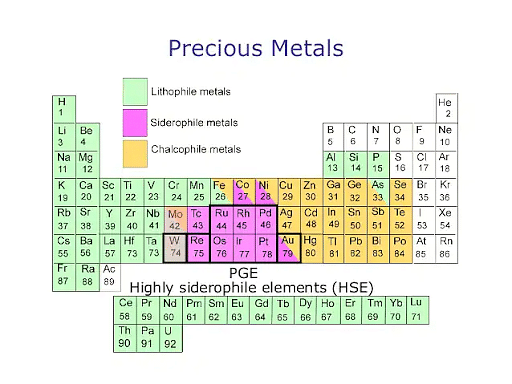
PGE Elements
Table of Properties
[Click Here for Sample Questions]
Study the table of properties of Platinum to know its both physical and chemical properties at a glance.
| Parameters | Values |
|---|---|
| Symbol | Pt |
| Atomic Number | 78 |
| Atomic Mass | 195.09 g.mol-1 |
| Discovered by | Antonio de Ulloa (1735) |
| Group | 10 |
| Period | 6 |
| Block | D |
| ChemSpider ID | 22381 |
| Electronegativity | 2.28 |
| Isotopes | 190Pt, 191Pt, 192Pt, 193Pt, 193Pt; 194Pt, 195Pt, 196Pt, 197Pt, 198Pt |
| State at 20°C | Solid |
| Electron configuration | [Xe] 4f145d96s1 |
| Electrons per shell | 2, 8, 18, 32, 17, 1 |
| Melting point | 2041.4 K (1768.3 °C, 3214.9 °F) |
| Boiling point | 4098 K (3825 °C, 6917 °F) |
| Density (g cm?³) | 21.5 |
| Relative atomic mass | 195.084 |
| CAS number | 7440-06-4 |
| Oxidation states | −3, −2, −1, 0, +1, +2, +3, +4, +5, +6 |
Occurrence of Platinum
[Click Here for Sample Questions]
Platinum is one of the rarest elements available in the earth’s crust. The availability of platinum may be around 5 μg/kg (0.005 ppm). South Africa is the biggest producer and supplier of Platinum in the world. About 80% of Platinum demand is met by South Africa only. The second-largest deposits of Platinum are found in the Ural Mountains in Russia. In India, abundant Platinum deposits are found in Tamilnadu. Platinum deposits are more on the Moon and meteorites.

Platinum Occurrence
Physical Properties of Platinum
[Click Here for Sample Questions]
- Platinum is a dense, malleable (flexible), ductile (pliable), and silverish-white metal.
- It is more ductile than other precious metals like gold, silver and copper. But it is less malleable than gold.
- It will be malleable when combined with gold.
- It is one of the densest metals with a density of 21.45 grams per cubic centimetre.
Chemical Properties of Platinum
[Click Here for Sample Questions]
- Chemically it is highly unreactive, that is why it is categorised as a precious metal.
- Platinum is highly resistant to corrosion. It is not tarnished in the air. That is why it does not form oxides, hydroxides, carbonates and sulphides when exposed to the atmosphere.
- It gets oxidised at 500oC.
- It is reactive with halogens like fluorine, chlorine, bromine, and iodine at very high temperatures.

Chemical Properties of Platinum
- It is soluble in hydrochloric acid (HCl) and nitric acid (HCO3).
- It absorbs abundant Hydrogen gas at high temperatures, just like a sponge soaks water, which is an unusual property of Platinum.
- Platinum shows a strong tendency to form complex ions. The most common one is Pt(I). This complex ion shows a planar structure. It is diamagnetic (temporary and weak magnetic pole formation).
Stages in Extraction of Platinum
[Click Here for Sample Questions]
Platinum is extracted very deep in the soil crust. It is extracted by the froth flotation process. The ore is heated up to 1500oC in an electric furnace. Platinum is extracted from the mineral concentrate by using aqua regia (HCl + HNO3). Ammonium chloride is used to convert chloroplatinic acid to ammonium hexachloroplatinate. The resultant substance is burnt to get the pure Platinum metal.

Platinum Extraction
Platinum Uses
[Click Here for Sample Questions]
- Platinum is used in different applications like jewellery, vehicle emissions control devices, petroleum refining, electrical appliances, glassmaking equipment, electrodes, oxygen sensors, spark plugs and turbine engines, medicines, anti-cancer drugs, etc.
- The most common use of platinum is as a catalyst in many chemical reactions.
- It is used as a catalyst during the preparation of nitric acid, benzene and silicone,
- It is used as a catalytic converter in vehicles.
- International standard measures like metre, kilogram and thermometer are made of Platinum.
- Platinum is used as a precious metal in jewellery making.

Platinum Jewellery
- It can be used in future investments.
- Platinum stands next to diamond and above gold in the title of awards.
- Platinum colour is a symbol and status of debit and credit cards also.
- Platinum is used in LASER applications.
- It is used in the photographic industry.
- It is used in razor coating.
- Strong magnets are made with Platinum and cobalt alloys.
- Platinum is used in the fabrication of breast implants and prosthetic (artificial) limbs.

Platinum Dental filling
- Platinum is used in dental filling and surgical materials.
- Compounds containing platinum, such as cisplatin, oxaliplatin and carboplatin, are applied in chemotherapy against certain types of cancer.
Health Problems
[Click Here for Sample Questions]
- Platinum salts are allergic to the skin and respiratory tract.
- It may cause cancer to different parts of the body, hearing problems, organ damage like intestine and kidney, etc.
Things to Remember
- Platinum is a rare transitional element.
- The atomic number of Platinum is 78 and its chemical symbol is Pt.
- Platinum is mostly found as a by-product in copper and nickel mining and is used as a catalyst in many chemical reactions.
- Platinum belongs to PGE. There are six Platinum groups of elements (PGE) in the periodic table.
- It belongs to the 10th group and 6th period.
- South Africa is the biggest producer and supplier of Platinum in the world. About 80% of Platinum demand is met by South Africa only.
- In India, abundant Platinum deposits are found in Tamilnadu.
- Platinum is very less reactive with elements. So, it is considered a noble metal.
- It is a dense, malleable (flexible), ductile (pliable), and silverish-white metal.
- It is more ductile than other precious metals like gold, silver and copper. But it is less malleable than gold.
- It is one of the densest metals with a density of 21.45 grams per cubic centimetre.
Also Read:
Sample Questions
Ques. What are the physical properties of Platinum? (2 marks)
Ans.
- Platinum is a dense, malleable (flexible), ductile (pliable), and silverish-white metal.
- It is more ductile than other precious metals like gold, silver and copper. But it is less malleable than gold.
- It will be malleable when combined with gold.
- It is one of the densest metals with a density of 21.45 grams per cubic centimetre.
Ques. What are the chemical properties of Platinum? (2 marks)
Ans.
- Chemically it is highly unreactive, that is why it is categorised as a precious metal.
- Platinum is highly resistant to corrosion. It is not tarnished in the air. That is why it does not form oxides, hydroxides, carbonates and sulphides when exposed to the atmosphere.
- It gets oxidised at 500oC.
- It is reactive with halogens like fluorine, chlorine, bromine, and iodine at very high temperatures.
Ques. What are the ores during whose extraction Platinum is found? (2 marks)
Ans. The main ore from which platinum is extracted are pyrrhotite, chalcopyrite, pentlandite, and cubanite. These ores contain traces of all the PGE metals particularly, palladium and platinum are found in excess in these ores.
Ques. What are the salient features of Platinum? (2 marks)
Ans. Platinum is very less reactive with elements. So, it is considered as a noble metal along with the other 5 elements in the PGE group. They resist any chemical attack even at high temperatures. So, Platinum is used as a catalyst in many chemical reactions. It was discovered by Antonio de Ulloa in the alluvial sands of South Africa. Because of its resistant properties, it is used in catalytic converters, electrodes, electrical equipment, Platinum resistance thermometers, and jewellery. As a heavy metal, it may show harmful effects on health if consumed.
Ques. What is meant by PGE? (2 marks)
Ans. There are six Platinum groups of elements (PGE) in the periodic table. They are Platinum, palladium, rhodium, ruthenium, iridium and osmium. So, Platinum belongs to PGE. It belongs to the 10th group and 6th period.
Ques. What are the different uses of Platinum? (2 marks)
Ans.
- Platinum is used in different applications like jewellery, vehicle emissions control devices, petroleum refining, electrical appliances, glassmaking equipment, electrodes, oxygen sensors, spark plugs and turbine engines, medicines, anti-cancer drugs, etc.
- The most common use of platinum is as a catalyst in many chemical reactions.
- It is used as a catalyst during the preparation of nitric acid, benzene and silicone,
- It is used as a catalytic converter in vehicles.
Ques. Why Platinum is a precious metal? (2 marks)
Ans. As platinum is a very unreactive metal which is found in trace quantities on the earth surface, it is considered a precious metal. Platinum is one of the rarest elements available in the earth’s crust. The availability of platinum may be around 5 μg/kg (0.005 ppm).
Ques. What are the largest producers of Platinum in the world? (2 marks)
Ans. South Africa is the biggest producer and supplier of Platinum in the world. About 80% of Platinum demand is met by South Africa only. The second-largest deposits of Platinum are found in the Ural Mountains in Russia. In India, abundant Platinum deposits are found in Tamilnadu. Platinum deposits are more on the Moon and meteorites.
Ques. How many naturally occurring isotopes of Platinum are there? (2 marks)
Ans. There are six isotopes of platinum namely, 190Pt, 191Pt, 192Pt, 193Pt, 193Pt; 194Pt, 195Pt, 196Pt, 197Pt, 198Pt.
Ques. Is platinum hazardous to our health? (2 marks)
Ans.
- Platinum salts are allergic to the skin and respiratory tract.
- It may cause cancer to different parts of the body, hearing problems, organ damage like intestine and kidney, etc.
For Latest Updates on Upcoming Board Exams, Click Here: https://t.me/class_10_12_board_updates
Check-Out:



Comments