



Education Journalist | Study Abroad Lead
Gold is a metallic element with the symbol Au and atomic number 79. It is a soft, bright, dense, malleable, and ductile metal with a reddish-yellow colour. In the periodic table, gold belongs to the sixth period and group eleven. It is a bright metal in its purest form. It is one of the least reactive chemical elements and is solid at room temperature. Let’s discuss gold in detail.
| Table of Content |
Keyterms: Gold, Atomic number, Atoms, Periodic table, Solid, Temperature, Chemical elements, Ductile metal
What is Gold?
[Click Here for Sample Questions]
- Gold is a valuable metal that has been utilised for money, jewellery, and other arts throughout recorded history, despite being a relatively rare element.
- Gold is classified as a transition metal. Transition metals are defined by the IUPAC as elements that have a partly filled subshell or atoms that can produce cations while having a partially full subshell.
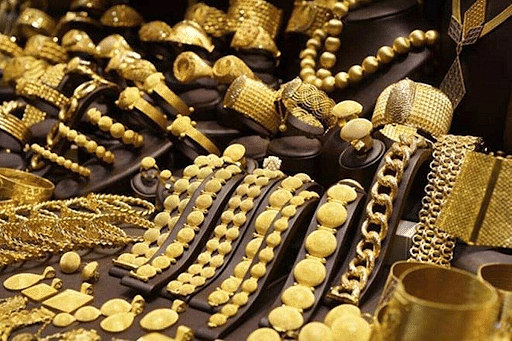
- When gold is accessible in large quantities, it is a soft, bright, dense, malleable, and ductile metal with a somewhat reddish-yellow colour. It becomes black, purple, or ruby when finely split.
- 28g of gold can be hammered into 300 square feet, making it one of the most malleable and ductile metals.
- A large portion of this soft metal is mined and delivered to us in the form of gravels, quartz veins, or pyrite deposits.
Gold
Also Read:
| Related Articles | ||
|---|---|---|
| Valency of Carbon | Periodic Properties of Elements | 20 Elements |
| Noble Gases | Periodic Elements Important Question | Classification of Elements |
Occurrence of Gold
[Click Here for Sample Questions]
- Gold is an element that can be easily found in nature. It can be found in low amounts in all igneous rocks.
- Its abundance in the Earth's crust is around 0.005 parts per million.
- Au-197 is the only isotope of this metal that occurs naturally.
- Gold may also be found in copper and lead deposits, and while the quantities present are often insignificant.
- It is easily removed as a by-product of the mining of these base metals. Large quantities of gold-bearing rock rich enough to be considered ores are extremely rare.
- A considerable proportion of gold may be found in two types of deposits. First, there are hydrothermal veins, where gold is coupled with quartz and pyrite (fool's gold), and then there are deposits, which are mostly formed by weathering of gold-bearing rocks.
Symbol of Gold
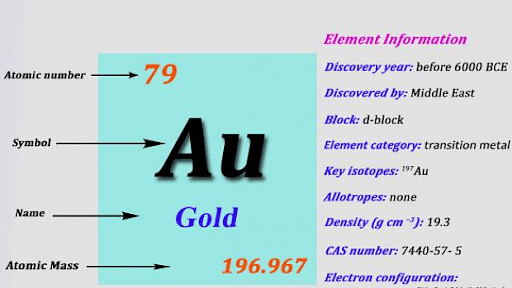
Au is the chemical symbol for gold. The first two letters of gold's Latin name, Aurum, are used to create this symbol.
Symbol of Gold
Atomic Number of Gold
The number of protons in a given element is determined by its atomic number. The atomic number of gold is 79.
Electron Configuration of Gold
[Click Here for Sample Questions]
- The nucleus of an atom is surrounded by different shells on which electrons orbit. The electrical configuration of an element refers to the number of electrons present in each of its shells.
- Xe 4f145d106s1 is the electrical configuration of gold.
- The electrons per shell of the Gold atom can be expressed as 2,8,18,32,18,1.
- Gold can have a valency of -1 to +5, with +1 and +3 being the most frequent.

Electron Configuration of Gold
Atomic Mass of Gold
The atomic mass of an element is the mass of one of its atoms, which is measured in atomic mass units (u), with one atomic mass unit equaling 1/12 the mass of the carbon-12 isotope. Because the mass of the electrons is small in comparison to their mass, we sum up the mass of the protons and neutrons when computing the atomic mass of a given element.
Gold has an average atomic mass of 196.97. It varies in its isotopes
Isotopes of Gold
[Click Here for Sample Questions]
- Au-197 is the only naturally occurring stable isotope of gold (Au79).
- It has 36 radioisotopes.
- The most stable isotope of Gold is Au-195, which has a half-life of 186 days.
- Au-171, which has a half-life of 30 seconds and decays through proton emission, is the least stable isotope of Gold.
- Gold is also known as the heaviest mono-isotopic metal element.
Properties of Gold
[Click Here for Sample Questions]
| Particulars | Details |
|---|---|
| Group | 11 |
| Period | 6 |
| Block | d |
| Atomic number | 79 |
| State at 20°C | Solid |
| Electron configuration | [Au] 4f145d106s1 |
| Melting point | 1064.18°C, 1947.52°F, 1337.33 K |
| Boiling point | 2836°C, 5137°F, 3109 K |
| Density (g cm−3) | 19.3 |
| Relative atomic mass | 196.967 |
| Key isotopes | 197Au |
| CAS number | 7440-57-5 |
Physical Properties of Gold
- Gold is an excellent conductor of heat and electricity.
- It has strong corrosion resistance and is extremely long-lasting.
- It is unaffected by air and most reagents.
- Gold has a glossy sheen to it.
- It is also ductile and malleable.
- Gold is extremely soft in its finest form.
- It is alloyed with another metal in order to give it strength.
- When gold is accessible in mass, it has a somewhat reddish-yellow colour.
- It becomes black, violet, or ruby when it is finely separated.
Chemical Properties of Gold
- Chloro-auric acid and auric chloride are the most common gold compounds.
- Most acids are insoluble in gold, but they may be dissolved in Aqua Regia (Royal Water). Gold forms a tetrachlorocuprate anion in Aqua Regia. It also dissolves in alkaline solutions of cyanide.
- Gold is one of the least reactive metals.
Uses of Gold
[Click Here for Sample Questions]
- Gold is mostly used in the production of jewellery, glass, and other electrical components.
- It is used to make over 75% of the world's jewellery.
- Gold thread can be used in embroidery.
- A thin covering of this metal is used to reflect the heat of the sun rays on the windows of large buildings.
- Gold is also used in Medicines. Some tumours are treated with Au-198, a radioactive isotope of Gold.
- To protect astronaut helmets from UV radiation, a tiny layer of gold is added to them.
Things to Remember
- Gold is a metallic element with atomic number 79.
- The Symbol of Gold is Au.
- Gold belongs to the sixth period and group eleven of the periodic table.
- It is one of the least reactive chemical elements and is solid at room temperature.
- It is a soft, bright, dense, malleable, and ductile metal with a reddish-yellow colour.
- Gold is mostly used in the production of jewellery, glass, and other electrical components.
- The most common gold compounds are Chloro-auric acid and auric chloride.
- Gold is a good conductor of heat and electricity.
- It has strong corrosion resistance and is extremely long-lasting. It is unaffected by air and most reagents.
Also Read:
Sample Questions
Ques: What are the benefits of using gold for Jewellery and Embroidery? (2 Marks)
Ans: Gold is a sparkling metal with a brilliant lustre. It is malleable, pliable, and ductile. Jewellers can create elaborate patterns with it. It is typically used as a decoration and looks lovely when worn. Due to its ductility, gold may be spun into a thin thread that can be utilised for beautiful embroidery.
Ques: What applications does gold have in the space exploration sector? (2 Marks)
Ans: Gold plays an important part in the space industry since astronauts' helmets are coated with a small layer of gold to protect them from sun’s radiation while in space.
Ques: What is Aqua Regia? (2 Marks)
Ans: Aqua Regia is a solution made up of concentrated nitric and hydrochloric acids, generally one part nitric acid to three parts hydrochloric acid by volume. The alchemists named this solution as royal water because of its propensity to dissolve gold. It is highly corrosive and can result in skin burns. Gold and platinum can get easily dissolved with aqua regia.
Ques: Write the application of gold in medical science? (2 Marks)
Ans: Some kinds of arthritis and associated disorders respond well to gold as a treatment. It relieves joint pain and stiffness in certain patients, reduces swelling and bone damage, and lowers the risk of joint deformity and impairment. Au-198, a radioactive isotope, is used to treat certain tumours.
Ques: Mention the physical properties of gold. (3 Marks)
Ans: Some physical properties of Gold are:
- Gold is a soft, bright, dense, soft, malleable, and ductile metal with a somewhat reddish-yellow colour.
- Gold is a good conductor of heat and electricity.
- The element has strong corrosion resistance and is extremely long-lasting.
- It is unaffected by air and most reagents.
Ques: Write the chemical properties of Gold. (3 Marks)
Ans: Here are some of the chemical properties of Gold
- Chloro-auric acid and auric chloride are the most common gold compounds.
- Most acids are insoluble in gold, but they may be dissolved in Aqua Regia (Royal Water).
- Gold forms a tetrachlorocuprate anion in Aqua Regia.
- It also dissolves in alkaline solutions of cyanide.
- Gold is one of the least reactive metals.
For Latest Updates on Upcoming Board Exams, Click Here: https://t.me/class_10_12_board_updates
Check-Out:



Comments