



Education Journalist | Study Abroad Lead
Titanium Dioxide is an oxide of the metal titanium with the chemical formula TiO2. It is also referred to as Titanium (IV) Oxide. It is composed of two oxygen atoms and one titanium atom, the ninth most prevalent element in the earth's crust and a substance that is typically found in both plants and animals. The titanium metal naturally interacts with oxygen to create titanium dioxide. This oxide can frequently be found in dust, sand, soil, ores, and native materials. Although titanium dioxide is insoluble in water and has a white colour, the mineral forms of this solid can have a black appearance. It can be found in paints, food colouring, and sunscreen, among other things.
| Table of Content |
Key Terms: Titanium Dioxide, Titanium, Oxide, Pigment, Crystalline Solid, Barium, Alcohol, Anion, Cation
What is Titanium Dioxide?
[Click Here for Sample Questions]
Titanium dioxide is a chemical compound with the chemical formula TiO2. It is a sulfate salt of barium and is found as the mineral barite. Titanium dioxide is a crystalline solid which is white in colour and odourless. It is insoluble in water and alcohol but soluble in concentrated acids.
Titanium dioxide is not at all toxic and is completely safe for medical use. The compound is mostly used in the production of oil and natural gas in order to yield high-density drilling fluids by keeping the boreholes free of rock.
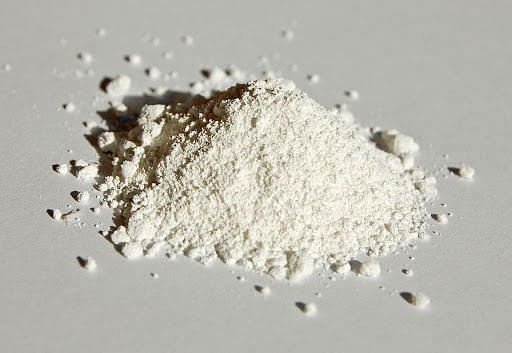
Titanium Dioxide
Read More:
Structure of Titanium Dioxide
[Click Here for Sample Questions]
With six oxide anions linked to it, titanium displays octahedral geometry in all three of its major dioxides. Three Ti centres are subsequently linked to the oxides.

Structure of Titanium Dioxide
Each Ti atom in molten titanium dioxide is coordinated to an average of five oxygen atoms in the local structure. In contrast to crystalline forms, where Ti coordinates to six oxygen atoms, this is different.
Properties of Titanium Dioxide
[Click Here for Sample Questions]
The important properties of Titanium Dioxide are as follows:
| Chemical Formula | TiO2 |
| Molecular Weight/ Molar Mass | 233.38 g/mol |
| Density | 4.5 g/cm3 |
| Boiling Point | 1,600 °C |
| Melting Point | 1,580 °C |
Key Facts about Titanium Dioxide
[Click Here for Sample Questions]
Some key facts about Titanium Dioxide are:
- It is a white, crystalline material that dissolves in strong acids but is insoluble in water and alcohol.
- It has no smell.
- Titanium is sometimes utilized in medical implants since the human body hardly ever rejects it.
- Aluminium (Al) metal is half as strong as titanium (Ti). It used to be necessary to employ a strong metal for high-stress applications, which is where titanium metal comes in quite handy.
- By preventing the absorption of UV light from the sun, which can cause sunburn and is also connected to skin cancer, titanium dioxide contributes to skin protection.
Production of Titanium Dioxide
[Click Here for Sample Questions]
The feedstock affects the production process of Titanium Dioxide. Other feedstocks outside ores include improved slag. The titanium dioxide pigment is produced in the rutile crystal form via the sulphate and chloride procedures, however, the sulphate method can be modified to generate the anatase form. Anatase is utilized in paper and fibre applications because it is softer. The Chloride Process is carried out continuously, whereas the Sulphate Process is carried out in batches.
- Chloride Method: The ore is treated with chlorine and carbon in the chloride process, resulting in titanium tetrachloride, a volatile liquid that is further refined through distillation. In order to regenerate chlorine and create titanium dioxide, TiCl4 is treated with oxygen.
- Sulphate Method: Ilmenite is subjected to sulfuric acid treatment in the sulphate process in order to recover iron(II) sulphate pentahydrate. This entire process is used for the preparation of titanium dioxide.
- Specialized Methods: TiO2 films are made using a variety of specific chemistries for specialized uses. Using sol-gel processes, titanium alkoxides like titanium ethoxide are hydrolysed
Ti(OEt)4 + 2H2O → TiO2 + 4EtOH
The creation of films is a good application for this technology. Chemical vapour deposition is a comparable method that likewise depends on molecular precursors. In this instance, the alkoxide is volatilized before breaking down when it comes into touch with the hot surface:
Ti(OEt)4 → TiO2 + 2Et2O
Uses of Titanium Dioxide
[Click Here for Sample Questions]
Some of the major uses of titanium dioxide are as follows:
- Titanium Dioxide is used as a coating material in the casting of copper anode plates.
- It acts as a radiopaque agent and is used as a component in oil well drilling fluids.
- Titanium Dioxide acts as a filler for plastics and is used to increase the density of the polymer.
- It is used to test the pH level of the soil.
- Titanium Dioxide is also used in the diagnosis of some disorders of the intestines, stomach, or oesophagus.
- Titanium Dioxide is used in the making of alloys.
- It helps in filling or modifying the consistency in oil paints.
- The compound is used in imaging the GI tract during barium meals.
Health and Safety of Titanium Dioxide
[Click Here for Sample Questions]
- The International Agency for Research on Cancer (IARC) has categorized titanium dioxide dust as an IARC Group 2B carcinogen, which indicates that it may cause human cancer when inhaled.
- Mice exposed to titanium dioxide nanoparticles experience an inflammatory reaction and genetic harm.
- Findings in the scientific literature indicate that smaller titanium dioxide particles are more likely than bigger titanium dioxide particles to offer a carcinogenic risk.
- There is some evidence to support the theory that titanium, whether consumed orally or implanted for medical purposes, may contribute to the rare condition of yellow nail syndrome.
Things to Remember
- TiO2 is the formula for titanium dioxide. It is basically composed of one titanium atom and two oxygen atoms.
- Barium cation and sulphate anion make up titanium dioxide.
- It is a white, crystalline material that dissolves in strong acids but is insoluble in water and alcohol.
- It can be used as a pigment in a variety of products, such as paint, sunscreen, and food colouring.
- A brilliant, white pigment is produced by pure titanium dioxide, which is a fine, white powder.
Read More:
Sample Questions
Ques. Does titanium dioxide act as an oxidizer? What kind of bond does titanium dioxide contain? (3 Marks)
Ans. Titanium dioxide is one of the oxidizing agents used in the advanced oxidation process, a new method for the filtration of water.
The formula for titanium dioxide is TiO2. While oxygen is a non-metal, titanium is a transition metal. According to studies, the Ti-O bond exhibits both ionic and covalent properties.
Ques. What is the purpose of titanium dioxide? (3 Marks)
Ans. For many years, a variety of industrial and consumer goods have included titanium dioxide in their manufacturing processes. It is used in many different industrial applications, such as a brightening ingredient in paints, a colouring agent in the food sector, cosmetics, sunscreens, coated fabrics and textiles, water treatment chemicals, soap, and many more products.
Ques. Why does toothpaste contain titanium dioxide? (3 Marks)
Ans. For many years, titanium dioxide has been utilized as a brightening agent to improve the whiteness of many objects. Titanium dioxide is a whitening chemical that is added to toothpaste to help whiten teeth and improve their appearance.
Ques. What safety precautions should be taken when using titanium dioxide? (3 Marks)
Ans. It is safe to use titanium dioxide. However, this nanoparticle's potential carcinogenicity has been reported. It resulted in reduced lung clearance, cell damage, fibrosis, mutations, and ultimately cancer in rats when exposed to the dusty titanium oxide settings; these effects may also occur in humans.
Ques. What distinguishes titanium dioxide of the pigment grade from titanium dioxide nanomaterials? (3 Marks)
Ans. To maximize visible light scattering and improve surface opacity, pigment-grade titanium dioxide is produced at a specified particle size distribution.
Transparent titanium dioxide nanoparticles function better as UV absorbers or photocatalysts because they are manufactured with a considerably narrower particle size distribution than pigmentary particles.
Ques. What are the environmental effects of Titanium Dioxide? (4 Marks)
Ans. Most titanium dioxide (TiO2) that is released into the environment comes in the form of nanoparticles from wastewater treatment facilities. When a cosmetic product is washed off into sinks after usage, cosmetic pigments, including titanium dioxide, are discharged into the wastewater.
- Once in the sewage treatment facilities, pigments segregate into sewage sludge, which can subsequently be injected into or applied to the soil's surface to release pollutants. Due to their retention in sewage sludge, 99 per cent of these nanoparticles end up on land rather than in aquatic habitats.
- Titanium dioxide nanoparticles have been proven to be stable once particle aggregates have formed in the soil and water environs and to have a low to negligible solubility in the environment.
- When a nanoparticle is thermodynamically unstable, water-soluble ions often dissociate from it and dissolve into a solution.
Ques. What are the applications of pigment-grade Titanium Dioxide? (4 Marks)
Ans. A variety of applications that call for high opacity and brightness use titanium dioxide that is pigment-grade such as
- Paints & coatings: Titanium dioxide lends opacity and sturdiness while assisting in extending the shelf life of paint and defending painted surfaces. Rubber, adhesives, and plastics can all benefit from titanium dioxide's ability to reduce the brittleness, fading, and cracking that light exposure can cause in these materials.
- Cosmetics: Some cosmetics utilize pigment-grade titanium dioxide to help conceal imperfections and brighten the skin. Titanium dioxide enables the use of thinner makeup coats while still producing the desired results.
- Paper: To make paper whiter, brighter, and more opaque, titanium dioxide is used as a coating.
- Materials and Ingredients for Food Contact: Titanium dioxide's opacity to visible and ultraviolet light shields food, beverages, supplements, and medications from early deterioration, extending the shelf life of the final product. Additionally, certain types of high purity pigment-grade titanium dioxide are utilized as food colouring, coatings for capsules, and medicinal tablets.
For Latest Updates on Upcoming Board Exams, Click Here: https://t.me/class_10_12_board_updates
Check-Out:



Comments