



Education Content Expert
Atmosphere is a blanket of gases on the surface of a planet. Earth's atmosphere is a mixture of gases surrounding the planet. Earth’s atmosphere is divided into layers and each of these layers has its own specific characteristics. Earth's atmosphere has 5 layers namely troposphere, stratosphere, mesosphere, thermosphere and exosphere.
Layers of atmosphere are divided based on temperature. All the weather processes occur in the lower layers of the atmosphere whereas the other exciting events such as aurora occurs in the upper layers of the atmosphere.
Read More: Role of Atmosphere in Climate Control
Key Terms: Atmosphere, Layers of Atmosphere, Troposphere, Stratosphere, Mesosphere, Thermosphere, Exosphere, Ozone
What is Atmosphere?
[Click Here for Sample Questions]
Atmosphere is simply defined as a blanket of gases surrounding a planet or any other celestial body with sufficient mass.
- Earth’s atmosphere extends up to 1000 Km from the surface of the earth.
- However, we can experience the entire mass of the earth’s atmosphere within 32 Km due to the strong gravitational pull of the earth.
- Earth’s atmosphere comprises a mixture of gases in varying proportions such as Nitrogen (78%), Oxygen (21%), and others (1% ) which include other gases like Carbon dioxide, Argon, Neon, Helium etc.
Structure of Atmosphere
[Click Here for Previous Years' Questions]
In the atmosphere, the changes in the temperature are irregular unlike pressure and density, which decrease with altitude.
- Temperature Gradient is a change in temperature with respect to distance.
- Earth’s atmosphere is divided into specific layers on the basis of the temperature gradient of that layer, which is determined by the heat source of the layer.

Layers of Atmosphere
[Click Here for Sample Questions]
Earth’s atmosphere has mainly 5 layers, which are as follows:
- Troposphere
- Stratosphere
- Mesosphere
- Thermosphere
- Exosphere
Read More: Air Composition
Troposphere
The word ‘Tropo’ means ‘Change’, that is almost all the weather changes occur in this layer of the atmosphere because of the formation of clouds from the water vapours.
- The troposphere is the first layer of the atmosphere at the equator and 8 km at the poles, extending up to 18 km in height.
- Troposphere comprises more than 90% of the total gases present in the earth’s atmosphere.
- In the troposphere, the temperature decreases with height, thus, the density of the air decreases with an increase in height.
- Tropopause is a term used to describe the maximum height where the temperature stops decreasing and can go as low as -58 degree celsius.
Stratosphere
Stratosphere is the second layer of the atmosphere that ranges up to 50 Km above the Troposphere.
- Stratosphere is the most useful layer of the atmosphere among all as it absorbs the UV radiations from the sun as ozone is present in this layer.
- This layer is warmer with a temperature of around 4 degrees Celsius.
- Since the stratosphere is free from clouds and weather phenomena, it offers ideal conditions for flying fighter jet planes.
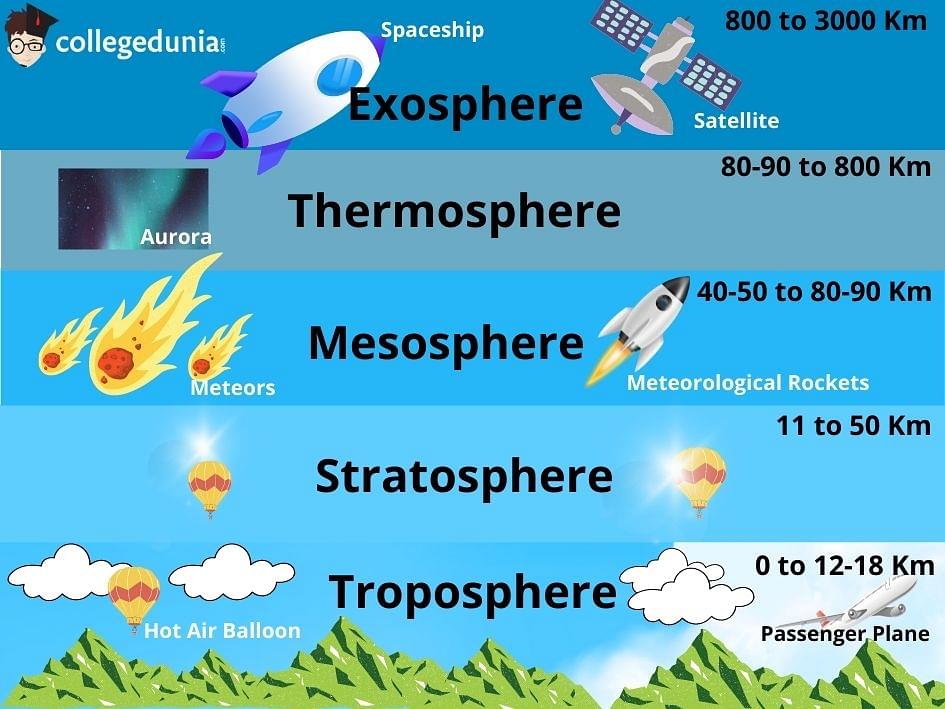
Layers of Earth's Atmosphere
Read More: Ozone Layer Depletion
Mesosphere
Mesosphere is the next layer of the atmosphere that lies above the Stratosphere.
- It extends up to a height of 80 Km and the meteors burn up in this layer.
- Mesosphere is one of the coldest layers of the atmosphere and has a temperature up to -90 degree celsius.
- One might face a lot of difficulties breathing in the mesosphere as the air is thinnest with bare minimum pressure in it.
- In this layer, none of the aeroplanes, fighter jets, etc. is present as none of them can fly this high to reach the layer.
Thermosphere
Thermosphere is the next layer found above the Mesosphere that extends upto a height of 640 Km.
- In this layer, the temperature increases with the height as the gas molecules absorb the UV radiations and the X-rays from the sun.
- Thermosphere is the only layer that helps in long-distance communication because of the electrically charged gas particles present in it that reflect back the radio waves from the Earth to space.
- Thermosphere basically helps to protect the earth from huge meteors and satellites.
Read More: Low Pressure & High-Pressure System
Exosphere
Exosphere is the last and the outermost layer of the atmosphere that extends up to 640 Km in height.
- The temperature of the exosphere is very high ranging between 300-1650 degree Celsius.
- It then merges into the interplanetary space as the height of the layer increases.
- Exosphere has the least amount of gases such as Oxygen, Argon, Helium etc. as the particles of the gases escape to space due to the bare minimum presence of gravity.
Things to Remember
- Atmosphere is a blanket of gases present on the surface of a planet.
- Earth's atmosphere is a mixture of gases such as Nitrogen, Oxygen, and other gases such as Carbon dioxide, Argon, Helium etc.
- There are mainly five layers in the earth’s atmosphere namely troposphere, stratosphere, mesosphere, thermosphere and exosphere.
- These layers are divided on the basis of the temperature gradient determined by the heat source of the layer.
- Troposphere is the first layer of the earth’s atmosphere and has 90% of the total gases of the atmosphere.
- Exosphere is the outermost layer of the atmosphere that merges into interplanetary space.
Previous Years’ Questions (PYQs)
- Atmosphere, hydrosphere, lithosphere and biosphere are…
- The uppermost region of the atmosphere is called…
- The point of temperature inversion between troposphere…
- Which of the following statements regarding ozone is…
- The upper stratosphere consisting of the ozone layer protects… (JEE Main 2019)
- The layer in earth's atmosphere which reflects radio waves… (COMEDK UGET 2012)
- Ultraviolet radiation from sun causes a reaction that…
- Ozone depletion over Antarctica is due to the…
- The primitive atmosphere on the earth largely had…
- There is no atmosphere on the moon, because…
Sample Questions
Ques. What is Ionosphere? (3 Marks)
Ans. The ionosphere is present within the thermosphere. It gets its name from the solar radiation that ionizes gas molecules in order to create a positively charged ion and one or more negatively charged electrons. These free electrons move within the ionosphere in the form of electric currents. The ionosphere has many unique characteristics due to these free ions. The Northern Lights and Southern Lights, the aurora and other exciting things occur in the Earth’s ionosphere.
Ques. Describe the composition of the earth’s atmosphere. (3 Marks)
Ans. Earth's atmosphere is composed of various gases in varying proportions which are:
- Nitrogen (78%)
- Oxygen (21%)
- Other gases (1%)
All these gases are found in the five layers of the atmosphere namely the troposphere, stratosphere, mesosphere, thermosphere, and exosphere which are defined by unique features such as temperature and pressure.
Ques. Answer the following questions:
(a) Name the factor that determines a new layer in the atmosphere.
(b) Where is ozone found in the atmosphere?
(c) Where do planes fly in the atmosphere? (3 Marks)
Ans. (a) The temperature gradient is the factor that determines a new layer in the atmosphere.
(b) The ozone layer is found in the second layer of the atmosphere, i.e. stratosphere.
(c) Planes fly in the stratosphere because of the less turbulence.
Ques. Elaborate on the structure of the atmosphere. (3 Marks)
Ans. The temperature changes in the various layers of the atmosphere are irregular unlike the changes in pressure and density that decrease with altitude. The change in temperature with distance is referred to as the temperature gradient. The layers of the earth’s atmosphere are based on the layer’s temperature gradient, and the temperature gradient in each layer is determined by the heat source of the layer.
Ques. Explain the reason for the troposphere being warmer at the base. (3 Marks)
Ans. Even though the sunlight reaches the surface of the earth from top to bottom, the troposphere is majorly heated at the base. Compared to the air, the Earth’s surface is much better at absorbing a wide range of solar radiation. When warm air moves upwards, it expands and cools down. Owing to this reason, the base of the troposphere is usually warmer because the air on the surface of the Earth absorbs the energy, gets heated up, and moves upward, which cools down.
Ques. Why is the Stratosphere warmer than the troposphere? (3 Marks)
Ans. The ozone molecules present in the stratosphere absorb high-energy UV light from the sun and convert the same into heat. Because of this specific activity, unlike the troposphere, the stratosphere gets warmer as we go higher.
Ques. An unprotected astronaut’s blood boils in the mesosphere. State the reason. (3 Marks)
Ans. An astronaut travelling through the mesosphere without protection would get a lot of severe burns from the sun’s ultraviolet light as the ozone layer providing the UV protection is present in the stratosphere which is present below. Meteorites burn in the mesosphere on entering the atmosphere from outer space.
Ques. Name the following:
(a) Hottest Layer of the Atmosphere
(b) Coldest Layer of the Atmosphere
(c) Outermost Layer of the Atmosphere (3 Marks)
Ans. (a) Thermosphere is the hottest layer of the earth’s atmosphere.
(b) Mesosphere is the coldest layer of the earth’s atmosphere.
(c) Exosphere is the outermost layer of the atmosphere of the earth.
Ques. Name the five main layers of the earth’s atmosphere. (2 Marks)
Ans. There are mainly five layers of the earth's atmosphere:
- Troposphere
- Stratosphere
- Mesosphere
- Thermosphere
- Exosphere
Ques. Name the three major gases present in the earth’s atmosphere. (3 Marks)
Ans. The three major gases present in the earth’s atmosphere are
- Nitrogen: Most abundant gas which makes up about 78% of air.
- Oxygen: Second most abundant gas at about 21%.
- Argon: Third most abundant gas at 0.93%.
Ques. What is the importance of the atmosphere? (2 Marks)
Ans. The atmosphere plays a very important part in the survival of life on earth. It protects us shielding the surface of the earth from incoming ultraviolet (UV) radiation. It keeps the planet warm through insulation and prevents extremes between day and night temperatures.
Ques. Can living organisms survive without the atmosphere? (1 Mark)
Ans. No, we can not survive without air present in the atmosphere. In absence of the atmosphere, the earth would get so cold at night that it would be impossible for living beings to survive on earth.
Ques. What is responsible for holding the atmosphere in place? (1 Mark)
Ans. The atmosphere of the earth is held in its place through gravity.
Check-Out:



Comments