




TS EDCET, also known as TG EdCET, is a state-level entrance examination for admission to the two-year B.Ed programme in Telangana. The TS EDCET syllabus tests teaching aptitude, subject proficiency, and educational awareness needed to teach effectively. The examination is conducted by Kakatiya University, Warangal, on behalf of the Telangana Council of Higher Education (TGCHE).
| Check Out: TS EDCET Official Syllabus 2027 (OUT SOON) |
- The syllabus covers five major sections: Subject Content, General Knowledge & Educational Issues, Teaching Aptitude, General English, and Computer Awareness.
- The exam consists of 150 objective-type questions, carrying a total of 150 marks. Candidates get 2 hours (120 minutes) to complete the entire examination.
- Subject Content covers Mathematics, Physical Sciences, Biological Sciences, and Social Studies, depending on the candidate's chosen methodology. It is mainly based on Class 6–10 SCERT-level concepts and carries the highest weightage of 60 marks.
- General Knowledge & Educational Issues carries 30 marks, making it the second-highest weighted section after Subject Content. Teaching Aptitude, General English, and Computer Awareness carry 20 marks each, giving these three sections equal weightage.
- The question paper is bilingual, with English paired with either Telugu or Urdu, allowing candidates to attempt the exam in their preferred language combination.
Related Links:
- TS EDCET Exam Pattern 2027: Total Questions, Marking Scheme, Subject-Wise Weightage, & PYQs
- TS EDCET Question Paper 2026: Download Shift-wise Question Paper with Solution PDF
Key Summary
- TS/TG EDCET 2027 is a state-level entrance exam for admission to two-year B.Ed programmes in Telangana.
- The exam has 150 MCQs for 150 marks, with a 2-hour duration and no negative marking.
- Subject Content carries the highest weightage of 60 marks, followed by General Knowledge & Educational Issues with 30 marks.
- The remaining sections—Teaching Aptitude, General English, and Computer Awareness—carry 20 marks each, with the paper available in English-Telugu or English-Urdu.
TS EDCET Syllabus 2027: Highlights
TS EDCET is a state-level entrance exam conducted for admission into the two-year Bachelor of Education (B.Ed) programme across universities and affiliated colleges in Telangana
- EDCET is conducted by Kakatiya University, Warangal, on behalf of the Telangana Council of Higher Education (TGCHE), rather than by a central body.
- The exam is bilingual, English paired with either Telugu or Urdu, and runs for 2 hours across 150 objective-type MCQs.
- The syllabus includes 5 sections:
- Subject Content (Maths, Science and Social Studies)
- General Knowledge
- General English
- Teaching Aptitude
- Computer Awareness
| Parameter | Details for TS EDCET |
|---|---|
| Conducting Body | Kakatiya University, Warangal (on behalf of TGCHE) |
| Total Marks | 150 marks |
| Total Questions | 150 questions |
| Total Duration | 2 hours (120 minutes) |
| Syllabus Level | Up to Class 10 for Subject Content; Graduation level for Teaching Aptitude/Methodology |
| Subjects Included | Subject Content (Maths, Science, Social Studies), General Knowledge, General English, Teaching Aptitude, Computer Awareness |
| Question Types | Objective-type MCQs |
| Language of Paper | Bilingual: English & Telugu, or English & Urdu |
Also Check:
TS EDCET Syllabus 2027: What's New?
The TS EDCET syllabus has changed from a rigid, stream-specific structure into a holistic exam testing general aptitude and school-level core content.
- 2021 brought the biggest change: the 100-mark graduation-level Methodology paper was removed and replaced with a 60-mark Subject Content section based on the Class 10 SCERT syllabus.
- Computer Awareness was added in 2021, carrying 20 marks to test basic digital knowledge.
- Since 2022, EDCET has been conducted as a Computer-Based Test (CBT), with Educational Issues giving more importance to topics such as NEP 2020.
- No major changes are expected in the 2027 EDCET syllabus, but General Knowledge and Educational Issues may include updated 2026–2027 current affairs.
| Time Period | Exam Structure & Key Features | Major Syllabus & Topic Changes |
|---|---|---|
| Pre-2021 Era | 150 Marks/Questions; stream-specific format |
|
| 2021 Major Overhaul | 150 Marks/Questions; Uniform format for all streams |
|
| 2022–2026 Evolution | 150 Marks/Questions; Shifted to online CBT |
|
| 2027 (Expected) | No structural change expected; 150 Marks/5 Sections; No negative marking |
|
Ques. Is the TS EDCET exam syllabus the same across all academic streams?
Ans. Yes, the TS EDCET exam syllabus follows a common structure for candidates from different graduation streams. Candidates select the relevant subject content while the core sections remain part of the common examination framework.
TS EDCET Mathematics Syllabus 2027
The Mathematics portion of the Subject Content section carries a total of 20 questions for 20 marks. The Maths exam covers 7 major units based on the Class 6 to 10 Telangana State Board (SCERT) curriculum.
- Number System includes basic operations, roots, sets, and Venn diagrams, whereas Algebra covers algebraic expressions, polynomials, and linear and quadratic equations.
- Geometry is the broadest unit, covering basic geometry, triangles, quadrilaterals, circles, and coordinate geometry.
| Unit | Syllabus Breakdown |
|---|---|
| Number System |
|
| Commercial Mathematics |
|
| Algebra |
|
| Geometry |
|
| Mensuration |
|
| Trigonometry |
|
| Data Handling |
|
TS EDCET Mathematics High-weightage topics
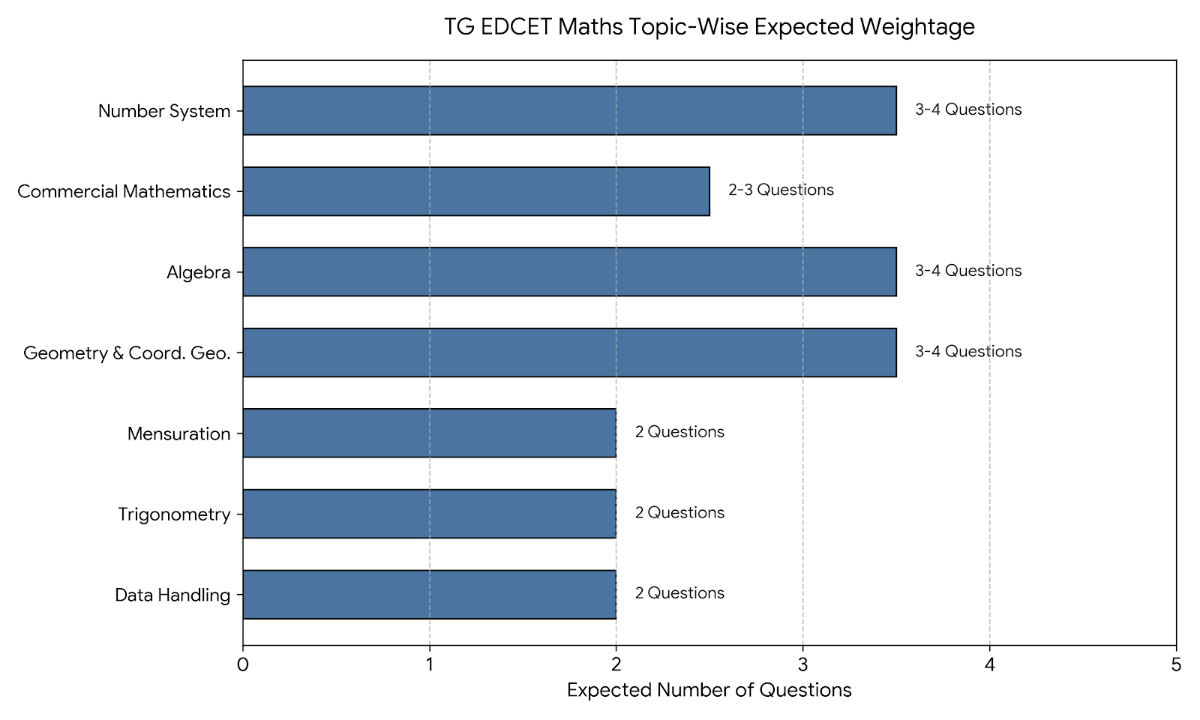
Prioritise Units 1, 3, and 4, as these three units make up nearly 50% of the entire Mathematics section, so mastering fundamentals in Algebra, Sets, and Coordinate Geometry first helps.
- Number System and Algebra each contribute 3–4 of the 20 questions, making them the two largest topic blocks.
- Geometry & Coordinate Geometry, taken together, also contribute 3–4 questions, concentrated in similar-triangle criteria and circle tangents.
- Practising exercise problems directly from Class 9 and 10 SCERT Mathematics textbooks comfortably covers the exam's actual difficulty level, thus, no higher-level formulas are needed.
| Unit | Main Topic | Expected Weightage | Most Important High-Yield Topics |
|---|---|---|---|
| 1 | Number System | 3–4 Questions | HCF & LCM, Progressions (AP), Divisibility Rules, Laws of Logarithms, and Venn Diagrams (Set Theory) |
| 2 | Commercial Mathematics | 2–3 Questions | Profit & Loss, Simple & Compound Interest, and Time & Work applications |
| 3 | Algebra | 3–4 Questions | Linear equations in two variables, Quadratic Equations (Nature of roots), and Algebraic Identities |
| 4 | Geometry & Coordinate Geometry | 3–4 Questions | Similar triangles criteria, Tangents and Secants of a circle, Distance formula, and Section formula |
| 5 | Mensuration | 2 Questions | Area/Perimeter of Circles, and Surface Area/Volume of Cubes and Cylinders |
| 6 | Trigonometry | 2 Questions | Specific angle values (30°, 45°, 60°), basic identities, and simple Height & Distance word problems |
| 7 | Data Handling | 2 Questions | Finding the Mean, Median, and Mode of ungrouped data, and basic Probability (Coins, Dice, Cards) |
Also Check:
TS EDCET Physical Sciences Syllabus 2027
In the TS EDCET, the Science subdivision carries a total of 20 questions for 20 marks, split between:
- Biological Sciences (10 marks) and
- Physical Sciences (10 marks)
Out of the 20 total Science questions, 10 come from Physical Sciences. As there are 14 units but only 10 questions, topics are grouped into logical clusters.
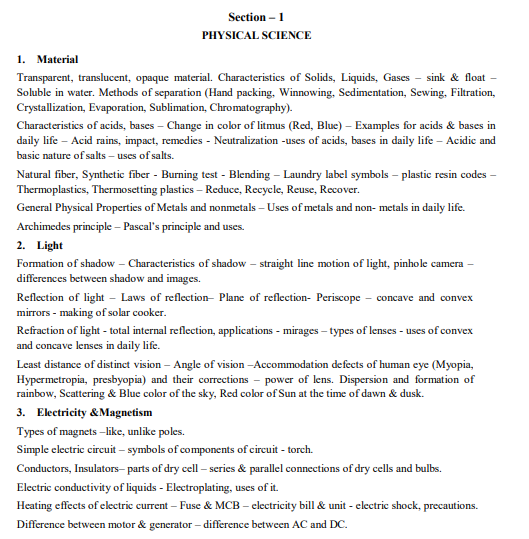
- Material and Chemical Reactions/Structure of the Atom together form the core Chemistry questions, spanning classification, acids/bases, and atomic models.
Source: TS EDCET Official Syllabus 2027
| Main Topic | Syllabus Breakdown |
|---|---|
| Material |
|
| Light |
|
| Electricity & Magnetism |
|
| Heat |
|
| Sound |
|
| Motion |
|
| Changes |
|
| Weather & Climate |
|
| Coal & Petrol |
|
| Some Natural Phenomena |
|
| Stars & Solar System |
|
| Metallurgy |
|
| Chemical Reactions |
|
| Structure of the Atom |
|
TS EDCET Physical Sciences High-weightage topics
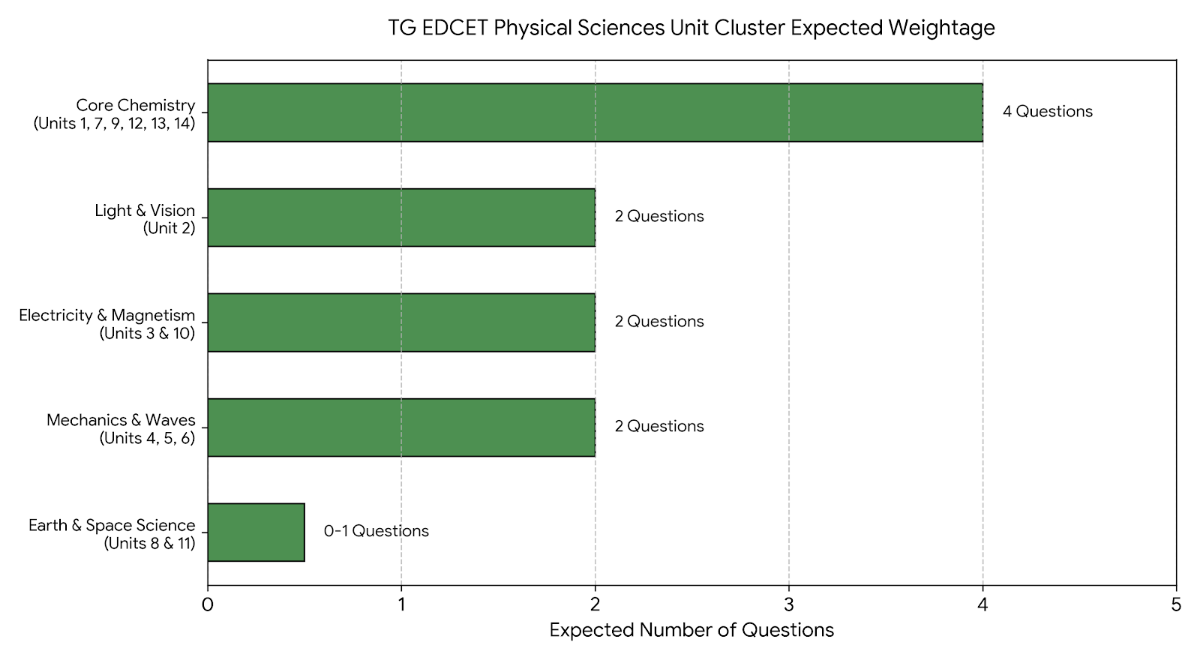
The table groups the Physical Sciences syllabus into major clusters based on their expected question contribution and high-yield concepts.
- Core Chemistry has the highest expected weightage, with focus on separation methods, chemical reactions, atomic models, and petroleum.
- Light & Vision, Electricity & Magnetism, and Mechanics & Waves are expected to contribute around 2 questions each, while Earth & Space Science may have 0–1 question.
| Unit Cluster | Expected Weightage | High-Yield Concepts to Focus On |
|---|---|---|
| Core Chemistry (Units 1, 7, 9, 12, 13, 14) | 4 Questions | Separation methods & indicators; Balancing equations & displacement reactions; Bohr's/Quantum atomic models; Petroleum by-products & calorific values |
| Light & Vision (Unit 2) | 2 Questions | Eye defects (Myopia/Hypermetropia) & corrections; Total Internal Reflection applications; Mirror and lens uses in daily life |
| Electricity & Magnetism (Units 3 & 10) | 2 Questions | Series vs. parallel circuit behaviours; Electroplating, fuses, and MCBs; Lightning conductors & charging methods |
| Mechanics & Waves (Units 4, 5, 6) | 2 Questions | Newton's Laws of Motion applications; Wave properties (frequency, pitch, amplitude); Anomalous expansion of water |
| Earth & Space Science (Units 8 & 11) | 0–1 Question | Richter scale & seismograph details; Phases of the moon and planet characteristics |
TS EDCET Biological Science Syllabus 2027
In the TG EdCET exam, the Biological Sciences section accounts for exactly 10 marks (10 questions) of the 20-mark Science section.
- Life Processes is the broadest unit, covering all major human organ systems alongside cell division and plant physiology.
Be precise with terminology like homologous vs. analogous organs, prokaryotic vs. eukaryotic structures, and mitosis vs. meiosis counts.
| Main Topic | Syllabus Breakdown |
|---|---|
| Food |
|
| Living Organisms |
|
| Life Processes |
|
| Biodiversity |
|
| Pollution |
|
TS EDCET Biological Sciences High-weightage topics
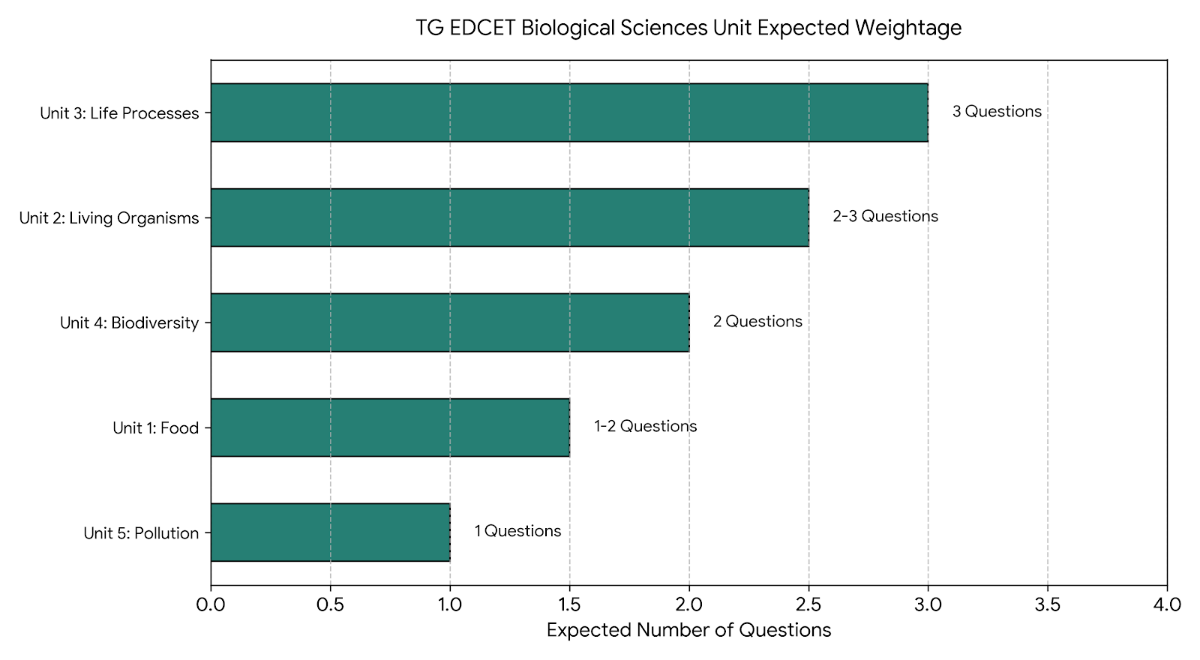
Because the entire Biology curriculum is condensed into 5 primary units, the questions are distributed evenly across high-yield life science concepts.
- Life Processes (Unit 3) carries the highest weightage of the whole section at 3 questions, covering human organ systems, cell division, and plant physiology.
- Living Organisms (Unit 2) follows at 2–3 questions, testing cell biology and micro-organism knowledge.
- Direct multiple-choice statements are frequently asked from highlighted fact boxes inside Class 8, 9, and 10 SCERT Biology textbooks.
| Units | Expected Weightage | Core High-Yield Concepts to Focus On | |
|---|---|---|---|
| Unit 3(Life Processes) | 3 Questions (Highest Weightage) |
| |
| Unit 2(Living Organisms) | 2–3 Questions |
| |
| Unit 4(Biodiversity) | 2 Questions |
| |
| Unit 1(Food) | 1–2 Questions |
| |
| Unit 5(Pollution) | 1 Question |
| |
TS EDCET Social Studies Syllabus 2027
The Social Studies segment carries a total of 20 questions for 20 marks in the TG EdCET. It spans four core disciplines:
- Geography,
- History,
- Political Science, and
- Economics
The syllabus covers the following topics:
- Geography covers Earth and maps, water and climate, natural realms, and human geography as sub-clusters.
- History spans Ancient & Medieval India through World History and regional Telangana-specific movements.
- Political Science and Economics round out the section with governance, rights, and economic-systems content.
| Units | Syllabus Breakdown |
|---|---|
| Geography |
|
| History |
|
| Political Science |
|
| Economics |
|
TS EDCET Social Studies High-weightage topics
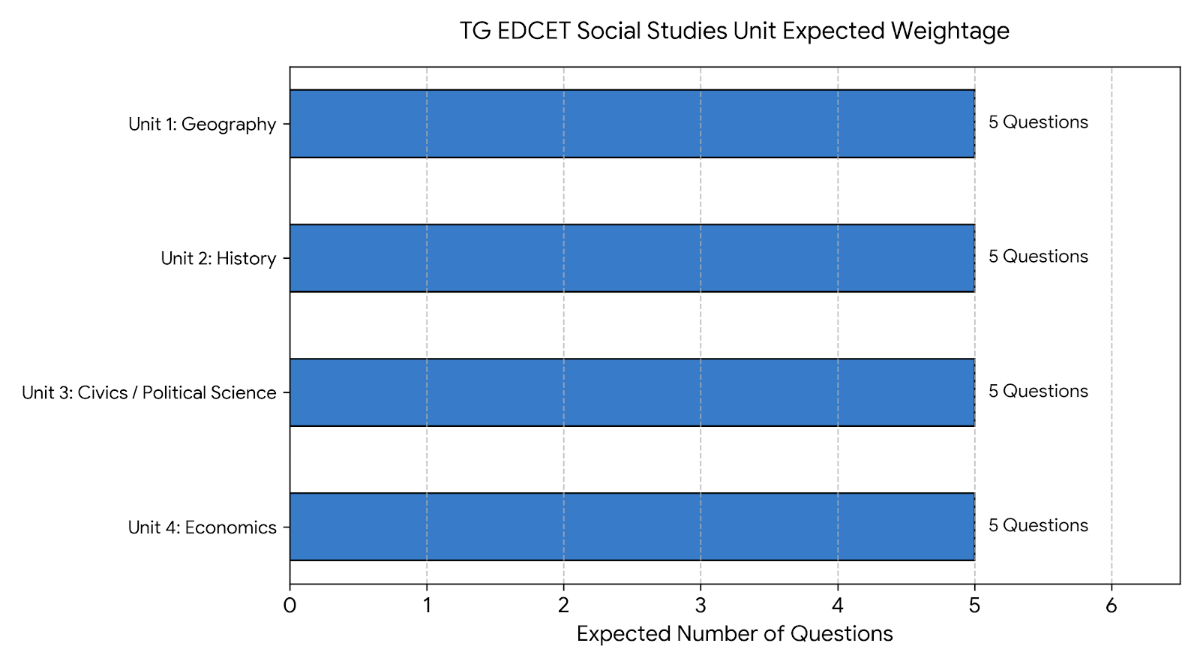
The standard weightage is split evenly, with 5 marks allocated to each of the 4 sections.
- Geography questions concentrate on relief features, latitude/longitude, atmospheric layers, and India's core river systems.
- History focuses heavily on Telangana's regional history, especially the Kakatiya dynasty, Ramappa Temple, Satavahana rulers, and Telangana State Formation committees.
- Political Science mainly covers the Preamble, Fundamental Rights, and the 73rd and 74th Constitutional Amendments related to local governance.
- Economics is mostly conceptual, with a focus on GDP, economic sectors, and food security rather than numerical calculations.
| Section | Expected Weightage | High-Weightage Topics |
|---|---|---|
| Unit 1: Geography | 5 Questions |
|
| Unit 2: History | 5 Questions |
|
| Unit 3: Civics / Political Science | 5 Questions |
|
| Unit 4: Economics | 5 Questions |
|
TS EDCET General Knowledge Syllabus 2027
The General Knowledge & Educational Issues section of TG EdCET (TS EdCET) consists of 30 questions carrying 30 marks, making it an important section for improving your overall score and rank.
- General Knowledge & Current Affairs covers everyday scientific awareness, current events, and India's relations with neighbouring countries.
- Educational Issues & Initiatives focuses squarely on national policy, NEP 2020, inclusion frameworks, and digital empowerment programmes.
| Unit | Main Topic | Syllabus Breakdown |
|---|---|---|
| 1 | General Knowledge & Current Affairs | Everyday Knowledge & Environment: general knowledge of the environment and its application to society, scientific outlook. Current Events & Affairs: India and International current affairs, governance and policy. India & Neighboring Countries: history, culture, geography, ecology, economics, national security, cashless economy. |
| 2 | Educational Issues & Initiatives | Policies & Governance: NEP-2020, school education quality and governance, PM Gati-Shakti National Master Plan. Inclusion & Rights: SEDGs, SSA, RTE. Empowerment & Assessment: digital empowerment and capacity building, holistic education, Indian knowledge system, PARAKH. |
TS EDCET General Knowledge High-weightage topics
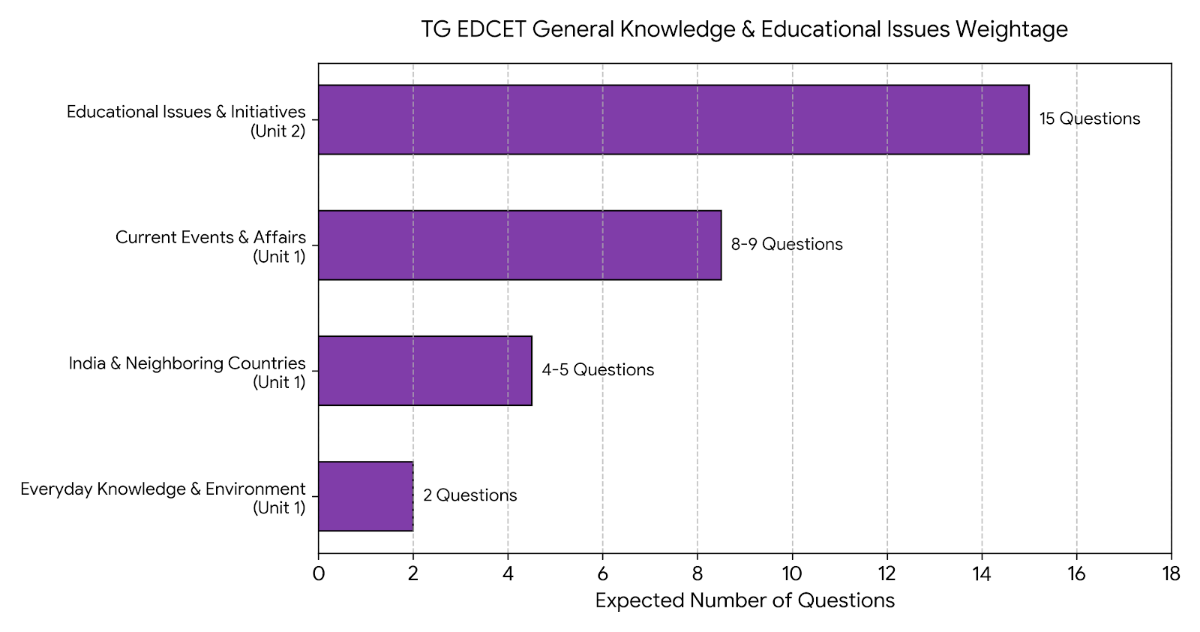
The section is generally divided into 15 marks for General Knowledge & Current Affairs and 15 marks for Educational Issues & Initiatives.
- Educational Issues & Initiatives accounts for 15 questions, with NEP 2020 and RTE 2009 being key areas to prepare.
- Current Events & Affairs contributes around 8–9 questions, covering important national and international events, awards, and sports.
- India & Neighbouring Countries and Everyday Knowledge & Environment make up the remaining questions with smaller weightage.
- Give special attention to NEP 2020 and RTE 2009, including their key provisions, targets, implementation years, and major features.
| Main Topic | Expected Weightage | Core High-Yield Concepts to Focus On |
|---|---|---|
| Educational Issues & Initiatives (Unit 2) | 15 Questions (Highest Weightage) |
|
| Current Events & Affairs (Unit 1) | 8–9 Questions |
|
| India & Neighboring Countries(Unit 1) | 4–5 Questions |
|
| Everyday Knowledge & Environment (Unit 1) | 2 Questions |
|
TS EDCET General English Syllabus and High-weightage Topics 2027
The General English section of TG EdCET (TS EdCET) carries 20 questions for 20 marks and mainly tests grammar, vocabulary, and reading skills.
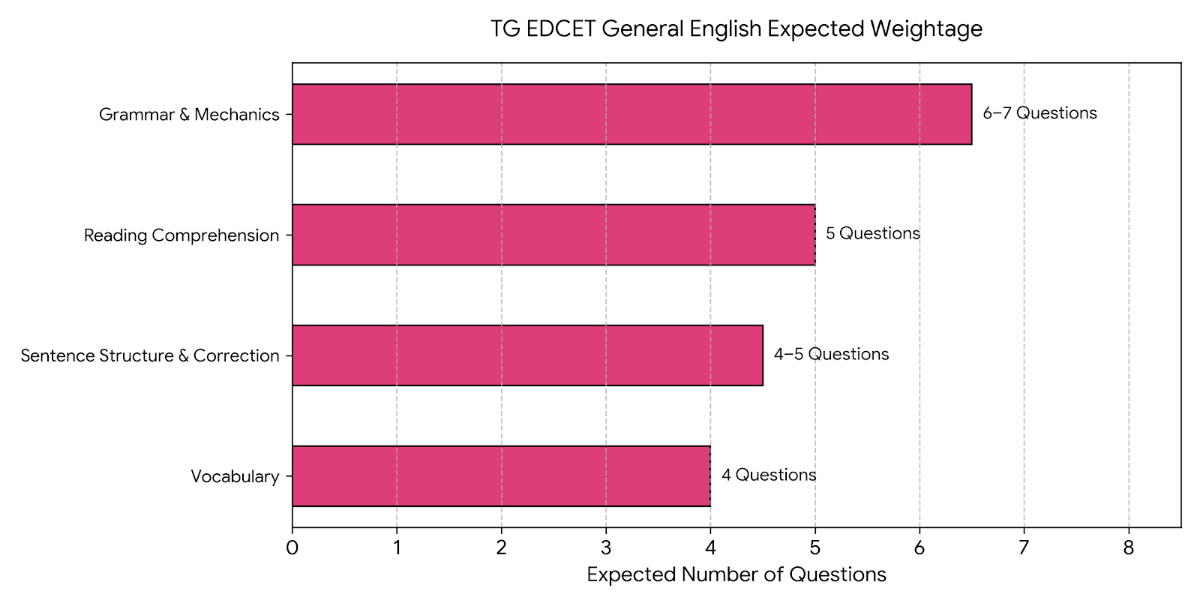
- Grammar & Mechanics has the highest weightage, covering tenses, subject-verb agreement, active-passive voice, and narration.
- Reading Comprehension and Vocabulary test understanding of unseen passages, main ideas, facts, and word meanings; practising passages can also help improve speed.
| Main Topic | Full Syllabus Breakdown | Expected Weightage |
|---|---|---|
| Reading Comprehension |
| 5 Questions |
| Grammar & Mechanics |
| 6–7 Questions |
| Vocabulary |
| 4 Questions |
| Sentence Structure & Correction |
| 4–5 Questions |
Ques. What are the TS EDCET important topics to prioritise?
Ans. The TS EDCET important topics include areas such as NEP 2020, RTE 2009, Algebra, Geometry and Life Processes. Candidates should also review the important topics listed under their respective subject content sections.
Also Check:
TS EDCET Teaching Aptitude Syllabus 2027
The Teaching Aptitude section of TG EdCET (TS EdCET) consists of 20 questions carrying 20 marks. It focuses on a candidate’s understanding of learners, situational judgment, classroom behaviour, and professional ethics as a future teacher.
Teaching Aptitude & Professional Outlook
- Teacher Attributes: Interest in teaching, competencies and skills in teaching, attitude towards teaching, nature of teaching.
- Professional Ethics: Teaching as a profession vs. occupation, ethics and values in teaching.
Pedagogy & Teaching Methods
- Instructional Strategies: Knowledge of teaching methods, creating a positive learning environment, online teaching and features of online teaching.
- Resources: Concept of a textbook and workbook, characteristics of a good textbook, teaching-learning resources.
Learner Psychology & Differences
- Learner Profile: Characteristics of learners, individual differences in students, study habits and study skills of students.
- Learning Process: Concept of learning, process of learning, student engagement and factors that enhance student engagement.
Classroom Management & Administration
- Classroom Control: Classroom management, strategies for effective classroom management, classwork and homework.
- Interaction: Teacher-pupil relationship, communication skills related to teaching.
Evaluation & Assessment
- Measurement Concepts: Knowledge of evaluation methods, assessment, and measurement.
- Testing Types: Different types of tests (verbal test, non-verbal test, performance test).
TS EDCET Teaching Aptitude High-weightage topics
The Teaching Aptitude section can be prioritised by focusing on learner behaviour, classroom practices, teaching methods, assessment, and teacher professionalism.
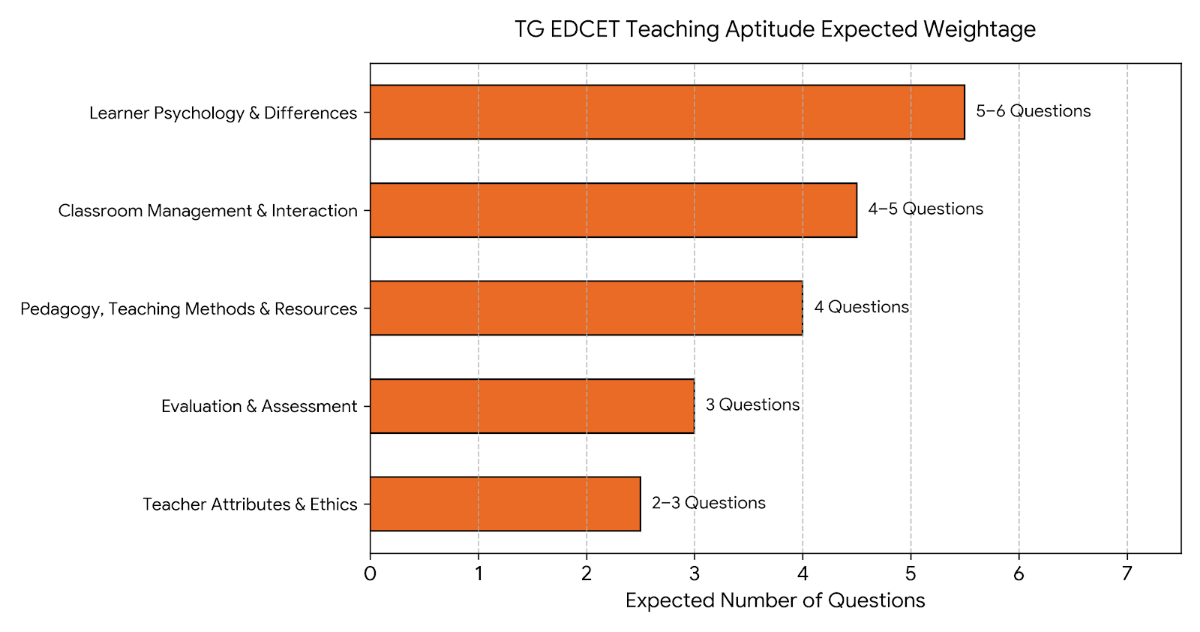
- Learner Psychology & Classroom Management together form the largest share, so focus on learner differences, engagement, classroom discipline, communication, and student behaviour.
- Pedagogy, Evaluation, and Teacher Ethics cover the remaining questions, with emphasis on teaching methods, assessment types, teaching resources, professional skills, and ethical values.
| Topic | Expected Weightage | Important Subtopics |
|---|---|---|
| Learner Psychology & Differences | 5–6 Questions | Individual differences, learner needs, student engagement, learning habits, slow learners, hyperactive children |
| Classroom Management & Interaction | 4–5 Questions | Teacher-pupil relationship, communication skills, classroom discipline, disruptive behaviour, homework & classwork |
| Pedagogy, Teaching Methods & Resources | 4 Questions | Teaching methods, activity-based learning, textbooks & workbooks, teaching-learning resources, online/blended learning, digital boards |
| Evaluation & Assessment | 3 Questions | CCE, formative & summative assessment, types of tests, verbal & non-verbal tests, performance-based assessment |
| Teacher Attributes & Professional Ethics | 2–3 Questions | Teaching competencies, professional skills, ethics, values, teacher's role, teaching as a profession |
Also Check:
TS EDCET Computer Awareness Syllabus 2027
The Computer Awareness section covers basic computer concepts, office applications, internet use, cybersecurity, and emerging technologies.
- Core areas: Computer fundamentals, DBMS, MS Word, MS Excel, MS PowerPoint, Internet and email.
- Important focus: Hardware and software, databases and keys, basic office operations, email functions, cybersecurity, AI and Machine Learning.
| Main Topic | Syllabus Breakdown |
|---|---|
| Computer Fundamentals |
|
| Database Management Systems (DBMS) |
|
| MS Office Applications |
|
| Internet & Communication |
|
| Security & Modern Technologies |
|
TS EDCET Computer Awareness High-weightage topics
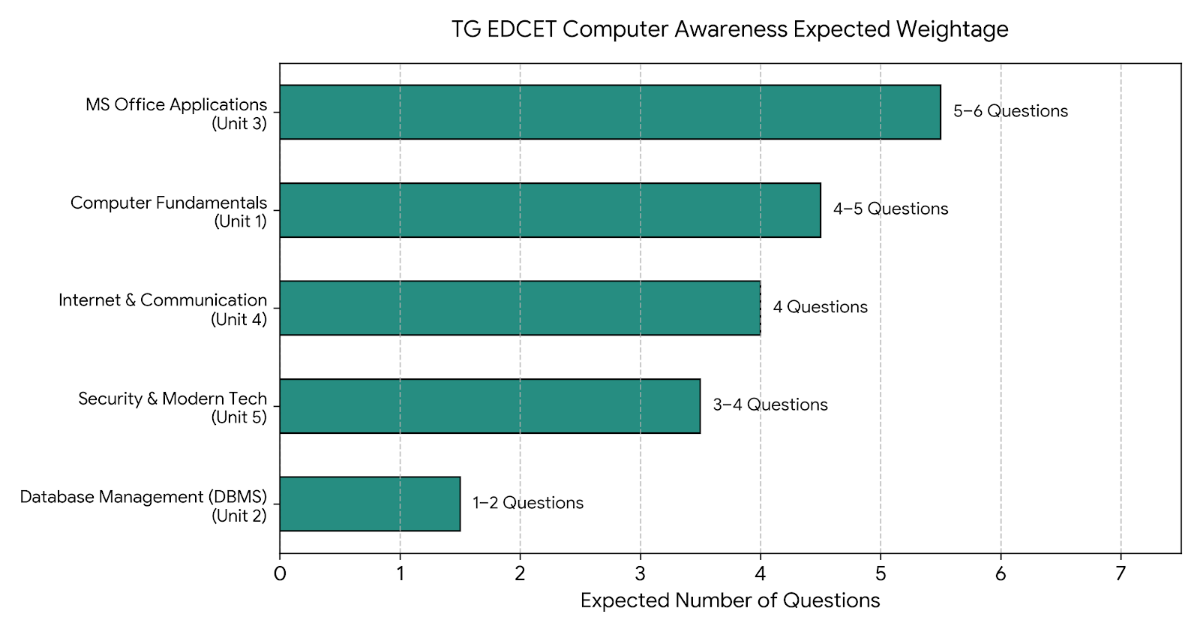
The exam focuses on basic computer operations, so revise common MS Office shortcuts and file extensions.
- MS Office Applications has the highest weightage, covering Word, Excel, and PowerPoint, including basic Excel formulas such as SUM(), AVERAGE(), and COUNT().
- Computer Fundamentals focuses on RAM, ROM, SSD, and types of software.
- Internet & Communication covers search engines, web protocols, email folders, and CC/BCC.
- Security & Modern Technologies includes viruses, Trojans, ransomware, AI, and Machine Learning applications.
- DBMS has the lowest weightage and mainly covers relational/non-relational databases and types of keys.
| Main Topic | Expected Weightage | High-Yield Concepts |
|---|---|---|
| MS Office Applications (Unit 3) | 5–6 Questions (Highest Weightage) | MS Word, MS Excel, MS PowerPoint |
| Computer Fundamentals (Unit 1) | 4–5 Questions | Hardware & Architecture, Software Systems |
| Internet & Communication (Unit 4) | 4 Questions | Web Browsing, Email Management |
| Security & Modern Technologies (Unit 5) | 3–4 Questions | Cyber Security, Emerging Tech |
| Database Management Systems (DBMS) (Unit 2) | 1–2 Questions | Databases & Keys, Key Frameworks |
This video discusses the in-depth syllabus of TG EDCET, effective preparation strategies, best resources, and important topics to prepare for the exam.
TS EDCET 2026 Question Paper with Solution PDF
| TS EDCET Date and Shift | Question Paper PDF | Solution PDF |
|---|---|---|
| TS EDCET 2026 Question Paper May 12 Shift 1 | Download PDF | Check Solution |
| TS EDCET 2026 Question Paper May 12 Shift 2 | Download PDF | Check Solution |
TS EDCET 2025 Question Paper with Solution PDF
| TS EDCET Date and Shift | Question Paper PDF | Solution PDF |
|---|---|---|
| TS EDCET 2025 Question Paper June 1 Shift 1 | Download PDF | Check Solution |
| TS EDCET 2025 Question Paper June 1 Shift 2 | Download PDF | Check Solution |
TS EDCET 2024 Question Paper
| Date | Shift | Question Paper PDF | Answer Key PDF |
|---|---|---|---|
| May 23, 2024 | Shift 1 | Download PDF | Download PDF |
| May 23, 2024 | Shift 2 | Download PDF | Download PDF |
TS EDCET Exam Pattern 2027
The TG EdCET (TS EdCET) 2027 exam is expected to have 150 multiple-choice questions for 150 marks, with a total duration of 2 hours and no negative marking.
- Subject Content carries the highest weightage at 60 marks, covering Mathematics, Physical Sciences, Biological Sciences, and Social Studies.
- General Knowledge & Educational Issues carries 30 marks, while Teaching Aptitude, General English, and Computer Awareness carry 20 marks each.
- Since there is no negative marking, candidates can attempt all 150 questions and avoid leaving questions unanswered.
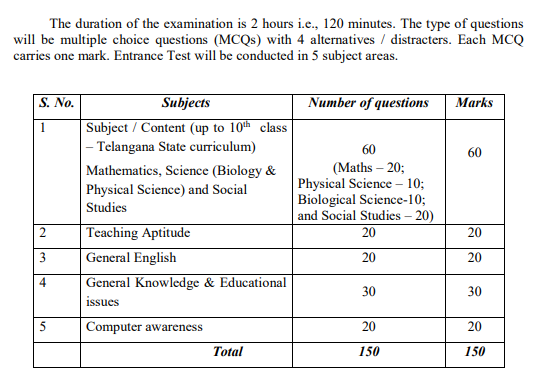
Source: TS EDCET Official Syllabus 2027
| S. No. | Subjects | Number of Questions | Marks |
|---|---|---|---|
| 1 | Subject/Content (Maths: 20, Physical Science: 10, Biological Science: 10, Social Studies: 20) | 60 | 60 |
| 2 | Teaching Aptitude | 20 | 20 |
| 3 | General English | 20 | 20 |
| 4 | General Knowledge & Educational Issues | 30 | 30 |
| 5 | Computer Awareness | 20 | 20 |
| Total | 150 | 150 | |
Ques. Does TS ED CET carry negative marking?
Ans. No, TS ED CET does not have negative marking. Candidates receive 1 mark for every correct answer, with no marks deducted for incorrect answers, allowing them to attempt questions without a penalty.
TS EDCET Syllabus Preparation Tips
TS EDCET Syllabus Preparation should focus mainly on Class 6–10 SCERT textbooks rather than graduation-level material. Since the syllabus is common across streams, candidates can use the following points as a combined preparation checklist.
- With 150 questions in 120 minutes, practise quick calculations and revise squares up to 30, cubes up to 15, and standard trigonometric ratios for faster Mathematics attempts.
- Physical Sciences focuses more on concepts and their daily-life applications than on simply memorising formulas.
- Social Studies has a strong focus on Class 9 and 10 SCERT content, so these textbooks should be studied thoroughly.
- Teaching Aptitude mainly tests comprehension, logical judgement, and classroom situations. Practising previous years' papers can help you understand the question pattern.
- For General English, focus on important grammar areas such as Subject-Verb Agreement, including either...or, neither...nor, and collective nouns.
- For Computer Awareness, revise basic computer concepts, malware types such as viruses, ransomware and Trojan horses, and applications of AI/ML in education.
| Subject | Preparation Tips |
|---|---|
| Mathematics | Memorise squares (up to 30), cubes (up to 15), and standard trigonometric ratios for speed |
| Physical Science | Focus on daily-life conceptual questions; Class 9–10 textbooks for depth, Class 6–8 for quick review |
| Social Studies | Over 70% of questions come from Class 9–10 SCERT textbooks — read these thoroughly |
| Teaching Aptitude | Practise past papers to internalise the tone of student-centric, patient answer choices |
| General English | Prioritise Subject-Verb Agreement exceptions and Active-Passive/Direct-Indirect Speech rules |
| General Knowledge | Prioritise NEP 2020 and RTE 2009 details alongside regular current affairs |
| Computer Awareness | Review malware types, AI/ML applications, and basic MS Office shortcuts |
Based on the Reddit discussions, below are some tips for effective preparation:
- Start with Syllabus & Pattern: Go through the entire syllabus and exam pattern thoroughly before beginning your preparation.
- Plan & Practice Papers: Create a study schedule dividing time across topics, and solve previous year's question papers, especially the last 5 to 10 years, as much as possible.
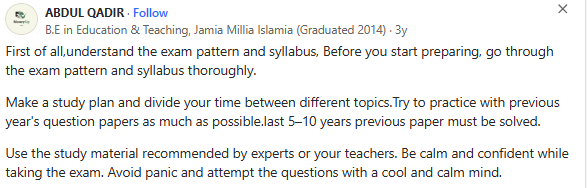
Source: Quora
TS EDCET Syllabus 2027 FAQs
Ques. What is the EDCET full form?
Ans. The EDCET full form is Education Common Entrance Test. In Telangana, the exam is officially conducted as the Telangana State Education Common Entrance Test (TG EdCET) for admission to B.Ed programmes.
Ques. What is the passing marks out of 150 in B.Ed CET?
Ans. There is no single fixed passing marks out of 150 in B.Ed CET for every candidate. The qualifying requirement and admission cutoff can vary based on the candidate's category and the rules applicable in a particular year.
Ques. Where can candidates find the TS EDCET Syllabus PDF for download?
Ans. Candidates can find the TS EDCET Syllabus PDF through the official TG EdCET website and the notification released by Kakatiya University. The syllabus covers all sections and subject areas included in the entrance examination.
Ques. Which sections carry the highest weightage in the TS EDCET syllabus?
Ans. In the TS EDCET syllabus, Subject Content carries 60 marks, making it the highest-weighted section. General Knowledge & Educational Issues follows with 30 marks, making these areas important for overall preparation.



Comments