History Mentor, Sri Venkateswara College | Updated on - Jul 21, 2026
The NCERT Solutions for history class 12 ncert solutions chapter 11 Mahatma Gandhi and the Nationalist Movement cover every back-exercise question on Gandhiji's role in the freedom struggle, as per the latest 2026-27 CBSE syllabus. Each answer is built on the sources the chapter uses, like newspapers, private letters and autobiographies. These solutions help students prepare for the Class 12 History board paper and revise the years 1915 to 1948 fast.
Covers all 12 exercise questions from Theme 11, with full source-based and long-answer points.
This Class 12 History chapter usually carries 6 to 8 marks per board paper.
Pairs with the Notes, Handwritten Notes and NCERT Book PDF linked lower on this page.
Every solution for class 12 history chapter 11 in this Collegedunia compilation is curated by subject experts, written from the official NCERT Themes in Indian History Part III, and checked against the last five years of CBSE board papers.
Student Feedback: In a Collegedunia poll of 10,910 Class 12 History students taken before the 2026 boards, 72% of students rated the "how did Gandhi transform the national movement" question as the toughest long answer in this chapter. Most students said building the answer movement by movement, from Champaran to Quit India, made it click.
Source: 2026-27 Class 12 History student poll. Sample of 10,910 students from CBSE schools across 14 states.
What the Mahatma Gandhi and the Nationalist Movement Chapter Is About
Mahatma Gandhi and the Nationalist Movement is Theme 11 of Themes in Indian History Part III. Its subtitle is Civil Disobedience and Beyond. The chapter studies Gandhiji's work in India during the crucial years 1915 to 1948, from his return from South Africa to the eve of Independence. It also shows how historians use sources to reconstruct a leader's career.
The chapter has two strands that students should keep apart while revising:
The movements: Champaran, the Rowlatt satyagraha, Non-Cooperation, Civil Disobedience and Quit India.
The sources: newspapers, private letters, autobiographies and official records used to study him.
So the chapter is really about a leader and the people he moved, plus how we know about both. A student who sorts each fact under "movement" or "source" can answer almost any question in chapter 11 history class 12. This is why ncert solutions class 12 history chapter 11 revision works best when you build a clear timeline first and then attach the sources to it.
How Gandhi Identified with the Common People
The first exercise question asks how Gandhiji sought to identify with ordinary Indians. This is a popular source-based topic, because the chapter gives clear, concrete examples. The answer is best written as a short list of habits and choices.
Dress: he gave up Western clothes and wore a simple dhoti, looking like a poor peasant.
Language: he spoke and wrote in the people's own tongue, not just English.
The charkha: he spun cotton himself every day, sharing the work of the poorest.
Travel: he toured the country by third-class train and lived simply in his ashram.
The point examiners look for is that Gandhiji did not just speak for the poor, he lived like them. By dressing, working and travelling as the common people did, he made the national movement feel like their own. For Question 11.1, students should give two or three of these examples and then explain the effect.
How Peasants Perceived Gandhi and the Salt Law Issue
Two questions look at how people saw Gandhiji and why the salt law became such a powerful issue. Both reward answers that mix fact with the feelings of ordinary people. The table sorts the key points for fast revision.
Topic
Key points to recall
Peasants' view of Gandhi
Many peasants saw him as a saviour, even a "Mahatma" with miraculous powers; rumours spread that he could free them from harsh landlords and taxes.
Why the rumours grew
Peasants read their own hopes into Gandhiji; some acted in his name even when he had not asked them to.
The salt law issue
Salt was used by rich and poor alike; the British tax on it touched every home, so breaking the law united all Indians.
The Dandi March
In 1930 Gandhiji walked about 240 miles to the sea and made salt, openly defying the law.
For the salt question, the key insight is that salt was a perfect symbol. Everyone needed it, so the unjust tax was easy to understand and easy to protest. Breaking the salt law let people of every class and region join the Civil Disobedience Movement at once, which is why it launched the struggle of 1930.
Newspapers, Letters and Autobiographies as Sources
Three questions in the chapter focus on sources, not events. They test whether students understand how historians study a leader. This is the chapter's special theme, so these answers must explain both the value and the limits of each source.
Newspapers: they tell us what people thought day by day, and how news of the movement spread across India.
Limits of newspapers: they were often written by particular groups, so they carry the writer's own bias.
Private letters: they show a person's private thoughts and feelings, away from the public eye.
Autobiographies: they give the writer's own story, but only what the writer chooses to remember and share.
The point students often miss is balance. Private letters and autobiographies reveal the inner person, while official accounts give the government's view. A good answer says newspapers are valuable but biased, and that private writing must be read with care because it is selective. This is exactly the kind of source-critical point the chapter wants in class 12 history chapter 11 important questions.
The Charkha, Non-Cooperation and the Round Table Conferences
This cluster of questions covers the symbols and methods of the movement. The charkha, the idea of non-cooperation, and the failure of the Round Table talks all come up as short and long answers. They are easiest to remember as cause-and-effect points.
The charkha as a symbol: it stood for self-reliance, honest labour and a stand against machine-made British cloth.
Non-cooperation as protest: Indians withdrew from schools, courts, titles and foreign goods, denying the Raj its support.
Khilafat link: joining the Khilafat issue brought Hindus and Muslims together in one struggle.
Round Table failure: the talks in London were inconclusive because the British and Congress could not agree, and key sessions lacked full support.
For the charkha, the strong point is that Gandhiji chose a humble tool on purpose. Spinning made every Indian, rich or poor, part of the movement, and it rejected the British mills that had ruined Indian weavers. For non-cooperation, the idea was simple but sharp, that a foreign rule which depends on Indian help can be weakened if Indians simply refuse to cooperate.
How Gandhi Transformed the National Movement
Question 11.8 is the biggest long answer in the chapter and a near-certain board question. It asks how Gandhiji changed the very nature of the freedom struggle. The best answers show a movement that went from a small elite group to a mass struggle.
Before Gandhi
After Gandhi
A movement of lawyers, doctors and the educated elite
A mass movement of peasants, workers, women and students
Petitions and speeches in English
Marches, boycotts and satyagraha in the people's language
Limited to a few big cities
All-India reach, from villages to towns
Focused on constitutional demands
Linked freedom to khadi, self-reliance and social reform
The single sentence that earns the marks is this: Gandhiji turned the national movement from an elite affair into a mass struggle. After the Rowlatt satyagraha of 1919 he became a truly national leader, and by 1922 hundreds of thousands of ordinary Indians had joined in. Students answering history class 12 chapter 11 question answer on this topic should give the before-and-after contrast and name the movements that prove it.
Mahatma Gandhi and the Nationalist Movement Exercise-wise Coverage
The chapter exercise has 12 questions, split into answer-in-brief, answer-in-detail and map or project tasks. The table maps each one to its topic so students can plan revision and find the right NCERT answer fast. The full step-by-step solution for each sits in the question set lower on this page.
Question
Topic it tests
Q 11.1
How Gandhiji sought to identify with the common people
Q 11.2
How the peasants perceived Mahatma Gandhi
Q 11.3
Why the salt laws became an important issue of struggle
Q 11.4
Why newspapers are an important source for the national movement
Q 11.5
Why the charkha was chosen as a symbol of nationalism
Q 11.6
How non-cooperation was a form of protest
Q 11.7
Why the Round Table Conference dialogues were inconclusive
Q 11.8
How Gandhiji transformed the nature of the national movement
Q 11.9
What private letters and autobiographies tell us, and how they differ from official accounts
Q 11.10 to 11.12
Map work on the Dandi route and project-style activities
Questions 11.8, 11.6 and 11.9 are the most-asked long answers, so students preparing chapter 11 history class 12 revision should learn those three first. The map and project tasks (11.10 to 11.12), including the route of the Dandi March, are also useful for the history project file class 12 chapter 11 that many schools assign.
Students who want the offline copy can save the class 12 history chapter 11 pdf from the download card above and tick off each question as they finish it.
Mahatma Gandhi and the Nationalist Movement Important Questions and Previous Year Trends
CBSE sets a steady mix of source-based, short and long answers from this chapter. Knowing the pattern helps students decide how much to write. The chapter is a regular source of one 5-mark or 8-mark source-based question, which is why a focused list of chapter 11 history class 12 important questions saves a lot of revision time.
Source-based (often 8 marks): an extract on the Salt March, a newspaper report, or a letter, with three sub-parts.
Long answer (5 to 6 marks): how Gandhiji transformed the movement, or non-cooperation as protest.
Short answer (3 marks): the charkha as a symbol, the salt law issue, or how peasants saw Gandhiji.
Objective and MCQ: dates of the movements, places like Champaran and Dandi, and key terms.
For quick recall before the exam, students often practise the class 12 history chapter 11 mcq set and a list of class 12 history chapter 11 important questions. The most repeated items are the transformation of the movement and the salt satyagraha, so keep those answer points ready in your own words.
Working through the ncert solution class 12 history chapter 11 set twice, once open-book and once from memory, fixes the timeline well before the board exam. It also helps to attempt a few extra source extracts, since this chapter is a favourite for the long source-based question.
Common Mistakes Students Make in the Mahatma Gandhi Chapter
A few errors cost marks every year in this chapter. Most come from muddling the dates of the movements or from missing the source-history theme. Avoiding them is the fastest way to lift a score.
Confusing Non-Cooperation (1920-22) with Civil Disobedience (1930) - keep the two dates clear.
Forgetting that Gandhiji called off Non-Cooperation after the Chauri Chaura violence.
Treating newspapers as fully reliable - they carry the writer's bias.
Writing only events for Question 11.9 - it is about sources, so compare private and official writing.
Saying the charkha was just for cloth - it was a symbol of self-reliance and protest.
Students who fix these five points usually move from average to high marks on the long answers. The exam rewards a clear timeline, so write the year next to each movement, and always note both the value and the limit of a source.
Mahatma Gandhi and the Nationalist Movement PDF Download Formats and Languages
The solutions are free to download in more than one format, so students can pick what suits their device and revision style. The download card at the top of the page carries each option for this chapter.
Normal and HD PDF: the history class 12 chapter 11 pdf is offered in a normal size for quick downloads and an HD version for clear printing.
English medium: all 12 answers are written in simple English for the CBSE board paper.
Question-only set: a print-and-practise sheet of class 12 history chapter 11 extra questions for self-testing.
Whole-book pack: the chapter 11 history class 12 ncert solutions sit in one set that runs through every theme, so you can revise across the book in one place.
Many students search for class 12 chapter 11 history answers on their phone the night before a test, so a saved PDF means you can revise even without internet. Keep both the question set and the solved version handy for a full self-check.
How the Mahatma Gandhi Solutions Pair with Notes and the Book PDF
These NCERT Solutions answer the back-exercise questions. To revise the full chapter, students should use them alongside the other resources for the same chapter, all linked in the table below.
Reading the original NCERT chapter text and figures
Tip: read the Notes first, then attempt these solutions on your own, and only then check the model answers here. That order builds memory faster than copying answers straight away.
All NCERT Solutions for Class 12 History Chapter 11 Mahatma Gandhi and the Nationalist Movement
The table links the NCERT Solutions for every chapter in Themes in Indian History so students can move across the book in one click. Chapter 11 is highlighted.
All NCERT Solutions for Mahatma Gandhi and the Nationalist Movement with Step-by-Step Solutions
Below are all 12 NCERT exercise questions for this chapter, exactly as they appear in the textbook. Tap Check Solution for the model answer or Expert Solution for the topper-style approach.
Q 11.1
How did Mahatma Gandhi seek to identify with the common people?
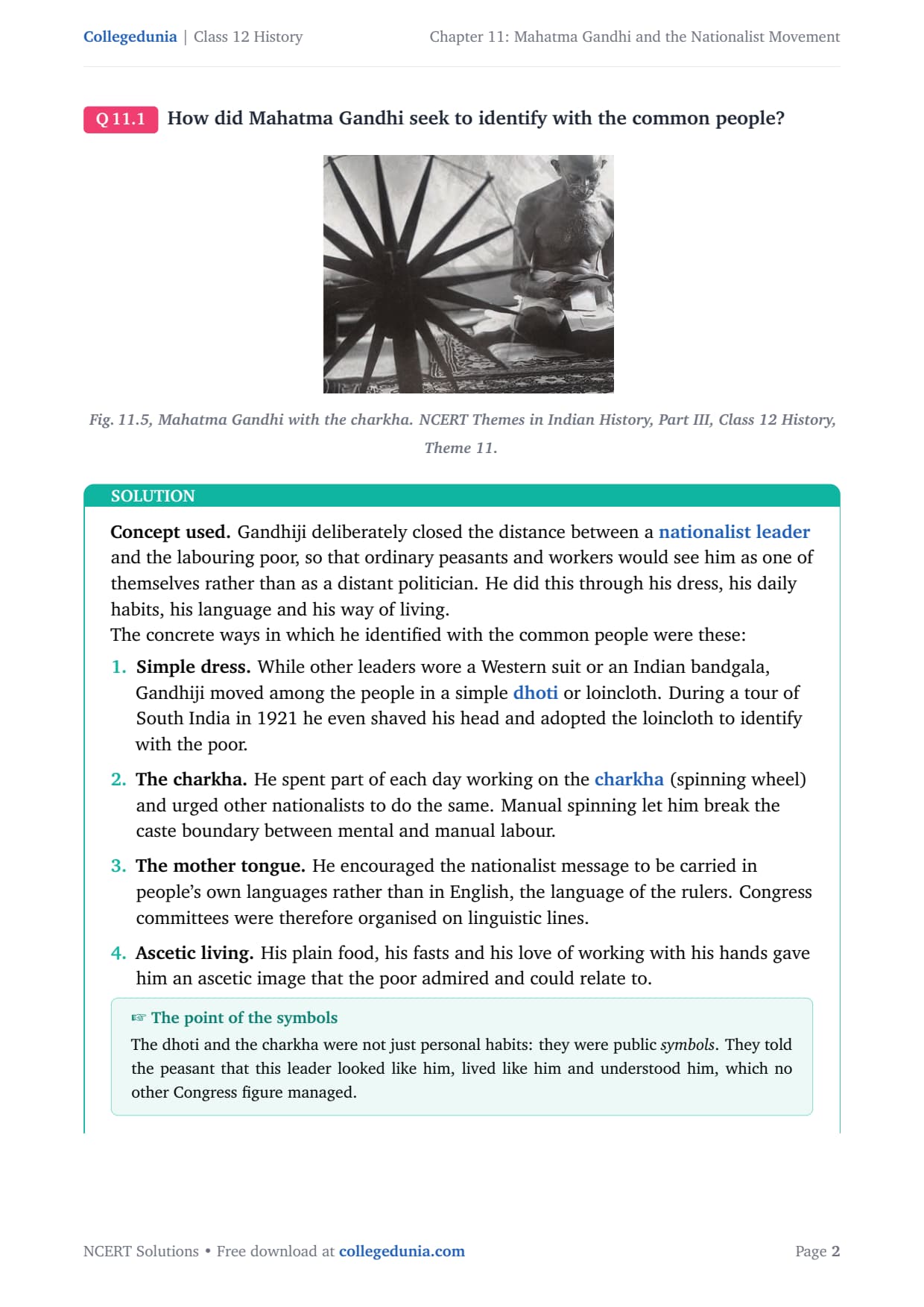
Fig. 11.5, Mahatma Gandhi with the
charkha. NCERT Themes in Indian History, Part III, Class 12 History,
Theme 11.
Concept used. Gandhiji deliberately closed the distance between a
nationalist leader and the labouring poor, so that ordinary
peasants and workers would see him as one of themselves rather than as a
distant politician. He did this through his dress, his daily habits, his
language and his way of living.
The concrete ways in which he identified with the common people were these:
Simple dress. While other leaders wore a Western suit or
an Indian bandgala, Gandhiji moved among the people in a simple
dhoti or loincloth. During a tour of South India in 1921
he even shaved his head and adopted the loincloth to identify with
the poor.
The charkha. He spent part of each day working on the
charkha (spinning wheel) and urged other nationalists to
do the same. Manual spinning let him break the caste boundary
between mental and manual labour.
The mother tongue. He encouraged the nationalist message
to be carried in people's own languages rather than in English, the
language of the rulers. Congress committees were therefore organised
on linguistic lines.
Ascetic living. His plain food, his fasts and his love of
working with his hands gave him an ascetic image that the poor
admired and could relate to.
The point of the symbols
The dhoti and the charkha were not just personal habits: they were public
symbols. They told the peasant that this leader looked like him,
lived like him and understood him, which no other Congress figure managed.
Gandhiji identified with the common people through a simple dhoti
or loincloth, daily spinning on the charkha, use of the mother tongue and a
plain ascetic life, so that the poor saw him as one of their own.
AS
Ananya Sharma
MA Modern Indian History, JNU
Verified Expert
Strategic angle. The examiner wants the means of
identification, not Gandhiji's biography. Sort your answer under clear heads,
dress, work, language, lifestyle, and tie each to its effect: it dissolved
the gap between the elite Congress and the masses.
Dress as a statement. Unlike formally dressed leaders,
Gandhiji wore a dhoti or loincloth (from his 1921 South India tour),
marking him visually as a man of the people.
Labour by hand. Daily spinning on the charkha and his
comfort with manual work let him cross the mental-manual,
upper-lower caste divide that other politicians never touched.
Speak their language. By pushing the nationalist message in
regional mother tongues and reorganising Congress on linguistic
lines, he reached groups previously untouched by nationalism.
Live like them. An ascetic diet, fasts and a saint-like
plainness gave him moral authority among the poor, who venerated
him as their ``Mahatma''.
Why this matters. This identification was real but also carefully
organised. It explains why, by 1922, the freedom movement was no longer a
club of lawyers and doctors but a struggle of hundreds of thousands of
peasants, workers and artisans.
Through dress (dhoti, loincloth), the charkha, the mother tongue
and an ascetic life, Gandhiji made the poor feel he was one of them, which
broadened nationalism into a genuine mass movement.
Q 11.2
How was Mahatma Gandhi perceived by the peasants?
Concept used. The peasants saw Gandhiji not as an ordinary
politician but as a messiah or saviour with almost magical powers.
This view comes to us mainly from the historian Shahid Amin's
study of reports and rumours in the local press of eastern Uttar Pradesh
when Gandhiji toured there in February 1921.
The peasants' perception had these features:
A saviour with many names. He was called ``Gandhi baba'',
``Gandhi Maharaj'' or simply ``Mahatma''. Peasants believed he would
rescue them from high taxes and oppressive officials and restore
dignity to their lives.
Miraculous powers. Rumours said he had been sent by the
King to redress the farmers' grievances, that his power was superior
to that of all local officials and even of the English monarch, and
that the colonial rulers would flee the district once he arrived.
Reward and punishment. Those who doubted or abused him were
said to suffer: houses collapsed, crops failed, a sceptic's wheat
turned to sesamum. Believers, by contrast, were rewarded.
Genuine devotion. Wherever he went, adoring crowds of tens
of thousands gathered at stations; people wept, sought his
darshan and showered coins and currency notes as offerings.
What the rumours reveal
The rumours tell us less about Gandhiji and more about the peasants
themselves: their hopes, their faith and the kind of saviour-figure they
longed for. Such beliefs spread because they matched what people already
wished to be true.
Peasants perceived Gandhiji as a messiah, ``Gandhi baba'' or
``Mahatma'', with miraculous powers sent to free them from oppressive taxes
and officials, rewarding the faithful and ruining those who opposed him.
RV
Rohan Verma
MA History, University of Delhi
Verified Expert
Strategic angle. Anchor your answer in Shahid Amin's evidence and
keep the focus on perception, what peasants believed, not on what
Gandhiji actually did. Build it from the names they gave him to the
miracles they attributed to him.
Naming the saviour. ``Gandhi baba'', ``Gandhi Maharaj'',
``Mahatma'': the very names cast him as a holy redeemer rather than a
political leader.
The miracle stories. Sent by the King, power above all
officials and the monarch, the magical splitting of a karah, wheat
turning to sesamum: these rumours marked him as superhuman.
A moral order. Tales that opponents met ``some tragedy''
while believers prospered turned Gandhiji into the enforcer of a
just moral world.
Mass devotion. Crowds of 10,000 to 20,000 at wayside
stations, weeping and offerings, show the depth of this faith.
Why this matters. Reading rumours as a historian, as Amin does,
opens a window into the ``mind'' of the peasantry, the circumstances that
made such belief possible, which official records alone could never reveal.
To the peasants Gandhiji was a miracle-working messiah and
saviour, named ``Gandhi baba'' or ``Mahatma'', believed to outrank every
official and to reward the faithful and punish doubters.
Q 11.3
Why did the salt laws become an important issue of struggle?
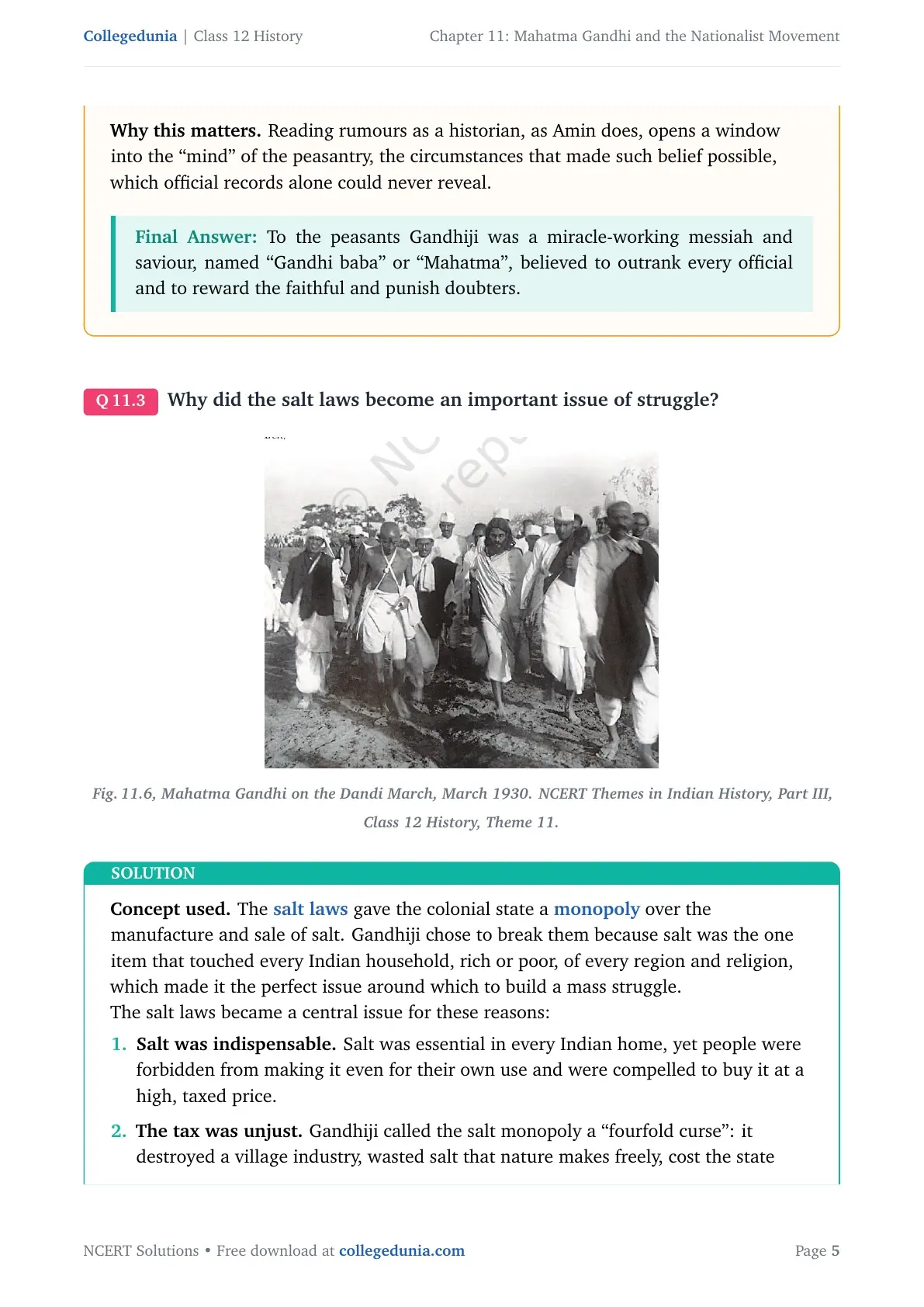
Fig. 11.6, Mahatma Gandhi on the Dandi
March, March 1930. NCERT Themes in Indian History, Part III, Class 12
History, Theme 11.
Concept used. The salt laws gave the colonial state a
monopoly over the manufacture and sale of salt. Gandhiji chose to
break them because salt was the one item that touched every Indian
household, rich or poor, of every region and religion, which made it the
perfect issue around which to build a mass struggle.
The salt laws became a central issue for these reasons:
Salt was indispensable. Salt was essential in every Indian
home, yet people were forbidden from making it even for their own
use and were compelled to buy it at a high, taxed price.
The tax was unjust. Gandhiji called the salt monopoly a
``fourfold curse'': it destroyed a village industry, wasted salt
that nature makes freely, cost the state money to destroy it, and
squeezed an enormous tax (he said over 1,000 per cent) from a
starving people.
It united everyone. Because the burden of the salt tax fell
on all classes, regions and communities alike, attacking it could
``mobilise a wider discontent'' against British rule than any
narrower grievance.
The march dramatised it. The Dandi March (12 March to 6
April 1930) turned this idea into action: Gandhiji walked from
Sabarmati to the sea and made salt, becoming a criminal in the eyes
of the law and launching Civil Disobedience.
Name the ``fourfold curse''
A top answer quotes Gandhiji's own logic, salt as a ``fourfold curse'', and
adds the three reasons the Salt March mattered: world attention, large-scale
participation of women, and the British realisation that the Raj could not
last forever.
Because salt was an everyday necessity for every Indian and yet
heavily taxed under a state monopoly, breaking the salt law could unite all
classes and communities, making it the ideal issue for the Civil
Disobedience struggle.
AN
Aditi Nair
MA Modern History, Jamia Millia Islamia
Verified Expert
Strategic angle. Separate two things the examiner rewards: why
salt (its universality and the injustice of the tax) and what the Salt
March achieved. Use Gandhiji's ``fourfold curse'' as your spine.
A universal necessity. Salt was used by every household,
cutting across caste, class, region and religion, so a campaign on
salt could reach the whole nation at once.
The fourfold curse. The monopoly killed a village industry,
wasted nature's free gift, cost money to enforce, and levied a tax
many times the salt's value on the poorest, a clear, dramatisable
injustice.
Tactical genius. By choosing salt, Gandhiji turned an
abstract demand for swaraj into a simple act anyone could perform,
boiling sea water, that openly defied the state.
The results. The Dandi March won world press coverage,
brought women into the movement in large numbers (Kamaladevi
Chattopadhyay), and convinced the British they would have to devolve
power.
Why this matters. The salt issue shows Gandhiji's method in its
purest form: pick a small, concrete, universally felt grievance and use it to
expose the moral bankruptcy of the whole colonial system. The nearly 60,000
arrests in the wake of the march, and the worldwide sympathy it won, proved
how much force a single everyday symbol could carry.
Salt mattered because it was a daily necessity for all Indians yet
unjustly taxed under a monopoly; attacking it united every class and
community and launched the Civil Disobedience Movement with the Dandi March.
Q 11.4
Why are newspapers an important source for the study of the
national movement?
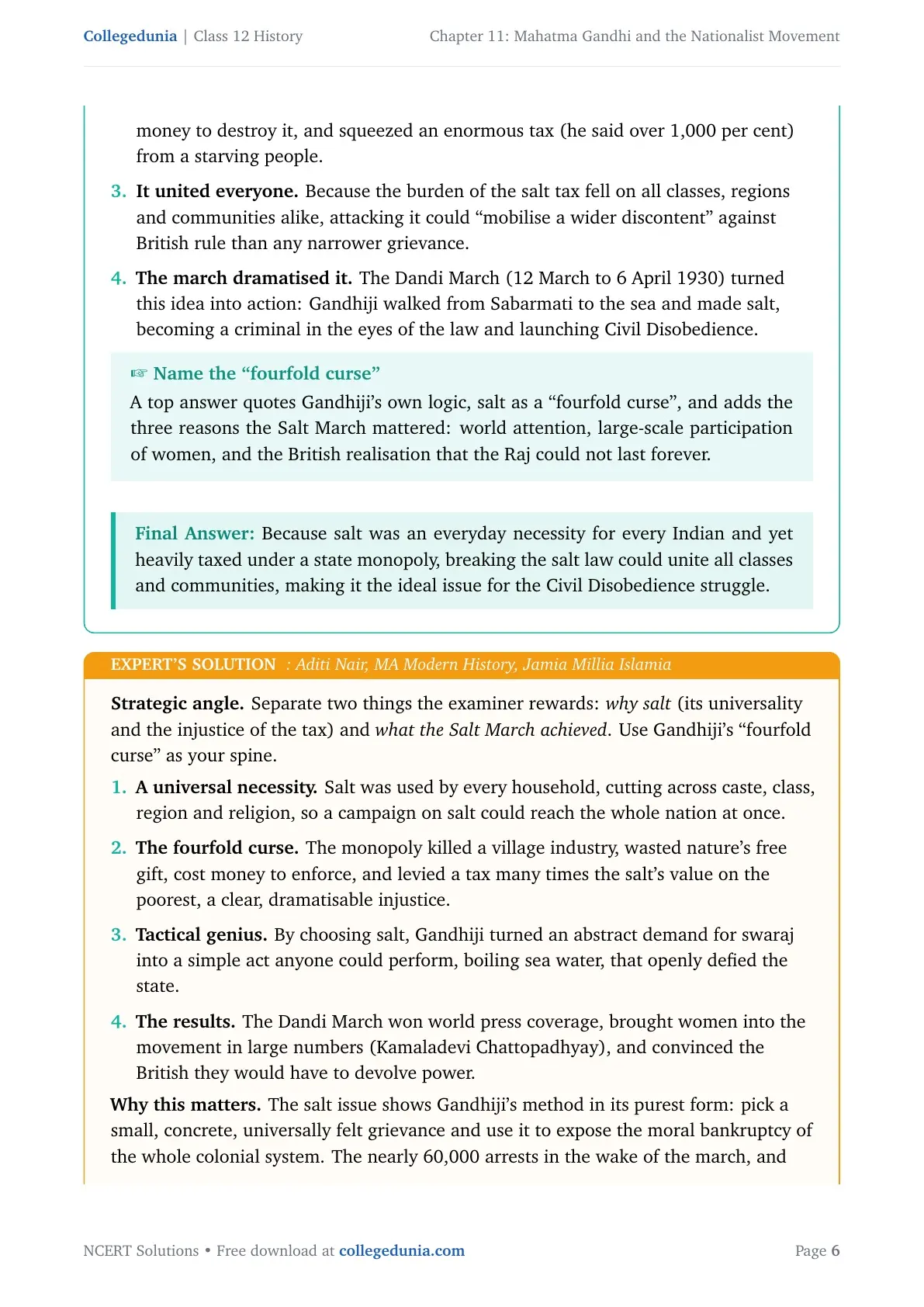
Fig. 11.17, A popular print showing
Mahatma Gandhi as the central figure in the ``tree of nationalism''. NCERT
Themes in Indian History, Part III, Class 12 History, Theme 11.
Concept used.Contemporary newspapers, published in
English and in many Indian languages, are a major source for the national
movement because they tracked Gandhiji's activities day by day and also
recorded what ordinary Indians thought of him. They must, however, be read
with care, since every paper carried its editor's politics.
Newspapers are an important source for these reasons:
They followed events closely. Papers reported Gandhiji's
movements, speeches and campaigns in detail, giving us a running,
dated record of the freedom struggle.
They captured popular opinion. They represented what
ordinary people felt about Gandhiji, including the rumours and
popular prints that show how he was perceived as a near-divine
figure.
They offer many viewpoints. Because reports appeared in both
English and Indian-language papers, a London newspaper and an Indian
nationalist paper described the same event very differently; reading
them together exposes their bias.
Do not take a report at face value
Newspaper accounts are ``not unprejudiced''. They were written by people with
their own world views, and often reflect the fears and anxieties of officials
unable to control a movement. Every statement must be weighed, not accepted
literally.
Newspapers are valuable because they tracked Gandhiji's activities
and recorded popular opinion in many languages; read critically and against
one another, they reveal both the events and the contrasting viewpoints of
the national movement.
KM
Karan Mehta
MA History, Aligarh Muslim University
Verified Expert
Strategic angle. Give the examiner two layers: why newspapers
are useful (coverage plus popular opinion) and the historian's caution
(they are partisan). The mark scheme rewards both the value and the caveat.
A dated record. Newspapers tracked Gandhiji's tours,
speeches and arrests, giving historians a continuous, time-stamped
account of the movement.
The voice of the people. They reported what ordinary
Indians thought, the rumours of miraculous powers, the popular
prints of Gandhiji as a saint, which formal records ignore.
Comparison across papers. English versus Indian-language,
London versus nationalist: comparing reports of one event reveals
each paper's slant and helps separate fact from opinion.
Read against bias. Because papers mirrored their owners'
politics, the historian treats them as evidence of viewpoint, not
as neutral truth.
Why this matters. Newspapers, like the confidential Fortnightly
Reports, are most useful when their bias is itself analysed: the way an
event is reported tells us about the reporter's anxieties as much as about
the event.
Newspapers matter because they recorded Gandhiji's activities and
popular opinion in many languages; used critically and comparatively, they
illuminate both the facts and the rival perspectives of the freedom
struggle.
Q 11.5
Why was the charkha chosen as a symbol of nationalism?
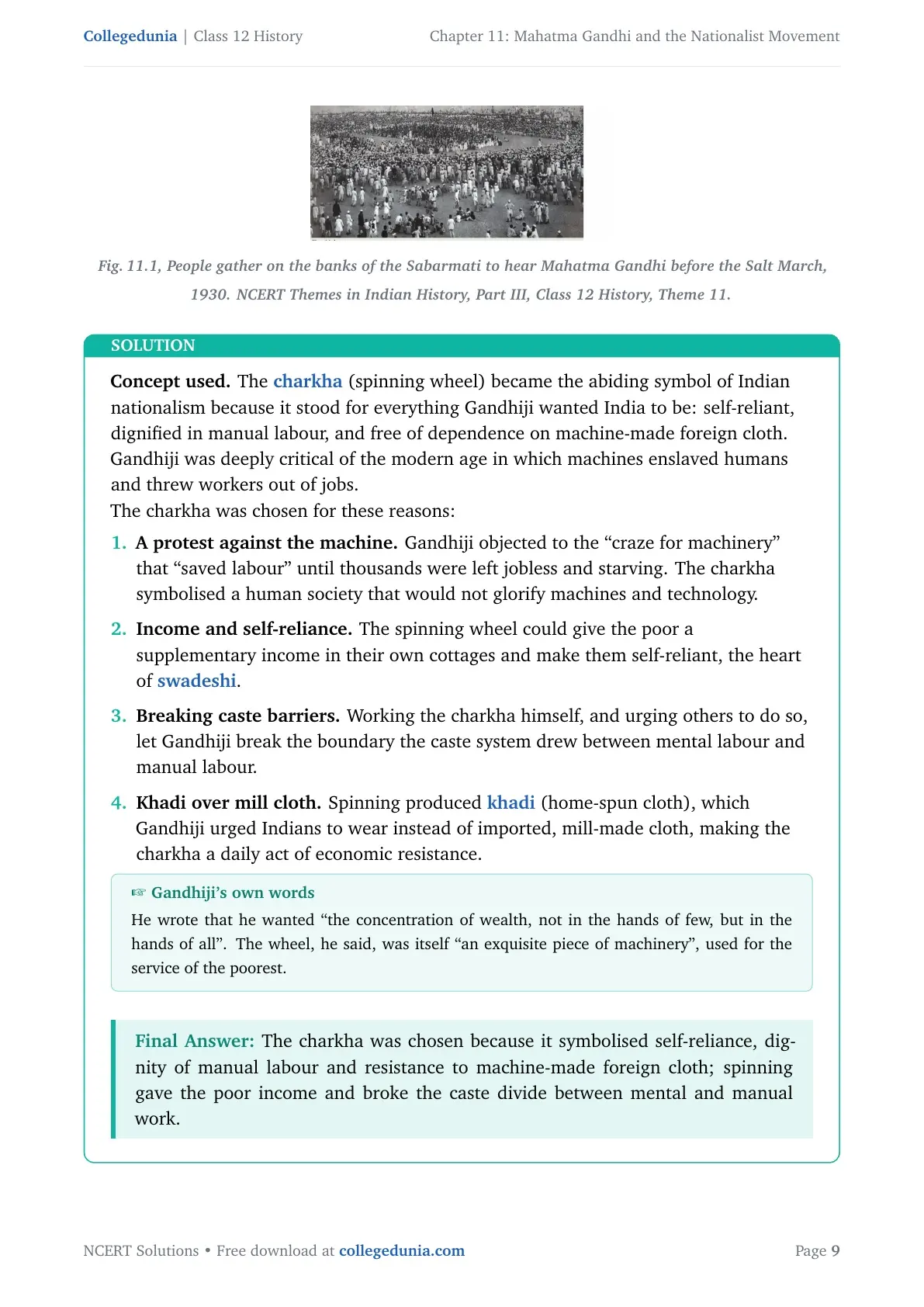
Fig. 11.1, People gather on the banks of
the Sabarmati to hear Mahatma Gandhi before the Salt March, 1930. NCERT
Themes in Indian History, Part III, Class 12 History, Theme 11.
Concept used. The charkha (spinning wheel) became the
abiding symbol of Indian nationalism because it stood for everything
Gandhiji wanted India to be: self-reliant, dignified in manual labour, and
free of dependence on machine-made foreign cloth. Gandhiji was deeply
critical of the modern age in which machines enslaved humans and threw
workers out of jobs.
The charkha was chosen for these reasons:
A protest against the machine. Gandhiji objected to the
``craze for machinery'' that ``saved labour'' until thousands were
left jobless and starving. The charkha symbolised a human society
that would not glorify machines and technology.
Income and self-reliance. The spinning wheel could give the
poor a supplementary income in their own cottages and make them
self-reliant, the heart of swadeshi.
Breaking caste barriers. Working the charkha himself, and
urging others to do so, let Gandhiji break the boundary the caste
system drew between mental labour and manual labour.
Khadi over mill cloth. Spinning produced khadi
(home-spun cloth), which Gandhiji urged Indians to wear instead of
imported, mill-made cloth, making the charkha a daily act of
economic resistance.
Gandhiji's own words
He wrote that he wanted ``the concentration of wealth, not in the hands of
few, but in the hands of all''. The wheel, he said, was itself ``an exquisite
piece of machinery'', used for the service of the poorest.
The charkha was chosen because it symbolised self-reliance,
dignity of manual labour and resistance to machine-made foreign cloth;
spinning gave the poor income and broke the caste divide between mental and
manual work.
MI
Meera Iyer
MA Modern Indian History, Banaras Hindu University
Verified Expert
Strategic angle. The charkha is a symbol, so explain what it
symbolised on three levels at once: economic (self-reliance), social
(dignity of labour) and moral (a critique of the machine age). Quote
Gandhiji's Young India reasoning.
Economic self-reliance. Spinning gave the poor a cottage
income and freed India from dependence on imported British cloth,
the swadeshi ideal in action.
Dignity of hand labour. By spinning himself, Gandhiji
dignified manual work and crossed the caste line between mental and
manual labour.
A critique of the machine. He saw the charkha as a stand
against an industrial age in which labour-saving machines starved
the masses; he wanted wealth in ``the hands of all''.
A unifying image. Simple, repeatable and visible, the
charkha became, with the dhoti, the most recognisable emblem of the
nationalist cause.
Why this matters. The charkha shows how Gandhiji fused economics,
ethics and politics in a single object: to spin was at once to earn, to
resist imports and to affirm a moral vision of an equal society.
The charkha symbolised self-reliance, the dignity of manual labour
and a moral protest against the machine age; spinning earned the poor an
income and rejected foreign mill cloth, making it the emblem of nationalism.
Q 11.6
How was non-cooperation a form of protest?
Concept used.Non-cooperation was Gandhiji's idea that
British rule survived only because Indians cooperated with it; if Indians
withdrew that cooperation, the Raj would collapse. The protest therefore
took the form of a planned ``renunciation of all voluntary association with
the British Government''. Gandhiji promised that if it was carried out fully,
India would win swaraj within a year.
Non-cooperation worked as a form of protest in these ways:
Boycott of colonial institutions. Indians were asked to
stop attending government schools, colleges and law courts. Students
left government schools, and lawyers refused to attend court.
Economic resistance. People refused to pay taxes,
surrendered titles, and boycotted foreign cloth, which was collected
and burnt in great bonfires, in favour of khadi.
Strikes and rural protest. The working class struck work:
official figures record 396 strikes in 1921 involving 600,000
workers. In the countryside, hill tribes in Andhra broke forest
laws, Awadh farmers withheld taxes and Kumaun peasants refused to
carry loads for officials.
Joining hands with Khilafat. By coupling non-cooperation
with the Khilafat Movement, Gandhiji hoped Hindus and
Muslims would together end colonial rule, widening the protest.
Peaceful yet powerful
As Gandhiji's biographer Louis Fischer wrote, non-cooperation was ``negative
enough to be peaceful but positive enough to be effective''. It entailed
denial, renunciation and self-discipline: it was ``training for self-rule''.
Its power was real. For the first time since the Revolt of 1857 the British
Raj was shaken to its foundations. Yet because it depended on non-violence,
Gandhiji called the whole movement off in February 1922 after a mob torched
a police station at Chauri Chaura, killing several constables,
which he refused to justify.
Non-cooperation was protest through total withdrawal of voluntary
support, boycott of schools, courts and foreign cloth, non-payment of taxes
and strikes, making it peaceful but powerful enough to shake the Raj, until
Chauri Chaura forced Gandhiji to call it off.
VD
Vikram Desai
MA Modern History, University of Calcutta
Verified Expert
Strategic angle. Frame the essay around the logic of
non-cooperation, withdraw cooperation and the Raj collapses, then list the
forms it took and close with its peaceful character and its end at Chauri
Chaura. A strong answer keeps returning to one idea: the protest was a refusal
to participate, not an attack.
Think of the forms of non-cooperation as falling into three layers:
Political: boycott of schools, colleges, courts and titles.
Economic: bonfires of foreign cloth, non-payment of taxes,
the spread of khadi.
Social: strikes by workers and defiance by peasants and hill
tribes.
The central idea. The Raj ran on Indian cooperation;
renouncing ``all voluntary association'' with it was meant to win
swaraj within a year without firing a shot.
Institutional boycott. Students quit government schools and
colleges, lawyers boycotted courts, and people gave up official
titles, draining the system of Indian participation.
Economic and labour action. Foreign cloth was burnt, taxes
went unpaid, and 396 strikes in 1921 (600,000 workers, seven million
lost workdays) showed mass force, alongside rural defiance of forest
and tax laws.
Hindu-Muslim unity. Linking it to the Khilafat Movement
broadened the base across India's two largest communities, making it a
genuinely national protest.
Why this matters. Non-cooperation was the first truly national, mass
form of protest, ``training for self-rule'', and it shook the Raj for the
first time since 1857. But its dependence on non-violence was also its limit:
a single violent outbreak at Chauri Chaura in February 1922, where a mob
killed several constables, was enough for Gandhiji to call the whole movement
off, because the method itself mattered more to him than any quick victory.
Non-cooperation protested by withdrawing all support from the Raj,
boycotting schools, courts, titles and foreign cloth, withholding taxes and
striking, a peaceful but effective mass action that shook British rule until
Chauri Chaura ended it.
Q 11.7
Why were the dialogues at the Round Table Conference
inconclusive?
Concept used. The Round Table Conferences were a series of
meetings the British government convened in London (1930, 1931, 1932) to
discuss India's political future after the Salt March had forced them to
realise that the Raj could not last forever. The talks failed to reach a
settlement because of who was, or was not, present and because the Indian
side did not speak with one voice.
The dialogues were inconclusive for these reasons:
The first conference had no Congress. The First Round Table
Conference met in November 1930 without the pre-eminent political
leader, Gandhiji, who was in jail, and without the Congress. This
rendered the meeting ``an exercise in futility''.
Congress claims were challenged. At the Second Conference
(late 1931) Gandhiji represented the Congress, but his claim that it
spoke for all of India was contested by three parties: the
Muslim League, which claimed to represent the Muslim
minority; the Princes, who said the Congress had no stake
in their states; and B.R. Ambedkar, who argued that the
Congress did not represent the lowest castes.
The deadlock over representation. With these rival claims
unresolved, no agreement on a common political settlement was
possible, and the Second Conference too ended without result.
A hostile Viceroy at home. Gandhiji returned to India and
resumed civil disobedience, but the new Viceroy, Lord Willingdon,
was deeply unsympathetic, so the door to a negotiated settlement
closed further.
Divide and the difficulty of unity
The conferences exposed the central problem of late colonial politics:
British India was no longer simply ``Indians versus the British''. It had
become a contest among the Congress, the League and other groups, which the
British could exploit and which made a single settlement very hard.
The Round Table dialogues failed because the first met without the
Congress, and at the second Gandhiji's claim to represent all India was
challenged by the Muslim League, the Princes and Ambedkar, leaving the
question of representation deadlocked.
SB
Sneha Banerjee
MA Modern Indian History, Jadavpur University
Verified Expert
Strategic angle. The examiner is testing why the talks broke
down. Organise the essay conference by conference, and make the rival claims
to representation at the second conference the heart of your answer. The single
thread to follow is this: who was allowed to speak, and for whom.
Before the steps, fix the basic timeline in your mind:
First Conference (Nov 1930): no Congress, no Gandhiji.
Second Conference (1931): Gandhiji present, but his claim to
speak for all India contested.
In between: the Gandhi-Irwin Pact, which only promised
further talks.
First conference, fatal absence. Held in November 1930
without Gandhiji (jailed) and the Congress, it lacked the one leader
who mattered and so was an exercise in futility.
The Gandhi-Irwin pause. Released in January 1931, Gandhiji
signed the Gandhi-Irwin Pact, but won only an assurance of talks, not
a commitment to independence, leaving the core issue open and angering
radical nationalists.
Three rival claimants. At the Second Conference the League
(for Muslims), the Princes (for their states) and Ambedkar (for the
Depressed Classes) all denied that the Congress spoke for them.
No common ground. With representation itself disputed, and
with the new Viceroy Willingdon hostile in India, the conference
closed inconclusively and Gandhiji returned home to resume civil
disobedience.
Why this matters. The breakdown shows how the British strategy of
recognising many separate interests, and the genuine plurality of Indian
society, combined to make a single agreed settlement almost impossible at this
stage. The same fault line, who truly represented India's Muslims and its
lowest castes, would deepen over the next decade and end in Partition.
They were inconclusive because the first conference excluded the
Congress and the second saw Gandhiji's claim to represent all India rejected
by the Muslim League, the Princes and Ambedkar, deadlocking the issue of
representation.
Q 11.8
In what way did Mahatma Gandhi transform the nature of the national
movement?
Concept used. Before Gandhiji, Indian nationalism was largely an
elite phenomenon, the work of lawyers, doctors and landlords
confined to the educated middle class. Gandhiji transformed it into a
genuine mass movement that drew in peasants, workers and artisans
across the whole country, a promise he first made in his BHU speech of
February 1916.
He transformed the movement in these ways:
From elite to mass base. By 1922 nationalism was no longer a
movement of professionals; hundreds of thousands of peasants, workers
and artisans now took part, venerating him as their ``Mahatma''.
New methods of struggle. He gave the movement
satyagraha and mass non-violent techniques, the Rowlatt
satyagraha, Non-cooperation, the Salt March and Civil Disobedience,
and Quit India, that ordinary people could join.
Powerful symbols. The dhoti, the charkha and khadi, and
simple acts like making salt, turned abstract politics into things
every Indian could see and do.
Careful organisation. New Congress branches and ``Praja
Mandals'' were set up, the message was carried in regional mother
tongues, and committees were based on linguistic regions, taking
nationalism to the farthest corners of the country.
A wide social coalition. His admirers ranged from poor
peasants to rich industrialists like G.D. Birla, and talented
lieutenants, Nehru, Patel, Azad, Rajagopalachari, Bose and others
from many regions and faiths, drew in countless followers.
Mass base plus method plus symbol
A full-mark answer shows three changes together: the social base
(elite to mass), the method (mass non-violent satyagraha) and the
symbols (dhoti, charkha, salt). Add the social reform agenda,
anti-untouchability and Hindu-Muslim harmony, to round it off.
Gandhiji turned an elite movement of lawyers and landlords into a
mass struggle of peasants and workers, using non-violent satyagraha, powerful
symbols like the charkha and salt, careful organisation in regional
languages, and a coalition stretching from poor peasants to industrialists.
AR
Aditya Rao
MA Modern History, University of Hyderabad
Verified Expert
Strategic angle. ``Transform'' is the keyword: contrast the
before (narrow, elite, petition-based) with the after (mass,
non-violent, symbol-driven). Use the BHU speech of February 1916 as your
anchor and the movement of 1922 as your proof that the promise was kept.
Group the change under four heads so the answer stays organised:
Base: from a handful of professionals to millions.
Widened the base. He fulfilled his BHU pledge: by 1922 the
struggle included hundreds of thousands of peasants, workers and
artisans, not just the educated few who had earlier led it.
Changed the method. Petitions gave way to mass satyagraha,
Rowlatt, Non-cooperation, Dandi and Quit India, which the common
people could join through boycotts, strikes and salt-making.
Created a common language. Dhoti, charkha and khadi, plus
propaganda in regional mother tongues and linguistically based
Congress committees, carried nationalism to the remotest villages.
Built a broad coalition. From the industrialist G.D. Birla to
landless peasants, and a band of gifted lieutenants (Nehru, Patel,
Azad, Bose, Rajagopalachari) across regions and religions, he
stitched together an all-India following.
Why this matters. Gandhiji also fused politics with social reform,
fighting untouchability and child marriage and preaching Hindu-Muslim
harmony, so that the freedom struggle became a movement to remake society as
well as to expel the British. That double purpose, swaraj outside and reform
within, is what made his transformation of nationalism so deep and lasting.
He transformed nationalism from an elite, petition-based movement
into a mass, non-violent struggle, broadening its base to peasants and
workers, arming it with satyagraha and symbols like the charkha, and
organising it across the whole country.
Q 11.9
What do private letters and autobiographies tell us about an
individual? How are these sources different from official accounts?
Concept used. Historians reconstruct a leader's career from many
kinds of sources. Private letters and autobiographies
give us access to the inner, personal world of an individual, while
official accounts (such as police and government records) give us
the state's view. Each must be read with its own cautions.
What private letters and autobiographies tell us:
Private thoughts and feelings. In letters people express
their anger and pain, dismay and anxiety, hopes and frustrations in
ways they would not in public statements, as Nehru's exchange with
Gandhiji and Rajendra Prasad in 1936 shows.
A self-framed picture. Autobiographies are rich in human
detail but are retrospective accounts, often written from memory.
They tell us what the author recalled, thought important, or wished
others to believe: writing one is ``a way of framing a picture of
yourself''.
The need to read silences. Because both are personal and
selective, the historian must ask what the author does not
tell us, the wilful or unwitting acts of forgetting.
A blurred public-private line. Many private letters were
written knowing they might be published; Gandhiji printed others'
letters in Harijan and Nehru published A Bunch of Old
Letters. So even ``private'' scripts can be shaped for a public.
Personal does not mean unbiased
Letters and autobiographies feel intimate and truthful, but they are still
shaped by memory, self-image and the awareness of a later readership. They are
evidence of how a person wished to be seen, not a transparent record of fact.
These sources differ from official accounts in important ways. Official
records, like the confidential Fortnightly Reports of the Home Department,
were written by policemen and officials and express what the higher
authorities saw or ``wanted to believe''. They often noticed sedition while
assuring themselves that the danger was unreal, and were unwilling to admit
that Gandhiji's actions stirred the masses. Private sources reveal the inner
life of individuals; official sources reveal the anxieties and blind spots of
the colonial state.
Private letters and autobiographies reveal an individual's inner
feelings and self-image, but are selective and memory-based; unlike official
accounts, which record the state's anxious, often distrustful view, they show
the personal and human side of history.
PJ
Priya Joshi
MA History, Visva-Bharati University
Verified Expert
Strategic angle. This is a two-part source question. Answer both
halves cleanly: first what private writings reveal (and their limits), then a
sharp contrast with official records. Use the 1936 Nehru-Prasad letters and
the confidential Fortnightly Reports as your concrete examples, and keep
reminding the examiner that no source is neutral.
The two kinds of private writing do slightly different work:
Letters catch a moment of feeling, written to one person but
often half-aware that others may read it later.
Autobiographies look back across a whole life and arrange it
into a deliberate, shaped story.
Inner voice. Letters expose private emotions, anger,
anxiety, hope, that public speeches hide, as in Nehru's pained 1936
exchange with Gandhiji and Prasad over socialism and Congress unity.
Framed self-portrait. Autobiographies, written from memory,
record what the author chose to remember and how he wished to be
judged; the historian must read their silences as carefully as their
words.
Public-private overlap. Knowing letters might be printed
(Gandhiji's Harijan, Nehru's A Bunch of Old Letters) shaped how
leaders wrote, so even these intimate scripts are partly performances.
Versus official accounts. Government and police records, like
the Fortnightly Reports, show the rulers' viewpoint, what they saw or
wished to believe, and repeatedly deny Gandhiji's mass appeal; they
reveal the colonial state, not the individual self.
Why this matters. The contrast teaches the core lesson of the
chapter: every source has a point of view. Private writings open the
individual's mind, with its feelings, memories and silences; official ones
open the official mind, with its anxieties and blind spots. A historian needs
both, read critically against each other, before trusting either, and that
double reading is exactly what reconstructing a leader's career demands.
Private letters and autobiographies disclose an individual's
feelings and self-image, though selectively and from memory; official
accounts instead record the colonial state's distrustful viewpoint, so the
two illuminate different sides of the same history.
Q 11.10
Find out about the route of the Dandi March. On a map of Gujarat
plot the line of the march and mark the major towns and villages that it
passed along the route.
Concept used. This is a map-work task on the route of the
Dandi March (12 March to 6 April 1930), the 24-day, roughly 240-mile
walk by which Gandhiji launched the Civil Disobedience Movement. You plot the
line from his Sabarmati Ashram in the north to the coastal village of Dandi in
the south, marking the towns and villages on the way.
How to complete the map work:
Mark the start and end. Begin at the Sabarmati
Ashram near Ahmedabad and end at Dandi on the Arabian Sea
coast, where Gandhiji broke the salt law on 6 April 1930.
Plot the main halts in order. Draw the line southward
through Aslali, Nadiad, Anand, Borsad, then across the Mahi river to
Kankapura, on to Kareli, Ankleshwar and Bharuch, then Surat, Navsari
and finally Dandi.
Show direction and distance. Use an arrow from Sabarmati to
Dandi to show the south-bound march, and add a scale or note that the
walk covered about 240 miles over 24 days.
Add a clear legend. Use one symbol for the route line, one
for towns and villages, and label Ahmedabad and Dandi prominently so
the start and finish stand out.
Keep the order correct
Examiners check the sequence of places, not artistic skill. List the
halts from north (Sabarmati) to south (Dandi) and keep them in order; a neat,
correctly sequenced line scores full marks.
On a map of Gujarat, draw the route from Sabarmati Ashram
(Ahmedabad) southward through Nadiad, Anand, Borsad, Bharuch, Surat and
Navsari to Dandi on the coast, with an arrow showing the direction and a
legend for the route and halts.
IG
Ishaan Gupta
MA Historical Geography, MS University of Baroda
Verified Expert
Picture-first. Map work is scored on accurate placement, not prose.
Fix the two endpoints first, Sabarmati in the north, Dandi on the coast, then
fill in the halts in correct order and finish with direction and a legend.
Anchor the endpoints. Sabarmati Ashram (near Ahmedabad) as
the start; Dandi, on the Arabian Sea, as the finish.
Trace the line in sequence. Aslali, Nadiad, Anand, Borsad,
across the Mahi to Kankapura, then Kareli, Ankleshwar, Bharuch, Surat
and Navsari before Dandi.
Mark direction and scale. A north-to-south arrow plus a note
of about 240 miles over 24 days (12 March to 6 April 1930).
Legend and labels. Distinct symbols for the route and for
towns and villages, with Ahmedabad and Dandi clearly named.
Why this matters. The route itself was a method: by walking through
village after village and speaking on the way, Gandhiji turned a journey into
a campaign that drew in officials, women and villagers of all castes.
Plot a south-bound line on a Gujarat map from Sabarmati Ashram
through Nadiad, Anand, Borsad, Bharuch, Surat and Navsari to Dandi, adding a
direction arrow, a scale note and a clear legend for the route and halts.
Q 11.11
Read any two autobiographies of nationalist leaders. Look at the
different ways in which the authors represent their own life and times, and
interpret the national movement. See how their views differ. Write an
account based on your studies.
Concept used. This is a project on reading
autobiographies as historical sources. The aim is not to summarise
two life stories but to compare how two nationalist leaders framed
their own lives and interpreted the same national movement, and to notice
where their views differ.
How to plan and write the account:
Choose two contrasting autobiographies. For example,
Jawaharlal Nehru's An Autobiography and M.K. Gandhi's
The Story of My Experiments with Truth, or Nehru paired with a
leader from a different region or ideology, so the contrast is sharp.
Read for self-representation. Note how each author frames a
picture of himself: what he stresses, what he is proud of, and, just
as importantly, what he stays silent about or chooses to forget.
Compare their reading of the movement. Set side by side how
each interprets key events (Non-cooperation, the Salt March, Quit
India) and ideas (non-violence, socialism, religion), and show where
they agree and where they diverge.
Write a comparative account. Organise the write-up by theme
rather than by book, and end by reflecting on how the authors' memory,
ideology and awareness of a later readership shaped what they wrote.
Compare, do not just summarise
The marks lie in the comparison. For every point, place the two authors next
to each other, and read each one's silences as carefully as the words on the
page.
Pick two contrasting autobiographies (such as Nehru and Gandhi),
read each for how the author frames his own life and the movement, compare
their views theme by theme, and write a comparative account that weighs their
memory, bias and silences.
KR
Kavya Reddy
MA Modern Indian History, Banaras Hindu University
Verified Expert
Strategic angle. Treat the two autobiographies as evidence to be
read against each other, not retold. Build the project around a few
shared themes and track how each author handles them differently.
Select for contrast. Choose two leaders who differ in
region, generation or ideology (for instance Gandhi and Nehru) so
their accounts genuinely diverge.
Map self-representation. For each, identify how the author
wants to be seen, and the gaps and silences that self-framing
produces.
Set views side by side. Compare their interpretations of the
same events and ideals, marking points of agreement and of clear
difference.
Conclude on the source itself. Reflect on how memory,
ideology and the expectation of publication shaped each
autobiography.
Why this matters. The project teaches the chapter's central skill:
autobiographies are retrospective, self-framed pictures. Comparing two of them
shows how the ``same'' national movement could be remembered and interpreted in
very different ways.
Read two contrasting nationalist autobiographies, analyse how each
frames the author's life and the movement, compare their views and silences
theme by theme, and write a reflective comparative account.
Q 11.12
Choose any event that took place during the national movement. Try
and read the letters and speeches of the leaders of the time. Some of these
are now published. Try and see how the local leaders viewed the activities of
the national leadership at the top. Write about the movement based on your
reading.
Concept used. This is a project on reading
letters and speeches as primary sources for one chosen event of the
national movement. The special aim is to compare the view from the
top (the national leadership) with the view of local leaders,
including, if possible, leaders from your own region.
How to carry out the project:
Pick one focused event. Choose a single, well-documented
episode, for example the Salt March of 1930 or the Quit India
Movement of 1942, so that you can study it in depth.
Gather the published sources. Read speeches and letters of
the time, such as Gandhiji's Dandi speech of 5 April 1930 in
The Collected Works of Mahatma Gandhi, or Nehru's letters in
A Bunch of Old Letters, and any published writings of a local
leader from your area.
Compare top and local views. See how the national leaders
described and directed the event, and how local leaders interpreted,
adapted or even quietly differed from those directions, since
peasants and local activists often acted ``in ways that best suited
their interests''.
Write your account. Present the event through these layered
voices, and reflect on why the same movement looked different from
the top and from the locality.
Why the layered view matters
The chapter shows that protest movements were ``sometimes carried out in
defiance of the local nationalist leadership''. Reading top and local sources
together reveals this gap, which a single national narrative would hide.
Choose one event (such as the Salt March or Quit India), read the
published letters and speeches of national leaders alongside the writings of a
local leader, compare the view from the top with the view on the ground, and
write a layered account of the movement.
DP
Dev Pillai
MA History, University of Calcutta
Verified Expert
Strategic angle. The heart of this project is the contrast between
top and local. Choose one event, collect both kinds of voice,
and build the account around how they agree and differ.
One event, studied deeply. Select a single episode (Salt
March 1930 or Quit India 1942) you can document well.
Read the leaders in their own words. Use published speeches
and letters, the CWMG, A Bunch of Old Letters, and any local leader's
writings from your region.
Set top against local. Compare how the national leadership
framed the event with how local leaders and ordinary people actually
interpreted and acted on it.
Write the layered story. Narrate the event through these
voices and explain why the view from above and the view from below
diverged.
Why this matters. The project applies the chapter's lesson that the
national movement was not one voice but many: peasants, workers and local
leaders often read the same call in their own way, so reading both levels
gives a truer history.
Pick one event, read the published letters and speeches of national
and local leaders, compare the leadership's view from the top with the local
response on the ground, and write a layered account of the movement.
FAQs on Mahatma Gandhi and the Nationalist Movement Class 12 NCERT Solutions
Mahatma Gandhi and the Nationalist Movement Class 12 History Common Questions
Ques. Where can I get the class 12 history chapter 11 ncert solutions PDF?
Ans. You can download the Mahatma Gandhi and the Nationalist Movement Class 12 History NCERT Solutions PDF directly from this page. It is free, follows the 2026-27 NCERT, and answers all 12 exercise questions step by step.
Ques. How many questions are there in class 12 history chapter 11 questions and answers?
Ans. The chapter has 12 exercise questions. Nine are written answers, and the last three (11.10 to 11.12) are map work and project activities used in the history project file class 12 chapter 11.
Ques. Which are the most important questions in history class 12 chapter 11 question answer practice?
Ans. How Gandhiji transformed the national movement (Q 11.8), how non-cooperation was a form of protest (Q 11.6), and what private letters and autobiographies tell us (Q 11.9) are the most-asked long answers. These three top every list of class 12 history chapter 11 important questions.
Ques. Why did the salt law become such an important issue?
Ans. Salt was used by every Indian, rich or poor, so the British tax on it touched every home. Breaking the salt law was easy to understand and let people of all classes and regions join the Civil Disobedience Movement of 1930 together.
Ques. What is the difference between Non-Cooperation and Civil Disobedience?
Ans. Non-Cooperation (1920-22) asked Indians to withdraw from schools, courts, titles and foreign goods. Civil Disobedience (1930) went further and broke specific laws, like the salt law during the Dandi March. Keeping these two dates clear is the key chapter 11 history class 12 point.
Ques. Is class 12 history chapter 11 hard to score in the board exam?
Ans. No. It is one of the higher-scoring chapters if you keep a clear timeline of the movements. Practise the source-based extracts and a few class 12 history chapter 11 mcq sets, and keep the transformation answer ready in your own words.








Comments