



Content Curator
The addition of unwanted waste material (in the form of solid, liquid, or gas) into our environmental resources like air, water, or soil is called Pollution. It is one of the major problems as it affects not only our health but also our environment in a very huge way. It also acts as a silent killer, which means that you will not realize that you have got bad health (due to pollution) until it's too late.
| Table of Content |
Keyterms: Pollution, solid, liquid, gas, air, water, soil, environment, environmental resources, smoke, dust, pollutants
Read Also: Biomagnification
What is Pollution?
[Click Here for Sample Questions]
Pollution is known as the contaminants introduced in our nature which has an adverse change in the natural environment and the living organism. Those substances that act as contaminants are called pollutants, e.g., smoke, dust, high level of noise, excess heat and light, garbage, etc. Pollution is one of the major environmental issues.
It is obvious that if our environment gets polluted, then that would affect the living organism on Earth. Many aquatic animals have lost their existence because of the pollution in water bodies, forest animals are heading towards the endangered zone, and most importantly, we human beings are getting different types of disease and we are suffering from health related issues.
Modernization is not the only cause of pollution since illiteracy and lack of awareness may also result in practices that lead to pollution. For example, you can think of the smoke coming out of huge chimneys of factories and enormous amounts of waste material getting dumped into rivers.
People in villages who unfortunately don't have enough knowledge regarding global warming and climate change tend to be more careless. Certain practises followed by them also increase pollution like in certain parts of Indian rural areas, cooking is done by wood and fire also known as indoor air pollution, small ponds or lakes are being filled with waste, and unnecessarily burning of garbage.
Read More: Effects of air pollution on environment
Types of Pollution
[Click Here for Sample Questions]
Pollution can be caused by both nature itself or human behaviour. Based on the cause and effect of pollution, it is mainly divided into four parts:
- Air Pollution
- Water Pollution
- Soil Pollution
- Noise Pollution
Other types of pollution are thermal pollution, radioactive pollution, and light pollution. They do not exist in a large amount as compared to the four main types. Radioactive pollution is considered as the deadliest type and it gets evolved from nuclear testing, nuclear explosion, etc. As of now we will be discussing only the four main types. Let’s hop into that:
Air Pollution
[Click Here for Sample Questions]
Air Pollution is one of the major types of pollution. Our daily needs and habits result in pollutants like smoke, dust particles, harmful gases, chemicals, biological particles, etc. that pollute the environment. There are numerous harmful gases getting mixed in the air as pollutants like Sulphur Dioxide, Carbon Monoxide, chlorofluorocarbons, and a lot of others.

Air Pollution
Causes of Air Pollution
- The main source of air pollution is emission of harmful gases from vehicles, factories, combustion processes, and household appliances like Air Conditioners, refrigerators, etc.
- Combustion of fossil fuels like petrol, diesel, kerosine, etc. are one of the main reasons behind air pollution. Human beings have been over using and exploiting these resources, and that is what increases the rate of air pollution.
- Airplanes release a harmful gas that depletes the ozone layer, which consequently allows excess UV rays to come to the Earth.
- Due to mining, a toxic and poisonous gas releases that if the workers do not cover their faces and do not carry on additional oxygen cylinders, they might die.
- Exhaust from factories, air conditioners, vehicles, and other machinery produces harmful gases like carbon dioxide, carbon monoxide, nitrogen oxide, etc.
Harmful Effects Of Air Pollution
Speaking of human beings, we have major and long term effects from air pollution like lung disease, heart disease, respiratory disease, and other serious problems. Liver, kidney, and even brain can have complications due to air pollution. Given below are certain other other types of effects of air pollution on the environment:
- Depletion of Ozone Layer
Depletion of Ozone Layer leads to the entrance of UV rays in excess quantity that consequently harms our skin and causes skin diseases. Chlorofluorocarbons (CFC) releases from refrigerators, which combine with halons which consequently depletes the ozone layer. Day by day, the ozone layer is vanishing.
- Global Warming
The increase in temperature of the Earth’s climate is called Global warming. The Earth’s temperature has already increased by 1 degree celsius since 1900. The reason behind the increase in temperature is the gases like carbon dioxide, greenhouse gases, and other pollutants. They technically absorb sunlight, and heat up the environment.
- Acid Rain
Factories have been releasing smoke that goes up in the cloud and hydrogen ions get mixed with the rain drops which precipitate and cause acid rain. When our skin gets exposed to acid rain, it causes rashes and skin diseases. Sulphur Dioxide and Nitrogen Oxides perform reactions with water to make acids in the atmosphere. These acid rain are harmful for plants and animals, and are destroying valuable monuments like the Taj Mahal, which has lost its quality as it was before.
Read More: Productivity in Ecosystem
Water Pollution
[Click Here for Sample Questions]
The addition of harmful matters that contaminates the water bodies like lakes, rivers, seas, and oceans is called water pollution. It affects aquatic animals and also becomes the reason for their death because of the amount of waste material being dumped in the water bodies. A huge amount of plastic waste material is dumped into water bodies on a regular basis, which is an alarming situation for underwater plants and animals. The consequence of this will affect the whole ecosystem in a huge way.
Industrialization and modernisation are one of the reasons behind this because they have been dumping untreated waste material into rivers and lakes that contain harmful chemicals. Population living at the shore of rivers exploits them. More than 400 million people are living at the Ganga basin and they have been using the water for numerous purposes.

Water Pollution
Harmful Effects Of Water Pollution
- Aquatic animals are dying
- Shortage of drinking water and unavailability of fresh water for domestic use
- Disturbance in ecosystem
- Higher mercury levels in water bodies
- Hypertrophication (growth of algae excessively)
Read More:-
| Montreal Protocol | water pollution control | Environment (Protection) Act, 1986 |
| Pollution | Photosynthetically active radiation | Aquatic ecosystem |
Soil Pollution
[Click Here for Sample Questions]
Mostly the mixing of non-biodegradable (e.g. plastic) materials causes soil pollution. Usage of harmful chemical fertilisers for agricultural purposes ruins the quality of the soil in the long run. Industries have been exploiting the soils and dumping waste material by making huge pits. Deforestation can also be the cause of soil pollution as it loses its fertility and it also causes soil degradation. Soil degradation is a phenomenon when soil gets flown away by wind or water flow from one place to another.

Soil Pollution
Harmful Effects Of Soil Pollution
- Low fertility of soil
- Living organism gets affected as their home relies on the type of soil
- Respiratory problems as well as lung defects can be caused by Silica Dust
- Insects living in the soil are dying. A number of insect species have lost their existence.
Also read: Air pollution control
Noise Pollution
[Click Here for Sample Questions]
Unwanted and irritating sound in an excessive amount is known as noise pollution. Heavy machines, factories, vehicles and airplanes, construction, etc. all of them make noises from boring and drilling machines, engines, etc. Firecrackers, loudspeakers, and Television are something to be used for entertainment purposes yet produce noise pollution. Sound above 85 decibels is bad for health and considered as detrimental. An airplane taking off creates 150 decibels of sound while a normal conversation makes 60 decibels of sound. The duration plays an important role as longer duration of noise pollution creates enough problems.
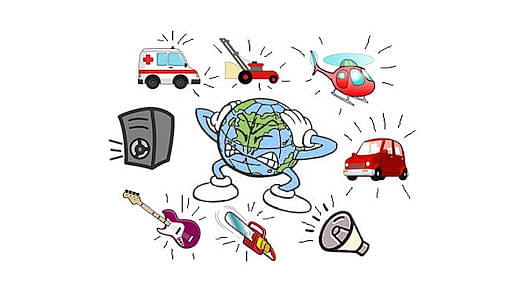
Noise Pollution
Harmful Effects Of Noise Pollution
- Headache and irritation
- Feeling of uneasiness
- Hearing Loss
- Stress and Hypertension
- Less sleep and aggressiveness
Read More: Placenta Definition
Things To Remember
- Air pollution, water pollution, noise pollution, and soil pollution are the four main types of pollution. Additionally there are few more, i.e., thermal pollution, radioactive pollution, light pollution, etc. The radioactive pollution is the deadliest one.
- Untreated waste material from the sewers of factories, disposal of waste material (mainly plastic) into seas and oceans, exploitation of lake and river water by the people living at the shore, and the harmful chemicals from industries are some of the main reasons behind water pollution.
- Deforestation, harmful fertilizers, and dumping non-biodegradable substances in the lands are some of the causes of soil pollution. Consequently, the soil loses its fertility, its natural ability, insects surviving under the soil are slowly dying and getting extinct.
- The results of noise pollution are severe headache, hearing loss, uneasiness, stress, sleeplessness, hypertension, etc. To avoid noise pollution, we can choose a peaceful neighbourhood (if possible) to live in, and a decent workplace. We do not realize it a lot because it is kind of virtual, but it affects our mental health in a very bad way.
Sample Questions
Ques. What is Radioactive Pollution? (1 mark)
Ans. Pollution caused by nuclear explosions, nuclear weapon production, and radioactive ores mining releasing radioactive substances in the environment, which harms the atmosphere is known as radioactive pollution and it is known to be the deadliest type of pollution.
Ques. What are the types of Pollution? (2 marks)
Ans. There are mainly four types of pollution, they are-
- Air Pollution
- Water Pollution
- Soil Pollution
- Noise Pollution
Additionally, there are more like-
- Light Pollution
- Thermal Pollution
- Radioactive Pollution
Ques. What are the causes of Acid Rain? (1 mark)
Ans. Sulphur dioxide and Nitrogen oxide react with water to form acids and while precipitation the acid comes along with the rain drops and causes damage. The amount of hydrogen ions increases.
Ques. What are the effects of air pollution? (1 mark)
Ans. The effects of air pollution are global warming, acid rain, depletion of ozone layer, respiratory disease, lung infection, skin disease, etc. Air pollution is the most expanded and vital form of pollution and it is affecting the health of all the living organisms on the Earth.
Ques. Name some greenhouse gases and their source of production. (1 mark)
Ans. Carbon dioxide, methane, water vapour, oxide of nitrogen, etc. are some of the common greenhouse gases. Carbon dioxide gets released on a very large scale due to forest fires, factories’ chimneys, combustion of fossil fuel, etc. Methane is produced due to incomplete decomposition of natural substances.
Ques. Looking at the deteriorating air quality because of air pollution in many cities of the country, the citizens are very much worried and concerned about their health. The doctors have declared a health emergency in the cities where the air quality is very severely poor.
(a) Mention any two major causes of air pollution.
(b) Write any two harmful effects of air pollution to plants and humans.
(c) As a captain of your school Eco-club, suggest any two programmes you would plan to organise in the school so as to bring awareness among the students on how to check air pollution in and around the school. (3 marks)
Ans. a. Two major causes are:
- Vehicular discharge
- Industrial smoke
- Two harmful effects are:
- Plants - Growth reduction and reduction in crop’s yield capacity.
- Humans - Respiratory problem, acid rain causing skin diseases.
- Two programs that I would organize are:
- Plantation drive
- Poster making competition on air pollution.
Ques. Mention two advantages for preferring CNG over diesel as an automobile fuel. (2 marks)
Ans. Two advantages are:
- Better pollution control
- Cannot be contaminated
Ques. Excessive nutrients in a fresh waterbody causes fish mortality. Give two reasons. (2 marks)
Ans. Two reasons are:
- Water bodies consisting of algal blooms lead to the reduction of oxygen level in the waterbody which leads to the death of the fishes.
- The remains of these dead fishes further deplete the oxygen level in the waterbody.
Ques. List two advantages of the use of unleaded petrol in automobiles as fuel. (2 marks)
Ans. Two advantages are:
- Unleaded petrol does not emit lead compounds, thus helps in controlling air pollution.
- Helps in controlling health diseases such as asthma, lung diseases and bronchitis.
Ques. Write the name of the organism that is referred to as the “Terror of Bengal”. (2 marks)
Ans. The aquatic plant Eichhornia crassipes is known as the “Terror of Bengal”.
Ques. State the cause of accelerated eutrophication. (2 marks)
Ans. Eutrophication gets accelerated when fertilizers runoff from a nearby field into a waterbody causing algal bloom. There is an increase in the temperature and BOD of the waterbody due to the introduction of sewage and industrial effluents, leading a rise in the biological activity, thus causing algal bloom.
Ques. Why is the use of unleaded petrol recommended for motor vehicles equipped with catalytic converters? (1 mark)
Ans. The use of unleaded petrol is recommended for motor vehicles equipped with catalytic converters because lead present in the petrol disables this catalyst and makes it useless.
For Latest Updates on Upcoming Board Exams, Click Here: https://t.me/class_10_12_board_updates
Check-Out:



Comments