



Content Curator
Vector notation is a mathematical language used to represent quantities that have both magnitude and direction.
- A vector is a mathematical object with a magnitude and a direction.
- It is commonly represented as an arrow above a letter, such as "→".
- For example, a vector A can be represented as \(\vec{A}\).
- Vectors can be easily represented and manipulated using this notation.
- Vector notation is essential in physics, engineering, and computer science for modeling and solving issues involving forces, velocities, accelerations, and other quantities.
- By utilizing vector notation, we may describe intricate ideas and relationships in a beautiful and effective manner.
| Table of Content |
Key Terms: Vectors, Unit vector, Physical quantities, Pythagorean theorem, Cartesian coordinates, Resultant vector, Polar coordinates.
What is Vector?
[Click Here for Sample Questions]
The physical quantities which have both magnitude and direction and obey the triangle or parallelogram laws of vector addition are known as vector quantities.
- Physics often needs the size and direction of a physical quantity. For example force, a vector quantity with both size and direction.
- Only the number, 5 N, without mentioning the direction of the force, would be incomplete.
- Direction is an important part of force because it gives the information needed to fully describe a vector quantity.
- Acceleration, speed, and linear momentum are also examples of vector quantities. So, we can say that a vector is a quantity that has both size and direction.
- Vector quantities are important in physics, engineering, and other fields because they help us give more complete and accurate descriptions of physical events.
- By writing physical quantities as vectors, we can easily model and solve real-world problems using math operations like addition, subtraction, and scalar multiplication.
How are Vectors Represented
[Click Here for Sample Questions]
Vectors can be shown in many different ways, depending on the situation and the use. Here are some examples of how vectors can be shown in different ways.
Geometric representation
Consider the vector u = ( 3, 4 ). We can represent this vector geometrically as an arrow in the Cartesian plane with length 5 and direction pointing towards the point (3, 4).

Geometric representation
Component form
Consider the vector OA with an initial point at the origin and endpoint at the point (2, -5). We can represent this vector as OA = ( 2, -5 ).
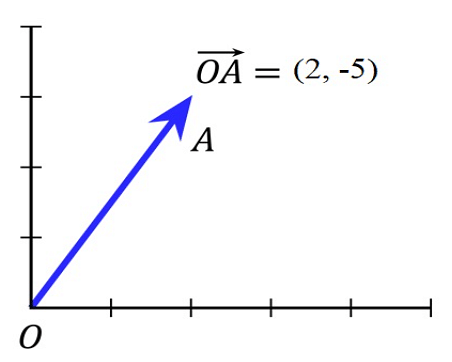
Component form
Unit vectors
A vector having a magnitude equal to one and whose direction is the same as that of the given vector is called a Unit vector
- We use the cap (^) sign above the symbol of the vector.
- Let a vector A can be represented as
\(\vec{A} = |A|\hat{A}\) ⇒ \(\hat{A} = \frac{\vec{A}}{|A|}\)
Where \(\hat{A}\) is a unit vector.
- There are predefined unit vectors along the x, y, and z axis which are \(\hat{X}\), \(\hat{Y}\), and \(\hat{Z}\).
Magnitude and direction
Consider the vector x with an initial point at (0, 0) and endpoint at (5, 12).
- We can represent this vector as x = |x| θ, where |x| = √(52 + 122) ≈ 13.0 is the magnitude of x.
- And, θ = tan-1 (12/5) ≈ 67.38 degrees is the angle between x and the positive x-axis.
- Therefore, we can represent x as x = 13.0 θ, where θ is the angle between x and the positive x-axis.
Representation of Two-Dimensional Vectors
[Click Here for Sample Questions]
Two-dimensional vectors can be shown in a number of different ways, such as graphically, in component form, or in polar form.
Geometric Representation of Vector
A common way to see vectors is through geometric representation, which shows vectors as arrows on a coordinate plane. This method is used in physics, engineering, and mathematics, among other fields.
- In geometric representation, vectors are shown on a coordinate plane as arrows.
- The arrow's tail is at the starting point of the coordinate system, and the arrow's head points in the direction of the vector.
- The length of the arrow shows how big the vector is, and the direction of the arrow shows which way the vector is moving.
- Geometric representation is helpful for performing various vector operations, such as addition, subtraction, and scalar multiplication.
- Different coordinate systems, like polar coordinates or Cartesian coordinates in three dimensions, can be used to show vectors.
- In fields like physics, engineering, mechanics, fluid dynamics, and computer graphics, geometry is a common way to show things.

Geometric Representation of Vector
Rectangular Notation
Cartesian vectors are sometimes represented using rectangular notation. The vector's components along the x, y, and optionally z axes are represented as an ordered pair or triplet of real values. This method is widely used in mathematics and physics for algebraic vector operations.
- In rectangular notation, the x, y, and z components of a vector are written as ordered pairs or triplets of real numbers (if in three dimensions).
- The x, y, and z parts of a vector can be found by using trigonometric functions and the size of the vector.
- Algebraic vector operations like addition, subtraction, scalar multiplication, dot products, and cross products are easier to do with rectangular notation.
- Cartesian coordinates can be used to make graphs of rectangular vectors.
- Rectangular notation is often used in mechanics, electromagnetism, and quantum mechanics.
- By putting vectors in a coordinate system, rectangular notation makes it easy to work with vectors in algebra.

Rectangular Notation
Polar Notation
Polar notation specifies the vector's magnitude and direction relative to a fixed point or origin. This geometric vector concept is utilized in physics and engineering to answer force, motion, and other physical quantity problems.
- Polar notation specifies a vector's magnitude and direction relative to a fixed point or origin using polar coordinates (radius and angle) (radius and angle).
- The Pythagoras theorem is used to figure out how big a vector is, while trigonometric functions like sine and cosine are used to figure out which way it is going.
- A polar coordinate system can plot polar notation vectors, where the magnitude is the distance from the origin and the direction is the angle between the vector and a defined reference direction.
- Polar notation helps solve problems involving force, motion, and other physical quantities by giving a geometric understanding of the vector that can be used to find its parts and do vector operations.
- Vector algebra is harder to do with polar notation because its parts are not clearly defined like they are in rectangular notation.
- In physics and engineering, especially mechanics, fluid dynamics, electricity, and magnetism, polar notation is used.
Equality of Vectors
[Click Here for Sample Questions]
Equality of vectors is a fundamental concept in vector algebra, and it refers to the idea that two vectors have the same magnitude and direction. Here are a few key points to remember about vector equality:
- Vectors are equal if they have the same size and direction. So, two vectors with the same length and the same direction are the same.
- Show in maths that vectors are equal. "a = b" or "b = a" means that the values of two vectors are the same.
- Equal vectors can be used in every kind of equation or expression. If "a" is the same as "b," you can use "b" instead of "a" in an equation.
- It's important to remember that two vectors can point in the same direction but have different sizes. These are not the same.
- Vector equality is useful in physics, mechanics, and computer graphics.
- You can check if two vectors are equal or not equal. Two vectors are not equal if their lengths and directions are different. "a!=b" shows that "a" does not equal "b."
Things to Remember
- A vector is a number with both size and direction. It can be shown with arrows, boldface, or letters that are underlined.
- Vectors that are parallel and have the same direction and length are the same.
- Negative vectors are parallel vectors that have the same length but go in different directions.
- Vectors can be added together, and subtracted from each other, and their lengths can be changed by multiplying them by a scalar.
- A vector's length is its magnitude.
- Vectors can be shown in different ways, such as with arrows, x and y components, or polar notation (using magnitude and angle).
Sample Questions
Ques. What is vector notation? (2 Marks)
Ans: Vector notation is a way to show a vector with symbols like letters in boldface, arrows, or letters that are underlined. In physics and maths, it is often used to describe the direction and size of a vector.
Ques. How do you add two vectors using vector notation? (2 Marks)
Ans: In vector notation, to add two vectors, you just add the corresponding parts of each vector. For example, if vector A is (2, 4) and vector B is (3, 1), then the sum of A and B, written as A + B, is (5, 5).
Ques. What is the dot product in vector notation? (2 Marks)
Ans: The dot product is a scalar number that is found by multiplying the components of two vectors that are the same and then adding them together. In vector notation, the dot product of two vectors A and B is written as A B = AxBx + AyBy + Az*Bz, where Ax, Ay, Az, Bx, By, and Bz are the parts of vectors A and B.
Ques. How do you represent a vector in 3D using vector notation? (2 Marks)
Ans: Using vector notation, you can represent a vector in 3D with a set of three numbers (x, y, z), where x, y, and z are the vector's parts in the x, y, and z directions, respectively. You can also use the standard vector notation with a boldface letter and an arrow above it, such as vector v = (v1, v2, v3) or v = (i v1 + j v2 + k v3), where I j, and k are unit vectors in the x, y, and z directions, respectively.
Ques. What is the cross product in vector notation? (2 Marks)
Ans: The cross product is a vector quantity that is found by adding up the components of two vectors that are the same. In vector notation, the cross product of two vectors A and B is written as A x B = (AyBz - AzBy, AzBx - AxBz, AxBy - AyBx), where Ax, Ay, Az, Bx, By, and Bz are the parts of vectors A and B.
Ques. What is vector addition? (4 Marks)
Ans: Vector addition is the process of putting together two or more vectors to get a single vector as a result. It is done by adding the parts of each vector that go with each other.
For example, if vector A is (2, 3) and vector B is (4, -1), then the sum of A and B, written as A + B, is (6, 2).
In geometry, vector addition is done by putting the tail of the second vector at the head of the first vector and then drawing a vector from the tail of the first vector to the head of the second vector. The resultant vector is the one that goes from the end of the first vector to the beginning of the second.
Vector addition follows the commutative law, which says that it doesn't matter what order the vectors are added in. It also follows the associative law, which says that the way vectors are put together when they are added doesn't change the final result.
Ques. Give some examples of scalar quantities. (4 Marks)
Ans. Scalar quantities are physical quantities that only have a size or a number value and don't have any direction. Here are some examples of scalar quantities:
- Distance: The length of the path between two points, measured in meters or kilometers.
- Mass: Mass is a scalar quantity that is used to describe the amount of matter in an object. It is measured in kilograms or pounds.
- Time: Time is a scalar quantity that refers to how long something takes and is measured in seconds, minutes, or hours.
- Temperature: Temperature is a scaled number that describes how hot or cold something or an area is. It is measured in Celsius or Fahrenheit.
- Speed: Speed is a scalar quantity that describes how fast something moves. It is measured in units like meters per second or miles per hour.
- Energy is a scalar quantity that is measured in units like joules or calories. It is the ability of a system to do work.
- Pressure: Pressure is a scalar quantity that is measured in pascals or pounds per square inch. It is the amount of force per unit area that is applied to a surface.
Ques. Three vectors are given as A = 3i - 4j + 6k, B = 4i + 5j - 6k, and C = – i + 2j + 3k. What is the dot product of A and B and the cross product of B and C? (5 Marks)
Ans. The dot product of A and B can be found by multiplying the corresponding components of A and B, and then adding them together.
In vector notation, the dot product of two vectors A and B is written as A · B = AxBx + AyBy + Az*Bz,
where Ax, Ay, Az, Bx, By, and Bz are the respective components of vectors A and B.
Using this formula, we have:
A · B = (3)(4) + (-4)(5) + (6)(-6)
= 12 - 20 - 36
= -44
Therefore, the dot product of A and B is -44.
The cross product of B and C can be found using the formula
B x C = (ByCz - BzCy, BzCx - BxCz, BxCy - ByCx)
Where Bx, By, Bz, Cx, Cy, and Cz are the respective components of vectors B and C.
Using this formula, we have:
B x C = (5)(3) - (-6)(2), (-6)(-1) - (4)(3), (4)(2) - (5)(-1)
= (15 + 12, 6 + (-12), 8 + 5)
= (27, -6, 13)
Therefore, the cross product of B and C is the vector (27, -6, 13).
Ques. Let u = 6 i − 9 j , and v = − 8 i + 7 j . Find v − u. (5 Marks)
Ans. To find v - u, we need to subtract the corresponding components of vectors v and u. In other words, we need to subtract the x-component of u from the x-component of v, and the y-component of u from the y-component of v.
Using vector notation, we can write v - u as
v - u = (-8i + 7j) - (6i - 9j)
Simplifying this expression by distributing the negative sign, we get:
v - u = -8i + 7j - 6i + 9j
Combining like terms, we have
v - u = (-8i - 6i) + (7j + 9j)
Simplifying further, we get
v - u = -14i + 16j
Therefore, v - u is the vector -14i + 16j.
Ques. Given the vectors u = [5, − 2] and v = [− 2, 9], find |7 u − 4 v|. (5 Marks)
Ans. Given
- u = [5, − 2]
- v = [− 2, 9]
⇒ 7u - 4v = [7(5) - 4(-2), 7(-2) - 4(9)]
⇒ 7u - 4v = [(35 + 8), (-14 - 36)]
⇒ 7u - 4v = [43, -50]
Now the magnitude of resultant vector 7u - 4v, is given by
|7u - 4v| = \(\sqrt{43^2+50^2}=\sqrt{1849+2500}=\sqrt{4349}\)
⇒ |7u - 4v| = 65.9
For Latest Updates on Upcoming Board Exams, Click Here: https://t.me/class_10_12_board_updates
Do Check Out:



Comments