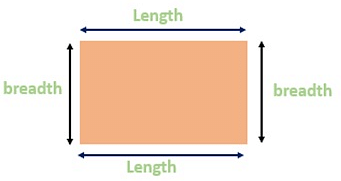
What Is the formula of finding breadth of Rectangle?

Collegedunia Team logo

Collegedunia Team

Content Curator

The formula for finding the breadth (b) of a rectangle is b = Area / Length. Where Length (l) is the longer side of the rectangle, and Area (A) is the product of the length and breadth.

Note: The breadth and width of a rectangle are used interchangeably, and they refer to the same dimension.

Related Links

Length and Breadth of Rectangle

Length and Breadth of Rectangle

Let us Understand the Formula through Examples

Example 1: A rectangle has an area of 120 square meters and a length of 20 meters. What is the breadth of the rectangle?

Solution: Breadth = 120 ÷ 20 = 6 meters

Example 2: A rectangle has an area of 144 square inches and a length of 12 inches. What is the breadth of the rectangle?

Solution: Breadth = 144 ÷ 12 = 12 inches

Example 3: A rectangle has an area of 150 square centimeters and a length of 30 centimeters. What is the breadth of the rectangle?

Solution: Breadth = 150 ÷ 30 = 5 centimeters

Important Points to Remember while Finding Breadth of a Rectangle

  • The breadth of a rectangle is one of the four important measurements required to fully describe the size and shape of a rectangle.
  • The breadth of a rectangle is equal to the width of the rectangle if it is oriented with its sides parallel to the x- and y-axes.
  • The breadth and length of a rectangle can be interchanged to create a different rectangle with the same area.
  • In a square, the breadth and length are equal, which makes finding the breadth of a square easier than a rectangle.

Also check:

CBSE CLASS XII Related Questions

  • 1.
    For \[ f(x)=x+\frac{1}{x}, \quad x\neq 0. \]

      • local maximum value is 2
      • local minimum value is \( -2 \)
      • local maximum value is \( -2 \)
      • local minimum value \( < \) local maximum value

    • 2.

      For two vectors \(\vec{a}\) and \(\vec{b}\):  

      Assertion (A): \[ |\vec{a}\times\vec{b}|^2+(\vec{a}\cdot\vec{b})^2 = |\vec{a}|^2|\vec{b}|^2 \] Reason (R): \[ |\vec{a}\times\vec{b}| = (\vec{a}\cdot\vec{b})\tan\theta, \quad \theta\neq\frac{\pi}{2}. \]

        • Both Assertion (A) and Reason (R) are true and the Reason (R) is the correct explanation of the Assertion (A).
        • Both Assertion (A) and Reason (R) are true, but Reason (R) is not the correct explanation of the Assertion (A).
        • Assertion (A) is true, but Reason (R) is false.
        • Assertion (A) is false, but Reason (R) is true.

      • 3.
        In a school, the probability of holding a debate competition is \( \frac{1}{3} \) and that of a quiz competition is \( \frac{2}{3} \). In the two participating teams, A has 4 girls and 6 boys and B has 7 girls and 3 boys. If a debate competition is held, the students are selected from team A and for the quiz competition they are selected from team B. If only two students are to be chosen from the teams, then find the probability that one will be a girl and the other a boy.


          • 4.

            The domain of \[ f(x)=\cos^{-1}(2x-5) \] is: 

              • \([-1, 1]\)
              • \([4, 6]\)
              • \([-7, -3]\)
              • \([2, 3]\)

            • 5.
              A function \[ f:\mathbb{R}-\left\{\frac{3}{5}\right\} \to \mathbb{R}-\left\{\frac{3}{5}\right\} \] is defined as \[ f(x)=\frac{3x+2}{5x-3}. \] Show that \(f\) is one-one and onto.


                • 6.
                  For a square matrix \(A\), \[ (3A)^{-1}= \]

                    • \( 3A^{-1} \)
                    • \( 9A^{-1} \)
                    • \( \frac{1}{3} A^{-1} \)
                    • \( \frac{1}{9} A^{-1} \)
                  CBSE CLASS XII Previous Year Papers

                  Comments


                  No Comments To Show