


Write any two similarities between Astronomical telescope and terrestrial telescope.

Collegedunia Team logo

Collegedunia Team

Content Curator

Astronomical telescopes and terrestrial telescopes have a number of similarities, including:

  1. Optical Design: Both types of telescopes use similar optical designs, such as the refracting telescope, which uses a lens to focus light, or the reflecting telescope, which uses a curved mirror to reflect light. This means that the basic principles of how the telescopes work are the same, regardless of whether they are used to observe objects in space or on Earth.
  2. Magnification: Another similarity between astronomical and terrestrial telescopes is that both are designed to magnify distant objects. This is achieved through the use of eyepieces, which allow the observer to see a magnified image of the object being observed. The level of magnification that can be achieved depends on a number of factors, including the size of the lens or mirror and the distance between the lens or mirror and the eyepiece.
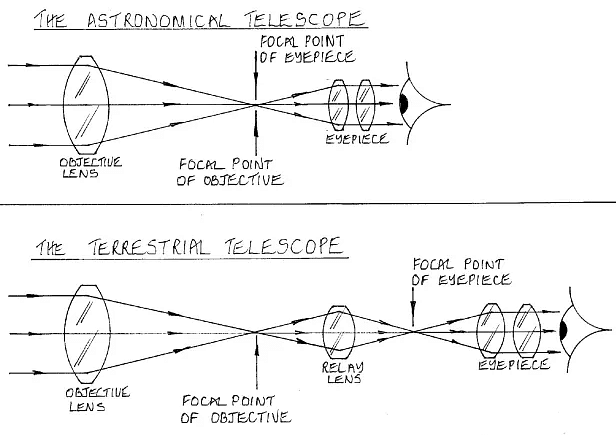
Astronomical and Terrestrial Telescope

Astronomical and Terrestrial Telescope


Previous Years’ Questions

  1. An astronomical telescope has objective and eyepiece of focal lengths… (NEET 2016)
  2. In an astronomical telescope in normal adjustment a straight black… (NEET 2015) 
  3. A telescope has an objective lens of 10 cm diameter and is situated…
  4. An astronomical refracting telescope will have large angular… (NEET 2018)
  5. The magnifying power of an astronomical telescope… (JIPMER 1995)
  6. An astronomical telescope has an angular magnification of… (JEE Advanced 1989)
  7. A telescope has an objective of focal length 100 cm… (BCECE 2009)
  8. An astronomical telescope of tenfold angular magnification… (NEET 1997)
  9. Calculate the limit of resolution of a telescope objective… (JEE Main 2019)
  10. Diameter of the objective lens of a telescope is… (JEE Main 2019)

Also check:

CBSE CLASS XII Related Questions

  • 1.
    An electric field $\vec{E}$ is established across the ends of a cylindrical conductor of length L and area of cross-section A. Discuss how electrons attain an average velocity, independent of time. Hence, obtain a relation between current in the conductor and this ‘average velocity’ of electrons.


      • 2.
        Consider the nuclear reaction \( X \to Y + Z \). Let \( M_x \), \( M_y \), and \( M_z \) be the masses of the three nuclei X, Y, and Z respectively. Then which of the following relations hold true?

          • \( (M_x - M_z)<M_y \)
          • \( (M_x - M_y)<M_z \)
          • \( M_x>(M_y + M_z) \)
          • \( M_x<(M_y + M_z) \)

        • 3.
          A charged particle $+q$ in an electric field $\vec{E}$ experiences a force in the direction of the electric field. As a result, its kinetic energy changes. Similarly, the charged particle also experiences a force when it moves in a magnetic field $\vec{B}$. But this magnetic force is perpendicular to both velocity $\vec{v}$ of the charged particle and the magnetic field $\vec{B}$, so it cannot change the kinetic energy of the charged particle. Consider two charged particles 1 and 2 of masses $m$ and $\frac{m}{2}$ having charges $-q$ and $+2q$ respectively. They are accelerated from rest through the same potential difference $V$ and acquire kinetic energy $K_1$ and $K_2$. Then they enter in a region of uniform magnetic field $\vec{B}$ perpendicular to their velocities.


            • 4.
              An astronomical telescope consists of two converging lenses. One of them of large aperture and large focal length is called objective lens and the other one, of smaller focal length and smaller aperture is called the eyepiece. It is used to see distant objects which are not seen clearly with naked eyes. The image formed by the objective lens acts as an object for the eyepiece and the final image produced by the eyepiece is magnified.


                • 5.
                  Write two advantages of reflecting telescope over refracting telescope.


                    • 6.
                      This ‘average velocity’ is found be few mm/s for currents in range of a few amperes. How then is current established almost the instant a circuit is closed ?

                        CBSE CLASS XII Previous Year Papers

                        Comments


                        No Comments To Show
