




These Bricks, Beads and Bones handwritten notes turn the whole Harappan Civilisation chapter into clean, handwritten pages for fast last-minute revision. They follow the 2026-27 CBSE syllabus and Theme 1 of Themes in Indian History Part I. Students get the dates, site names, diagrams and the rulers debate in a pen-on-paper format that is easy to skim before a test.
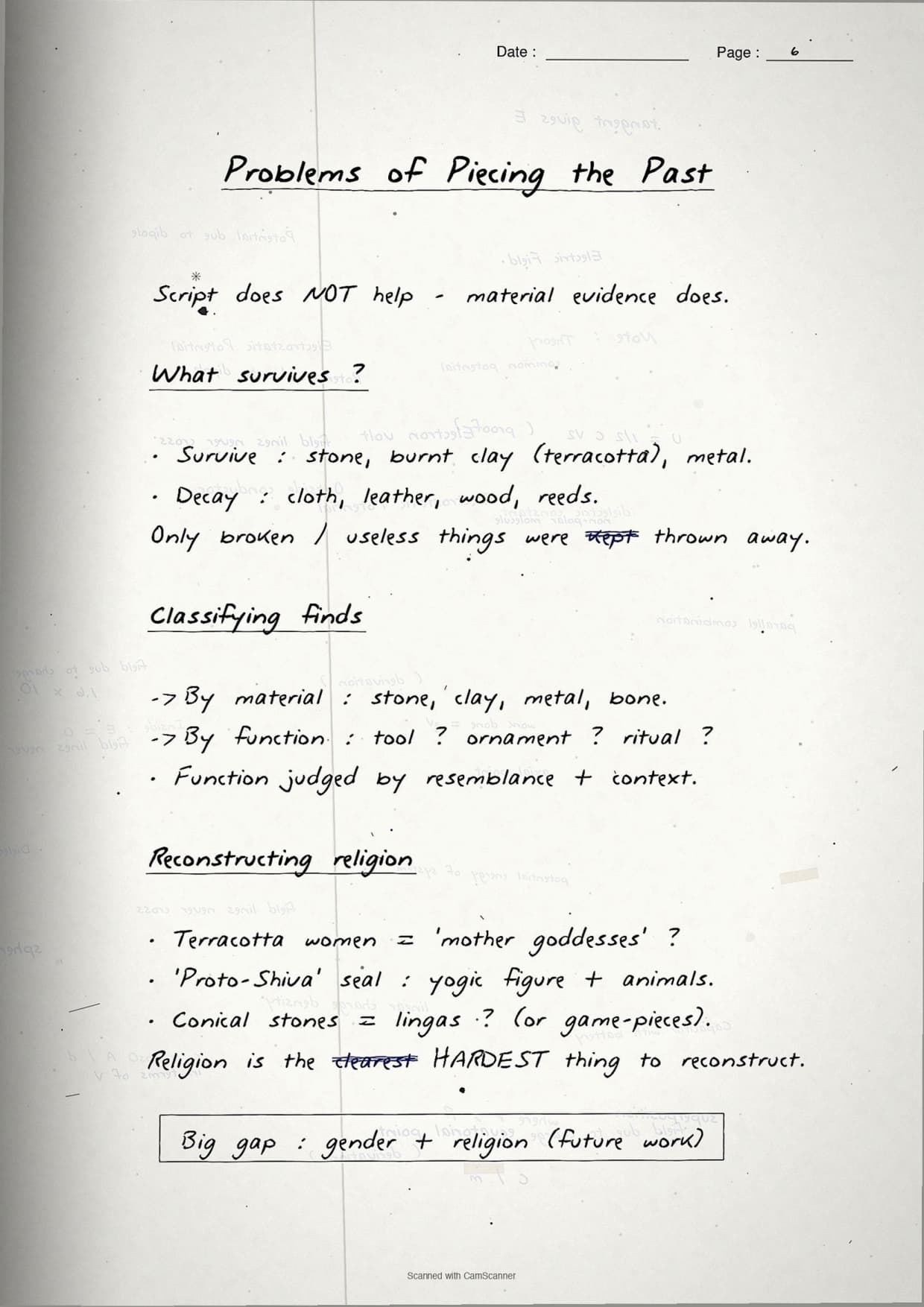
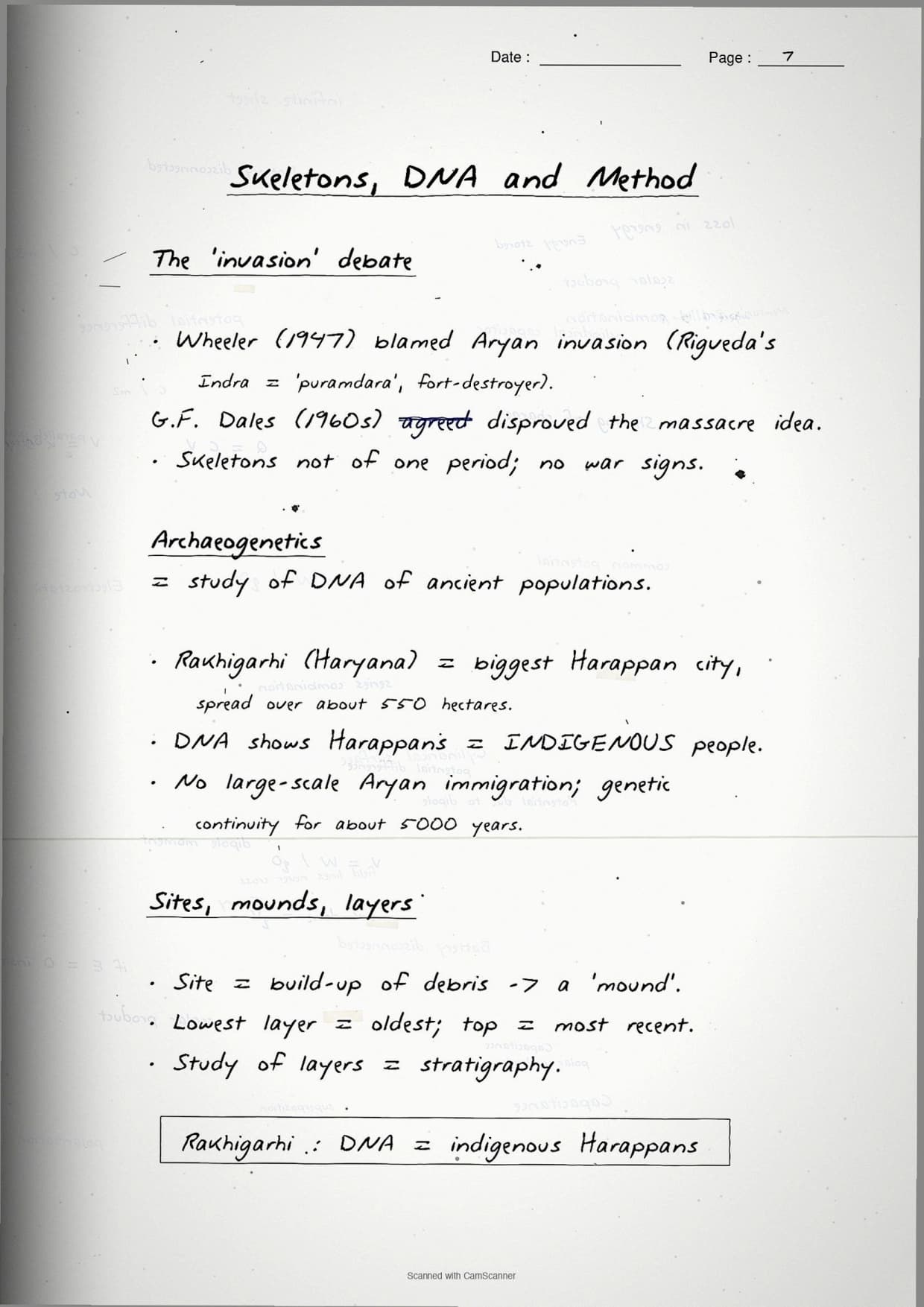
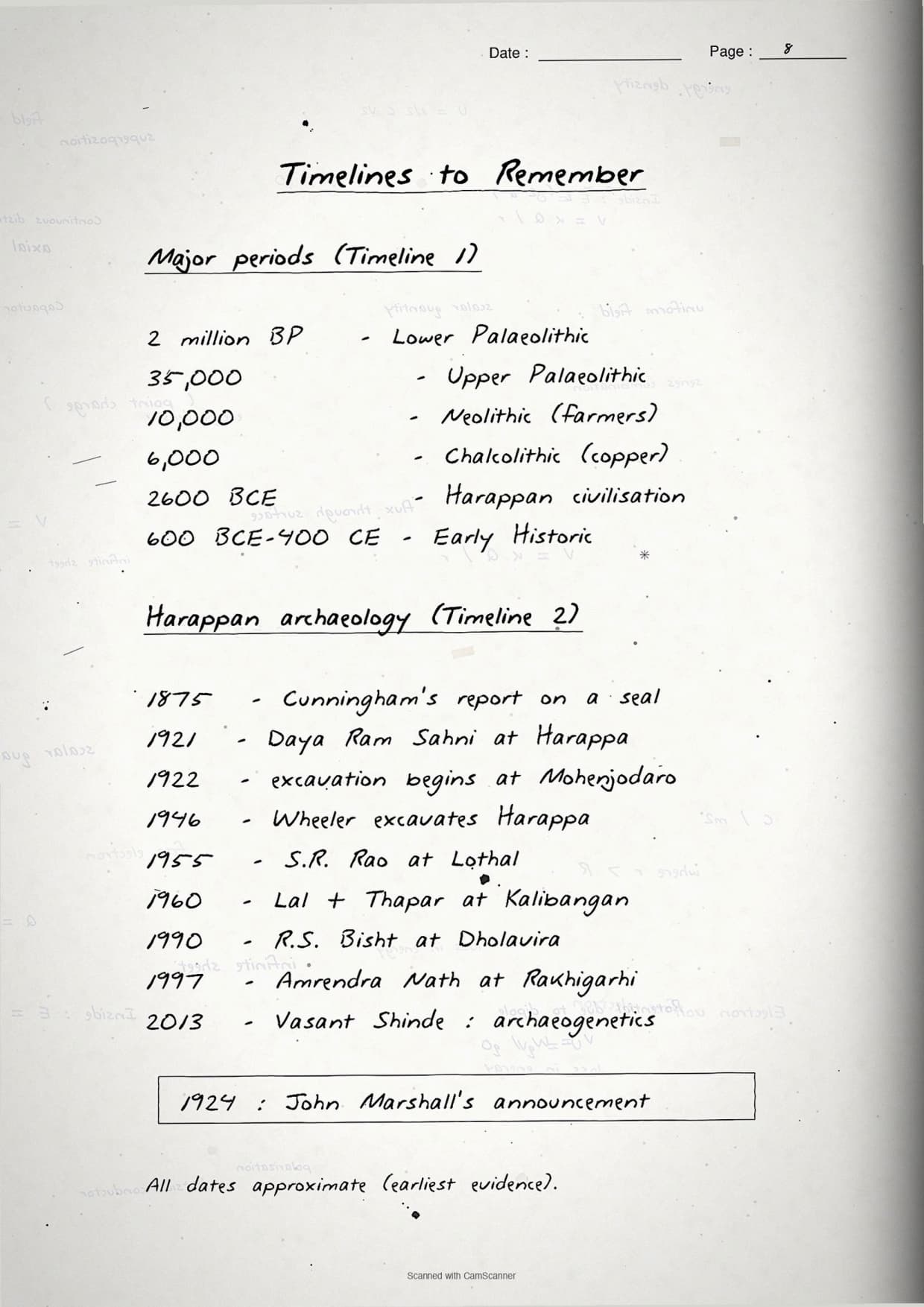
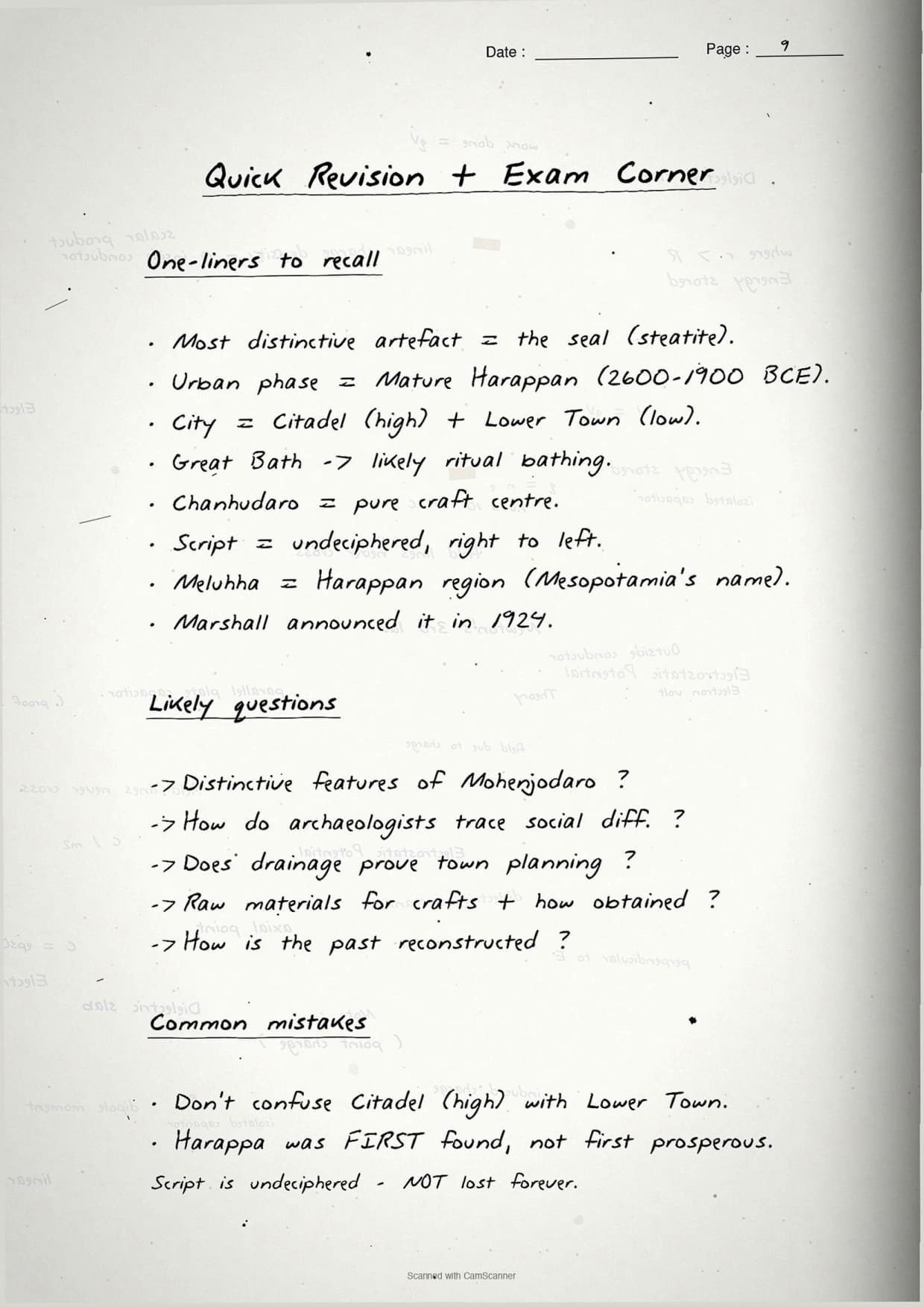
- Handwritten pages with boxed key terms and labelled sketches.
- This Class 12 History chapter usually carries 6 to 8 marks in the board paper.
- Pairs with the NCERT Solutions, Notes and Book PDF linked lower on this page.
These Bricks, Beads and Bones handwritten notes are prepared from the official NCERT Themes in Indian History Part I and checked against the last five years of CBSE board papers.
Student Feedback: In a Collegedunia poll of 8,360 Class 12 History students before the 2026 boards, 74% of students said handwritten notes felt faster to revise from than printed text for this chapter. Most students used the labelled Mohenjodaro sketch to recall the town-planning answer in the exam.
Source: 2026-27 Class 12 History student poll. Sample of 8,360 students from CBSE schools across 12 states.
|
Table of Contents |
What These Handwritten Notes Include
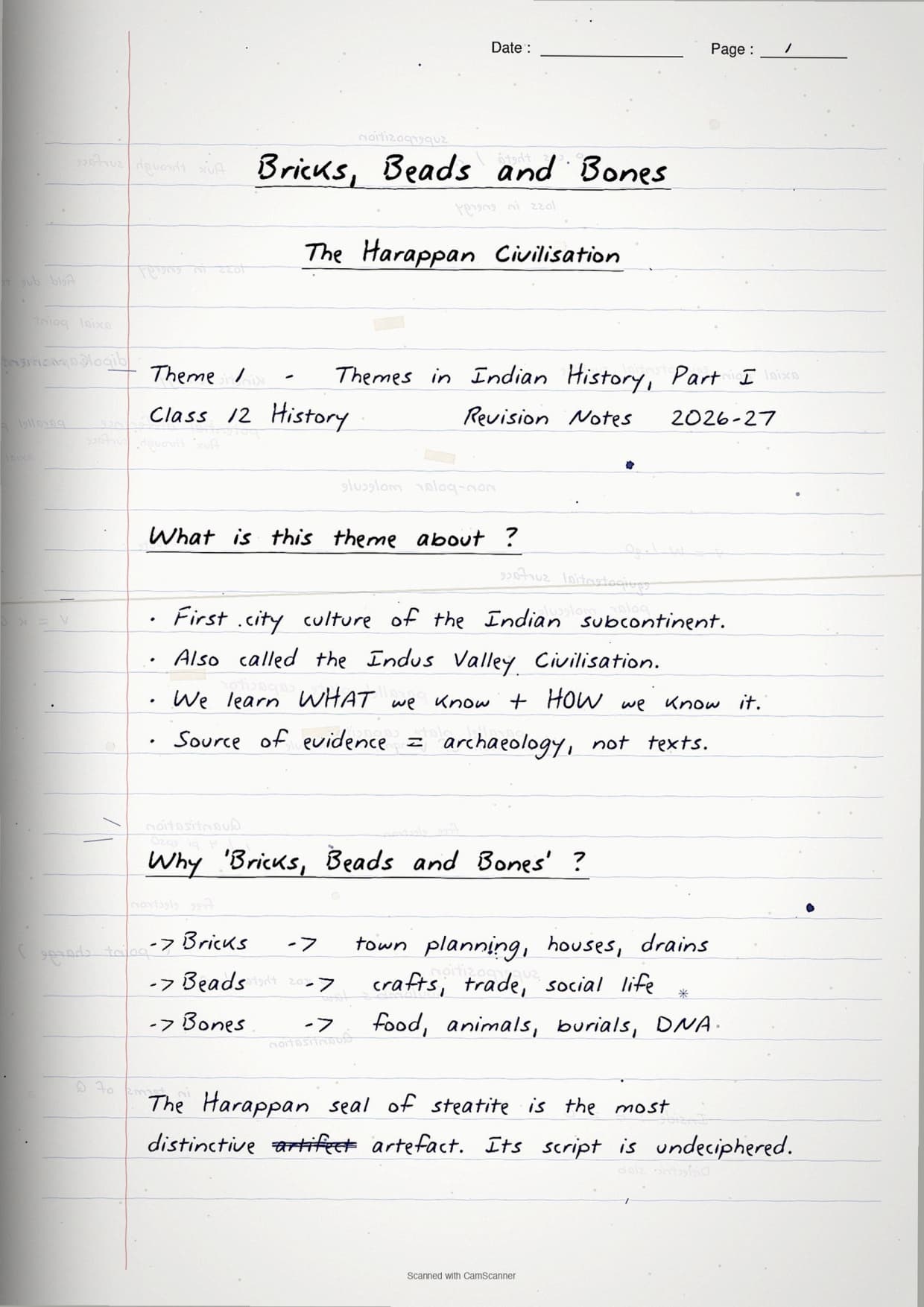
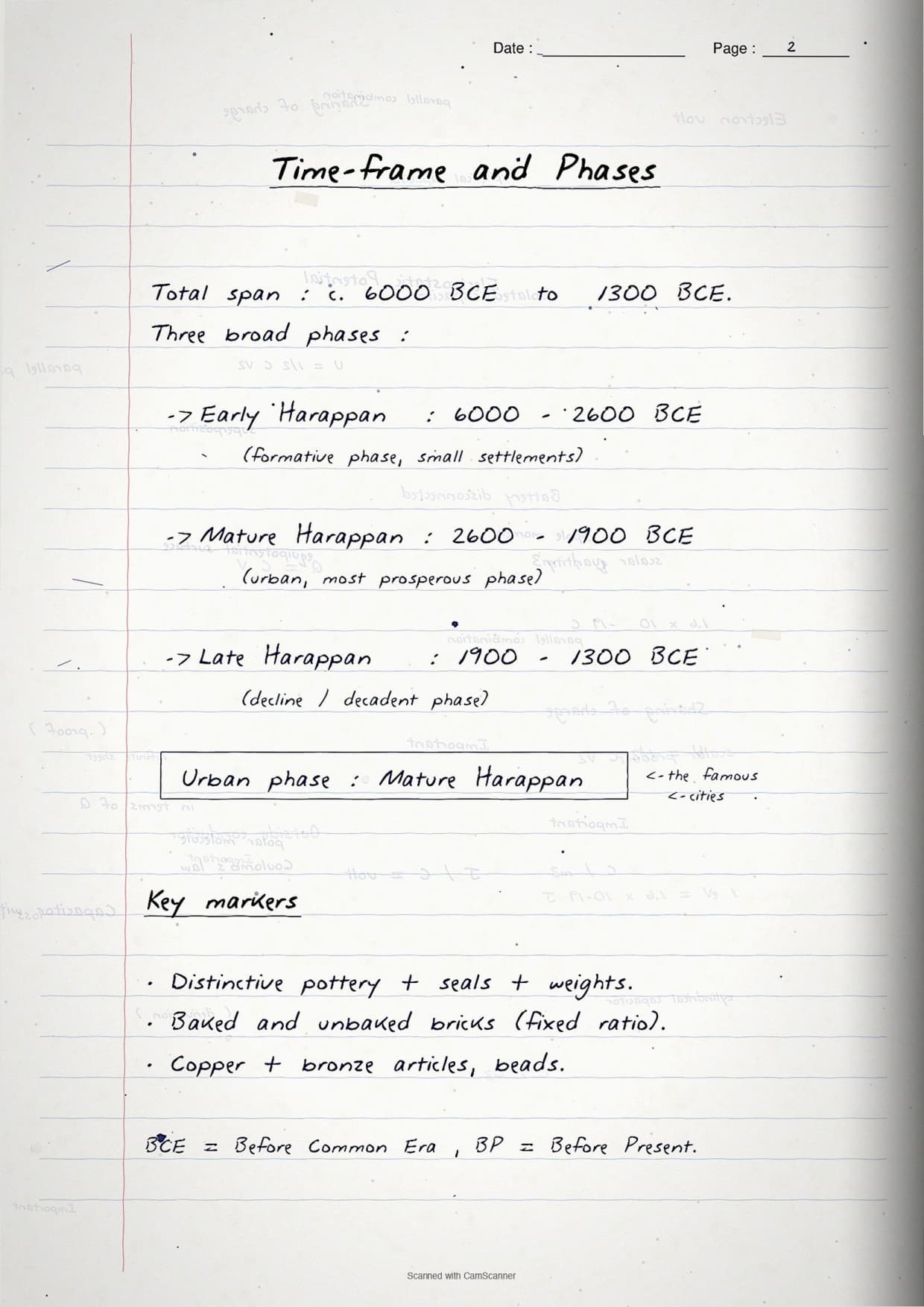
Bricks, Beads and Bones is the first chapter of Themes in Indian History Part I. It studies the Harappan or Indus Valley Civilisation, a Bronze Age urban culture that grew along the Indus and its tributaries between roughly 2600 BCE and 1900 BCE. These handwritten notes condense the chapter into pages a student can read in one sitting.
Every page is built around the three words in the chapter title:
- Bricks pages cover town planning, houses, drains and the Great Bath.
- Beads pages cover craft production, trade and the work of specialists.
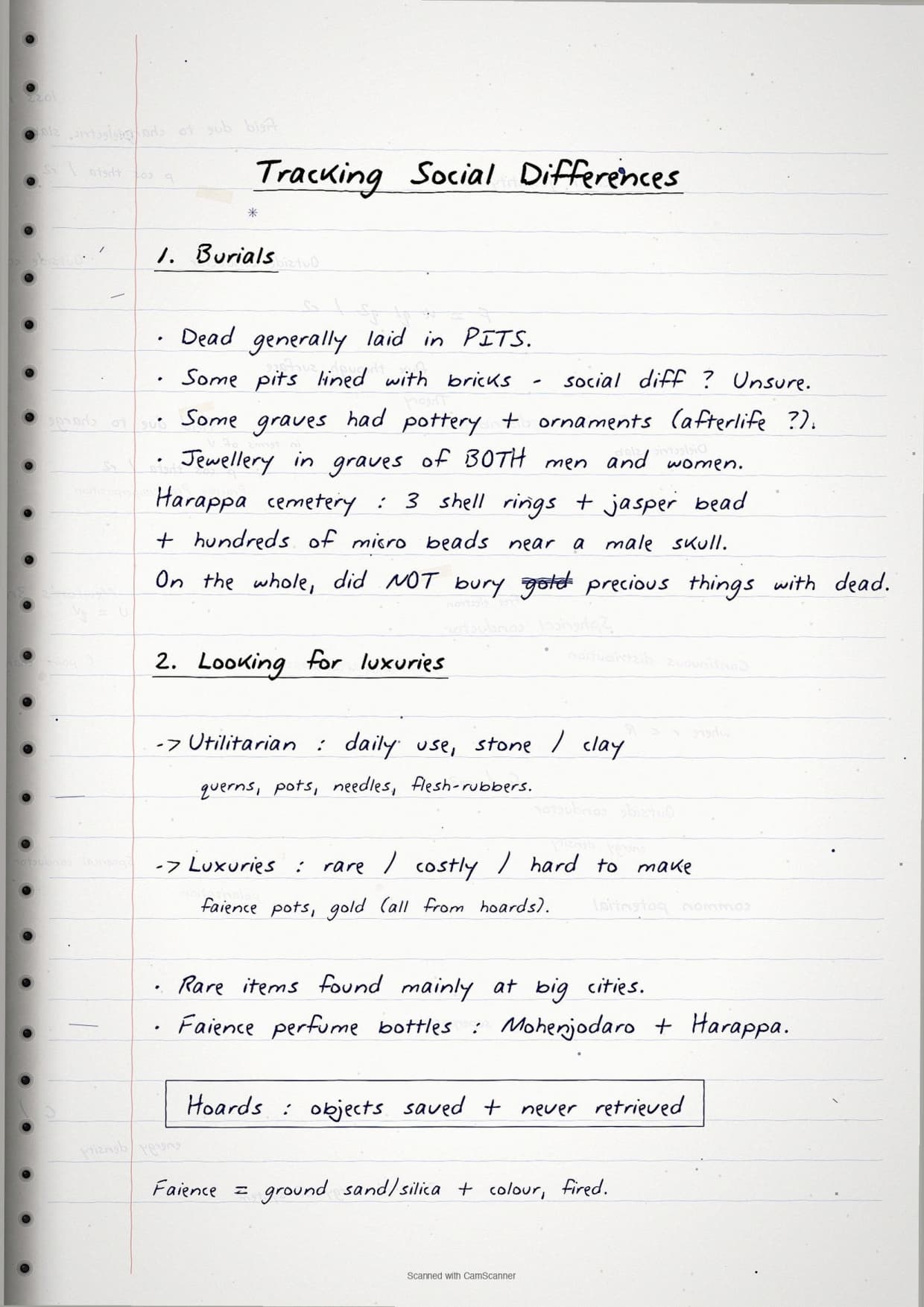
- Bones pages cover food, farming and the social differences seen in burials.
Because the notes are handwritten, the key terms sit in boxes and the important dates are underlined, so the eye jumps straight to them. This makes the bricks beads and bones handwritten notes ideal for a last revision when there is no time to read full paragraphs. Sort each fact under bricks, beads or bones, and the whole of chapter 1 history class 12 falls into place.
Subsistence and Farming Pages
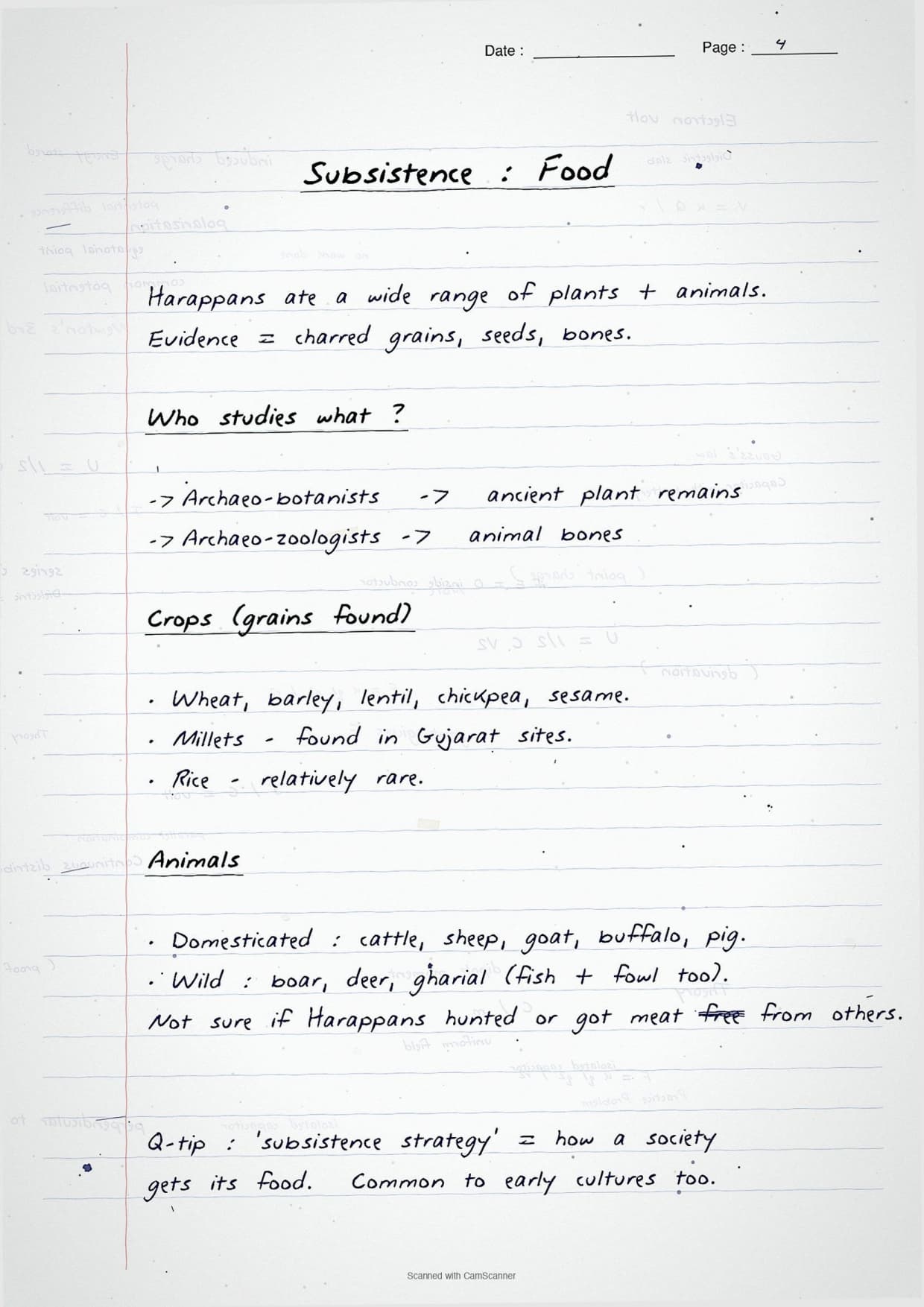
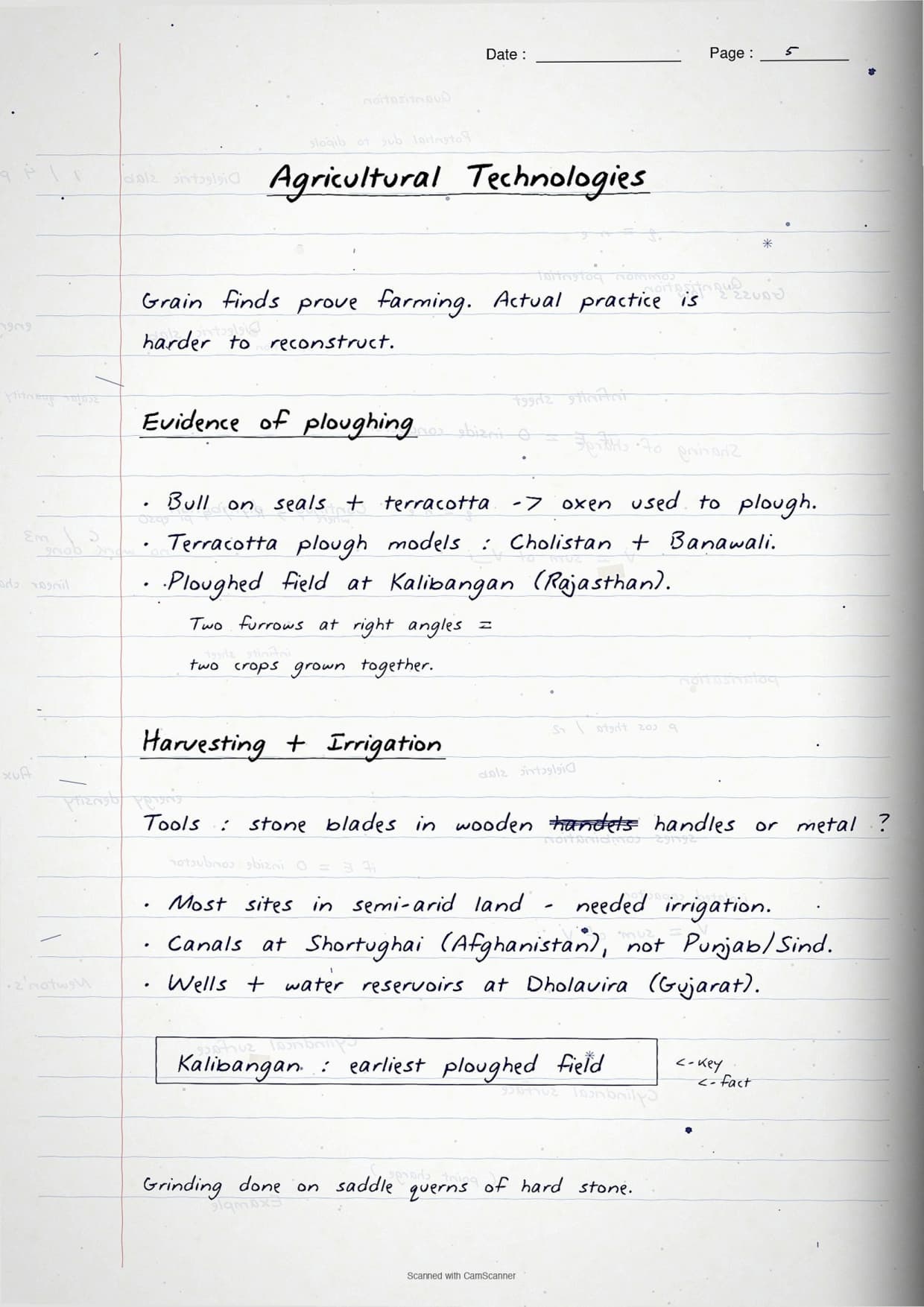
The bones pages start with food. Archaeologists know what Harappans ate from charred grains, animal bones and the tools shown on seals. The notes keep the food base as two short, boxed lists so students can copy them straight onto the answer sheet.
- Cereals grown: wheat, barley, lentil, chickpea and sesame; rice grains are rare finds.
- Animals reared: cattle, sheep, goat, buffalo and pig; wild-species bones show hunting too.
- Tools and methods: a terracotta model of a plough was found; ploughed fields are seen at Kalibangan.
- Water management: wells and canals likely helped irrigation in dry zones like Shortughai.
The food question in the exercise asks for the food items and the groups who supplied them. The notes underline the key point: farmers, herders, fishers and hunters together fed the cities, so name all four groups, not just farmers. A hand-drawn arrow links each food item to the group that produced it, which makes the answer easy to recall under exam pressure.
Mohenjodaro and Town Planning Pages
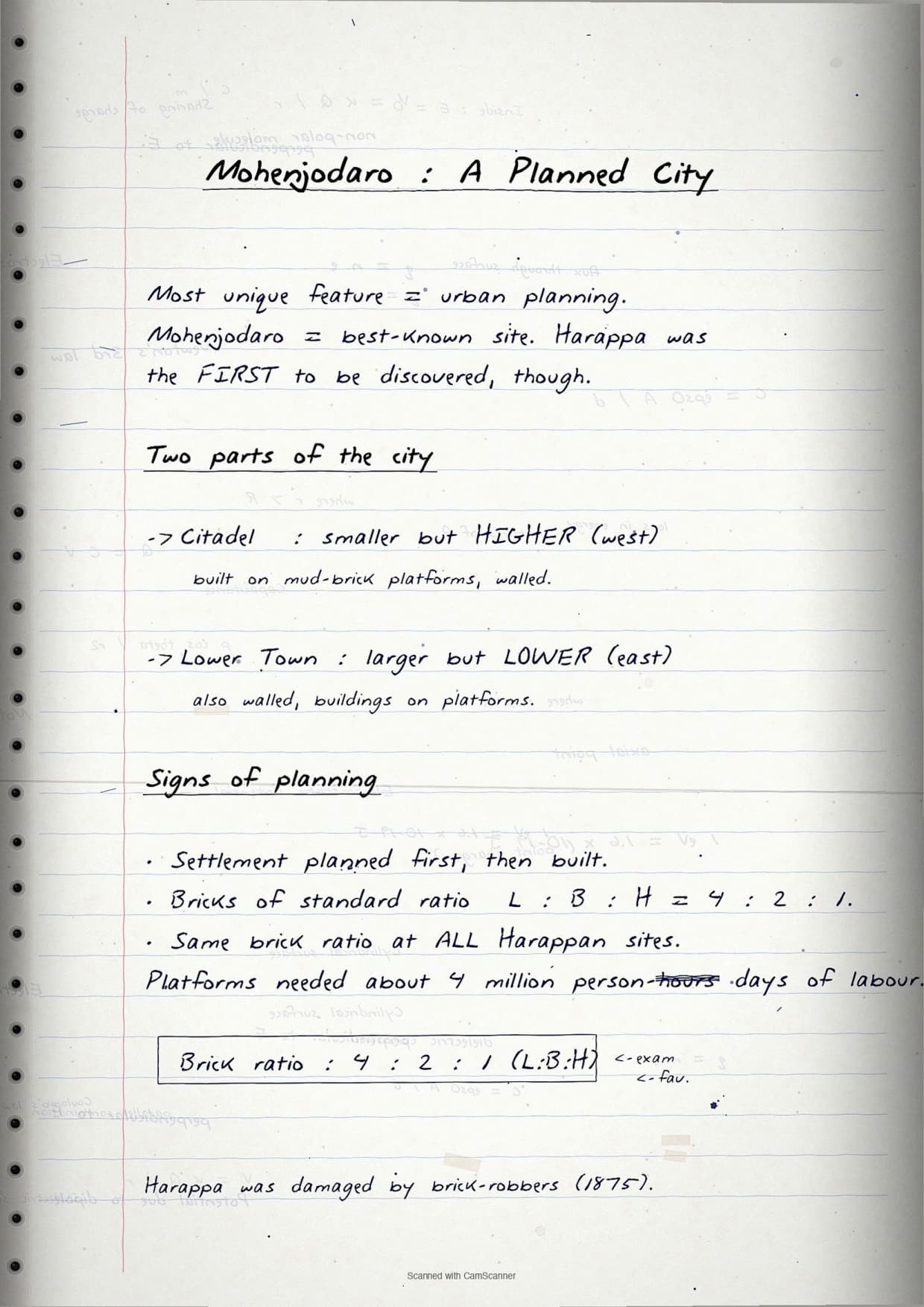
The bricks pages carry a labelled sketch of Mohenjodaro, the best-known Harappan city. The drawing splits the city into its two heights and marks each feature, so students can describe the layout in detail. The table below lists what the sketch labels for quick revision.
| Feature | What it shows |
|---|---|
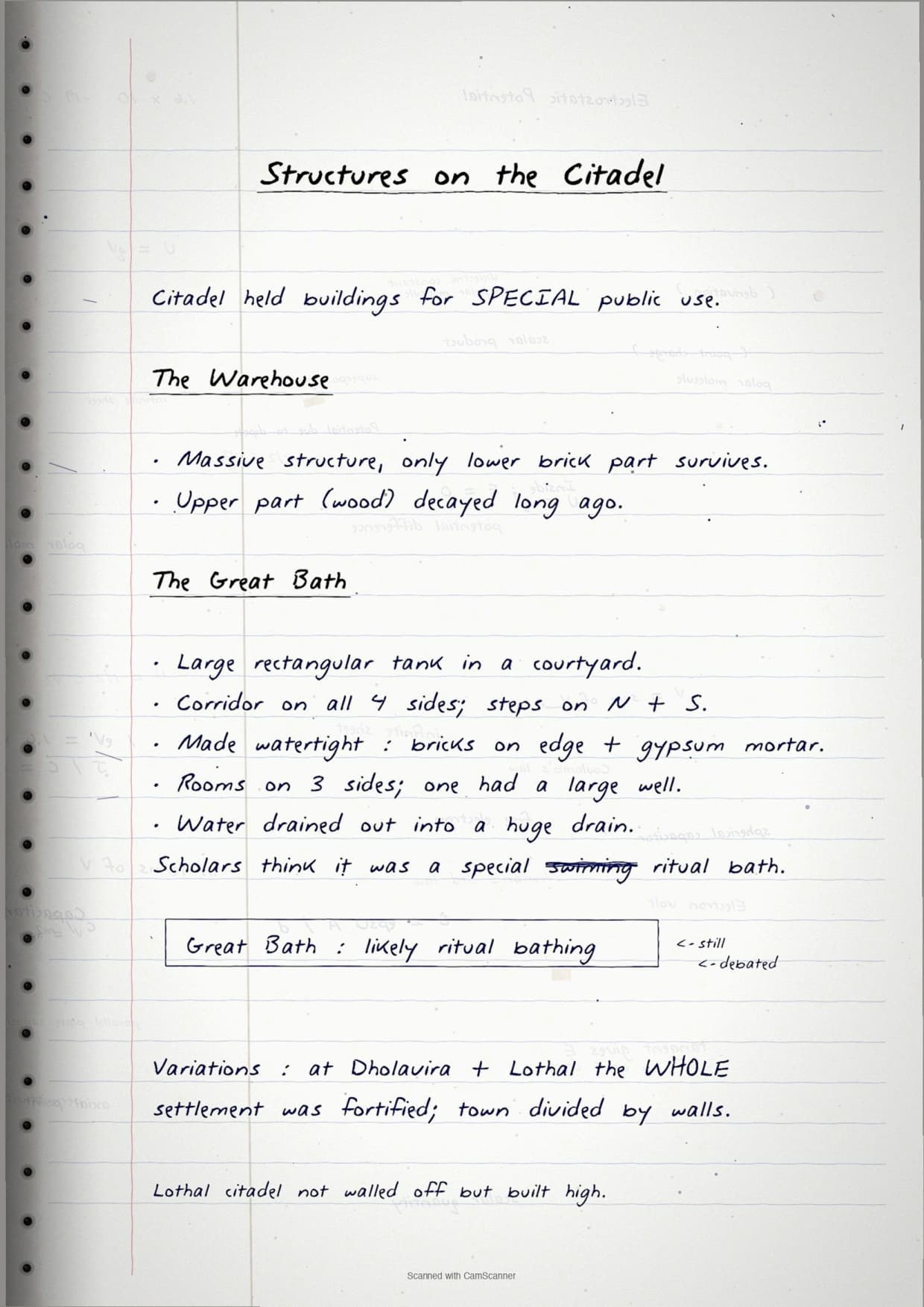
| Citadel | Raised western part on mud-brick platforms; held the Great Bath, warehouse and large halls. |
| Lower Town | Larger eastern part; residential, laid out on a rough grid of streets. |
| Grid streets | Roads crossed at right angles, dividing the town into blocks. |
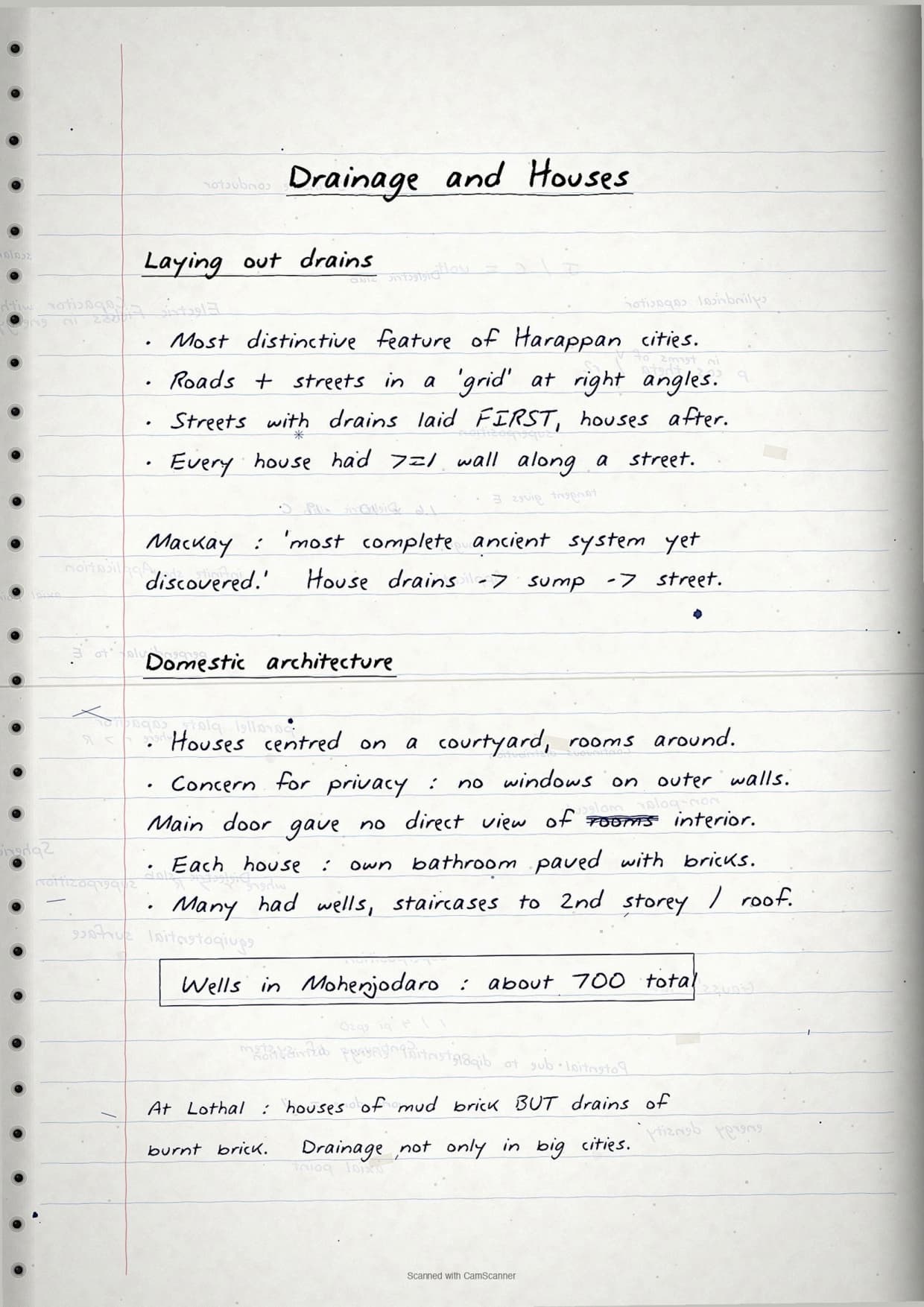
| Drainage | Covered drains along streets, joined to house drains; planned before houses were built. |
| The Great Bath | A watertight tank on the Citadel, likely used for special ritual bathing. |
The notes box the single most important point in red ink: the drains were planned and laid first, and then houses were built along them. That one fact proves real town planning. The pages also note that bricks followed a standard ratio (length twice the width, width twice the height) across far-apart cities, which again shows shared planning rules.
Crafts, Beads, Seals and Trade Pages
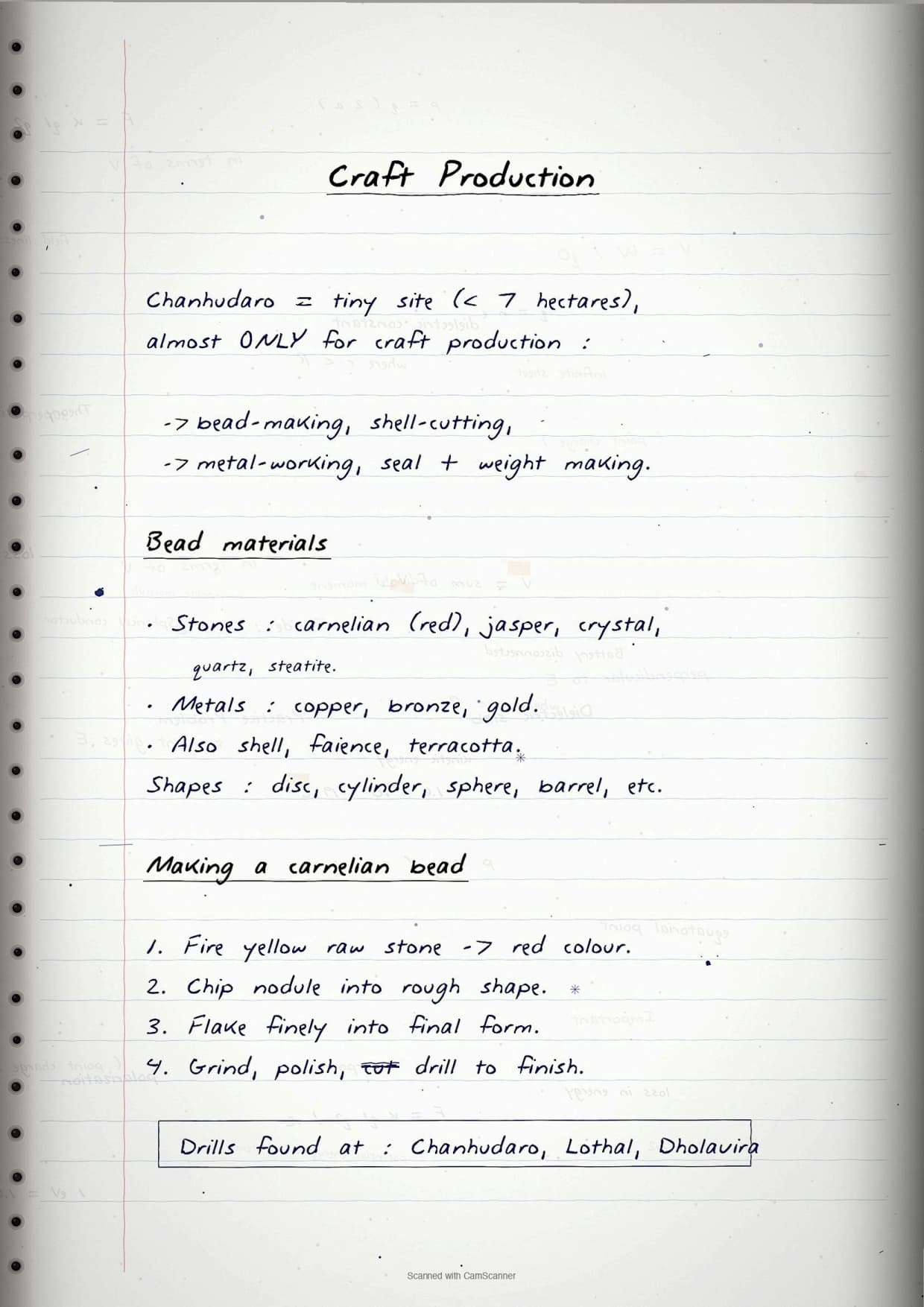
The beads pages cover the whole world of Harappan craft. Cities like Chanhudaro were almost fully given over to making things, which tells us specialists existed. The notes use bead-making as the example process, and add seals, weights and trade as boxed lists for the short answers.
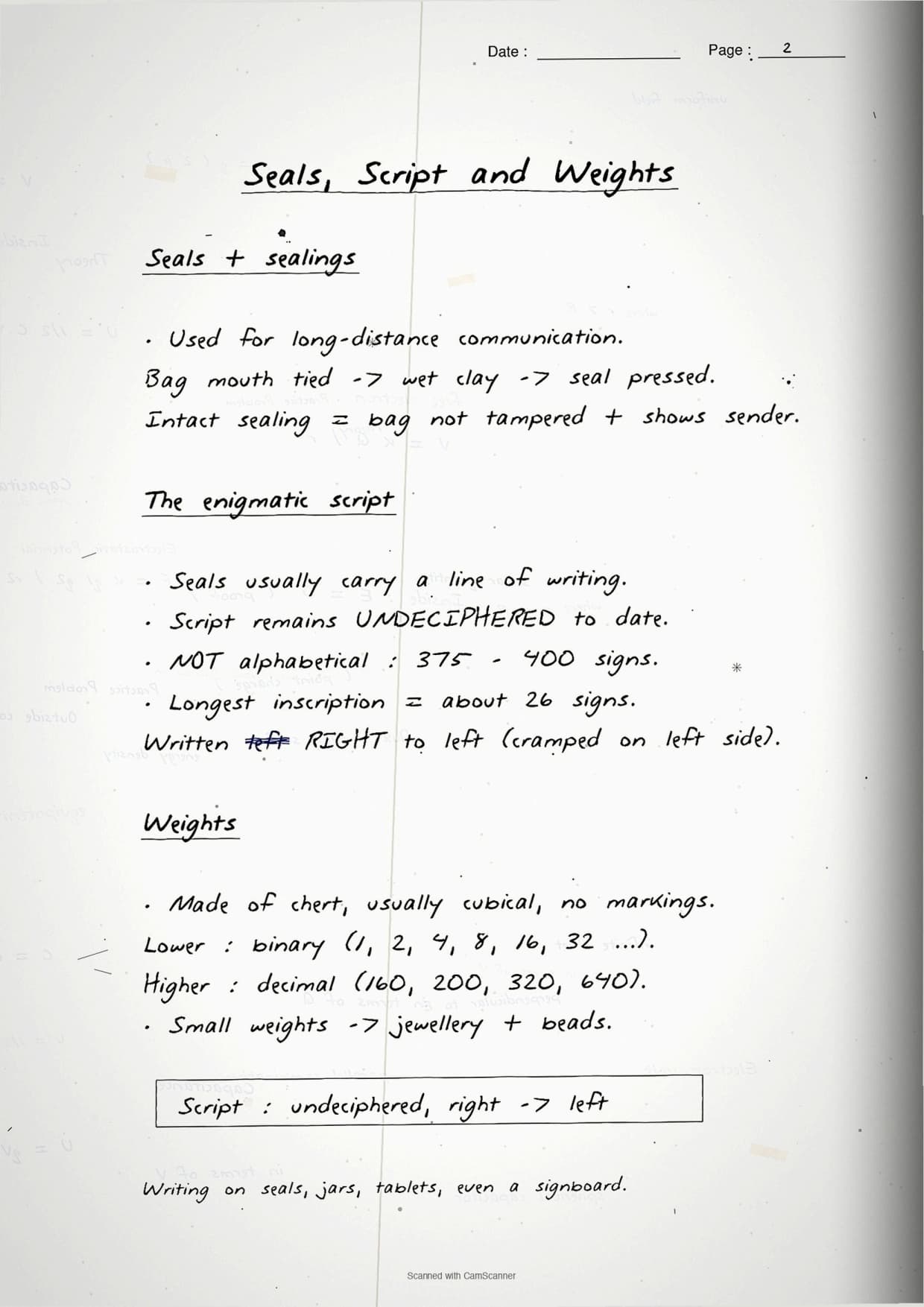
- Bead materials: carnelian, jasper, crystal, quartz, steatite, copper, bronze, gold, shell, terracotta and faience.
- Bead-making steps: hard stones were sawn, flaked, ground, polished and then drilled.
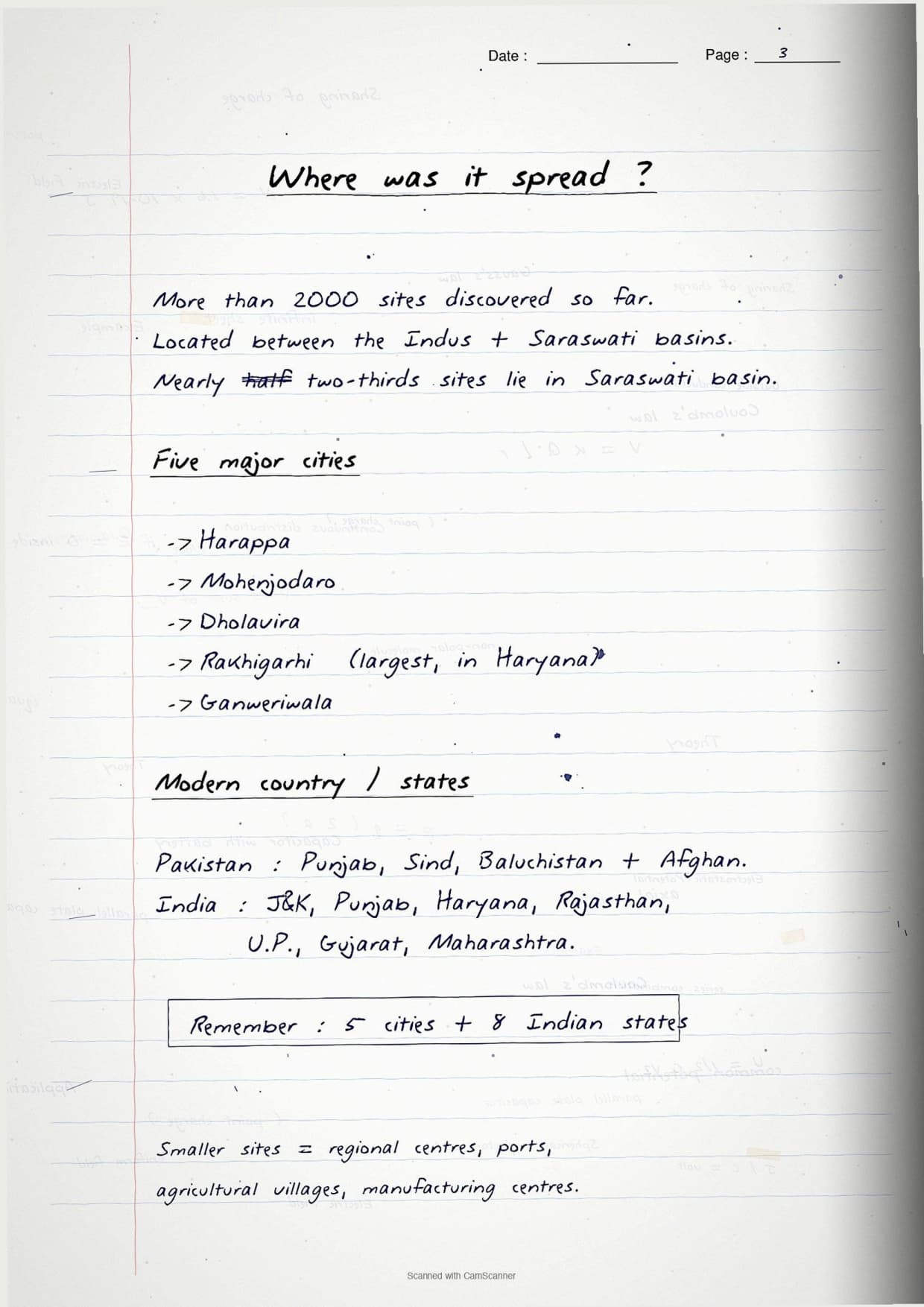
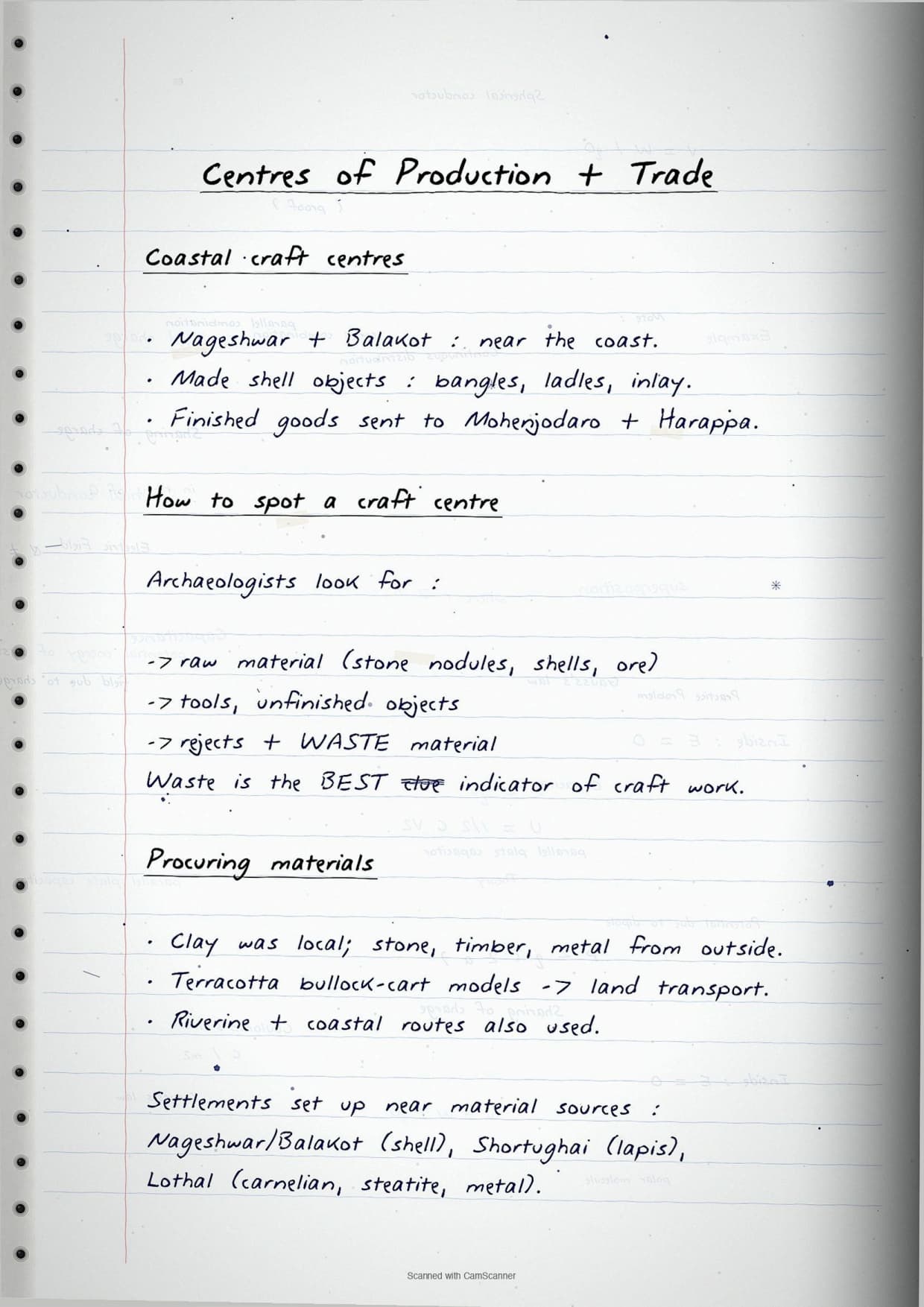
- Craft centres: Chanhudaro, Lothal, Nageshwar and Balakot focused on shell and bead work.
- Seals and script: seals marked goods; the script is still undeciphered and was written right to left.
- Weights: made of chert; lower units doubled, higher ones followed a decimal system.
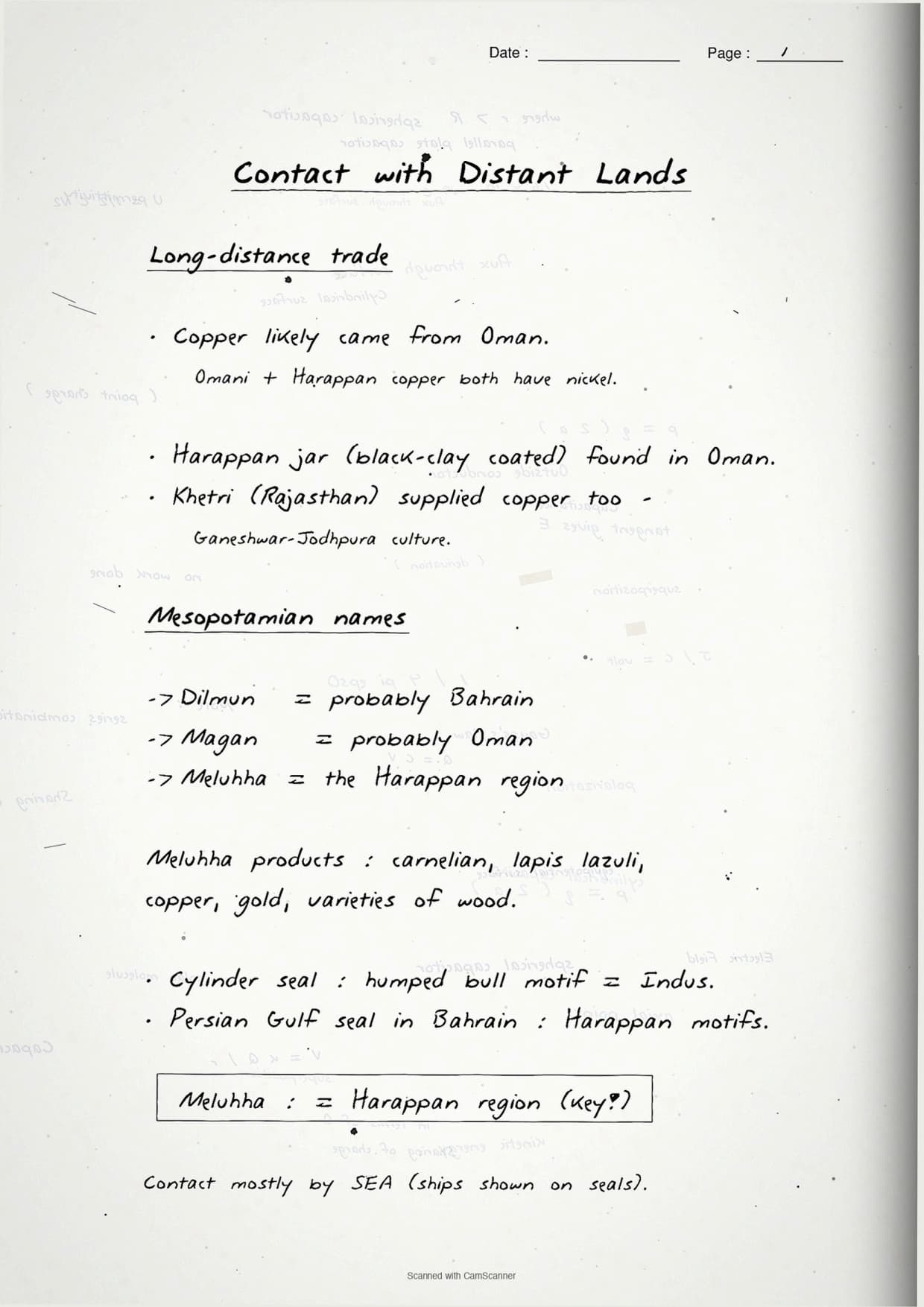
For raw materials the notes underline one rule: some came from the plains, but many were brought from far-off areas through trade. Copper came from Rajasthan and Oman, tin from Afghanistan, carnelian from Gujarat, and lapis lazuli from Afghanistan. A small hand-drawn map links each material to its source and to settlements like Shortughai, which makes the trade answer easy to picture.
Rulers, Burials and Reconstructing the Past Pages
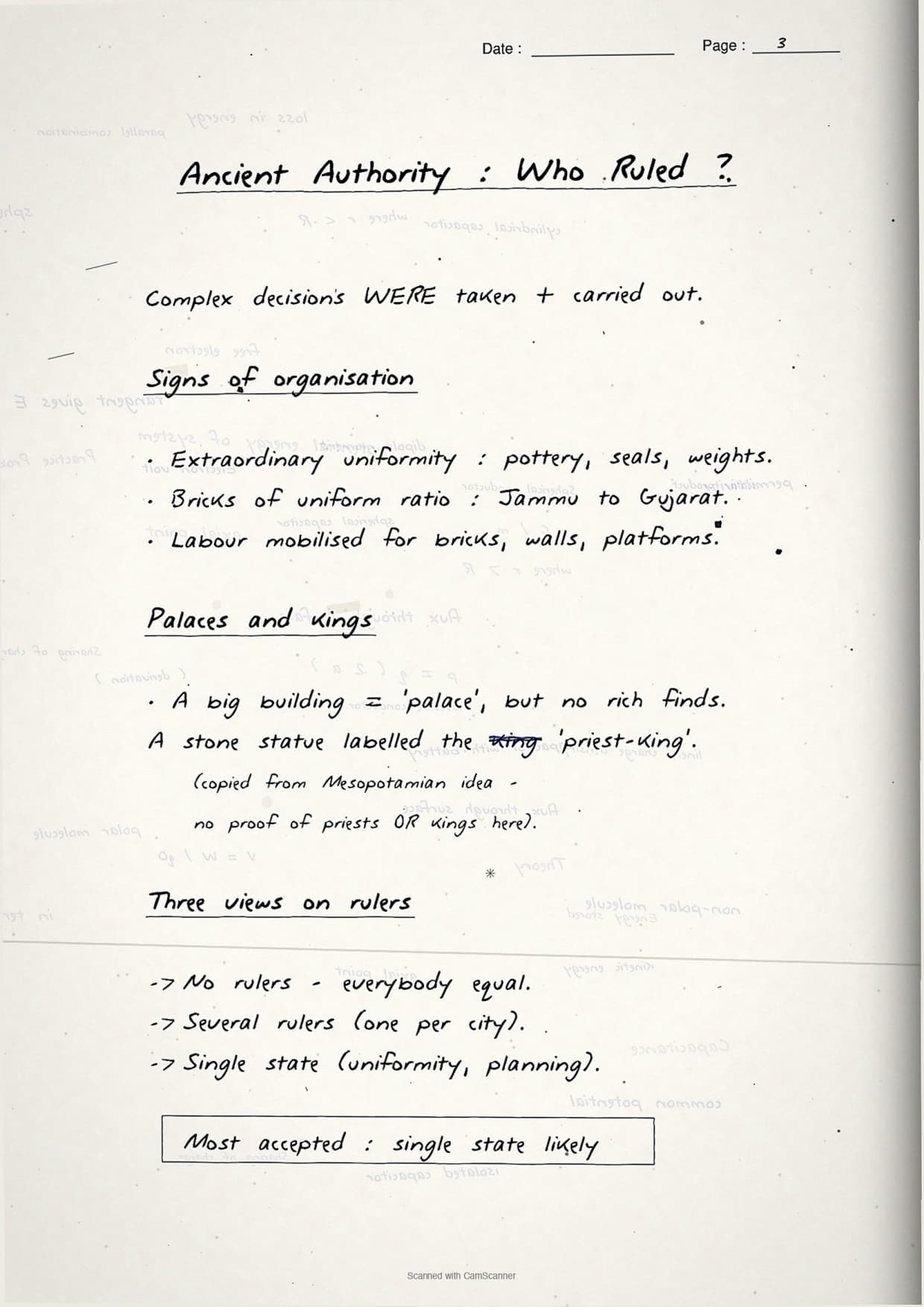
Because the script cannot be read, archaeologists study burials and luxury objects to find social differences. The notes give this its own set of pages, since it feeds both the "how do we reconstruct the past" answer and the rulers debate. Both are long-answer favourites, so the pages keep all three rulers views side by side.
- Burials: some graves had pottery, ornaments, copper mirrors or jewellery, while others were plain.
- Luxuries vs daily use: rare items like faience pots and gold appear only at large sites, hinting at status.
- Beliefs are hardest: the "Proto-Shiva" seal and Mother Goddess figures are interpretations, not proof.
- The "priest-king": a stone figure Marshall named so, though there is no firm proof of priests or kings.
The rulers debate is boxed with all three views. Some scholars say there was no ruler and everyone was equal; others suggest several rulers; a third view favours a single state. The single-state view is the strongest, because of the shared bricks, planned cities, common weights and the way settlements cluster near raw materials. The notes underline the honest line that material remains are easy to find, but religious meaning is the hardest to recover.
Decline and Rediscovery Pages
The last set of pages covers the end of the cities and how the civilisation was found again. By about 1900 BCE the mature Harappan cities began to fade. Both threads are short-answer favourites, so the notes keep the points in one boxed table for fast revision.
| Theme | Key points to recall |
|---|---|
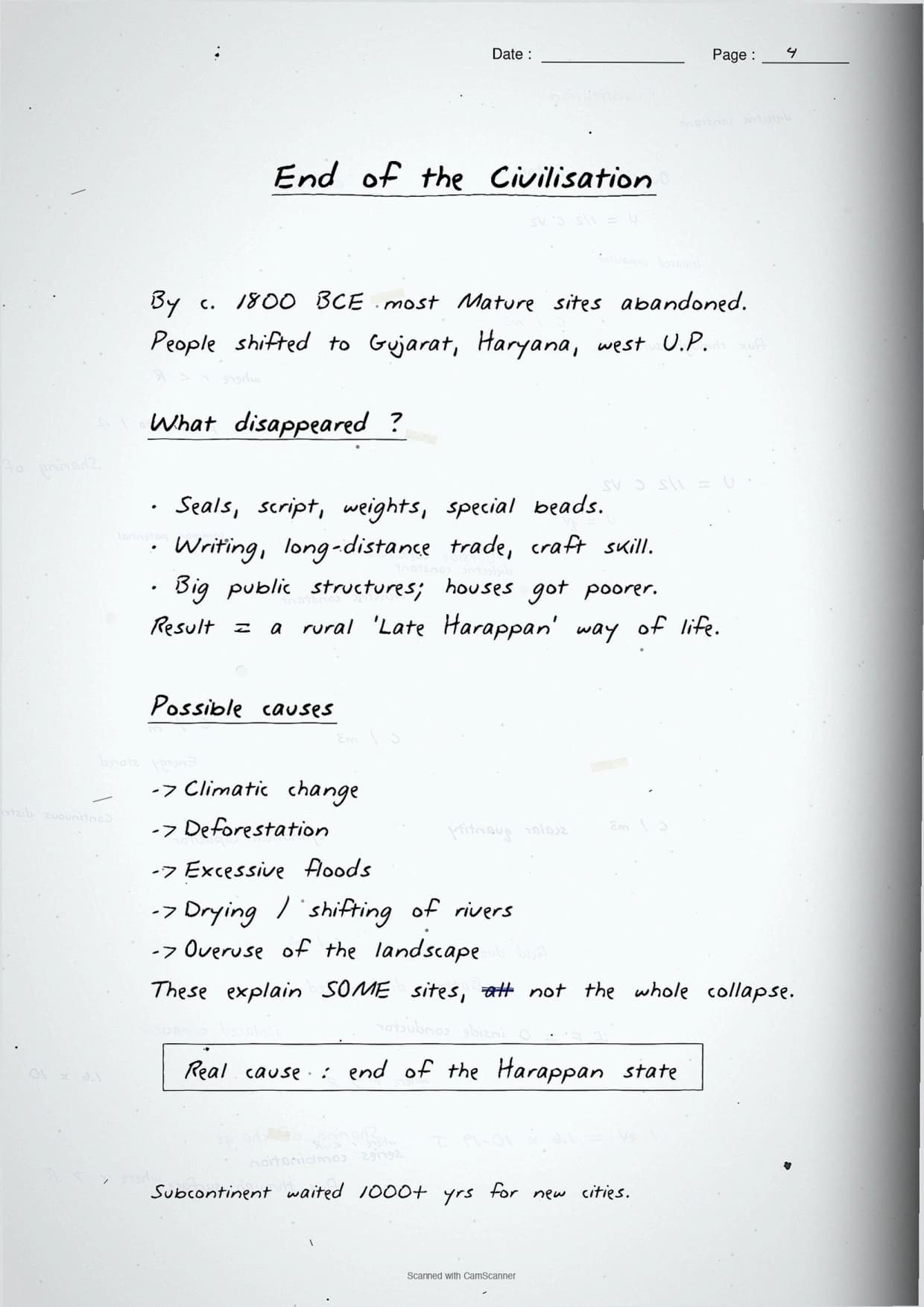
| Signs of decline | Writing, seals, weights and long-distance trade disappear; cities are abandoned; new pottery appears. |
| Possible causes | Climate change, drying of rivers, deforestation, floods, or the end of a strong central authority. |
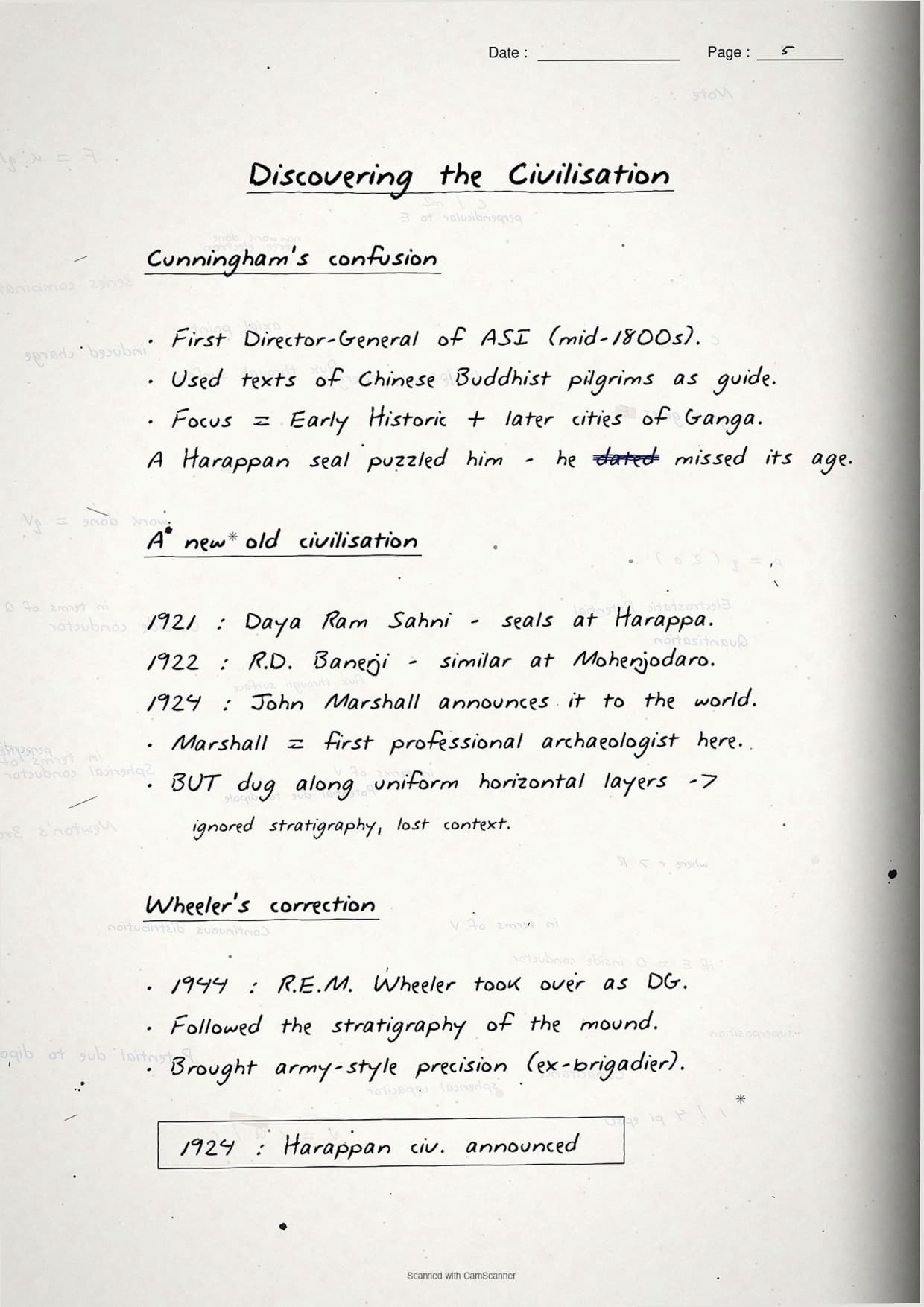
| Rediscovery | Cunningham missed it at first; Marshall announced it in 1924; Wheeler brought stratigraphic precision. |
One sharp point the notes box in the margin: Cunningham, the first Director-General of the ASI, used old texts to study the past and so failed to date Harappan seals correctly. The lesson is that the Harappan past needed a new method based on objects, not travel accounts. This connects the decline story back to the "how do we reconstruct the past" theme, which the pages mark with a linking arrow.
How to Use These Handwritten Notes
Handwritten notes work best as a final layer of revision, not as your first read. The plan below helps students get the most out of the bricks beads and bones handwritten notes before the board exam. Follow it once a week in the run-up to the test.
- First pass: read the notes once, following the bricks, beads and bones order of pages.
- Active recall: cover the boxed terms and try to write each list from memory.
- Sketch practice: redraw the Mohenjodaro layout and label it without looking.
- Self-test: attempt a short class 12 history chapter 1 mcq drill to check the small facts.
Because the notes come as a downloadable PDF, students can save them on a phone and revise offline on the way to the exam centre. Many students search for class 12 history chapter 1 notes on their phone the night before a test, so a saved PDF means revision is always at hand. Pair these pages with the full solutions to check your written answers against model points.
Common Mistakes These Notes Help You Avoid
A few errors cost marks in this chapter every year. Most come from stating guesses as facts or from giving only one side of a debate. The notes flag each soft point in the margin so students phrase it safely on the answer sheet.
- Calling the script "deciphered" - it is still not read.
- Saying the "priest-king" was a real king - it is only a name Marshall gave a statue.
- Giving only one view on rulers - always list all three, then pick the single-state view.
- Treating Mother Goddess and Proto-Shiva ideas as proven religion - they are interpretations.
- Forgetting that drains were planned before houses - this is the key town-planning point.
Students who fix these five points usually move from average to high marks. The exam rewards careful wording, so write "may have", "likely" or "scholars suggest" when the evidence is not certain. The handwritten margin notes nudge you to use these soft words in the right places.
How These Notes Pair with the Solutions and Book PDF
These handwritten notes are a revision layer. To prepare fully, students should use them with the other resources for the same chapter, all linked in the table below. Read the notes, then test yourself with the solutions, and open the book PDF for the original text and figures.
| Resource | Best used for |
|---|---|
| Bricks, Beads and Bones NCERT Solutions | Step-by-step answers to all 12 back-exercise questions |
| Bricks, Beads and Bones Class 12 Notes | Quick chapter summary with all dates and site names in one place |
| Bricks, Beads and Bones NCERT Book PDF | Reading the original NCERT chapter text and figures |
Tip: use the handwritten sketches to memorise layouts, then write the full answer in your own words. Drawing the Mohenjodaro plan once from memory fixes the town-planning answer for good.
All Class 12 History Handwritten Notes by Chapter
The table links the handwritten notes for every chapter in Themes in Indian History so students can move across the book in one click. Chapter 1 is highlighted.
| Chapter | Handwritten Notes |
|---|---|
| Chapter 1 | Bricks, Beads and Bones |
| Chapter 2 | Kings, Farmers and Towns |
| Chapter 3 | Kinship, Caste and Class |
| Chapter 4 | Thinkers, Beliefs and Buildings |
| Chapter 5 | Through the Eyes of Travellers |
| Chapter 6 | Bhakti-Sufi Traditions |
| Chapter 7 | An Imperial Capital Vijayanagara |
| Chapter 8 | Peasants, Zamindars and the State |
| Chapter 9 | Colonialism and the Countryside |
| Chapter 10 | Rebels and the Raj 1857 |
| Chapter 11 | Mahatma Gandhi and the Nationalist Movement |
| Chapter 12 | Framing the Constitution |
FAQs on Bricks, Beads and Bones Handwritten Notes
Bricks, Beads and Bones Class 12 Handwritten Notes Common Questions
Ques. Where can I download the Bricks, Beads and Bones handwritten notes PDF?
Ans. You can download the Bricks, Beads and Bones handwritten notes PDF directly from this page. It is free, follows the 2026-27 NCERT, and gives the chapter as clean handwritten pages with boxed terms and labelled sketches.
Ques. Are handwritten notes good enough for the class 12 history board exam?
Ans. Yes, for revision. Handwritten notes are best used as a final layer after you have read the chapter and practised the solutions. They make dates, site names and the Mohenjodaro layout quick to recall in the exam.
Ques. What does the Bricks, Beads and Bones chapter cover?
Ans. It covers the Harappan Civilisation from about 2600 BCE to 1900 BCE, including planned cities like Mohenjodaro, standard bricks, beads and crafts, seals, the undeciphered script, the rulers debate, and the decline and rediscovery of the cities.
Ques. Why is the drainage system seen as proof of town planning?
Ans. Because the covered drains were planned and laid first, and houses were built along them. The drains ran in straight lines, were joined from house to street, and used standard bricks. This advance planning is the heart of the chapter 1 history class 12 town-planning answer.
Ques. How should I use these notes for quick revision?
Ans. Read the pages once in the bricks, beads and bones order, cover the boxed terms and write each list from memory, redraw the Mohenjodaro sketch, then attempt a short class 12 history chapter 1 mcq drill to test the small facts.



Comments