Senior History Editor, 8 Yrs | Updated on - Jul 21, 2026
The NCERT Solutions for History Class 12 NCERT Solutions Chapter 1 Bricks, Beads and Bones cover every textbook question on the Harappan Civilisation, according to the latest 2026-27 CBSE syllabus. Each answer is based on the archaeological evidence that Cunningham, Marshall and Wheeler used to reconstruct this lost Bronze Age culture. These solutions help students prepare for the Class 12 History board paper and the UPSC foundation in 2026-27.
Covers all 12 exercise questions from Theme 1, with full source-based and long-answer points.
This Class 12 History chapter usually carries 6 to 8 marks per board paper.
Pairs with the Notes, Handwritten Notes and NCERT Book PDF linked lower on this page.
Every solution for class 12 history chapter 1 in this Collegedunia compilation is curated by subject experts, written from the official NCERT Themes in Indian History Part I, and checked against the last five years of CBSE board papers.
Student Feedback: In a Collegedunia poll of 11,540 Class 12 History students conducted before the 2026 boards, 68% of students rated the "How do archaeologists reconstruct the past?" question as the most-confusing part of Bricks, Beads and Bones. Most students said that listing evidence type by type made the answer click.
Source: 2026-27 Class 12 History student poll. Sample of 11,540 students from CBSE schools across 14 states.
What the Bricks, Beads and Bones Class 12 Chapter Is About
Bricks, Beads and Bones is the very first chapter of Themes in Indian History Part I. It studies the Harappan or Indus Valley Civilisation, which grew along the Indus and its tributaries between roughly 2600 BCE and 1900 BCE. The chapter is special because it has no written history students can read. Everything we know comes from objects dug out of the ground.
The title itself is a clue to the three kinds of evidence the chapter uses:
Bricks point to town planning, houses, drains and the Great Bath.
Beads point to craft production, trade and the work of specialists.
Bones (animal and human) point to food, farming and social differences seen in burials.
So the chapter is really about reading silent objects. A student who keeps the three Bs in mind can connect almost any question in chapter 1 history class 12 back to one of these evidence types. This is why history 12 class chapter 1 revision works best when you sort facts under bricks, beads or bones first.
Subsistence and Farming in the Harappan Civilisation
Harappans grew crops and kept animals. Archaeologists know this from charred grains, animal bones and the tools shown on seals. The food base was mixed, which is why both farming groups and herders mattered.
The main points students should remember about Harappan subsistence are:
Cereals grown: wheat, barley, lentil, chickpea and sesame; rice grains are rare finds.
Animals reared: cattle, sheep, goat, buffalo and pig; bones of wild species show hunting too.
Tools and methods: a terracotta model of a plough was found; fields may have been ploughed, as seen at Kalibangan.
Water management: canals and wells likely helped irrigation in drier zones like Shortughai.
The first exercise question asks students to list food items and name the groups who supplied them. Farmers, herders, fishers and hunters together fed the cities, so the answer should name all four groups, not just farmers.
Distinctive Features of Mohenjodaro and Harappan Town Planning
Mohenjodaro is the best-known Harappan city and the focus of several questions. Its layout shows careful planning that students must be able to describe in detail. The city was split into two parts that sat at different heights.
Feature
What it shows
Citadel
Raised western part on mud-brick platforms; held the Great Bath, warehouse and large halls.
Lower Town
Larger eastern part; residential, laid out on a rough grid of streets.
Grid streets
Roads crossed at right angles, dividing the town into blocks.
Drainage
Covered drains along streets, connected to house drains; planned before houses were built.
The Great Bath
A watertight tank on the Citadel, likely used for special ritual bathing.
A key insight for the drainage question is the order of building. The drains were planned first, and then houses were built along them. That single point is what proves real town planning, and it earns the marks in Question 1.3. Bricks were also of a standard ratio (length twice the width, width twice the height) across far-apart cities, which again shows shared planning rules.
Crafts, Beads and Raw Materials in Harappan Cities
The "beads" in the chapter title stand for the whole world of Harappan craft. Cities like Chanhudaro were almost fully given over to making things, which tells us specialists existed. Bead-making is the example NCERT uses to explain the full craft process.
Students should be ready to list materials and describe one bead-making process:
Shaping: hard stones were sawn, flaked, ground, polished and then drilled.
Steatite beads: made from a paste of powdered soft stone, so they could be moulded into tiny shapes.
Specialised centres: Chanhudaro, Lothal, Nageshwar and Balakot focused on shell and bead work.
For raw materials, the rule is simple. Some came from the plains, but many were brought from far-off areas. Copper likely came from Rajasthan and Oman, tin from Afghanistan, carnelian from Gujarat, and lapis lazuli from Afghanistan. The Harappans got these through trade, expeditions and settlements like Shortughai, set up near the source.
Seals, Script, Weights and the Question of Harappan Rulers
Seals, sealings, the undeciphered script and the standard weights all point to how the Harappans organised trade and authority. These objects come up in both short and long answers, especially the "rulers" question.
Seals and sealings: used to mark goods and close bundles, showing trade controls.
The script: still not deciphered; it was written right to left and is not alphabetical.
Weights: made of chert in a fixed pattern; lower units doubled, higher ones followed a decimal system.
The "priest-king": a stone figure Marshall named so, though there is no firm proof of priests or kings.
The rulers question is debated. Some scholars say there was no ruler and everyone was equal; others suggest several rulers; a third view favours a single state. The single-state view is the strongest, because of the shared bricks, planned cities, common weights and the way settlements cluster near raw materials. For Question 1.9, students should give all three views and then explain why the single-state idea fits the evidence best.
Social Differences, Burials and How Archaeologists Read the Past
Because the script cannot be read, archaeologists study burials and luxury objects to find social differences. This method is the heart of Questions 1.2 and 1.8, which ask how the past is reconstructed.
The main ways archaeologists trace differences and rebuild the story are:
Burials: some graves had pottery, ornaments, copper mirrors or jewellery, while others were plain.
Luxuries vs daily use: rare items like faience pots and gold are found only at large sites, hinting at status.
Recovering remains: they classify objects by material and function, study where things were found, and date layers.
Reconstructing beliefs: hardest of all; the "Proto-Shiva" seal and Mother Goddess figures are guesses, not proof.
The honest answer to "how do archaeologists reconstruct the past" is that material remains are easy to find, but religious meaning is the hardest to recover. Strong answers admit this limit instead of stating beliefs as facts. This is exactly the point the 68% of students in our survey said helped them most.
The Decline of the Harappan Civilisation and Its Rediscovery
By about 1900 BCE the mature Harappan cities began to fade. The chapter explains both the end of the cities and how the civilisation was found again in modern times. Both threads are short-answer favourites.
Theme
Key points to recall
Signs of decline
Writing, seals, weights and long-distance trade disappear; cities are abandoned; new pottery appears.
Possible causes
Climate change, drying of rivers, deforestation, floods, or the end of a strong central authority.
Rediscovery
Cunningham missed it at first; Marshall announced it in 1924; Wheeler brought military precision to digging.
One sharp exam point: Cunningham, the first Director-General of the ASI, used texts to study the past and so failed to date Harappan seals correctly. The lesson is that the Harappan past needed a new method based on objects, not old travel accounts. This connects the decline story back to the "how do we reconstruct the past" theme.
Bricks, Beads and Bones Class 12 Exercise-wise Coverage
The chapter exercise has 12 questions. The table maps each one to its topic so students can plan revision and find the right NCERT answer fast. The full step-by-step solution for each sits in the question set lower on this page.
Question
Topic it tests
Q 1.1
Food items in Harappan cities and the groups who supplied them
Q 1.2
Tracing socio-economic differences through burials and objects
Q 1.3
Drainage system as proof of town planning
Q 1.4
Bead materials and the bead-making process
Q 1.5
Source-based reading of the burial in Fig. 1.30
Q 1.6
Distinctive features of Mohenjodaro
Q 1.7
Raw materials for crafts and how they were obtained
Q 1.8
How archaeologists reconstruct the past
Q 1.9
Functions of rulers in Harappan society
Q 1.10 to 1.12
Map work and project-style activities
Questions 1.6, 1.8 and 1.9 are the most-asked long answers, so students preparing chapter 1 history class 12 revision should learn those three first. The map and project tasks (1.10 to 1.12) are also useful for the history project file class 12 chapter 1 that many schools assign.
Students who want the offline copy can save the class 12 history chapter 1 pdf from the download card above and tick off each question as they finish it.
Bricks, Beads and Bones Important Questions and Previous Year Trends
CBSE sets a steady mix of source-based, short and long answers from this chapter. Knowing the pattern helps students decide how much to write. The chapter is a regular source of one 5-mark or 8-mark source-based question, which is why a focused list of chapter 1 history class 12 important questions saves a lot of revision time.
Source-based (often 8 marks): a passage on the Great Bath, drainage or a burial, with three sub-parts.
Long answer (5 to 6 marks): features of Mohenjodaro, or functions of rulers.
Short answer (3 marks): bead-making, raw materials, or signs of decline.
Objective and MCQ: dates, site names, and who discovered what.
For quick recall before the exam, students often practise the class 12 history chapter 1 mcq set and a list of class 12 history chapter 1 important questions. The most repeated history class 12 chapter 1 question answer items are the Mohenjodaro features and the rulers debate, so keep those answer points ready in your own words.
It also helps to attempt a short history class 12 chapter 1 mcq drill and the class 12 history chapter 1 extra questions and answers after you finish the main exercise. These extra sets test the small facts, such as exact dates and site names, that examiners use for one-mark objective questions.
Working through the ncert solution class 12 history chapter 1 set twice, once open-book and once from memory, fixes those facts well before the board exam.
Common Mistakes Students Make in the Bricks, Beads and Bones Chapter
A few errors cost marks every year in this chapter. Most come from stating guesses as facts or from giving only one side of a debate. Avoiding them is the fastest way to lift a score.
Calling the script "deciphered" - it is still not read.
Saying the "priest-king" was a real king - it is only a name Marshall gave a statue.
Giving only one view on rulers - always list all three, then pick the single-state view.
Treating Mother Goddess and Proto-Shiva ideas as proven religion - they are interpretations.
Forgetting that drains were planned before houses - this is the key town-planning point.
Students who fix these five points usually move from average to high marks on the long answers. The exam rewards careful wording, so write "may have", "likely" or "scholars suggest" when the evidence is not certain.
Bricks, Beads and Bones PDF Download Formats and Languages
The solutions are free to download in more than one format, so students can pick what suits their device and revision style. The download card at the top of the page carries each option for this chapter.
Normal and HD PDF: the history class 12 chapter 1 pdf is offered in a normal size for quick downloads and an HD version for clear printing.
English medium: all 12 answers are written in simple English for the CBSE board paper.
Question-only set: a print-and-practise sheet of class 12 history chapter 1 extra questions for self-testing.
Whole-book pack: the chapter 1 history class 12 ncert solutions sit in one set that runs through every theme, so you can revise from Chapter 1 to the final chapter in one place.
Many students search for class 12 chapter 1 history answers on their phone the night before a test, so a saved PDF means you can revise even without internet. Keep both the question set and the solved version handy for a full self-check.
How the Bricks, Beads and Bones Solutions Pair with Notes and the Book PDF
These NCERT Solutions answer the back-exercise questions. To revise the full chapter, students should use them alongside the other resources for the same chapter, all linked in the table below.
Reading the original NCERT chapter text and figures
Tip: read the Notes first, then attempt these solutions on your own, and only then check the model answers here. That order builds memory faster than copying answers straight away.
All NCERT Solutions for Class 12 History Chapter 1 Bricks, Beads and Bones
The table links the NCERT Solutions for every chapter in Themes in Indian History so students can move across the book in one click. Chapter 1 is highlighted.
All NCERT Solutions for Bricks, Beads and Bones with Step-by-Step Solutions
Below are all 12 NCERT exercise questions for this chapter, exactly as they appear in the textbook. Tap Check Solution for the model answer or Expert Solution for the topper-style approach.
Q 1.1
List the items of food available to people in Harappan cities.
Identify the groups who would have provided these.
Concept used. This is a subsistence question. The food
list comes from charred plant remains studied by archaeo-botanists
and from animal bones studied by archaeo-zoologists. To name the
provider groups you reason from this evidence to the kinds of producers a
city would have depended on.
The Harappans ate a wide range of plant and animal products, including fish.
Cereals and pulses: wheat, barley, lentil, chickpea and
sesame. Millets are found at sites in Gujarat, while finds of rice
are relatively rare.
Animal products: bones of cattle, sheep, goat, buffalo and
pig show these animals were domesticated. Bones of wild species such
as boar, deer and gharial are also found, along with the bones of
fish and fowl.
These foods would have reached the cities from several producer groups:
Farmers in the surrounding countryside grew the cereals,
pulses and oilseeds.
Pastoralists / herders supplied milk and meat from the
domesticated cattle, sheep, goat and buffalo.
Fisherfolk caught the fish and fowl found at the sites.
Hunting communities may have supplied the meat of wild
animals; we do not know whether the Harappans hunted these
themselves or obtained meat through exchange.
Link the food to the worker
Examiners want both halves: the food item and the group that
produced it. Pair them, do not just list grains.
Food: wheat, barley, lentil, chickpea, sesame, millets, rice;
plus meat and milk of cattle, sheep, goat, buffalo, pig, and fish and fowl.
Providers: farmers, pastoralists, fisherfolk and (for wild meat) hunting
communities.
AS
Ananya Sengupta
MA Ancient Indian History, JNU
Verified Expert
Picture-first. Read the question as a food chain that ends at the
city. A Harappan city did not grow its own grain inside the walls, so every
item on the plate points outward to a producer in the hinterland. If you fix
that mental map, you never leave out the provider half of the answer.
Open by naming the evidence in one line: charred grains and
seeds (archaeo-botany) and animal bones (archaeo-zoology). This earns
the source-of-evidence mark before you even list the food.
Group the food, do not scatter it: (a) cereals and pulses, (b) milk
and meat from domesticated animals, (c) fish and fowl. Naming wheat,
barley, lentil, chickpea, sesame, millets and rice covers the plant
side fully.
Map each group to a producer: cultivators for grain, herders for milk
and meat, fishing folk for fish and fowl, and possibly hunter
communities for wild boar, deer and gharial.
Why this matters. The honest line that "we do not know whether the
Harappans hunted or obtained wild meat by exchange" shows you understand the
limits of archaeological inference, which is exactly the maturity a Class 12
examiner rewards.
Grains, pulses, oilseeds, millets, some rice; milk and meat of
domesticated animals; fish and fowl. Supplied by farmers, herders,
fisherfolk and hunters.
Q 1.2
How do archaeologists trace socio-economic differences in
Harappan society? What are the differences that they notice?
Concept used.Socio-economic difference means inequality
of wealth or status between people. Archaeologists cannot read it directly
(the script is undeciphered), so they infer it from two material strategies:
the study of burials and the classification of artefacts into
utilitarian objects and luxuries.
Studying burials. The dead were generally laid in pits.
Sometimes the burial pit was lined with bricks, and some graves held
pottery and ornaments (jewellery is found in burials of both men and
women). At Harappa, an ornament of three shell rings, a jasper bead
and hundreds of micro beads was found near the skull of a male.
Looking for "luxuries". Objects of daily use made cheaply
from ordinary stone or clay (querns, pots, needles) are called
utilitarian. Rare objects made from costly, non-local materials or
with difficult techniques (such as faience pots) are treated as
luxuries.
Mapping the spread. Rare valuable objects, like miniature
faience pots, cluster in large cities such as Mohenjodaro and
Harappa and are scarce in small settlements like Kalibangan. All the
gold jewellery was recovered from hoards.
What they notice. The differences are real but modest.
Burials show some variation but, on the whole, the Harappans did not bury
great wealth with the dead (unlike the Egyptian pyramids). The clearest gap
is between big cities and small settlements in who owned rare luxury goods.
Compare with Egypt
The chapter sets the Harappan burials against the Egyptian pyramids, which
held enormous royal wealth. Naming that contrast shows the Harappan elite
display was comparatively restrained, a key marking point.
They use burials and the utilitarian-versus-luxury classification of
artefacts. They notice only modest differences: little wealth buried with the
dead, but rare luxury goods (faience, gold from hoards) concentrated in the
big cities.
RI
Rohan Iyer
MA Archaeology, Deccan College Pune
Verified Expert
Strategic angle. Split the answer into "method" and "findings" with
a clear hinge sentence. The method half is the two strategies; the findings
half is what those strategies reveal. Markers scan for both, so signpost
them.
Method one, burials: note the pit burials, occasional brick lining,
and grave goods (pottery, jewellery for both sexes, the male skull
ornament at Harappa). Add the honest caveat: we are "not sure" these
variations prove social rank.
Method two, artefacts: define utilitarian versus luxury, then use the
distribution evidence (faience perfume pots and gold hoards in
Mohenjodaro and Harappa, almost none at Kalibangan) to argue for a
city-versus-village gap.
State the headline finding crisply: differences exist but are
limited; Harappan cemeteries "show little social differentiation",
which is itself an unsolved puzzle in the chapter.
Why this matters. The strongest scripts resist over-reading the
data. Saying the inequality was modest, and flagging the unanswered question
about cemeteries, signals genuine historical thinking rather than guesswork.
Add one sharp contrast for full marks: unlike the Egyptian pyramids, which
were royal tombs packed with wealth, the Harappans buried little of value
with their dead, so even the richest graves stay restrained. That single
comparison tells the examiner you can place the Harappan evidence in a wider
ancient-world setting, which is exactly the skill the question rewards.
Strategies: burials and artefact classification (utilitarian
versus luxury), read through the spatial spread of rare goods. Finding:
limited inequality, with luxury goods concentrated in large cities.
Q 1.3
Would you agree that the drainage system in Harappan cities
indicates town planning? Give reasons for your answer.
Concept used. This is an argument question: you must take a
clear position (Yes) and defend it with evidence. Town planning
means a settlement built to a deliberate design rather than growing at
random. The drainage system is strong evidence for such planning.
Yes, the drainage system clearly indicates town planning. The
reasons:
Streets and drains came first. Roads and streets in the
Lower Town were laid out on a rough "grid", intersecting at right
angles. Streets with drains were laid out first, and houses were
built along them afterwards. Planning the network before the houses
is the heart of town planning.
Every house was tied to the system. Because waste water had
to flow into the street drains, every house needed at least one wall
along a street. House drains first emptied into a sump or cesspit
where solid matter settled, and only the waste water flowed on into
the street drains.
The drains were engineered. Channels were made of bricks set
in mortar and covered with loose bricks (sometimes limestone) that
could be lifted for cleaning. Long channels had sumps at intervals
for cleaning. Mackay called it "the most complete ancient system as
yet discovered".
It was a shared standard, not a one-off. Drains were not
unique to the big cities; even at small Lothal, houses were of mud
brick but the drains were built of burnt brick.
State your stand in line one
For "Would you agree" questions, open with a clear "Yes" (or "No") and then
give numbered reasons. A fence-sitting answer loses the argument mark.
Yes. The grid streets with drains laid before the houses, every
home connected through sumps to covered, cleanable brick channels, and the
same standard reaching even small sites like Lothal, all show deliberate town
planning.
MK
Meera Krishnan
MA History, University of Hyderabad
Verified Expert
Strategic angle. Treat each feature of the drains as a separate
"proof" of planning, and connect it back to the claim every time. The drain
is your evidence; "planning" is what you must keep proving.
Sequence is the killer point: streets and drains were laid first,
then houses built along them. Lead with this, because it most
directly proves a plan existed before construction.
Integration: every house plugged into the public network through its
own bathroom drain and a sump. A city where private and public
systems interlock did not happen by accident.
Maintenance and uniformity: removable covers, cleaning sumps, and the
same drainage idea reaching small Lothal show a shared civic
standard, not local improvisation.
Why this matters. A good answer does not just describe drains, it
argues from them. Each line should end with "and this shows planning", so the
examiner sees a thesis being defended, not a paragraph being copied. Borrow
Mackay's own verdict, that this was "the most complete ancient system as yet
discovered", as a quotable closing line; an apt source quotation lifts an
argument answer from good to top band, because it shows you are reasoning from
the excavators' record and not just from the textbook summary.
Yes, strongly. Pre-planned grid drains, universal house
connections, engineered cleanable channels and a shared standard across big
and small sites are all hallmarks of deliberate town planning.
Q 1.4
List the materials used to make beads in the Harappan civilisation.
Describe the process by which any one kind of bead was made.
Concept used.Craft production at sites like Chanhudaro
included bead-making. The answer has two clear parts: a list of the raw
materials, and a step-by-step account of making one bead (carnelian is the
clearest example because the chapter describes its process in full).
Materials used for beads:
Stones: carnelian (a beautiful red), jasper, crystal, quartz
and steatite.
Metals: copper, bronze and gold.
Other materials: shell, faience, and terracotta (burnt clay).
Some beads combined two or more stones cemented together, or stone with gold
caps. Shapes included disc, cylindrical, spherical, barrel-shaped and
segmented, decorated by incising, painting or etching.
Making a carnelian bead:
The red colour of carnelian was obtained by firing the
yellowish raw material (and the beads) at various stages of
production.
Nodules were chipped into rough shapes.
They were then finely flaked into the final form.
Grinding, polishing and drilling completed the process.
Specialised drills have been found at Chanhudaro, Lothal and
Dholavira.
Steatite is the odd one out
The very soft stone steatite was worked differently: beads could be
moulded from a steatite-powder paste, allowing shapes that harder stones
could not take. How the tiny steatite micro bead was made is still a puzzle.
Materials: carnelian, jasper, crystal, quartz, steatite, copper,
bronze, gold, shell, faience and terracotta. Carnelian bead: fire the raw
material for colour, chip the nodule, finely flake it to shape, then grind,
polish and drill.
DN
Devika Nair
MSc Archaeological Science, IIT Gandhinagar
Verified Expert
Structural observation. The question has two commands, "list" and
"describe", worth roughly equal marks. So split your time evenly: a tight
materials list, then a clean four-stage process for one bead. Picking
carnelian is smart because the chapter gives its full method.
List by category, not at random: stones, metals, then shell or
faience or terracotta. Categorised lists read as informed and are
easier to mark.
For the process, hold the order firmly: fire (for the red colour),
chip, flake, then grind or polish or drill. The firing step is the one
students forget, yet it is what makes carnelian carnelian.
Add one location detail, that specialised drills come from Chanhudaro,
Lothal and Dholavira, to anchor the craft in real sites.
Why this matters. Naming Chanhudaro as an almost wholly craft
settlement shows you grasp that bead-making was a specialised industry, not a
household chore, which lifts the answer above a bare list.
Beads were made from carnelian, jasper, crystal, quartz, steatite,
copper, bronze, gold, shell, faience and terracotta. A carnelian bead was
fired for colour, chipped, finely flaked, then ground, polished and drilled.
Q 1.5
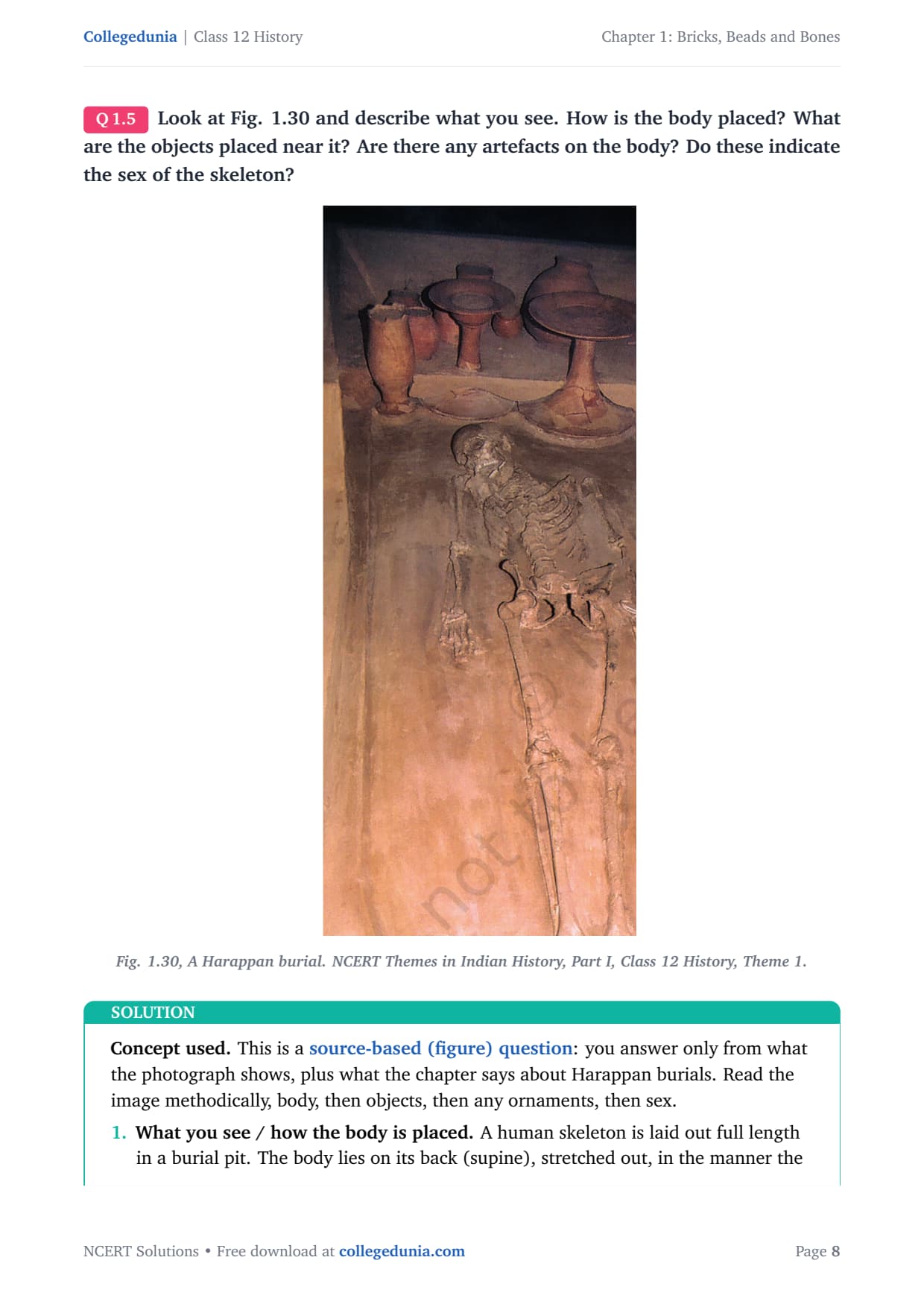
Look at Fig. 1.30 and describe what you see. How is the body
placed? What are the objects placed near it? Are there any artefacts on the
body? Do these indicate the sex of the skeleton?
Fig. 1.30, A Harappan burial. NCERT Themes
in Indian History, Part I, Class 12 History, Theme 1.
Concept used. This is a source-based (figure) question: you
answer only from what the photograph shows, plus what the chapter says about
Harappan burials. Read the image methodically, body, then objects, then any
ornaments, then sex.
What you see / how the body is placed. A human skeleton is
laid out full length in a burial pit. The body lies on its back
(supine), stretched out, in the manner the chapter describes for
Harappan pit burials.
Objects placed near it. A number of pottery vessels
(pots) are placed near the head and upper body. Such grave pottery
may reflect a belief that these vessels could be used in the
afterlife.
Artefacts on the body. There are no clear ornaments or
jewellery visible on the skeleton in this image. The chapter notes
that on the whole the Harappans did not bury precious things with the
dead, though jewellery is sometimes found in burials.
Sex of the skeleton. The objects (mainly pots) do not
indicate the sex. In Harappan burials jewellery is found with both
men and women, so grave goods cannot fix the sex; that needs
skeletal (osteological) study, not the pots.
Answer all five mini-questions
Q5 asks five things: what you see, body position, nearby objects, artefacts
on the body, and sex. Tick each one off so you do not drop easy marks.
A skeleton lies extended on its back in a pit, with pottery vessels
placed near the head. No ornaments are clearly visible on the body, and the
grave goods do not reveal the skeleton's sex (jewellery occurs with both men
and women), so sex cannot be told from the objects.
SQ
Sara Qureshi
MA Archaeology, Aligarh Muslim University
Verified Expert
Picture-first. The marks here are literally on the page in front of
you. Describe only what the photo actually shows and resist inventing details
(no "rich ornaments", no "royal burial"). Then close the loop with the
chapter's rule that grave goods do not reveal sex.
Describe the placement plainly: an extended, supine skeleton in a
simple pit. That single accurate sentence already earns the
"how is the body placed" mark.
Identify the objects as pottery near the head, and link them to the
afterlife belief the chapter mentions. Do not over-claim wealth.
Answer the sex question with a reason, not a guess: jewellery is found
with both sexes, so the goods are sex-neutral; only bone study can
decide.
Why this matters. The examiner is testing whether you can separate
observation (what the image shows) from inference (what it might mean). Saying
clearly that the objects cannot fix the sex is the mark of careful source
reading.
An extended skeleton on its back in a pit, pots set near the head,
no visible ornaments; the grave goods do not indicate the sex of the
skeleton.
Q 1.6
Describe some of the distinctive features of Mohenjodaro.
Fig. 1.7, Layout of Mohenjodaro, showing the
Citadel (west) and the Lower Town (east). NCERT Themes in Indian History,
Part I, Class 12 History, Theme 1.
Concept used. Mohenjodaro is the best-preserved Harappan city and
the model for a planned urban centre. A "distinctive features"
essay should move through the city in an orderly way: its two-part layout,
the drains, the houses, and the special buildings on the Citadel.
1. A two-part, planned settlement. Mohenjodaro is divided into two
sections: a smaller but higher part (the Citadel) and a much larger
but lower part (the Lower Town). The Citadel is high because its
buildings stood on mud-brick platforms, and it was walled, physically
separated from the Lower Town. Putting the platforms in place alone has been
estimated at four million person-days of labour, which shows large-scale
organisation. Once platforms were laid, building was confined to fixed areas,
so the settlement was planned first and then built.
2. Standardised bricks and a grid of streets. Bricks, whether
sun-dried or baked, followed a fixed ratio (length and breadth four and two
times the height) and were used at all Harappan sites. The Lower Town's roads
and streets ran on an approximate "grid", intersecting at right angles.
3. A planned drainage system. Streets with drains were laid out
first and houses built along them, so every house had at least one wall on a
street to carry its waste water out. House drains ran through the wall into
the covered street drains, which had removable covers and cleaning sumps.
4. Domestic architecture built for privacy. Many houses centred on a
courtyard with rooms around it, used for cooking and weaving. There were no
windows in the ground-level walls, and the main entrance did not give a
direct view of the interior, showing a concern for privacy. Each house had
its own brick-paved bathroom, many had staircases to an upper storey or roof,
and there were perhaps about 700 wells in the city.
5. Special structures on the Citadel. The Citadel carried buildings
for public purposes: a massive warehouse (its lower brick portion
survives) and the famous Great Bath, a large watertight rectangular
tank with steps on the north and south, a surrounding corridor, and a nearby
building with eight bathrooms. Scholars think the Great Bath was meant for
some kind of special ritual bath.
Use the Citadel/Lower Town spine
Organise the whole essay around the two-part layout. Every distinctive
feature, drains, houses, the Great Bath, hangs off it, which keeps a 500-word
answer tidy.
Mohenjodaro's distinctive features: a planned two-part layout
(walled Citadel on platforms + larger Lower Town), standardised bricks and a
grid of streets, a covered cleanable drainage system, courtyard houses built
for privacy with their own bathrooms and wells, and special Citadel
structures like the warehouse and the Great Bath.
VD
Vikram Desai
MA Ancient History, Banaras Hindu University
Verified Expert
Strategic angle. A 500-word essay needs visible structure. Use four
or five bold sub-headings, exactly the spine of the chapter section, and the
answer almost writes itself: layout, drains, houses, Citadel structures. That
also stops you from dumping everything into one block.
Open with the headline fact: Mohenjodaro is the best-preserved
Harappan city and the showpiece of urban planning. This frames every
feature as evidence of planning, and it is worth contrasting it with
Harappa, the first site found but badly damaged by brick robbers, so
the examiner sees why Mohenjodaro is the standard example.
Walk the city top to bottom in a fixed order so nothing is missed: the
walled Citadel raised on mud-brick platforms (cite the four million
person-days of labour as proof of organised effort), then the gridded
Lower Town with streets crossing at right angles, then a typical
courtyard house with its windowless ground-floor walls, indirect
entrance, private brick bathroom and well.
Give the drains their own beat: streets and drains were laid first and
houses fitted to them, every house plugged into covered, cleanable
brick channels, and even small Lothal copied the idea in burnt brick.
This single feature carries most of the "planning" marks.
Finish on the Citadel's special buildings, the warehouse (only the
lower brick portion survives) and the Great Bath, a watertight tank
with steps, a corridor and an eight-bathroom block beside it. Add the
careful line that the Bath was "probably" a ritual structure, since
the chapter never proves it.
Why this matters. The marker is looking for breadth and order, not
just a pile of facts. Hanging everything on the Citadel and Lower Town gives
the essay a clear backbone, and the cautious wording on the Great Bath shows
you know which conclusions are firm and which are still debated. A 500-word
answer that marches through layout, bricks, drains, houses and Citadel
structures in that order reads as planned, which quietly mirrors the planned
city you are describing.
Cover the two-part layout, standardised bricks and grid streets,
the covered drainage system, courtyard houses with bathrooms and wells, and
the Citadel's warehouse and Great Bath, all framed as proof of deliberate
urban planning.
Q 1.7
List the raw materials required for craft production in the
Harappan civilisation and discuss how these might have been obtained.
Concept used. Craft production needed many raw materials,
only some of which were locally available. The answer pairs a list of
materials with the strategies of procurement the Harappans used to
reach materials that lay outside the alluvial plain.
Raw materials required:
Locally available: clay, found in the alluvial plain itself.
From outside the plain: stone (carnelian, steatite, etc.),
timber, metals (copper, gold), shell, and
precious stones such as lapis lazuli.
How these materials were obtained:
Settling near the source. The Harappans set up settlements
where a material was found: Nageshwar and Balakot near shell;
Shortughai in far-off Afghanistan near the best lapis lazuli; and
Lothal near sources of carnelian (Bharuch), steatite (south Rajasthan
and north Gujarat) and metal (Rajasthan).
Sending expeditions. They sent expeditions to areas such as
the Khetri region of Rajasthan (for copper) and south India (for
gold). These expeditions made contact with local communities; finds
of Harappan steatite micro beads in such areas hint at this contact.
The Ganeshwar-Jodhpura culture of the Khetri area, rich in copper
objects, may have supplied copper to the Harappans.
Long-distance trade overseas. Copper was probably also
brought from Oman: both Omani and Harappan copper carry traces of
nickel, suggesting a common origin, and a large Harappan jar coated
with black clay has been found at Omani sites. Mesopotamian texts
speak of copper from Magan (perhaps Oman) and of products from
Meluhha (probably the Harappan region), including carnelian, lapis
lazuli, copper, gold and wood.
Transport. Goods moved by bullock cart over land (terracotta
toy carts survive), and along riverine routes on the Indus and its
tributaries and by coastal and sea routes.
Trade reveals reach
The Oman and Mesopotamia links show the Harappans were not isolated; their
hunt for raw materials drew them into a wide exchange network across West
Asia.
Materials: local clay, plus stone, timber, metals (copper, gold),
shell and lapis lazuli from outside. Obtained by founding settlements at the
source, sending expeditions (Khetri for copper, south India for gold), and
overseas trade (Oman, Mesopotamia), moved by cart, river and sea.
IS
Imran Sheikh
MA History, Jamia Millia Islamia
Verified Expert
Structural observation. The verb "discuss" outweighs "list" here, so
spend most of your words on the how. Give a quick materials list, then
build the essay around three procurement strategies: settle at the source,
send expeditions, and trade overseas.
Sort the materials into local (clay) versus imported (stone, timber,
metal, shell, lapis). The simple contrast frames the whole problem of
procurement.
For each strategy, name the proof: Nageshwar and Balakot for shell,
Shortughai for lapis, and Khetri or south India for the metals. Site
names are what turn a vague answer into a marked one.
Use the nickel-trace evidence and the black-clay jar in Oman to show
how archaeologists know about distant trade, then close with
the transport routes (cart, river, sea).
Bring in the Mesopotamian written record as outside confirmation:
their texts name Magan (probably Oman), Dilmun (probably Bahrain) and
Meluhha (probably the Harappan region), and list Meluhha's exports as
carnelian, lapis lazuli, copper, gold and wood. A second, independent
source backing the archaeology is a strong marks-fetching move.
Why this matters. Tying each material to a named site or a scientific
clue (the nickel signature) demonstrates that procurement is reconstructed
from evidence, not assumed, which is exactly the skill the essay tests. It
also quietly proves a bigger point: the search for raw materials is what
pulled the Harappans into a trading world stretching from Afghanistan to the
Persian Gulf, so a question that looks like a list is really about the reach
of the civilisation.
List local clay versus imported stone, timber, metal, shell and
lapis; then discuss three routes to them, settlements at the source,
expeditions to Khetri and south India, and overseas trade with Oman and
Mesopotamia.
Q 1.8
Discuss how archaeologists reconstruct the past.
Concept used. Because the Harappan script is undeciphered, the past
is reconstructed not from texts but from material evidence, pottery,
tools, ornaments, bones, buildings. Reconstruction is a chain: recover the
remains, classify them, read their context, and interpret them with care.
What survives, and what does not. Organic materials (cloth,
leather, wood, reeds) usually decay, especially in the tropics. What
remains is stone, burnt clay (terracotta) and metal. Also, only
broken or useless things were thrown away; valuable objects were
recycled, so intact finds are accidental rather than typical.
Classifying finds. Archaeologists classify finds first by
material (stone, clay, metal, bone, ivory) and then, more
tricky, by function, deciding whether an object was a tool, an
ornament, ritual, or several of these.
Using analogy and context. Function is judged partly by
resemblance to present-day things (beads, querns, pots) and partly by
the context of the find: was it in a house, a drain, a grave,
a kiln? Indirect evidence is used too, such as judging clothing from
depictions in sculpture.
Building frames of reference. The first Harappan seal could
not be understood until there was a context to place it in, both its
cultural sequence and a comparison with Mesopotamian finds.
Interpreting with caution, especially religion. Terracotta
female figurines (read as mother goddesses), the "priest-king", the
Great Bath, fire altars and "proto-Shiva" seals are all interpreted by
moving "from the known to the unknown". This is reasonable for querns
and pots but speculative for religious symbols, so conclusions stay
open.
Reconstruction can be reversed
The "massacre at Mohenjodaro" claim (Wheeler) was later overturned by George
Dales. Mentioning this shows reconstruction is provisional, not final.
Archaeologists reconstruct the past from surviving material remains:
they recover finds, classify them by material and function, read each find's
context and present-day analogies, build frames of reference (e.g. comparison
with Mesopotamia), and interpret cautiously, most of all for religion, where
conclusions remain speculative.
LM
Lakshmi Menon
MPhil Archaeology, University of Calcutta
Verified Expert
Strategic angle. Present reconstruction as a method with stages, not
a list of facts. The examiner wants the process: survival of evidence,
classification, context, analogy, and cautious interpretation. End on the
limits, because honesty about uncertainty is the chapter's main theme.
Start with the survival problem: organics rot, only durable materials
last, and intact valuables are accidental finds. This explains why
the record is partial.
Move to method: classify by material, then function; use analogy with
modern objects and the find-context (house, grave, drain, kiln) to
decide what a thing was for.
Close on interpretation and its limits: the leap from object to
meaning is safe for tools but risky for "religious" items, and earlier
readings (Wheeler's massacre) have been reversed, so all
reconstruction is provisional.
Why this matters. Naming a concrete reversal (Dales versus Wheeler)
proves you understand that archaeology is self-correcting. That single example
lifts the essay from description to genuine historical method. You can sharpen
it further by mentioning the recent archaeogenetic work at Rakhigarhi, where
DNA from skeletal remains is now being read to study the Harappans, evidence
unavailable to Marshall or Wheeler. Showing that the toolkit itself keeps
growing, from the trowel to the gene sequencer, is the most current way to
prove that reconstructing the past is an open, evolving process.
Recover durable remains, classify by material and function, read
context and analogy, build frames of reference, and interpret cautiously;
treat all conclusions, especially about religion, as provisional and open to
revision.
Q 1.9
Discuss the functions that may have been performed by rulers in
Harappan society.
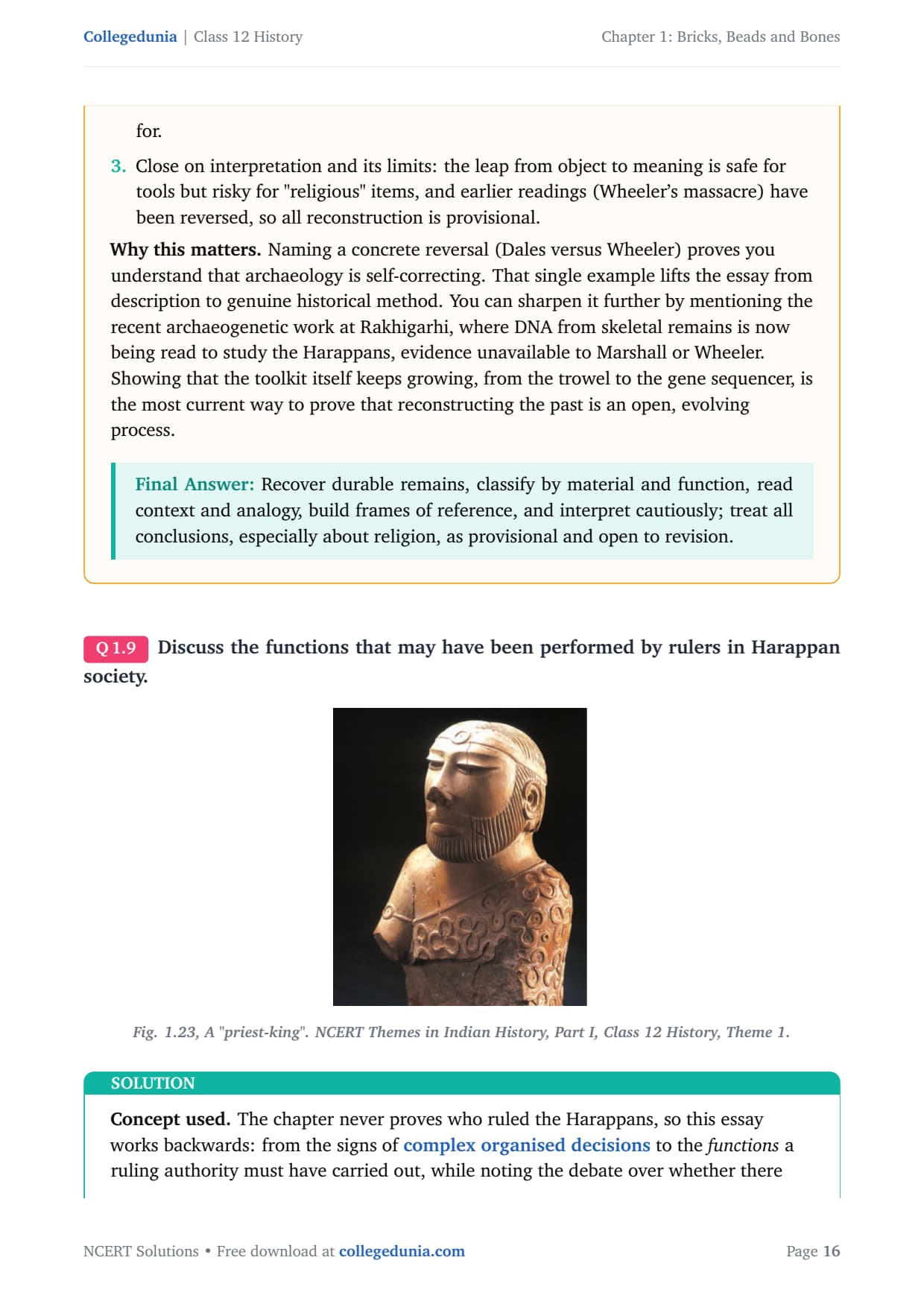
Fig. 1.23, A "priest-king". NCERT Themes in
Indian History, Part I, Class 12 History, Theme 1.
Concept used. The chapter never proves who ruled the Harappans, so
this essay works backwards: from the signs of complex organised
decisions to the functions a ruling authority must have carried out,
while noting the debate over whether there were rulers at all.
Evidence that some authority existed:
The extraordinary uniformity of artefacts: pottery, seals,
weights and especially bricks of a fixed ratio from Jammu to Gujarat.
Mobilised labour for making bricks and building the massive
walls and platforms.
Settlements deliberately placed near sources of raw material.
Functions a ruler / authority may have performed:
Planning and public works: organising the platforms, walls,
drainage and the layout of cities.
Enforcing standards: maintaining the uniform brick ratio,
weights and seals across a huge region.
Mobilising and managing labour: gathering the workforce for
brick-making and large constructions.
Controlling craft and trade: setting up settlements at raw-
material sources and managing long-distance exchange.
The debate over rulers. A large building at Mohenjodaro was called a
"palace", but yielded no spectacular finds; a stone statue is called the
"priest-king" only because archaeologists knew Mesopotamian priest-kings, not
because we know he ruled. So scholars disagree: some think Harappan society
had no rulers and everybody was equal; some think there were
several rulers (one for Mohenjodaro, one for Harappa, and so on);
others argue for a single state, given the uniform artefacts, planned
settlements and standard brick ratio.
Functions, then the debate
List the likely functions first, then present the three scholarly views. A
top answer makes clear that the rulers are inferred, not proven.
If rulers existed, they likely planned public works, enforced the
uniform standards (bricks, weights, seals), mobilised labour and oversaw craft
and trade. But the evidence is indirect: scholars variously argue for no
ruler, several rulers, or a single Harappan state.
AR
Arjun Reddy
MA History, University of Delhi
Verified Expert
Strategic angle. The trap is to assert there was a king.
Instead, argue from the evidence of organisation to the functions a central
authority would have performed, and give equal weight to the three competing
views. Balance is what scores here.
Lay the evidence first: uniformity of bricks, weights and seals;
mobilised labour; planned settlements. These are the facts every view
must explain.
Convert each piece of evidence into a function: someone planned the
works, someone enforced the standards, someone mobilised the labour,
someone managed trade.
Present the debate fairly, no ruler / several rulers / one state, and
use the "palace" with no rich finds and the wrongly-named
"priest-king" to show how thin the direct evidence really is.
Why this matters. The examiner rewards the student who separates what
the artefacts show (organisation) from what they cannot show (a named king).
Holding that line, while still listing plausible functions, is the mark of a
careful historian.
Likely ruler functions: planning public works, enforcing
uniform standards, mobilising labour and controlling craft and trade, all
inferred from organisation, not proof; scholars still dispute whether there
was no ruler, several, or a single state.
Q 1.10
On Map 1, use a pencil to circle sites where evidence of
agriculture has been recovered. Mark an X against sites where there is
evidence of craft production and R against sites where raw materials were
found.
Concept used. This is a map-work task. You apply the
chapter's site evidence to Map 1 using three marks: a circle for
agriculture, an X for craft production, and an R for raw
materials. Below is the guide for which marks go where; on the actual Map 1
in your book, place each mark on the named site.
Circle (agriculture).Kalibangan (evidence of a
ploughed field at Early Harappan levels) and Banawali
(terracotta plough model); the Cholistan area also has plough models.
Most Harappan sites had farming, so circle the major sites such as
Harappa and Mohenjodaro too.
X (craft production).Chanhudaro (a tiny settlement
almost wholly devoted to bead-making, shell-cutting, metal-working,
seal-making and weight-making), Lothal and Dholavira
(specialised drills for bead-making), and the large cities
Mohenjodaro and Harappa, which also produced crafts.
R (raw materials).Nageshwar and Balakot
(shell, near the coast), Shortughai in Afghanistan (lapis
lazuli), Khetri in Rajasthan (copper) and south India / Kolar
(gold); carnelian came from Bharuch and steatite from south Rajasthan
and north Gujarat.
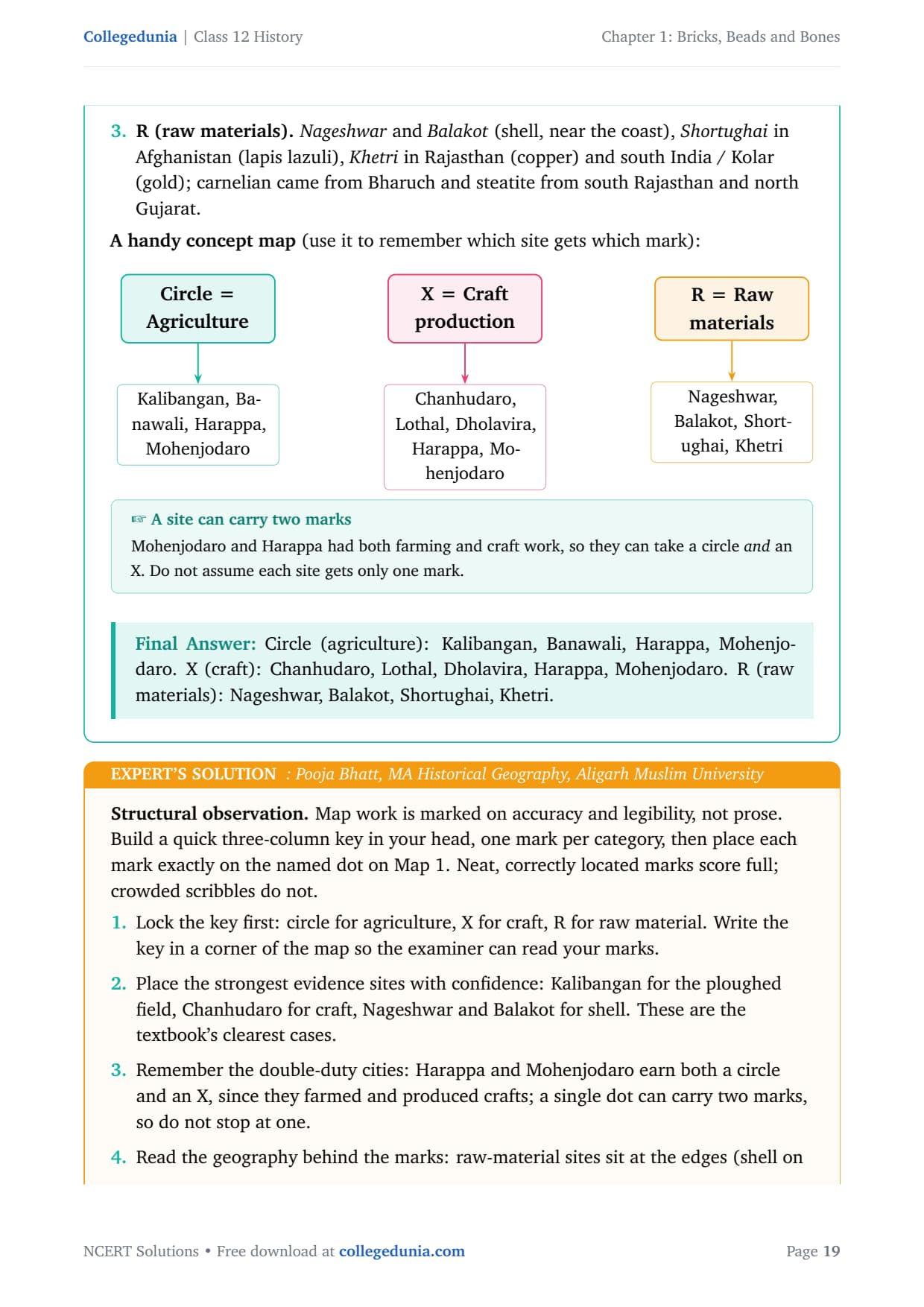
A handy concept map (use it to remember which site gets which mark):
!
[See diagram in the PDF version]
A site can carry two marks
Mohenjodaro and Harappa had both farming and craft work, so they can take a
circle and an X. Do not assume each site gets only one mark.
Circle (agriculture): Kalibangan, Banawali, Harappa, Mohenjodaro.
X (craft): Chanhudaro, Lothal, Dholavira, Harappa, Mohenjodaro. R (raw
materials): Nageshwar, Balakot, Shortughai, Khetri.
PB
Pooja Bhatt
MA Historical Geography, Aligarh Muslim University
Verified Expert
Structural observation. Map work is marked on accuracy and
legibility, not prose. Build a quick three-column key in your head, one mark
per category, then place each mark exactly on the named dot on Map 1. Neat,
correctly located marks score full; crowded scribbles do not.
Lock the key first: circle for agriculture, X for craft, R for raw
material. Write the key in a corner of the map so the examiner can
read your marks.
Place the strongest evidence sites with confidence: Kalibangan for
the ploughed field, Chanhudaro for craft, Nageshwar and Balakot for
shell. These are the textbook's clearest cases.
Remember the double-duty cities: Harappa and Mohenjodaro earn both a
circle and an X, since they farmed and produced crafts; a single dot
can carry two marks, so do not stop at one.
Read the geography behind the marks: raw-material sites sit at the
edges (shell on the coast at Nageshwar and Balakot, lapis far off at
Shortughai, copper at Khetri), while craft and farming cluster in the
core river plains. That pattern is the real story the map tells.
Why this matters. The skill being tested is turning text into
geography: knowing not just that the Harappans farmed and crafted, but
where. Correct placement on Map 1 is the whole answer, and the spread
of the marks, sources on the rim, production in the centre, quietly explains
why the Harappans had to settle near sources and trade over long distances.
Agriculture (circle): Kalibangan, Banawali, plus Harappa and
Mohenjodaro. Craft (X): Chanhudaro, Lothal, Dholavira, Harappa, Mohenjodaro.
Raw materials (R): Nageshwar, Balakot, Shortughai, Khetri.
Q 1.11
Find out if there are any museums in your town. Visit one of them
and write a report on any ten items, describing how old they are, where they
were found, and why you think they are on display.
Concept used. This is a project (museum visit). There is no
single correct answer; you are marked on how well you observe and record real
museum objects. The guide below shows how to plan the visit and structure the
report.
Find a museum. Look for any local, state or national museum,
for example the National Museum in Delhi or the site museum at Lothal,
both mentioned in the chapter, or any nearby archaeology or heritage
gallery.
Pick ten items and note three things for each. For every
object record: (a) how old it is (the date or period on the
label), (b) where it was found (the find-spot or site), and (c)
why you think it is on display (rarity, fine craftsmanship,
historical importance, or what it tells us about daily life).
Write the report. Add a short introduction (museum name,
date of visit), then a table or list of your ten items with the three
details, and a brief conclusion on what you learned.
Read the museum labels
Most of the marks come from accurate details. Copy the age and find-spot
straight from each object's label, then add your own one-line reason for why
it matters.
Visit any local museum, choose ten objects, and for each note its
age, find-spot and why it is displayed; present this as a short report with an
introduction, a list or table of the ten items, and a conclusion.
NV
Nikhil Verma
MA Museology, MS University of Baroda
Verified Expert
Strategic angle. Treat the museum like an archaeologist treats a
site: observe carefully and record systematically. A three-column table (item,
age and find-spot, reason for display) turns a vague visit into a
mark-friendly report.
Before the visit, prepare a blank table with the three columns so you
can fill it in quickly on site.
During the visit, choose a spread of object types (pottery, tools,
ornaments, coins, sculpture) so your ten items show variety, not ten
of the same thing.
After the visit, write your "why on display" reasons in your own
words, linking each object to what it reveals about the people who
made or used it.
Why this matters. The project teaches the chapter's core lesson, that
objects are evidence, by making you read real artefacts the way archaeologists
read Harappan finds.
Use a three-column table (item, age and find-spot, reason for
display) across ten varied objects, and frame each object as evidence of the
past in a short, well-organised report.
Q 1.12
Collect illustrations of ten things made of stone, metal and clay
produced and used at present. Compare these with the pictures of the Harappan
civilisation in this chapter, and discuss the similarities and differences
that you find.
Concept used. This is a project (comparison). You gather ten
modern stone, metal and clay objects and set them beside Harappan objects from
this chapter (querns, pottery, beads, copper tools, terracotta figurines) to
see what has stayed the same and what has changed.
Collect ten present-day objects. Choose across all three
materials, for example: stone (grinding stone, idol), metal (steel
vessel, copper pot, coin, scissors), and clay (earthen pot, diya,
terracotta toy, brick).
Match each to a Harappan counterpart. Compare your modern
items with the chapter's pictures: the Harappan saddle quern with a
modern grinding stone, Harappan painted pottery with an earthen pot,
Harappan beads with present-day beads, and Harappan copper tools with
modern metal tools.
Discuss similarities. Many basic forms continue: people
still grind on stone, store in clay pots, wear beads and use metal
tools. The same three materials are still in everyday use.
Discuss differences. Modern objects use new materials
(steel, plastic) and machine-making; designs, finishes and uses have
changed; mass production has replaced hand-crafting.
Continuity and change
The whole point is to feel the long continuity of craft traditions in the
subcontinent, while also seeing how technology and materials have moved on.
Collect ten modern stone, metal and clay objects, pair each with a
Harappan picture from the chapter, and discuss the similarities (same
materials and basic forms persist) and the differences (new materials and
machine-made designs today).
TJ
Tara Joshi
MA Art History, Visva-Bharati University
Verified Expert
Picture-first. The strongest version of this project is a
side-by-side layout: paste the modern illustration next to the matching
Harappan figure, then write two lines, one similarity, one difference, under
each pair. The visual pairing does most of the comparison for you.
Build pairs deliberately: quern with grinding stone, Harappan pot with
earthen pot, ancient beads with modern beads, copper tool with steel
tool. Pairing is the heart of the task.
For similarities, focus on what persists: the same three materials and
the same basic needs (grinding, storing, adorning, cutting).
For differences, focus on technology and materials: hand-made versus
machine-made, and old materials versus new ones like steel and
plastic.
Why this matters. Pairing past and present makes the abstract idea of
"continuity and change" concrete, which is the historical skill the project is
really teaching.
Lay modern stone, metal and clay objects beside their Harappan
counterparts from the chapter, and for each pair note one similarity (enduring
material and form) and one difference (new materials and machine production).
FAQs on Bricks, Beads and Bones Class 12 NCERT Solutions
Bricks, Beads and Bones Class 12 History Common Questions
Ques. Where can I get the class 12 history chapter 1 ncert solutions PDF?
Ans. You can download the Bricks, Beads and Bones Class 12 History NCERT Solutions PDF directly from this page. It is free, follows the 2026-27 NCERT, and answers all 12 exercise questions step by step.
Ques. How many questions are there in class 12 history chapter 1 questions and answers?
Ans. The chapter has 12 exercise questions. Nine are written answers, and the last three (1.10 to 1.12) are map work and project activities used in the history project file class 12 chapter 1.
Ques. Which are the most important questions in history class 12 chapter 1 question answer practice?
Ans. The features of Mohenjodaro (Q 1.6), how archaeologists reconstruct the past (Q 1.8), and the functions of rulers (Q 1.9) are the most-asked long answers. These three top every list of class 12 history chapter 1 important questions.
Ques. What is the Harappan Civilisation?
Ans. The Harappan or Indus Valley Civilisation was a Bronze Age urban culture that flourished from about 2600 BCE to 1900 BCE. It is known for planned cities like Mohenjodaro, standard bricks, seals, and an undeciphered script.
Ques. Why is the drainage system seen as proof of town planning?
Ans. Because the covered drains were planned and laid first, and houses were built along them. The drains ran in straight lines, were connected from house to street, and used standard bricks. This advance planning is the heart of the chapter 1 history class 12 town-planning answer.
Ques. Is class 12 history chapter 1 hard to score in the board exam?
Ans. No. It is one of the easier scoring chapters if you avoid stating guesses as facts. Practise the source-based extracts and a few class 12 history chapter 1 mcq sets, and keep the rulers debate ready in your own words.








Comments